

A difficult conversation simulator for managers gives you a place to rehearse before a high-stakes workplace talk. Delayed feedback, unresolved conflict, and unclear expectations can disrupt handoffs, strain working relationships, and create friction across daily operations.
You know the guidance: be specific, stay calm, and address the issue directly. The harder part is applying it when an employee pushes back, disputes the facts, or adds information you did not expect. Rehearsal gives you a chance to decide how to respond before a live problem tests your approach.
This article explains how to practise workplace conversations, evaluate simulation tools, and build repeatable practice into manager development. Focus on scenarios that match the work, useful reflection, and self-paced access that fits how your team operates.
Key Takeaways
- Use a difficult conversation simulator for managers to rehearse high-stakes talks before they happen.
- Choose practice scenarios that match managers’ roles, team context, and real conversation stakes.
- Look for a practice loop that lets managers make choices, encounter responses, and reflect on their approach.
- Build rehearsal around upcoming conversations and recurring manager development priorities.
- Review observable communication behaviors rather than relying on a general impression of progress.
Difficult Conversation Simulators Give Managers a Place to Rehearse Before the Stakes Rise
Delayed feedback can leave expectations unclear across shifts. Unresolved conflict can also disrupt coordination between sales, dispatch, and operations. Managers need a way to prepare before those gaps cause more friction.
A difficult conversation simulator for managers provides a structured setting to practise workplace discussions before they happen. You can test how you will open the conversation, explain the issue, and respond if the employee disagrees, without adding a real employee or operational deadline to the practice.
This video from Google offers practical guidance managers can apply in conversation practice:
Which management conversations benefit from rehearsal?
Practise performance feedback, missed expectations, team conflict, and accountability. A sales manager might address recurring gaps in information passed to dispatch. A yard manager might discuss an employee’s repeated failure to follow an agreed process. Before choosing a scenario, identify the role, the issue to address, and the operational pressure that could affect the exchange.
What does a simulator let a manager practice?
Manager conversation simulation gives you a chance to choose your words, respond to a reaction, and try another approach. Reading a communication model explains the steps. Rehearsal asks you to use them when an employee pushes back or introduces new information. Some AI-powered platforms use OpenAI’s generative AI models for interactive exchanges. The practical test is whether the scenario helps you examine your decisions before a real discussion.
A Manager Conversation Simulation Must Rehearse Decisions, Reactions, and Consequences
How does a manager move through a simulated conversation?
Start with the situation, the outcome you need, and the opening you plan to use. For example, prepare to discuss a missed customer commitment and clarify what needs to happen next. The simulation should respond to your choices, giving you a turn to handle rather than asking you to repeat a fixed script.
After the exchange, review where your response helped clarify the issue and where it stalled progress. Choose one adjustment, then try the scenario again. Comparing attempts helps you examine how a change in wording or focus affects the exchange, while recognizing that a real employee may respond differently.
Why does realistic pressure matter in practice?
Time pressure, defensiveness, and incomplete information can change how a conversation unfolds. Scenarios should reflect those demands while remaining safe to repeat. Realistic practice gives you a chance to examine your judgment under pressure before you need to use it at work.
For broader leadership context, consider high-stakes communication training for leaders and Training Industry’s insights on navigating difficult conversations. Georgia’s self-paced role-play platform supports repeatable leadership practice through personalized simulations.
Evaluate a Difficult Conversation Simulator by Scenario Fit, Not Scenario Volume
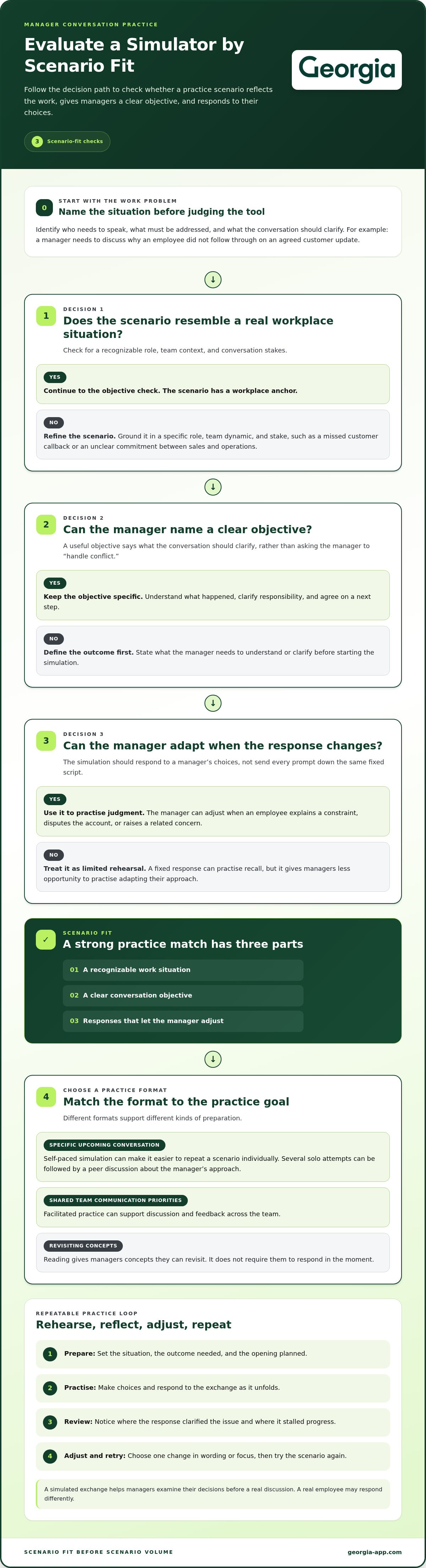
A long scenario catalogue can look impressive and still miss the conversation your managers need to practise. Evaluate a difficult conversation simulator for managers by whether its situations reflect the role, team dynamics, and stakes of your workplace. A prompt about generic office tension offers limited preparation for a manager addressing a missed customer callback or an unclear commitment between sales and operations.
Start with the work problem. Identify who needs to speak, what must be addressed, and what the conversation should clarify. Then assess whether the simulation lets the manager make choices and respond to believable reactions. Guidance on evaluating an AI role-play training platform can frame the review, but the decision should come down to whether the scenario serves a defined communication need.
Which scenario details make practice relevant?
A relevant scenario names a recognizable situation and gives the manager a clear objective. For example, a manager needs to discuss why an employee did not follow through on an agreed customer update. The objective might be to understand what happened, clarify responsibility, and agree on a next step. That is more useful than a broad prompt to “handle conflict” because it gives practice a specific workplace anchor.
Check how the simulation handles responses, too. If every prompt leads to the same fixed line, managers practise recall rather than judgment. Useful practice lets them adapt when an employee explains a constraint, disputes the account, or raises a related concern. Keep details grounded in real work, and avoid assuming why the issue occurred before the conversation begins.
How should managers compare practice formats?
Reading gives managers concepts they can revisit, but it does not require them to respond in the moment. Peer role-play adds another person’s reactions and can surface language that feels awkward or unclear. Facilitated practice can support discussion and feedback, while self-paced simulation makes it easier to repeat a scenario individually. Each format serves a different purpose.
Compare access and repeatability against the practice goal. A manager preparing for a specific conversation may benefit from several solo attempts, followed by a peer discussion about the approach. A team working through shared communication priorities may need facilitated reflection. Self-paced simulations can complement existing training by giving managers another place to practise. They do not replace context, experience, or human judgment.
Before adopting a tool, test one scenario against a current development priority. Ask whether the manager recognizes the situation, can pursue a clear objective, and can adjust when a response changes the conversation. This practical review tells you more than catalogue size alone.
Build a Practice Routine Around Real Manager Conversations
Practice loses value when scenarios have no connection to a conversation managers need to handle. Start with recurring situations that carry operational stakes, such as missed customer follow-up, unclear ownership when priorities change, or repeated gaps in an employee’s work. A difficult conversation simulator for managers should help prepare for these moments, rather than present abstract exercises with no clear use.
Make rehearsal part of existing manager development. Connect each scenario to a current team priority or an upcoming conversation. Georgia’s personalized, self-paced simulations provide structured communication practice for teams, including managers working different locations or schedules.
How can training leads introduce simulator practice?
Choose a small set of conversation types tied to what managers are facing now. Explain why the scenarios matter, what managers should practise, and how rehearsal fits into existing leadership development. Set a clear expectation: managers engage with the situation, consider their choices, and identify a practical adjustment through reflection.
Build a repeatable rhythm around the work. A manager might rehearse before an upcoming performance discussion, then return to a related scenario as responsibilities or circumstances change. Self-paced access gives managers room to practise when it fits their preparation. It also makes rehearsal available across teams without requiring every manager to be in the same place at the same time.
What should managers review after practice?
Keep reflection focused. Ask managers to record the outcome they intended, the response choices they made, and one adjustment they would test in another attempt. That record makes practice a concrete development activity rather than a completion task.
Review observable behaviors: Was the expectation stated clearly? Did the manager listen to the employee’s explanation before responding? Did they identify a specific next step and establish follow-through? These are behaviors a manager or training lead can discuss and revisit over time. They provide a more useful basis for development than a general impression that a conversation “went well.”
Keep the evaluation grounded. Practice shows what a manager chose to say in a simulation; it does not, by itself, establish that a business outcome improved. If you want to connect development to workplace results, define the measures and gather supporting evidence separately. Use simulation to structure rehearsal, then use real conversations and follow-up to assess what managers apply.
Make the routine easy to sustain: select a relevant scenario, rehearse, record one behavior to apply, then review what happened after the live conversation. This connects training to workplace behavior without promising an outcome that practice alone cannot verify.
Final Thought: Put a Difficult Conversation Simulator for Managers Into the Rehearsal Loop
Choose one recurring conversation where preparation could improve clarity. It might involve resetting expectations after a missed handoff, discussing a pattern of incomplete follow-through, or addressing tension between roles. Define the behavior you want managers to demonstrate, such as stating the expectation clearly, listening before responding, or confirming a next step.
A difficult conversation simulator for managers belongs in development when its scenarios reflect real work, managers can repeat practice, and reflection identifies a behavior to apply. Use those criteria to decide how rehearsal fits into existing training. The objective is disciplined preparation, with the manager still responsible for applying judgment in the live conversation.
What should a manager do next?
Pick a single scenario and connect it to an upcoming conversation or a current development priority. Choose a practice format managers can return to within their existing routines. After rehearsal, have each manager record the intended outcome, the response that challenged them, and one adjustment to test in another attempt.
Then revisit the live conversation. Ask what the manager observed, which behavior they applied, and what they would handle differently next time. This closes the loop between preparation and workplace practice without treating a single discussion as proof of business impact.
How can a training lead assess platform fit?
Bring a representative manager scenario to a platform demonstration. Use a situation your team recognizes, with enough context to make the stakes clear: the roles involved, the point of friction, and the outcome the manager needs to pursue. Notice whether the simulation supports realistic responses and gives managers room to practise different approaches.
Consider how self-paced simulation could fit alongside your current manager development, sales training, or customer operations training. Georgia’s AI-powered role-play platform provides personalized, self-paced communication practice for these development needs. Keep the decision grounded in scenario relevance, repeatability, and reflection that points to observable behavior.
That gives your team a practical basis for deciding how simulation fits its current training approach. Start with the conversation managers actually need to handle, then assess how rehearsal can support the work already underway.
Make Rehearsal Part of How Your Managers Prepare
The next consequential conversation on your calendar is a practical starting point for changing how your team prepares. Put rehearsal alongside existing manager development, then use what managers notice in practice to shape the next round of support. Consistency comes from making preparation an expected part of the work, not an activity reserved for a crisis.
A difficult conversation simulator for managers can support that routine when you connect it to team responsibilities and define the behavior you want managers to demonstrate. Use a demonstration to assess how the platform could fit your current approach, what managers would practise, and how your team would review their preparation. Keep the decision tied to a specific use case and development need.
Start with one conversation your managers need to prepare for, then build the practice routine around what your team learns. Book a Georgia demo to see how self-paced role-play can fit your manager development.
Give managers a clear starting point before the next difficult talk arrives.
Frequently Asked Questions
Can a difficult conversation simulator prepare managers for real workplace talks?
Yes. It gives managers a chance to rehearse how they will explain an issue and respond to an employee’s reaction. A difficult conversation simulator for managers can help them consider different responses before a real discussion, such as when an employee challenges a change in priorities. Treat the practice as preparation, not a forecast: people may react differently in a live conversation, and the manager still needs to use judgment.
What conversations should managers practice in a simulator?
Choose conversations that affect performance, coordination, or customer service. For example, a manager could practise responding when an employee disputes responsibility for a customer complaint or asks for an exception to an agreed process. Use situations managers recognize from their work, and define what the conversation needs to clarify. That focus connects practice to an actual leadership responsibility.
How does an AI role-play simulation work for managers?
An AI role-play simulation gives a manager a workplace situation to respond to through an interactive exchange. The manager chooses what to say, receives a response from the simulated counterpart, and continues the conversation. The manager supplies the decisions, while the scenario provides a practice setting. Afterward, the manager can review what they communicated and what they might try differently in a comparable discussion at work.
Can managers practice performance feedback before a real meeting?
Yes. A manager can rehearse explaining a specific performance concern, responding to disagreement, and clarifying expectations before meeting with an employee. For example, they might practise discussing incomplete customer-call records and how that affects the next person handling the account. Keep the scenario grounded in observed behavior and the purpose of the discussion. Rehearsal helps the manager prepare an approach, while the live conversation must reflect the actual facts.
How can a company introduce conversation simulation across its management team?
Start by identifying a shared development need, such as managers avoiding direct conversations about follow-through. Choose scenarios that reflect different roles, then explain how practice connects to existing leadership development. Give managers a clear way to reflect on one behavior they want to apply. A self-paced format makes practice available across a distributed team, while leaders review whether scenarios remain useful as priorities change.
How should you evaluate a difficult conversation simulator for managers?
Assess whether the practice matches managers’ responsibilities and gives them room to make decisions. Consider how a field sales manager would use a scenario about a disputed customer commitment. Review whether the simulation supports meaningful practice and reflection, and whether its format fits current training routines. A broad catalogue may offer options, but the decision should rest on whether relevant scenarios serve a defined development need.
Does a conversation simulator replace manager coaching or live practice?
No. A simulator gives managers a repeatable way to prepare, while conversations with colleagues, managers, or facilitators can provide human perspectives and context. Each approach supports a different part of development. Use simulation to let managers test their choices, then use discussion or live practice when the situation calls for shared feedback. Managers remain responsible for adapting what they practise to the employee and circumstances in front of them.