

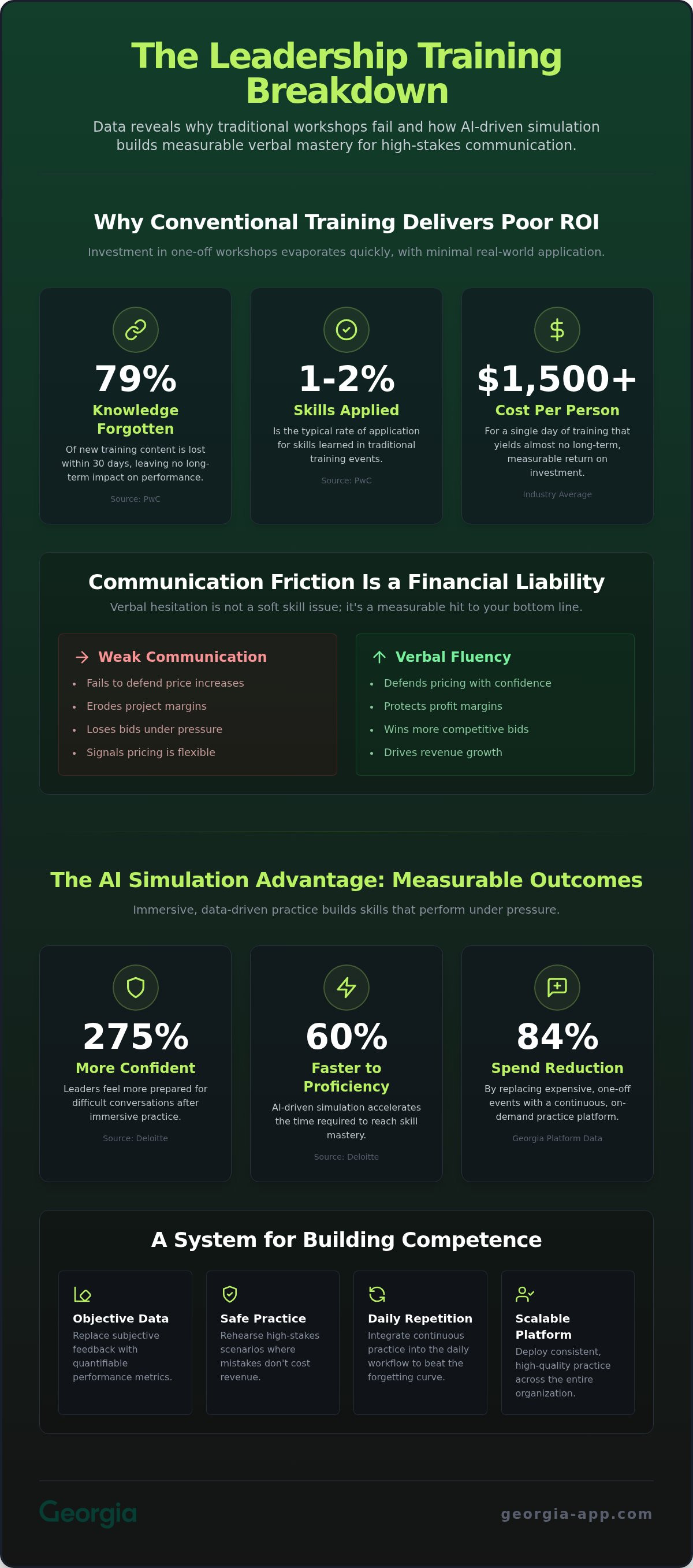
Every hesitation during a major contract negotiation is a direct hit to your bottom line. Poor verbal fluency in the C suite creates friction that stalls projects and erodes margins. Most organizations attempt to fix this with workshops, yet 79% of training content is forgotten within 30 days according to PwC. High stakes communication training for leaders is a necessary audit of your leadership's ability to protect revenue.
Theoretical soft skills often fail during the heat of a real operational crisis. You have seen leaders master a slide deck in a quiet room only to crumble during a hostile board meeting or a tense negotiation. This article shows you how to move past ineffective classroom sessions. You will learn how to transition from abstract theory to measurable verbal mastery using AI driven simulation.
This guide examines why traditional training fails and how immersive practice builds actual proficiency. You will discover how to quantify communication performance with the same rigor you apply to your balance sheet. We will prove that verbal fluency is a mechanical skill that requires high repetition rather than a theoretical lecture.
Key Takeaways
- Audit leadership communication as a financial liability to stop revenue leakage caused by verbal friction.
- Utilize high stakes communication training for leaders to reverse the 79% retention loss identified by PwC.
- Practice in immersive environments to gain the 275% confidence boost reported by Deloitte research.
- Replace subjective feedback with objective performance data to measure leadership fluency across the organization.
- Reach proficiency 60% faster through scalable AI driven simulation platforms according to Deloitte.
Quantify the Financial Impact of Communication Friction
Poor communication is a structural failure in your leadership pipeline. It is not a minor interpersonal quirk. It is a measurable financial liability that causes constant revenue leakage.
Leaders who lack verbal fluency fail to protect confidential data during high pressure negotiations. They buckle under improper vendor requests or fail to defend price increases. This friction destroys margins in the building materials sector where price push ceilings often remain below 5%.
Your teams lose 90% of potential conversions because they cannot handle objections under pressure. Only 10% of leads convert when verbal mastery is absent. This is a mechanical breakdown of the commercial process.
Every stutter during a contract renewal signals to the client that your pricing is flexible. You are losing money because your leaders cannot speak with precision when the stakes are highest. High stakes communication training for leaders is the only way to tighten these operational bolts.
Identify the Operational Cost of Poor Conversations
Traditional workshops often cost $1,500 per person for a single day of training. They offer almost zero long term ROI. PwC research indicates that only 1% to 2% of training content is ever applied in real customer conversations.
Most of your training budget is spent on content that evaporates before the next quarterly review. You are paying for attendance while the actual behavior remains unchanged. Wasted capital is the primary output of standard leadership retreats.
Georgia reduces this training spend by 84%. It replaces expensive, one off events with continuous, on demand practice. You stop paying for travel and start paying for measurable proficiency.
This platform ensures every leader reaches a verified baseline of verbal competence. It turns a variable expense into a predictable investment in human capital. Proficiency is no longer a guessing game.
Recognize Communication as a Strategic Asset
Verbal fluency is your competitive moat. High stakes communication training for leaders ensures your team defends your pricing strategy with absolute confidence. It prevents the drift that occurs when leaders guess their way through a difficult conversation.
When your leaders speak with authority, you win more bids without cutting prices. Precision is a profit driver. Consistent rehearsal ensures every leader maintains ethical selling standards and accurate product claims.
Implementing a safe communication framework protects the organization from legal liability. Stop Bidding and Praying on the outcome of your next high level negotiation. Treat communication with the same rigor as a financial audit to eliminate the hidden costs of friction.
Combat the Forgetting Curve With Daily AI Simulations
Knowledge retention is a structural failure in traditional corporate education. The Journal of Marketing Education reports that 79% of what salespeople learn is forgotten within 30 days. This decay happens because theoretical workshops lack the repetition required to create permanent behavioral change. You cannot expect a leader to change a lifetime of communication habits after a six hour seminar.
High stakes communication training for leaders requires more than a one day seminar. AI driven role play platforms allow leaders to practice soft skill conversations in a self paced environment. Continuous practice via voice or chat ensures method integrity is maintained without drift or dilution. You eliminate the risk of managers teaching their own bad habits to the rest of the team.
Define the Application Gap in Leadership Training
The application gap is the distance between knowing what to do and executing it under stress. Most leadership programs provide frameworks but fail to offer a safe space to fail. You need an environment where mistakes don't cost you a contract or a key employee. Theoretical knowledge is useless if it vanishes the moment a negotiation turns hostile.
Simulations tailored to real world scenarios bridge this gap by forcing active participation. This is how you build performance under pressure without risking your reputation or your revenue. You can schedule a walk through of the platform to see how these simulations apply to your specific operational challenges. Immersive practice forces the brain to treat the interaction as real, which builds the conversational resilience needed for executive roles.
Integrate Daily Repetition into the Workflow
Effective communication skills for leadership require daily rehearsal rather than annual workshops. Scalable AI technology lets leaders practice on their phones between meetings or during travel. This moves training from a calendar event to a daily habit. Professional athletes train daily to maintain performance; communication mastery requires the same commitment to repetition.
The Forgetting Curve is a financial drain where 79% of your training investment is lost within 30 days according to the Journal of Marketing Education. High stakes communication training for leaders solves this by making practice a standard part of the executive workflow. Continuous repetition turns theory into muscle memory. This ensures that when a crisis hits, the leader responds with precision instead of panic.
Rehearse High Stakes Interactions to Improve Performance Under Pressure
Classroom learning is a passive activity. It does not prepare you for the friction of a hostile negotiation or a high pressure board meeting. Deloitte research shows that participants feel 275% more confident after simulation training versus classroom only sessions. Confidence is not a feeling; it's a byproduct of repetition in a realistic environment.
High stakes communication training for leaders provides the specific rehearsal needed to protect your margins. Leaders who role play before critical interactions perform 20% to 45% better under pressure according to Deloitte. This improvement directly prevents unnecessary discounting when a client pushes back on pricing. In the concrete and aggregates industry, a single percentage point in a contract can represent millions in revenue. Rehearsing specific objections allows leaders to maintain control and avoid the concessions that drain profitability.
Simulate Stress to Build Verbal Fluency
Stress is a cognitive inhibitor. It shuts down the prefrontal cortex and forces leaders into a reactive state during difficult conversations at work. Immersive AI personas mimic the physiological stress of a live call to build conversational resilience. This is not about learning what to say; it's about being able to say it when your heart rate is elevated.
Repetitive simulation desensitizes the leader to high pressure triggers. Verbal fluency training software provides the repetition needed to stay calm and articulate. You turn a high pressure interaction into a routine operation. This mechanical approach to soft skills ensures that leaders don't lose their train of thought when a stakeholder becomes aggressive.
Prepare for Difficult Conversations Before They Happen
You must map out real world scenarios before they occur. This includes performance reviews, conflict resolution, and resource cuts. Practicing how to escalate concerns the right way within a simulated environment prevents organizational drift. You can utilize an AI Role-Play Training Platform to audit these interactions before they happen.
Proactive rehearsal ensures that method integrity is maintained across the entire leadership team. It turns a stressful performance review into a standard operational procedure. You eliminate the "bidding and praying" mentality that often accompanies difficult personnel decisions. Leaders who have already navigated the simulation are less likely to make emotional mistakes that lead to legal liability or talent loss. Consistency is the primary goal of professional rehearsal.
Use Data to Eliminate Subjective Feedback in Leadership Coaching
Subjectivity is the enemy of operational excellence. Gut feelings are a poor substitute for hard data. You only manage what you measure.
High stakes communication training for leaders must be treated with the same analytical rigor as a financial audit. You need visibility into the friction existing in your leadership team. Manager dashboards provide this transparency by tracking activity and performance across the entire organization.
Analytical leaders require evidence to justify their spend. Participation certificates are insufficient to ensure your team is ready for a high stakes interaction. Performance tracking identifies specific communication gaps before they cause a structural failure in your negotiations.
Replace Vague Feedback with Performance Scoring
Traditional coaching relies on the subjective opinion of a human trainer. This creates inconsistency. AI simulations provide objective benchmarks for soft skills that were previously unmeasurable.
Scoring is based on your own methodology and internal compliance policies. This removes the touchy-feely jargon of standard professional development. It replaces it with a numerical score that reflects real world readiness.
One executive noted the impact of this shift toward objective measurement. "Retention scores tripled in 60 days" according to a VP of Sales Enablement. This level of improvement is only possible when you move from vague feedback to precise scoring.
Monitor Team Progress via Manager Dashboards
Dashboards highlight which leaders are committing to their development and which are falling behind. You can see real time data on verbal fluency and objection handling. This transparency eliminates the bidding and praying strategy often used in leadership development.
Identify your top performers and use their data to set benchmarks for the rest of the team. If your best negotiators score in the 90th percentile, you now have a standard for every new hire. This data driven approach ensures your team is ready for Sales Negotiation Training that delivers results.
Consistent monitoring prevents the 79% retention loss reported by the Journal of Marketing Education. You stop the drift before it impacts your bottom line. Data turns communication from an art into a repeatable, mechanical process.
Measurement is the difference between a training event and a performance strategy. You either have visibility into your team's skills or you are operating in the dark. Choose the data driven path to secure your revenue.
Deploy Scalable Practice Without Increasing Training Spend
Scaling leadership training usually requires hiring expensive human coaches or consultants. This manual approach is a financial drain that limits your reach. High stakes communication training for leaders can be deployed across the entire organization using AI driven simulation.
Traditional workshops cost $1,500 per rep. A basic annual subscription to Georgia for Leadership is $240 per rep. This represents an 84% lower cost per rep while providing continuous access to practice. Switching to AI driven simulation saves approximately $12.6K per 10 rep team.
These are hard savings that go directly to your bottom line. You stop paying for attendance and start paying for performance. AI removes the bottleneck of human scheduling and availability.
Reduce Training Costs While Increasing Impact
Organizations eliminate travel costs and time away from the field for senior leaders. These hidden expenses often exceed the cost of the training itself. AI role play platforms handle the repetitive practice required for mastery. This allows you to focus your remaining budget on high value strategic initiatives.
Time to proficiency is reduced by 60% according to PwC research. Faster proficiency means your leaders are ready to protect revenue and handle difficult conversations sooner. Every week a leader spends at low proficiency is a week of continued revenue leakage. The ROI of accelerated learning is immediate and measurable.
Maintain Methodological Integrity at Scale
Traditional train the trainer models suffer from inevitable dilution. Every layer of human instruction adds variance and personal bias. High stakes communication training for leaders ensures your signature experience is delivered exactly as designed every time. You eliminate the risk of a coach misinterpreting your core message.
Method applied as designed: every time. This protects your methodology from the drift that occurs in human led workshops. You ensure that every executive uses the same proven frameworks for negotiation and conflict resolution. Consistency across the leadership team is a strategic advantage that manual training cannot provide.
When every leader speaks the same commercial language, organizational friction disappears. You are building a repeatable system for communication. This mechanical approach to leadership development ensures long term stability. You move from individual talent to institutional capability.
Secure Your Revenue Through Verbal Mastery
Communication friction is a structural defect in your leadership chain. High stakes communication training for leaders is no longer an optional corporate luxury. Every failed negotiation and stuttered pricing defense is capital leaving your organization.
Moving to AI driven simulation ensures that 79% of training content is no longer forgotten within 30 days as reported by the Journal of Marketing Education. This shift results in 275% more confident leaders according to Deloitte and 60% faster proficiency according to PwC research.
Adopting these simulations achieves an 84% lower training spend. You now have the tools to fix revenue leaks at scale. Immersive rehearsal builds the conversational resilience required to defend your margins under pressure.
Final Thought
You will now audit leadership communication as a financial asset. You will replace annual workshops with daily AI simulations to eliminate the 79% retention loss found in the Journal of Marketing Education. Every critical interaction will be preceded by a realistic rehearsal to verify that leaders are ready for pressure. Verbal fluency is a mechanical requirement for executive performance.
Frequently Asked Questions
How do communication skills for leadership impact the bottom line?
Leadership communication directly impacts the bottom line by preventing revenue leakage from verbal friction. Leaders who cannot negotiate effectively often resort to unnecessary discounting. This is particularly damaging in the building materials sector where margins are tight. High stakes communication training for leaders ensures that every interaction protects the margin rather than eroding it through verbal hesitation or improper concessions.
Can AI role-play platforms effectively simulate high-pressure business interactions?
AI role-play platforms effectively simulate the physiological stress of live business interactions to build conversational resilience. These platforms use voice or chat to force active participation in real-world scenarios. Leaders practice defending price increases or responding to improper requests in a safe environment. This repetition desensitizes the brain to high-pressure triggers. It ensures that leaders respond with precision when the financial stakes are highest in real negotiations.
What is the typical ROI for leadership communication training?
Switching to AI-driven simulation delivers an 84% lower training spend compared to traditional workshops. Organizations save approximately $12.6K per 10-rep team by moving from $1,500 per head to a $240 annual subscription. Beyond direct cost savings, the ROI is found in protected margins and faster proficiency. You stop paying for travel and one-off events that deliver no lasting behavioral change or measurable impact.
How does simulation training compare to traditional leadership workshops?
Traditional workshops fail because they lack the repetition needed to create permanent behavioral change. Simulation training provides a safe environment to practice high-stakes interactions until they become a reflex. Participants feel 275% more confident than those who only attend classroom sessions according to Deloitte. While workshops offer theory, simulations provide verified proficiency through objective performance scoring and consistent methodological integrity across the organization.
Why is verbal fluency important for leaders in the building materials industry?
Verbal fluency is a mechanical requirement for maintaining price-push ceilings that often remain below 5%. In construction and aggregates, a single percentage point in a contract represents significant revenue. Leaders must speak with authority to defend pricing and manage complex dispatch operations. Precise communication prevents the organizational drift that occurs when teams guess their way through customer objections or high-level contract renewals.
How can leaders find time for communication practice in a busy schedule?
Time is a resource that must be managed with efficiency. Scalable AI technology allows leaders to practice on their phones during travel or between meetings. This moves training from a scheduled event to a daily habit. On-demand access via voice or chat fits into the existing workflow without requiring time away from the field. Continuous practice ensures that proficiency is maintained without the need for expensive off-site workshops.
What metrics should be used to track leadership communication performance?
Organizations should use objective performance scoring instead of subjective trainer feedback to track leadership communication. Metrics include verbal fluency scores, objection handling accuracy, and participation rates visible on manager dashboards. These benchmarks identify specific communication gaps before they impact the bottom line. Tracking these numbers provides the analytical evidence needed to justify training investments and ensure every leader meets a verified baseline of competence.
Is AI-driven communication training suitable for remote leadership teams?
AI role-play platforms are designed for global scalability without the need for human coaches in the room. Remote leaders access the same high stakes communication training for leaders regardless of their geographic location. This ensures that methodology is delivered exactly as designed without the dilution common in remote train-the-trainer models. Teams maintain consistent standards across every plant and region through a centralized digital practice environment.