

Communication skills for leadership help your team act clearly when plans change.
An unclear handoff can leave the next shift working from the wrong plan. A delayed escalation can give a delivery issue time to compound, while an unresolved performance concern can keep disrupting the work.
Managers need to set direction, address performance, and explain change. The challenge is helping them communicate effectively when a conversation becomes difficult.
This article covers the habits that shape leadership outcomes and practical ways to rehearse them. You’ll learn how to adapt your approach, prepare for difficult conversations, and make practice part of leadership development.
Key Takeaways
- Build communication skills for leadership around observable behaviors, so teams understand expectations and know what action to take.
- Choose your approach based on the conversation’s purpose: giving direction, hearing concerns, providing feedback, or resolving disagreement.
- Prepare experienced managers to apply communication principles under pressure through realistic rehearsal.
- Use a repeatable practice routine: select a real conversation, set one objective, rehearse, review, and retry.
- Use personalized, self-paced simulations to give leaders more opportunities to practice challenging conversations.
Communication Skills for Leadership Shape Whether Teams Execute Clearly
An unclear handoff can leave the next shift working from the wrong plan. A delayed escalation or unresolved performance concern can disrupt execution. Communication skills for leadership show up in whether people understand expectations, know who owns the next action, and can raise a barrier before it grows.
Leadership communication is made up of observable behaviors: stating expectations, listening to concerns, checking understanding, and following through. When a manager names the required outcome, owner, and timing, people have a clearer basis for action.
These strategies offer practical examples for leading a team:
Which communication skills matter most in frontline leadership?
Make each behavior repeatable. Routine updates can stay brief. Conversations involving resistance, risk, or performance need questions and confirmation so you can respond to what is actually happening.
- Listen: Summarize the concern before responding.
- Set expectations: State the outcome, owner, and timing.
- Direct: Lead with the task, then give essential context.
- Follow through: Check the agreed action and address changes.
These behaviors form part of Communications Training for Leaders, including listening and conflict resolution.
Why does communication break down under operational pressure?
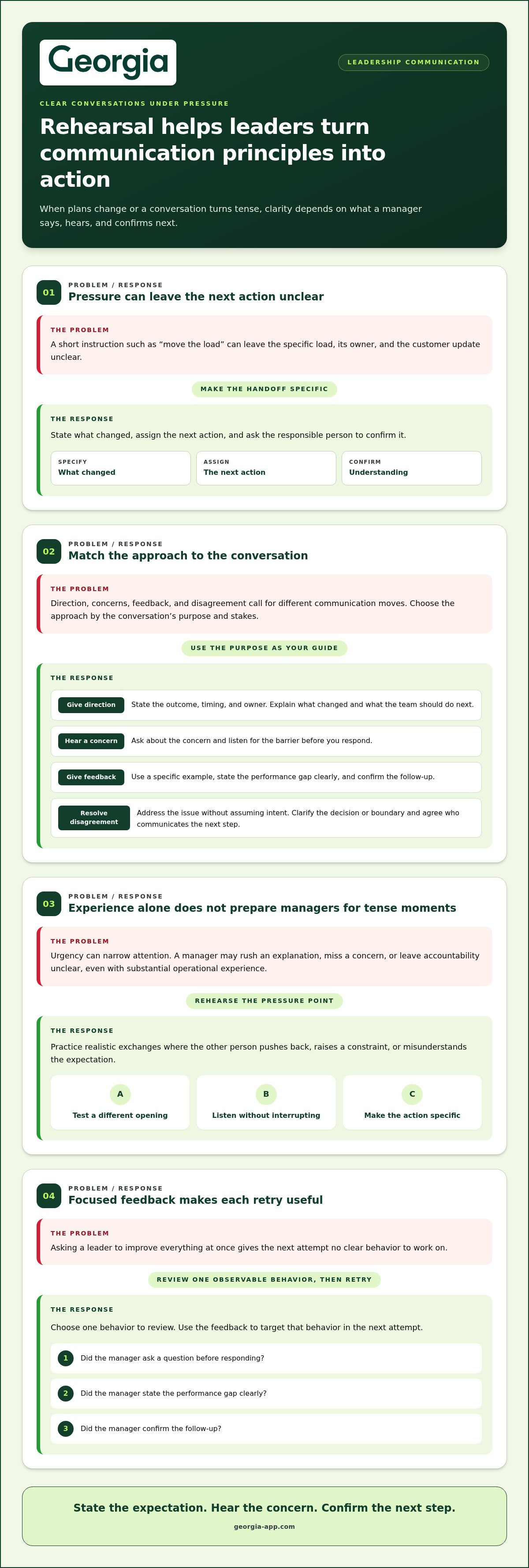
Time pressure can shorten explanations and eliminate checks for understanding. For a dispatch change, “move the load” leaves the specific load, owner, and customer update unclear. State what changed, assign the next action, and ask the responsible person to confirm it.
Effective leadership communication clarifies expectations, listens for barriers, and confirms the next step.
Match Your Leadership Communication to the Conversation
Choose your approach based on the conversation’s purpose and stakes. Direction calls for clarity. Concerns call for listening. Feedback needs a specific example, while disagreement requires you to address the issue without assuming motives.
Before you start, define the outcome you need. Ask about the other person’s concern, state your message, and check understanding. Personality labels can suggest questions, but respond to the person and situation in front of you.
How should leaders communicate expectations and changes?
State the required outcome, timing, and owner. Explain what changed and what the team should do next. Ask the recipient to summarize the action so you can catch confusion before it affects the work.
How should leaders handle resistance or conflict?
Separate the concern from assumptions about someone’s intent. Acknowledge the operational issue, then clarify the decision or boundary. If a team member questions a changed customer commitment, ask what constraint they see, address the practical issue, and confirm who will communicate the next step.
Rehearsing these exchanges gives managers a chance to prepare for pushback. Explore a demo of conversation practice for your leadership team.
Address the Experience Gap Before Difficult Conversations Cost Momentum
Seniority gives managers context. It does not automatically prepare them to respond well when a conversation turns tense. Under pressure, even an experienced leader can rush an explanation, miss a concern, or leave accountability unclear.
That gap matters in operations. A manager may understand the principles of clear feedback, then hesitate to address a recurring handoff problem because the employee is already stretched and the shift is busy. The issue stays unresolved, expectations remain open to interpretation, and the next handoff carries the same risk.
Why can experienced managers still struggle in high-stakes moments?
Urgency narrows attention. Resistance can trigger a defensive response. Incomplete information makes it harder to choose the right words, especially when a leader needs to correct performance while keeping work moving.
Experience can also create false confidence. A manager may expect a familiar approach to work in every situation, then find that a performance conversation needs a different balance of directness and listening than a routine update. Postponing the discussion adds another problem: the person may not know what needs to change or when it will be reviewed.
Communication principles provide a starting point. Applying them under pressure takes practice with the objections, uncertainty, and emotion that can surface in an actual conversation.
What does practice add to leadership development?
Advice can explain what a strong conversation should include. Rehearsal lets a manager test their words when the other person pushes back, raises a constraint, or misunderstands the expectation. The leader can try a different opening, listen without interrupting, and make the requested action more specific.
Feedback makes each retry useful. Focus on one observable behavior: Did the manager ask a question before responding? Did they state the performance gap clearly? Did they confirm the follow-up? The next attempt can target that behavior instead of asking the leader to improve everything at once.
Conversation rehearsal builds readiness by letting leaders test their words, respond to resistance, and refine their approach before the real stakes arrive. It helps managers apply a principle when urgency competes for their attention. For more on high-stakes communication practice for leaders, consider how rehearsal can prepare managers to stay clear and responsive under pressure.
Build practice around real leadership responsibilities, such as giving corrective feedback, addressing conflict between team members, or explaining a changed priority. Repeating a focused scenario gives managers a chance to refine their wording and follow-through before those conversations affect execution.
Build a Repeatable Practice Routine for Leadership Conversations
Communication improves when managers practice specific behaviors before they need them. A repeatable routine makes that practice practical: use a real upcoming conversation, focus on one skill, and assess what changed between attempts.
Choose a real conversation, set one objective, rehearse, review the behavior, and retry. Keep a brief record after each session: the outcome you intended and the next action you want to take in your next attempt. This keeps practice tied to work and gives the manager a clear focus for the next session.
How can managers rehearse a difficult conversation?
Choose a situation the manager will recognize, such as a missed commitment, conflict between colleagues, or a performance concern. Define the result the conversation needs to reach. Then rehearse three moves: open with the issue clearly, ask a question that invites relevant information, and confirm what happens next.
Keep the exercise focused on one observable behavior at a time. If the goal is clearer feedback, listen for whether the manager names the specific performance gap and expected change. If the goal is stronger listening, notice whether they ask a follow-up question before offering a solution.
Then vary the other person’s response. They might disagree, explain a constraint, or misunderstand the request. The manager gets another attempt to stay composed, respond to the information given, and bring the conversation back to its objective. The aim is preparation for uncertainty, not memorizing a script.
How can training managers reinforce communication between sessions?
Assign short, self-paced practice around conversations managers already need to handle. Connect each exercise to one defined behavior, then review what the manager said and did. Look for clarity in the opening, listening before responding, and a useful response when resistance appears.
Scenario-based practice helps training managers make rehearsal repeatable across leadership development. AI role-play practice can give managers a way to rehearse challenging exchanges and retry their approach. Personalized, self-paced simulations also let leaders practice between formal training sessions.
Use each review to select the next behavior to work on rather than judging the conversation as a whole. A manager who improves the opening may next focus on checking understanding or naming a clear follow-up. This progression gives teams a practice routine they can sustain.
Prepare Leaders With Personalized Conversation Practice
Managers need practice that reflects the conversations they actually face. A communication lesson may explain a principle, but leaders also need to apply it when an employee challenges feedback, a team member raises a conflict, or an operational change creates uncertainty. Georgia is an AI-powered role-play platform with personalized, self-paced conversation simulations designed to help leaders practice soft-skill conversations under pressure.
This format gives leadership development a practical rehearsal component. Managers can work through scenarios around feedback, conflict, and change, then revisit relevant practice as new conversations approach. The aim is to strengthen communication skills for leadership through deliberate preparation, so the first attempt does not have to happen in a consequential moment.
What should leadership role-play practice include?
Start with situations tied to a manager’s responsibilities and recurring conversations. A useful scenario has a clear purpose: address a missed commitment, surface a concern affecting coordination, or explain a change in priorities. Include the context the manager needs to respond realistically, while keeping the practice focused on the conversation itself.
Give leaders room to test more than one response. If the other person resists, asks for clarification, or introduces a constraint, the manager can practice staying curious and keeping the intended outcome in view. Variation prepares leaders for uncertainty without asking them to memorize lines that may not fit the real exchange.
Keep the objective specific. A manager might practice opening a performance conversation with a clear example, asking a question before proposing a solution, or confirming an agreed follow-up. A focused objective makes the practice easier to apply to an upcoming discussion and easier to review afterward.
How can teams turn practice into a training routine?
Connect simulations to the leadership development already underway. Training managers can identify recurring conversation types, then encourage leaders to revisit a relevant scenario ahead of a real discussion. Self-paced practice lets managers continue rehearsing between formal training sessions, with each exercise tied to a conversation they need to handle.
Keep the routine connected to work. After practice, the manager can note the conversation’s intended outcome and one behavior to carry into the real exchange. Afterward, they can reflect on whether they used that behavior and what they would adjust next time. This loop connects rehearsal to application and gives future practice a clear focus.
For decision-makers assessing how personalized simulations could support their leadership training program, a demo offers a way to explore Georgia’s approach.
Make Conversation Readiness Part of Leadership Development
Start by identifying where a leadership conversation can change the course of work. Set a clear expectation that managers prepare for those moments with the same discipline they bring to other responsibilities. That turns communication skills for leadership into an ongoing development priority, rather than a topic revisited only after a conversation goes badly.
Choose a practical starting point for your team’s development plan. Decide which conversations deserve preparation, what readiness looks like, and how managers will keep building that capability as responsibilities change. A consistent standard gives leaders direction and keeps practice connected to the work ahead.
Give your managers room to prepare before pressure peaks. The next conversation can begin with greater clarity and purpose.
Frequently Asked Questions
What are the most important communication skills for leadership?
The most important skills are clear speaking, active listening, sound questioning, feedback, and follow-through. Together, these communication skills for leadership help managers turn priorities into actions people can carry out. After setting a shift priority, for example, ask a team member to explain how it affects their current work. Their response can surface a conflict or misunderstanding before it disrupts coordination.
Can leadership communication skills be learned?
Yes. Managers can strengthen communication through focused practice, observation, and feedback. Start with one behavior, such as asking a neutral question before offering a solution. Apply it in a low-risk check-in, then note whether the other person shared useful information. Repeat the exercise in different situations, then build toward more demanding conversations involving accountability or change.
How can leaders communicate better with different personality types?
Adapt to the person’s communication preferences without assuming a personality label explains their needs. Ask whether they want the key decision first or more context, then pay attention to how they respond. A detail-oriented employee may need the rationale behind a change, while a colleague focused on immediate action may need ownership and timing stated upfront. Confirm understanding with both.
How do you practice leadership communication before a difficult conversation?
Write down the specific outcome you need, the key facts, and the question you want answered. Say your opening aloud and prepare for a likely response, such as disagreement or a request for more time. Keep the discussion focused on observable behavior and its impact. This preparation gives you a clear purpose while leaving room to listen.
How often should managers practice communication skills?
Practice whenever an upcoming conversation carries meaningful consequences, and build regular rehearsal into leadership development. A manager preparing to address repeated missed commitments may benefit from revisiting the scenario before the discussion. Less demanding situations also give managers opportunities to apply one skill in daily work. Set a cadence your team can sustain, then adjust it when priorities or recurring communication gaps change.
How can organizations measure leadership communication improvement?
Track observable behaviors and workplace signals together. Review whether managers state owners and deadlines, invite questions, and confirm next steps. Then look for related patterns, such as fewer clarification requests after handoffs or more timely escalation of issues. Use manager and employee feedback to understand what changed, and compare observations over time while accounting for shifts in workload and team responsibilities.
What is the difference between leadership communication and public speaking?
Public speaking usually addresses an audience through a planned presentation. Leadership communication covers the daily exchanges that help teams coordinate, raise concerns, make decisions, and respond to feedback. A manager may present a change clearly in a team meeting, then listen to an employee’s concern in a private conversation. Presentation skill helps in one setting, while leadership communication spans many interactions.
Prepare your managers for their next high-stakes conversation with personalized, self-paced practice. Book a Georgia demo.