

Training for high pressure conversations gives your team a practical way to prepare before a tense customer call puts an order or relationship at risk. A delivery change, disputed availability, or price challenge can test whether an employee can explain the situation clearly and agree on a workable next step.
Your team may know the process and still struggle to apply it when a customer is upset or resistant. One-off instruction gives employees little opportunity to rehearse the conversations that carry real commercial stakes.
Start with situations employees actually face, then practise specific communication behaviours in those scenarios. Personalized, self-paced role-play makes that rehearsal repeatable across the team.
Key Takeaways
- Identify conversations where urgency, disagreement, or commercial stakes can disrupt the outcome.
- Use training for high pressure conversations to practise pausing, listening, clarifying concerns, and agreeing on next steps.
- Build each rehearsal around a real trigger, the customer’s concern, an operational constraint, and a clear objective.
- Turn recurring team friction into practice material, focusing each session on a small number of observable behaviours.
- Use personalized, self-paced AI role-play to make relevant communication practice repeatable across the team.
Treat High-Pressure Conversations as an Operational Risk
A delivery change can force a customer to adjust a pour schedule or crew plans. If sales, dispatch, and the customer leave the call with different expectations, resolving the operational issue becomes harder and may put the working relationship under further strain.
A high-pressure conversation involves meaningful stakes, urgency, disagreement, or commercial consequences that make a clear response more difficult. It might involve a price challenge, disputed availability, a complaint, or an explanation of a process. Communication affects how decisions are made and what the customer expects next.
Spot the moments where pressure changes the conversation
In sales, a customer may challenge a quote. Dispatch may need to explain a revised delivery window, while customer operations handles a complaint about what was promised. Compliance-related communication can also become tense when an employee must explain a process and the other person wants an immediate answer. Under pressure, employees may interrupt, make assumptions, or skip a detail. General background on psychological stress and high-pressure situations provides context, while training should focus on observable communication behaviours.
Separate the operational trigger from the communication failure
The trigger might be a delivery change or unavailable material. An employee may not control that condition, but an unclear explanation or premature concession can add friction and create expectations the team cannot meet.
Training for high pressure conversations gives employees practical rehearsal for communicating clearly in realistic, consequential situations. Prepare them to explain constraints, clarify what the customer needs, and agree on what happens next.
Train for the Behaviours Pressure Makes Harder
A rushed response can intensify friction. An employee may defend a decision before understanding the concern or make a commitment beyond their authority. Practise a clear sequence instead: pause, listen, clarify, state the constraint, and agree on a next step. Define behaviours people can hear and repeat, rather than asking them to “show confidence.”
Make the response observable
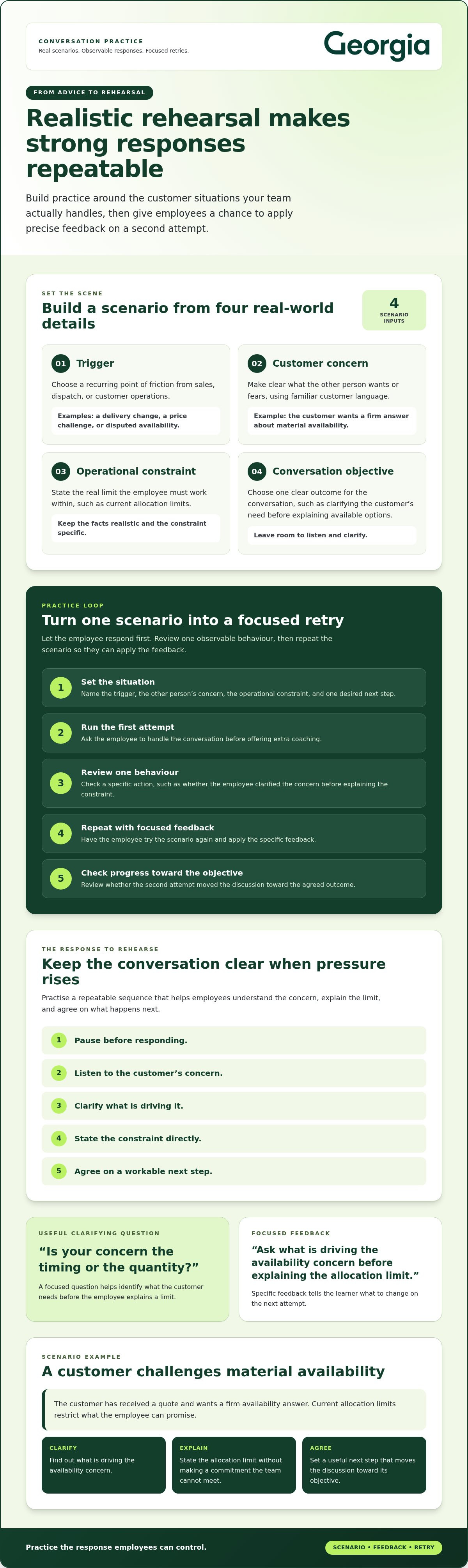
Practise a brief pause, then ask a focused question: “Is your concern the timing or the quantity?” Once the concern is clear, state the limit directly and explain what action is possible. That gives the employee a specific response to practise and the manager clear points to review.
Keep the conversation focused when disagreement rises
Separate confirmed facts from assumptions and requests. If a customer says an order is short and asks for replacement material, acknowledge the concern, clarify what was received, and then discuss the request. A focused response could be: “I understand you expected the full quantity. Let’s confirm what arrived and agree on the next step.” For broader context, see Harvard University insights on negotiation and communication.
Effective practice makes conversation behaviours observable, repeatable, and relevant to the decision at hand. Review whether the employee clarified the concern, stated the constraint, and agreed on an action. To see how Georgia supports conversation practice, visit Georgia’s AI role-play platform.
Rehearse Real Scenarios Instead of Relying on Advice
Advice describes what a strong response should sound like. Rehearsal shows whether an employee can produce that response when a customer pushes back. Build practice around situations the team handles, then give employees another attempt after focused feedback.
For example, a customer challenges material availability after receiving a quote. The employee must address the concern, work within current allocation limits, and agree on a useful next step. This scenario reflects a decision the employee may actually face, rather than an abstract prompt about handling conflict.
Build a scenario from a recurring operational moment
Choose a repeatable point of friction from sales, dispatch, or customer operations. Set out the trigger, what the other person wants or fears, the employee’s real constraint, and the objective for the conversation. Keep the objective narrow, such as clarifying what the customer needs before explaining the available options.
Familiar details make role-play more credible. A customer might have a competing quote, want a firm availability answer, and object when the employee cannot commit immediately. Keep the facts realistic and the customer’s concern specific. Give the learner enough context to respond while leaving room to listen and clarify.
Run a short practice and retry loop
Use this sequence to turn advice into an observable skill:
- Set the trigger, the other person’s concern, the operational constraint, and one desired next step.
- Ask the employee to handle the conversation before offering extra coaching.
- Review one behaviour, such as whether the employee clarified the concern before explaining the constraint.
- Have the employee repeat the scenario and apply the feedback.
- Review whether the second attempt moved the discussion toward the agreed objective.
Keep feedback precise. “Be more confident” gives the learner little to change. “Ask what is driving the availability concern before explaining the allocation limit” gives them a clear action to try on the next attempt.
Some employees find role-play artificial when the prompts are generic. Specific triggers, familiar customer language, and real operational limits make practice closer to the calls employees recognize. The scenario does not need to predict every turn. It needs to test the response the employee can control.
This sequence adds a practical layer to AI Training Platforms Must Simulate High-Stakes Pressure to Stop Revenue Leaks: realistic practice includes a first attempt, focused review, and a second attempt. The retry gives employees a chance to apply feedback before the next consequential customer exchange.
Build Practice Into the Team’s Training Routine
Practice loses value when it stays separate from the work creating the pressure. Draw scenarios from recurring team friction, then revisit them as customer expectations, delivery conditions, or commercial priorities change. That makes practice part of team training rather than a one-off event.
Choose scenarios from recurring friction
Use situations the team already encounters: repeated objections to price or availability, service complaints, delivery changes, or confusion about what was promised. Prioritize conversations with a clear business consequence, such as a delayed decision, a strained customer relationship, or a handoff that leaves the next team without a clear expectation.
Keep each practice prompt focused. State the trigger, the customer’s concern, the employee’s constraint, and one conversation objective. For example, a dispatcher might practise explaining a changed delivery window while confirming what the site needs to plan its next move. The objective could be to clarify the customer’s priority and agree on the next communication step.
Managers can gather scenarios from routine team discussions, service reviews, or recurring employee questions. Turn observed friction into a focused practice prompt without trying to reproduce every detail of a customer interaction. This approach also connects with the themes in Customer Service Role Play Software Prevents Revenue Loss from Support Friction, where realistic service practice helps teams address conversations that can affect commercial relationships.
Observe behaviour without inventing a scorecard
A manager does not need a new scoring system to make practice useful. After each attempt, ask what the employee said that helped the discussion, where the exchange became less clear, and what they will try differently next time. Keep feedback tied to words and actions the learner can change.
Record recurring practice themes through the team’s existing training process. If several scenarios reveal difficulty clarifying a concern before presenting an option, make that a focus for a future session. If customer or delivery conditions shift, update the scenario to reflect current work. Practice stays useful when managers refresh examples and keep the objective clear.
Personalized AI role-play can make this model repeatable and self-paced, with scenarios tailored to the situations employees handle. The manager sets the business priority and chooses the behaviour the team needs to practise.
Use Georgia’s AI Role-Play to Make Practice Repeatable
A clear practice model gives your team a way to rehearse real conversations. Georgia provides an AI-powered role-play platform for personalized, self-paced communication practice. Employees can practise through simulations relevant to their roles, giving sales, customer operations, and leadership teams a structured way to prepare for recurring pressure points.
Match personalized simulations to team needs
Sales teams can practise responding when a customer challenges a price or asks for a firm commitment. Customer operations teams can practise handling a complaint or explaining a service constraint. Leadership teams can prepare for difficult internal discussions where expectations, responsibilities, or priorities differ.
The value comes from matching practice to the work. A general lesson can describe a useful approach, while a role-relevant simulation gives employees a setting to practise expressing it. Self-paced access lets employees practise communication skills without making every rehearsal depend on a manager being available to play the other side.
Set the business objective as you introduce a platform. Decide which recurring conversations matter, which roles need practice, and which communication behaviour the team should focus on. Georgia supports personalized, self-paced conversation simulations for sales, customer support, and leadership teams, so managers can connect practice to existing training priorities.
Use the platform as part of the routine you have built, with practice grounded in situations employees actually face. The simulations make conversation practice repeatable, while your team’s objectives keep it relevant to customer and commercial needs.
Final Thought
Choose one recurring high-pressure conversation your team handles. Define the objective, identify the communication behaviour that needs rehearsal, and give employees a chance to practise before the next consequential call. Then make that scenario part of the ongoing training routine, so preparation comes before a customer concern, a tight delivery window, or a commercial disagreement demands a response.
Make Rehearsal Part of Readiness
The next consequential customer conversation will arrive with its own timing and pressures. Assign a manager, team lead, or training owner to keep practice connected to the work and notice when customer expectations or operating conditions shift. That person can keep preparation relevant and make rehearsal a normal part of getting ready for important conversations.
Set the expectation that employees practise before a situation becomes urgent. Build practice into the team’s existing rhythm, and give people room to apply what they learn in their own words. Training for high pressure conversations becomes more useful when preparation has an owner and a place in the routine.
Start by choosing the conversation that would create the most friction if your team faced it unprepared. Use that answer to choose the next scenario and make practice part of how the team gets ready.
Frequently Asked Questions
What counts as a high-pressure conversation at work?
It is a work conversation where the consequences matter and the conditions make a clear response harder. A customer may challenge an order detail while sales and dispatch coordinate information, or ask for a commitment the employee cannot make. Choose situations where communication influences a decision, expectation, or working relationship, then practise what the employee can control.
How often should employees practise high-pressure conversations?
Set a cadence that fits the team’s existing training routine and the frequency of the conversations. A recurring objection may warrant regular rehearsal, while a less common situation may need practice when processes or customer expectations change. Include practice for new employees before they handle consequential calls independently. Employees need an opportunity to rehearse before they face the situation, not only a reminder after a difficult exchange.
Can role-play work for experienced sales and operations teams?
Yes, when practice respects what experienced employees already know. Give them realistic judgment calls, such as responding when a customer requests an exception that conflicts with an agreed commercial boundary. Let employees use their own words rather than memorizing a script. Then review whether the explanation was clear, the working relationship was preserved, and the conversation reached a viable decision.
What should a manager listen for during a practice conversation?
Listen for whether the employee’s words help the other person understand what can happen next. Notice unqualified commitments, unclear ownership, and conversations that end without confirming what was agreed. “I’ll get back to you” leaves follow-up vague; a stronger close identifies who will take the next action and what information is needed. Review one or two points, then let the employee try again.
How can teams tailor conversation practice to their work?
Adapt the same broad situation to each role’s responsibilities. A salesperson may practise discussing a customer’s requested terms, while a customer operations employee may focus on explaining what information is needed to address a complaint. Keep the other person’s perspective credible and the employee’s authority limits clear. Georgia provides personalized, self-paced simulations for communication practice that teams can use within their training approach.
How can I tell whether conversation training is useful?
Define the communication behaviour you want employees to demonstrate, then review whether it appears during practice. You might look for a clear explanation of a decision or confirmation that both parties understand the next action. Managers can also note relevant patterns in routine conversations over time. Treat those observations as evidence to examine, rather than proof that training alone caused a change in customer or commercial results.