

A tense customer call can put an order, a delivery relationship, and future revenue at risk. For building materials, concrete, and aggregates teams, customer de-escalation training software should let employees practise difficult conversations before they handle them live.
The operational gap is often practice. A training session can communicate procedures and expectations, yet leave each person with too few chances to work through a realistic exchange. When a customer is frustrated about a delivery, an order discrepancy, or product availability, employees need to respond clearly while keeping the conversation focused on what happens next.
Evaluate software by the situations it lets your team practise, the choices learners must make, and how repeatable the practice is. This guide shows how to assess those factors and fit communication practice into customer operations training.
Key Takeaways
- Identify recurring customer conversations that create pressure for your team and can strain service relationships.
- Assess customer de-escalation training software against the situations, language, and decisions employees encounter.
- Distinguish learning content that explains a response from role-play that asks learners to form one.
- Compare scenario relevance, repeatability, learner flexibility, and fit with your current training program.
- Use one recurring customer situation to evaluate a platform and plan a focused rollout.
Treat De-Escalation Gaps as Trainable Operational Risk
An unresolved complaint can lead to repeat contact and put a customer relationship under strain. In building materials, concrete, and aggregates, tension may begin with a delivery disruption, an order that does not match expectations, or material that is unavailable when expected. Employees have to address the immediate issue while communicating clearly and staying within their authority.
De-escalation practice gives employees a chance to rehearse calm, clear responses before live customer interactions. A foundational overview of De-escalation techniques can help frame the skill. For training, the next step is applying communication guidance to the situations employees actually handle.
Identify the conversations where service friction escalates
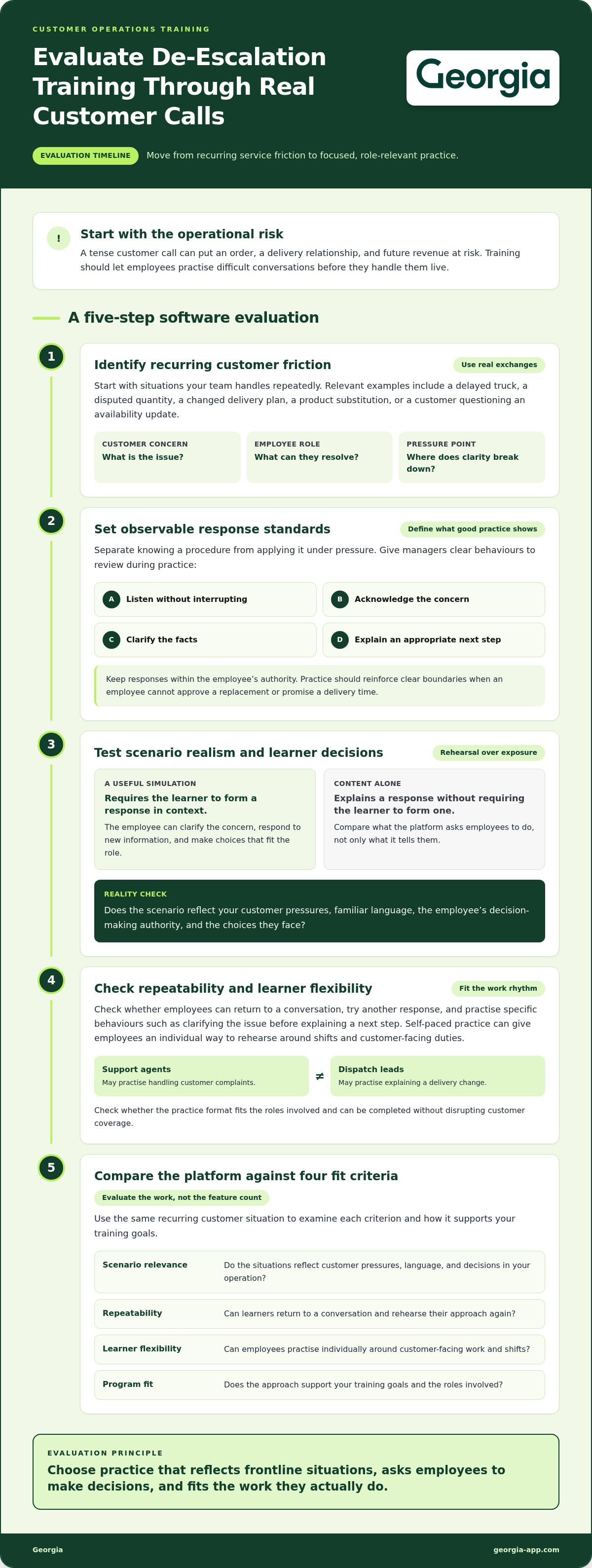
Start with recurring triggers, such as a delayed truck, a disputed quantity, a changed delivery plan, or a product substitution. Note what the customer is concerned about, what the employee can resolve, and where the conversation tends to become defensive or unclear. Use these details to build scenarios around real exchanges rather than generic complaints.
For example, when a customer challenges an availability update, the employee may need to clarify which product or order they mean before explaining the options. A rushed answer can sound dismissive; a defensive explanation can turn a service issue into an argument over responsibility. Training should give employees practice staying focused on the concern and the next useful step.
Separate policy knowledge from conversational performance
Knowing a procedure does not show whether an employee can apply it under pressure. Define observable behaviours for the conversation: listen without interrupting, acknowledge the concern, clarify the facts, and explain an appropriate next step. These give managers a practical basis for reviewing a response and identifying what needs more practice.
Keep the response standard within the employee’s role. If an employee cannot approve a replacement or promise a delivery time, the scenario should reward clear boundaries and an accurate explanation of what they can do. That prevents practice from reinforcing language that conflicts with your operating procedures.
Demand Realistic, Repeatable Practice From De-Escalation Training Software
A useful simulation asks the employee to respond to a customer situation. Course content explains a response; rehearsal requires the learner to form one. Apply that distinction when assessing customer de-escalation training software. Learners should make communication choices in context, rather than only read about what a good response might include.
Check whether scenarios reflect frontline customer situations
Compare the practice scenarios with calls your team handles, such as a customer questioning a product substitution or challenging an availability update. Check whether the employee’s role, decision-making authority, and familiar language are represented. The scenario should give the learner enough context to understand the issue, then require a response that fits the role.
Evaluate what the learner has to do. Can they clarify the customer’s concern before giving an explanation? Do they have to respond to new information as the exchange develops? A scenario that only presents a complaint and a suggested answer offers less practice in deciding what to say.
Personalized simulations can help focus practice on relevant interactions. Georgia’s AI role-play platform provides personalized, self-paced simulations for communication practice under pressure. Use a recurring customer situation as the basis for evaluating whether that practice aligns with your team’s needs.
Look for practice employees can repeat at their own pace
Self-paced simulations give employees an individual way to practise around shifts and customer-facing duties. Repeating a scenario lets a learner try a response again and work on specific behaviours, such as clarifying the issue before explaining a next step. This can make practice easier to fit into a training routine than an exercise that requires the whole team to attend at once.
During evaluation, consider whether learners can complete the practice without disrupting coverage and whether the format suits the roles involved. A support agent handling complaints and a dispatch lead explaining a delivery change may need different scenarios, even when both need to communicate calmly and clearly.
Compare Software by Practice Quality, Fit, and Deployment Needs
Feature lists can make platforms look interchangeable. Start the comparison with the work employees need to do: understand guidance, practise a response, or both. Judge the software by what employees can practise, not by the number of features presented. This keeps the evaluation tied to frontline work.
Use the criteria below to compare customer de-escalation training software against your team’s needs. Treat each row as a question to test in the evaluation.
| Criterion | What to assess | Fit indicator |
|---|---|---|
| Scenario relevance | Do situations reflect customer pressures, language, and decisions in your operation? | Employees recognize the context and must make a relevant response. |
| Repeatability | Can learners return to a conversation and rehearse their approach? | Practice supports another attempt, rather than a single exposure. |
| Learner flexibility | Can employees complete practice individually around customer-facing work? | The format can fit the team’s shifts and work rhythm. |
| Program fit | Does the approach support your training goals and the roles involved? | Practice can sit alongside the knowledge your program needs to deliver. |
Compare learning formats against the job to be done
Course-led learning communicates concepts, procedures, and expectations. Learners review information to build a shared understanding of the guidance. Role-play asks them to apply that guidance in a simulated exchange, making choices about what to say and how to respond as the situation develops.
Identify whether your current gap is knowledge, conversation rehearsal, or both. If employees need to understand a procedure, include content that explains it. If they know the procedure but struggle to apply it during difficult calls, add a way to rehearse. Many training programs can use both in sequence: establish the guidance, then practise using it.
Assess fit across roles and operating routines
Support agents may handle complaints and order questions. Dispatch leads may need to explain a delivery change. Sales teams may address disputed expectations or product availability. One scenario may not represent all of these responsibilities, so compare whether practice can address role-specific situations while reinforcing consistent communication expectations.
Also decide how employees will make time for practice, who will introduce it, and where it belongs in the current training program. Personalized, self-paced simulations can support individual communication practice without requiring everyone to participate at once. Keep the evaluation grounded in the work: choose relevant scenarios, assess the practice format, and plan around real operating routines.
Run a Focused Evaluation Before Rolling Out a Training Program
A broad rollout can use training time without answering the central question: can employees practise the conversations that matter in their roles? Evaluate customer de-escalation training software against a defined use case first. A focused test gives decision-makers a consistent way to assess scenario relevance, learner participation, and fit with existing training routines.
Use a short sequence to keep the evaluation focused:
- Identify a recurring customer situation that creates pressure for a specific team.
- Define the communication behaviours employees should demonstrate in that situation.
- Assess whether the simulation reflects the team’s context and requires the learner to respond.
- Consider whether employees can participate in a way that fits their work and learning needs.
- Plan how the practice will fit within current customer operations training.
Keep the scope tight. One representative situation can reveal more than a broad demonstration built around calls your team rarely handles.
Choose scenarios and define the response standard
Select a recurring situation with a clear operational context, such as a customer disputing a delivery change. Before evaluating a simulation, agree on what a useful response includes. Your standard might ask the employee to acknowledge the concern, clarify the immediate issue, and explain an appropriate next step without promising anything beyond their authority.
Use those behaviours as observable criteria. Assess whether the scenario uses familiar language, reflects the employee’s role, and gives the learner room to consider a response. Keep the standard aligned with existing customer operations guidance so practice reinforces how your team is expected to communicate.
Plan adoption around real operating demands
Identify which roles need practice first and how employees can fit it around customer-facing responsibilities. Support agents, dispatch leads, and sales teams face different pressures, so begin with the group whose recurring conversations are easiest to define. A clear use case also helps you decide who will introduce the practice and how it connects to training already in place.
As you assess learner fit, observe whether participants understand the scenario and make communication choices that suit their role. Consider whether self-paced simulations fit the team’s routines. Related approaches include customer service role-play software and AI role-play training. Keep rollout decisions tied to the situations and communication skills your operation needs to practise.
Final Thought
Choose customer de-escalation training software by the quality of its realistic, repeatable practice and its fit with your team’s work. Start with one recurring customer situation, name the team that handles it, and define the response employees should rehearse. Georgia’s personalized, self-paced simulations support communication practice under pressure through an AI role-play training platform. Book a demo to explore how the platform fits your training program.
Put Your Evaluation Into Practice
Turn a recurring customer challenge into a practical test. Choose the team, identify the situation, and define what employees should practise. Then assess whether the software gives them a realistic way to prepare for that exchange and fits the training already on their schedule.
Bring that scenario to a product demonstration. Georgia’s personalized, self-paced AI role-play simulations are designed for communication practice under pressure. Use the demo to evaluate the practice against your team’s priorities and consider how it fits your training program.
A clear scenario gives your evaluation a practical starting point. Use it to make the next training decision and prepare your team for the conversations that matter.
Frequently Asked Questions
What is customer de-escalation training software?
Customer de-escalation training software helps employees prepare for difficult customer conversations through learning content, simulated dialogue, or both. When evaluating a platform, identify whether learners review guidance, practise formulating a response, or do both. Test a scenario drawn from a recurring operational challenge, then assess whether employees can repeat the practice. The format should match the capability gap and the way your team delivers customer operations training.
Can software help employees practise handling angry customers?
Yes. Software can give employees a setting to practise responding to simulated customer situations. For example, a customer may dispute the quantity recorded on an order and ask for an immediate correction. Assess whether the scenario lets the employee clarify the issue and explain an appropriate next step. Practice is more relevant when it reflects the team’s responsibilities and asks learners to form a response, rather than only review suggested language.
How do I choose customer de-escalation training software?
Choose customer de-escalation training software by testing it against a situation your team handles and a clear practice goal. Ask a representative from the relevant role to try the scenario, then note whether the context feels familiar and the learner has to make communication choices. Include the person responsible for training in the review. They can assess whether the practice fits existing learning routines and supports the training program.
What should de-escalation training scenarios include?
Scenarios should present a credible customer concern, enough context to understand the issue, and a response appropriate to the employee’s role. For example, a customer questioning a materials invoice may require the employee to clarify which line item is disputed before explaining the review process. Include realistic language and clear boundaries around what the employee can promise or decide. This keeps practice grounded in customer conversations and company procedures.
Is AI role-play useful for customer service training?
AI role-play can provide simulated conversations for practising communication. Georgia offers personalized, self-paced simulations designed to help teams practise communication under pressure. Assess the format against your team’s needs: does the scenario represent a real customer interaction, and can employees work through it at their own pace? Treat the simulation as a training method to evaluate. It creates practice opportunities, while customer outcomes also depend on the broader service context.
How can customer service teams fit de-escalation practice into busy schedules?
Fit practice into routines your team already uses for learning, such as onboarding or recurring role-specific training. Choose one customer situation for the initial use case, identify the employees who handle it, and set a clear practice goal. Self-paced simulations give employees an individual way to practise without requiring the whole team to attend at once. Assess how that approach fits day-to-day responsibilities before extending the program to other situations or roles.