

A delayed feedback conversation leaves an operational gap in place. A missed handoff, incomplete customer update, or skipped process step can create rework for the next person and friction for the customer. How to give constructive feedback training starts with helping managers address a specific behavior while the event is still clear.
Managers may avoid these conversations, soften the point, or describe an attitude instead of naming what happened. A model explained in a training session will not prepare them to respond when a conversation becomes difficult. They need to rehearse specific language, listen to different perspectives, and agree on practical next steps.
Build a process that helps managers describe observable behavior, practice realistic conversations, and follow up consistently. The aim is clear: managers address issues promptly, employees understand the next action, and practice carries into real work.
Key Takeaways
- Use how to give constructive feedback training to help managers replace vague judgments with specific observations.
- Guide each discussion from the situation and observed behavior to its impact, the employee’s perspective, and an agreed next action.
- Build practice around real sales, dispatch, customer, and team situations managers face on the job.
- Review whether managers name specific behaviors, listen to employees, and agree on clear next steps, then use those observations to shape further practice.
Treat Delayed Feedback as an Operational Performance Risk
A missed handoff can leave the next shift without a critical update. An unclear customer response can create confusion that follows an order into its next step. When feedback is delayed, the same gap can recur, and people may have less information to work out what happened.
Constructive feedback gives an employee specific information about a behavior and its effect on work. Effective how to give constructive feedback training prepares managers to address that behavior while the details are fresh and the next action is still relevant.
Watch this brief video for a practical perspective on feedback conversations:
Connect feedback delays to observable work consequences
Separate what happened from assumptions about intent. “The shift note omitted the revised delivery window” identifies a verifiable event. “You don’t care about the team” assigns a motive and gives the employee no useful direction.
Set a clear standard for constructive feedback
Describe the moment, explain its work impact, state the next action, and invite a focused response. This aligns with constructive criticism, which aims to support improvement.
- Identify when the event occurred.
- Describe the observed behavior.
- Explain its effect on work or customers.
- Agree on a clear next action.
Judge the conversation by what changes in the next relevant interaction. A polished delivery matters less than an action the employee understands and can apply.
Train Managers to Describe Behavior Before They Judge It
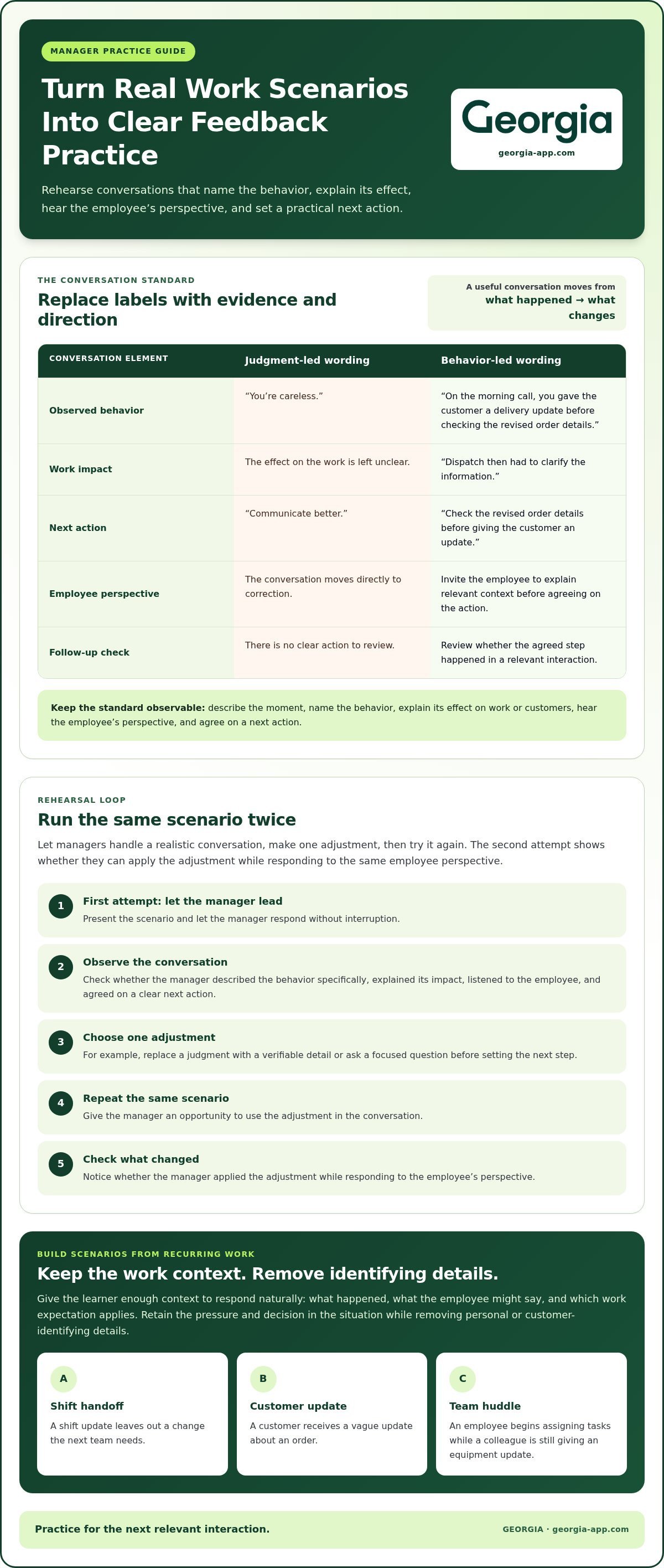
Labels such as “careless” leave the employee guessing which action needs to change. Train managers to prepare feedback using what they directly saw or heard, then connect it to a work expectation. This keeps the discussion grounded in evidence and gives the employee a fair chance to respond.
Separate facts from interpretation in a feedback conversation
A manager could say, “On the morning call, you gave the customer a delivery update before checking the revised order details. Dispatch then had to clarify the information.” This describes the interaction and its consequence. A judgment such as “you’re careless” adds a claim about character without helping the employee identify what to do differently.
Make the next action clear and measurable
Invite the employee to explain relevant context, then agree on an action both people can recognize. Replace “communicate better” with “check the revised order details before giving the customer an update.” The manager and employee can review whether that step happened in a relevant interaction.
- Identify the work situation.
- Describe the observed behavior.
- Explain its impact.
- Hear the employee’s perspective.
- Agree on the next action and follow-up point.
Managers can rehearse this sequence before applying it in a workplace conversation. Rehearsal gives them a chance to find vague wording, practice listening, and make the next step specific.
Rehearse Feedback Scenarios Managers Actually Face
Managers need practice with the conversations their roles demand. A generic script rarely prepares a dispatch lead to address incomplete shift notes or a sales manager to coach a rep who speaks over a customer. Build scenarios from recurring work situations, then let managers rehearse before they need the conversation on the floor, in the yard, or on a call.
For how to give constructive feedback training to carry into operations, each scenario needs a clear behavior to address and a realistic employee response. Remove names and identifying details while retaining the work context, pressure, and decision the manager must make.
Build scenarios around recurring operational conversations
Start with patterns managers recognize: a shift update leaves out a change the next team needs, a customer receives a vague order update, or an employee repeatedly skips a step in an established process. Adapt each situation to the manager’s role and the behavior the conversation should change.
Give the learner enough context to respond naturally, including what happened, what the employee might say, and which work expectation applies. Remove personal or customer-identifying details. The scenario should feel familiar because the work is familiar, not because it exposes a real individual.
Use repetition to improve delivery under pressure
Run the same scenario twice. In the first attempt, let the manager handle it without interruption. An observer can then assess whether the manager described the behavior specifically, explained its impact, listened to the employee’s response, and agreed on a clear next action.
Consider this team-huddle example. A weak response is: “You’re disruptive and need to show more respect.” It labels the person and gives no usable direction. A stronger response is: “In the last two shift huddles, you began assigning tasks while a colleague was still giving the equipment update. The team missed part of the information. Let the update finish before assigning tasks at the next huddle. Is there something making it difficult to wait?”
After the first attempt, give feedback on the manager’s wording and listening. Ask them to make one adjustment, such as replacing a judgment with a verifiable detail or asking a focused question before setting the next step. Then run the conversation again. The second attempt shows whether the manager can apply the adjustment while responding to the same employee perspective.
Use role-play that matches the pressure and pace of the work. Georgia’s AI-powered communication role-play platform gives managers personalized, self-paced simulations to practice soft-skill conversations. Sales managers can rehearse a response to a rep who talks over a customer, while customer operations and leadership teams can practice conversations relevant to their roles. Keep each practice objective narrow and review observable actions.
Build Practice and Follow-Up Into the Training Process
A training session can explain the right approach and still leave managers unprepared for a difficult conversation. Build a repeatable cycle instead: identify a skill gap, rehearse it, apply it at work, review evidence, and practice again. Connect each step to a feedback conversation the manager is responsible for having.
For how to give constructive feedback training to carry into daily operations, define what you expect to see. Look for specific descriptions of behavior, a clear explanation of work impact, active listening to the employee’s perspective, and an agreed next action. These indicators give managers and training leads concrete behaviors to review.
Separate participation from application. Attendance, module completion, and role-play attempts show that a manager took part in training. They do not show that the manager used the skill in a real conversation. Treat participation as a process measure, then examine practice performance and appropriate workplace observations to understand how the skill is transferring.
Make practice fit manager workloads
Keep practice focused on one behavior at a time. A manager who jumps quickly to judgment can rehearse replacing labels with observable details. A manager who gives feedback but fails to listen can focus on inviting the employee’s perspective and responding to it. A narrow objective makes each practice attempt easier to fit around active operational work.
Self-paced, personalized role-play is one way to repeat relevant conversations without relying on a scheduled group session. Managers can practice situations tied to their responsibilities, such as addressing an incomplete handoff or correcting an unclear customer update. Keep each scenario connected to a conversation they need to handle, then carry the same skill into the workplace.
Review application without inventing success claims
Use evidence that matches the behavior being trained. A manager can reflect on a recent conversation: Did they describe a specific action? Did they explain its effect on the work? Did they hear the employee’s response and agree on what happens next? A training lead can use appropriate observation or conversation notes to identify where the sequence breaks down.
Review the quality of the feedback behavior before drawing conclusions about broader outcomes. If managers still rely on general labels, return to evidence-based wording in practice. If they state the issue clearly but fail to agree on an action, rehearse the close. Connect any claim about operational results to reliable evidence from your organization.
Use the review to select the next practice objective. That closes the loop between training and work, keeps development tied to manager responsibilities, and makes follow-up part of the process rather than an afterthought.
Final Thought
Choose one real conversation. Prepare the observable behavior, explain its impact, agree on the employee’s next action, then follow up on what changed. That gives how to give constructive feedback training a practical test: managers apply the method in the work they lead. Keep rehearsal in the process so managers can prepare for difficult conversations before they happen.
Make Feedback Practice Part of the Operating Rhythm
Make feedback skill visible in the way managers lead every day. Choose a real conversation coming up, prepare carefully, and reflect afterwards on what the employee understood and did next. That review gives you a practical starting point for the next round of how to give constructive feedback training.
Keep rehearsal connected to the work. Georgia’s AI-powered role-play platform provides personalized, self-paced simulations for practicing communication before a difficult conversation on the job. Use that practice to refine the moments that matter in your operation.
Build a routine your managers can sustain, then strengthen it with deliberate practice.
Every clear conversation is a chance to improve how the team works together.
Frequently Asked Questions
How do you train managers to give constructive feedback?
Train managers through demonstration, rehearsal, and workplace review. Effective how to give constructive feedback training shows them how to identify behavior, connect it to work impact, and agree on a next action. Use a scenario from the manager’s role, such as addressing an incomplete quote handoff. Give focused feedback on clarity and listening, let the manager try again, then review an appropriate workplace conversation.
How often should managers practice giving feedback?
Managers should practice often enough to prepare for relevant conversations and apply adjustments. A universal schedule can conflict with changing workloads and team needs. Use recurring training opportunities and observed skill gaps to decide when another round will help. For example, after noticing that a manager avoids addressing missed updates, schedule focused practice around that conversation before a similar situation arises.
What should a manager do when an employee becomes defensive during feedback?
Stay calm, pause, and give the employee room to explain their perspective. A defensive response can point to missing context, but it does not settle what happened or change the work expectation. Acknowledge what the employee says, then return to the specific event and its effect. Before ending, clarify the action both of you expect next and any follow-up needed to review it.
Should constructive feedback be given in private?
Sensitive or corrective feedback is generally easier to discuss privately, where the employee can respond without an audience. Choose a setting that allows a focused exchange and protects the employee from unnecessary exposure. Public recognition can be appropriate when it respects the individual’s preferences and workplace norms. Match the setting to the purpose of the conversation, the subject matter, and the people involved.
How can training managers measure whether feedback skills improve?
Review observable behaviors during practice, such as whether managers give a specific example, explain the impact clearly, listen without interrupting, and agree on an action. For workplace application, combine suitable observations with manager reflection on a recent conversation. Track attendance and completion separately from demonstrated skill. Connect claims about broader improvement to reliable evidence from your organization rather than assuming training activity proves a result.
Can AI role-play help managers practice constructive feedback?
Yes. AI role-play can provide repeatable, self-paced simulations of communication conversations. Managers can rehearse their wording, respond to different employee reactions, and make a focused adjustment before a real discussion. Use the practice to prepare for conversations managers actually handle, then apply judgment in the workplace. Role-play supports preparation; the manager remains responsible for listening, assessing context, and choosing an appropriate response. Book a Georgia demo to see how the platform can fit into your training program.