

Soft skills for support teams shape customer outcomes. A vague answer can prompt another contact, while a rushed handoff can leave a customer repeating the issue. Those avoidable interactions add work for agents and make it harder to resolve the customer’s original concern.
Product knowledge matters, but knowing the answer does not guarantee an agent can listen carefully, explain it clearly, or stay steady when a customer is under pressure. Those behaviours need to be defined and practised rather than left to individual instinct.
This article shows you how to identify the conversation skills that improve support, turn them into observable behaviours, and build realistic practice into team development. You’ll find practical ways to rehearse acknowledging a concern, asking focused questions, and confirming the next step. The aim is more consistent conversations across agents and shifts, with clear progress toward resolution.
Key Takeaways
- Define soft skills for support teams as observable actions agents can practise, rather than personality traits you expect them to show.
- Identify how listening, clear explanations, empathy, ownership, and de-escalation appear in actual customer conversations.
- Use scripts and knowledge resources to support accuracy, then practise adapting language to the customer’s situation.
- Build a repeatable practice loop around recurring support interactions, from selecting a scenario to reviewing the behaviour.
- Use anonymized themes from real customer interactions to make practice relevant while protecting customer-identifying details.
Treat inconsistent support conversations as an operational problem
A vague answer can leave a customer unsure about what happens next. That uncertainty may lead to another contact, an escalation, or extra work clarifying the response. Across shifts, inconsistent conversations make support harder to manage and review.
Soft skills for support teams are observable communication behaviours that help agents understand concerns, explain information clearly, and guide interactions forward. They describe actions, not personality traits. The broader overview of What are soft skills? provides useful context for this support-specific definition.
Identify the moments where communication breaks down
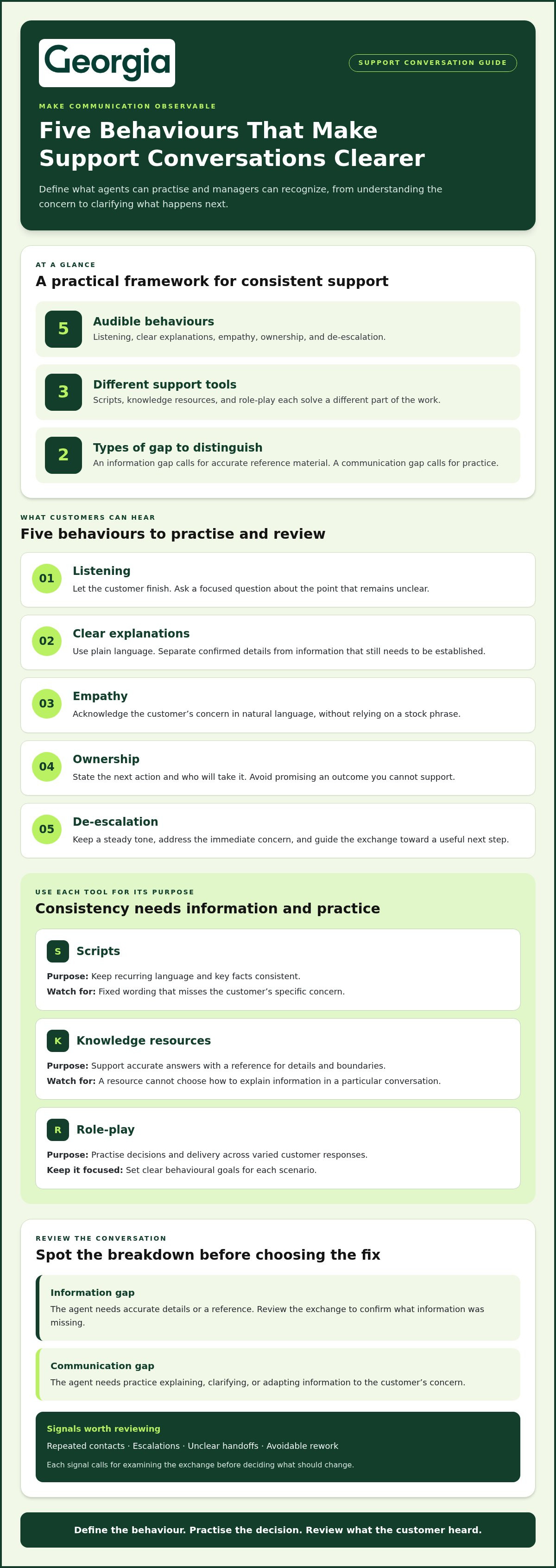
Review recurring interactions such as complaints, delivery questions, and unresolved service issues. Look for moments when an agent answers before understanding the request, skips a relevant question, or ends the exchange without clarifying what happens next. Separate an information gap from a communication gap: the first calls for accurate reference material, while the second calls for practice explaining or clarifying information.
Define the cost in terms leaders can observe
Use repeated contacts, escalations, unclear handoffs, and avoidable rework as signals for review. None proves a communication failure by itself, so examine the exchange before deciding what needs to change. Did the agent address the question? Could the next person act on the handoff? Did the customer understand what to expect?
Consistent conversations make support activity easier to observe, compare, and review. Start with a specific interaction, then identify the behaviour that would have made it clearer or more useful.
Train the behaviours customers can hear
Give agents actions they can use and managers can recognize. For soft skills for support teams, focus practice on five behaviours:
- Listening: Let the customer finish, then ask a focused question about the point that remains unclear.
- Clear explanations: Use plain language and separate confirmed details from information that still needs to be established.
- Empathy: Acknowledge the customer’s concern in natural language, without relying on a stock phrase.
- Ownership: State the next action and who will take it, without promising an unsupported outcome.
- De-escalation: Keep a steady tone, address the immediate concern, and guide the exchange toward a useful next step.
Listen for the issue before choosing a response
Before answering a delivery question, clarify what the customer needs to know. They may be checking timing or trying to understand how a change affects their plans. A short summary, such as “You’re checking how this change affects the expected timing,” gives the customer a chance to correct a misunderstanding before the agent responds.
Explain next steps with clarity and ownership
Agents should distinguish what they know from what they still need to establish, then explain the next action in plain language. Name who will act and what the customer can expect next, while avoiding commitments the agent cannot support. Adapt the wording to the customer’s question rather than reciting a fixed line. Teams can rehearse these decisions with a customer service role-play software guide.
Use scripts for consistency, then practise adaptation
Scripts, knowledge resources, and role-play solve different problems. A script provides approved wording for recurring explanations. A knowledge resource supports accurate answers. Practice helps agents choose and deliver a response when the customer’s situation shifts. Using one tool for all three leaves a gap: agents may have the right information and still struggle to apply it in a live conversation.
Soft skills can feel subjective until you define what you expect to hear. Set criteria before practice: does the agent acknowledge the concern, explain the relevant information plainly, and adjust the response when the customer asks for clarification? Those actions give agents and managers a shared standard for practice and review.
Scripts
Purpose: Keep recurring language and key facts consistent. Strength: Give agents a reliable starting point. Limitation: Fixed wording can miss the customer’s specific concern.
Knowledge resources
Purpose: Support accurate information. Strength: Give agents a reference for details and boundaries. Limitation: A resource cannot choose how to explain information in a particular conversation.
Role-play
Purpose: Practise decisions and delivery. Strength: Lets agents rehearse varied customer responses. Limitation: Scenarios need clear behavioural goals to keep practice focused.
Keep scripts useful without making conversations sound mechanical
Use approved wording for facts, boundaries, and explanations that recur across customer contacts. Then identify where the agent must respond to the person in front of them: the concern they raised, what they already understand, and what they need clarified. A script should anchor accurate language while leaving room for listening and judgement.
For example, an agent can use consistent language to explain a known service constraint, then adapt the explanation if the customer says it does not answer their question. Review whether the agent addressed the actual concern clearly, rather than whether they repeated a line word for word.
Practise decisions that a script cannot make
Build variations around one support topic. In one version, the customer is confused by an explanation. In another, they are dissatisfied with the information. In a third, they ask for clarification after the agent has started outlining next steps. Ask the agent to choose a response and state what it should accomplish. Then review the behaviour against the criteria you set.
This approach gives soft skills for support teams a practical place in development: shared reference materials establish what agents can say, while rehearsal develops how they respond. For broader program context, read about soft skills training programs. Georgia’s AI role-play platform provides self-paced conversation simulations for teams to practise adapting their responses. Explore a role-play demo for your existing training program.
Build a repeatable practice loop around real support work
Training has more practical value when it reflects the conversations agents handle every day. Build a short loop around recurring support work: select an interaction, define the behaviour, rehearse it, and review what happened.
- Select a recurring interaction. Choose a support theme agents encounter regularly, such as a complaint, an unclear request, or a customer seeking an update. Use it to set a realistic context without reproducing a particular customer’s case.
- Define one behaviour. Pick a single action to practise, such as asking a clarifying question before responding or explaining a next step in plain language. State what an observer should hear or see.
- Rehearse with variation. Give agents different customer reactions so they must respond to the situation rather than repeat a memorized answer. Practise the chosen behaviour on its own, then combine it with other skills once the action is clear.
- Review and apply. Discuss where the behaviour appeared, where it dropped out, and what the agent will try in a real interaction. Keep the review focused on the behaviour and its effect on the conversation.
A repeatable support practice loop turns recurring customer interactions into focused rehearsal, observable feedback, and a clear next behaviour to apply.
Choose scenarios that match the team's customer conversations
Build scenarios from themes your team recognizes, including complaints, incomplete requests, or confusion about information already provided. Remove names, order details, contact information, and other identifying details before turning an interaction into a practice scenario. Keep only the context agents need to rehearse the communication challenge.
Then vary the customer’s response. One version might begin with a concise question; another could include frustration or a request to explain the answer differently. Keep the situation grounded in your customers and operating context. The goal is relevant practice that develops judgement, rather than a script agents can memorize and deliver unchanged.
Reinforce learning without creating a measurement detour
After rehearsal, ask each agent to name one behaviour they will apply in an upcoming customer interaction. In a later review, the manager can listen for that action and give specific feedback. Team reflection can also surface wording or responses that helped move the exchange forward.
Keep the review practical. Point to the moment the agent summarized the request, asked a useful question, or clarified what would happen next. If the behaviour did not appear, identify a more suitable phrase or decision to try during the next rehearsal. Explore the customer service soft skills guide for related context.
Final Thought: Put support conversations into deliberate practice
Choose one recurring support interaction and name one behaviour agents should practise, such as summarizing the customer’s concern before responding. Reinforce it in routine work by listening for that action and giving specific feedback. Georgia’s AI-powered platform provides personalized, self-paced simulations for teams to practise soft-skill conversations under pressure. Use it to give agents a structured way to rehearse challenging interactions as part of your training program.
Turn Your Next Support Review Into Practice
Connect communication development to a real team priority. Choose a recurring support interaction that matters to your operation, then use it to set a focused practice objective. That keeps soft skills for support teams tied to the conversations agents handle and gives managers a clear behaviour to reinforce in everyday work.
Georgia offers personalized, self-paced simulations designed to help teams practise communication under pressure. Add role-play to your support training so agents can rehearse challenging conversations before they happen with customers.
Start with one conversation, define the behaviour that would improve it, and give your team a way to practise before the next customer interaction.
Frequently Asked Questions
What are the most important soft skills for a customer support team?
Prioritize the skills that address your team’s recurring conversation challenges. Listening, clear explanations, empathy, ownership, and de-escalation are a practical starting point. Review where customers ask for clarification or agents lose momentum. If customers leave unsure about what happens next, focus first on clear explanations and ownership. If agents respond before understanding the issue, focus on listening.
How can support agents improve their communication with customers?
Agents can improve by reviewing specific moments in real conversations and trying a more effective response. For example, after a customer says an explanation was confusing, the agent can pause, ask which detail needs clarification, and answer that point directly. Managers can help agents notice when jargon, long explanations, or assumptions obscure the message. Practising alternative wording makes clearer responses easier to use during live support.
Can soft skills be taught to customer service teams?
Yes. Teams can learn communication behaviours when leaders describe them clearly, demonstrate examples, and provide opportunities to practise. Start with a specific situation, such as a customer questioning an invoice, and identify the action that would help: acknowledge the concern, ask what seems incorrect, and respond to that point. Feedback should address the behaviour and its effect on the conversation, giving the agent a clear adjustment to try.
How do you practise difficult customer conversations?
Rehearse a realistic scenario with different customer reactions. One practice round might involve a calm request for an update; another might include a customer who challenges the answer or asks the same question in a different way. Ask the agent to respond in their own words, then review whether the response stayed clear and addressed the concern. Georgia’s personalized, self-paced simulations provide a format for practising conversations under pressure.
Are scripts enough to improve customer support communication?
Scripts help agents communicate recurring facts and explanations consistently, but they cannot account for every question or reaction. An agent still needs to recognize when a customer has misunderstood, identify which part needs clarification, and choose suitable wording. Treat scripts as a reference for approved language. Pair them with practice that tests whether agents can apply the information thoughtfully when a conversation moves beyond the expected exchange.
How can managers help agents use soft skills consistently?
Give agents a shared set of behavioural standards and use the same criteria when reviewing conversations across the team. For example, define what an effective acknowledgment sounds like and distinguish it from simply repeating the customer’s words. Managers can compare observations, discuss differences in interpretation, and give feedback tied to a specific exchange. This makes expectations clearer across shifts while leaving room for agents to use natural language.
How often should support teams practise communication skills?
Set a recurring practice rhythm your team can maintain, then adjust it when new interaction patterns or skill gaps emerge. A short weekly session can keep practice visible; a focused review after a difficult customer exchange can address a timely need. Choose a cadence that fits team operations and revisit it if rehearsal becomes irregular. Consistency gives agents more chances to refine their responses than occasional training alone.
Book a Georgia demo to see how self-paced role-play can support your team’s communication practice.