

Poorly handled sales objections cost construction firms millions in lost contracts every year. Managers waste hours on repetitive role-play sessions that yield no measurable data. Implementing self-paced soft skills practice addresses this friction by treating communication as a financial asset.
You likely recognize that traditional training fails to stick. Deloitte research shows 79% of information is forgotten within 30 days.
Only 1% to 2% of lecture-based content is ever applied in the field. High-stakes communication requires the same level of rigorous, performance-based repetition as any other mission-critical operation.
This article provides a framework to transform verbal fluency into a performance metric. You will learn how high-pressure AI simulations ensure your team is 20% to 45% better under pressure while freeing managers from constant coaching loops.
This system reduces friction in high-stakes leadership interactions and scales without increasing your operational overhead. You will gain a training system that employees actually use and find valuable for closing high-stakes deals.
Key Takeaways
- Manage communication as a financial asset with measurable performance metrics to prevent revenue leakage.
- Replace passive lectures with self-paced soft skills practice to combat the 79% of training content forgotten within 30 days.
- Use AI simulations to reach 60% faster proficiency in de-escalating high-pressure sales interactions.
- Deploy a practice before the meeting rule to eliminate manager burnout and ensure team members are 20% to 45% better under pressure.
The High Cost of Friction: Why Traditional Soft Skills Training is a Financial Liability
Communication friction is a mechanical failure. It causes measurable financial leakage in every department. Unaddressed friction in your communication pipeline acts as a tax on every closed deal. Sales reps who miss objections lose revenue, while managers who cannot de-escalate conflict drive turnover.
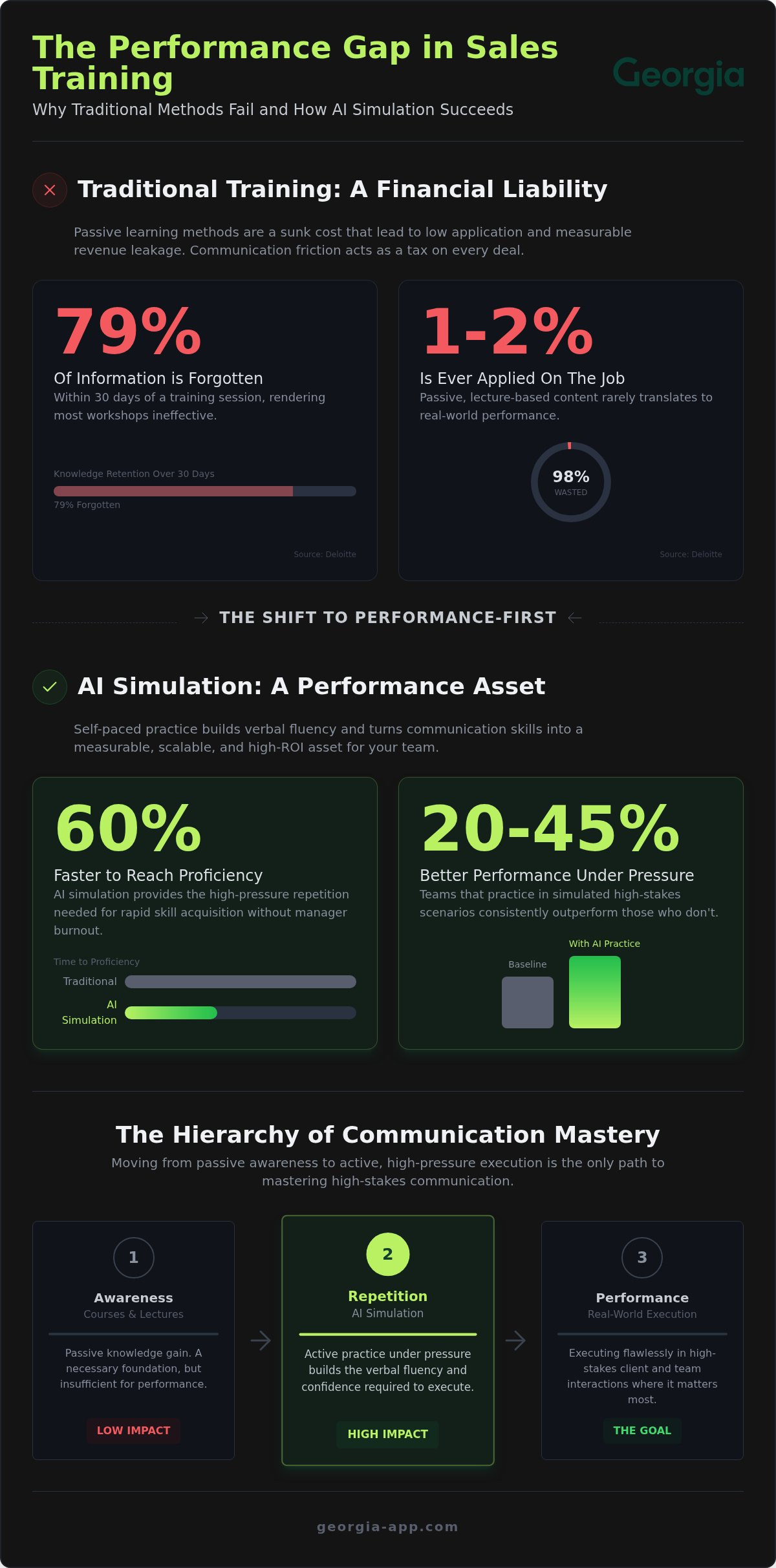
Traditional training is a sunk cost. Deloitte research indicates 79% of training content is forgotten within 30 days. Only 1% to 2% of that content is ever applied on the job. This is the Forgetting Curve in action. Most management training is wasted within 24 hours of the session.
Quantifying the Communication Gap
Every botched sales objection represents lost deal value. High-stakes communication is a performance metric rather than a personality trait. You must identify where communication leakage occurs in your team data. If a rep fumbles a price objection, that is a direct hit to the bottom line.
Communication friction manifests in several quantifiable ways:
- Direct revenue loss occurs when sales reps fail to handle pricing objections.
- Operational drag increases when managers cannot provide clear, direct feedback.
- Recruitment costs rise as poorly handled internal conflict drives employee turnover.
- Deal velocity slows when negotiation teams lack verbal fluency under pressure.
Poor verbal fluency is a structural failure. It creates operational drag that slows down every transaction. Friction in leadership communication leads to employee burnout and expensive recruitment cycles. These are not interpersonal issues; they are financial liabilities.
The Failure of Passive Learning
Watching a video about empathy fails to prepare a rep for a hostile client. Reading a slide deck is insufficient for learning crisis management. Understanding what are soft skills is mere awareness. Behavioral mastery requires repetition.
Implementing self-paced soft skills practice allows for this repetition without management burnout. Consistent self-paced soft skills practice ensures every team member meets a baseline of conversational execution before they speak to a client. Employees move from theoretical knowledge to conversational execution.
Practicing through simulations makes employees 20% to 45% better under pressure. This is the difference between knowing a skill and performing it. Crisis management is a performance. If your team only practices during live, high-stakes deals, you are using your customers as test subjects.
In-person workshops are too slow. They are static events in a dynamic market. Modern enterprise needs require a system that scales and provides immediate feedback. Passive consumption creates a false sense of competence while the revenue gap remains. You need a training system that treats soft skills with the same rigor as financial auditing.
What is Self-Paced Soft Skills Practice in 2026?
True self-paced soft skills practice is an active simulation. It mimics the physiological stress of real-world interactions. Traditional training focuses on theoretical awareness. Modern practice focuses on conversational execution. You replace passive reading with high-pressure repetition.
Success depends on a feedback loop that is immediate and objective. Data-driven analysis identifies specific conversational failures. This shift toward scenario-specific simulation is critical for revenue protection. Organizations like the National Soft Skills Association highlight these interactive capabilities as core competencies for the modern workforce.
Verbal fluency is the target metric. It is the ability to speak clearly and persuasively under high-stakes pressure. Fluency is a financial asset. If a rep hesitates during a price negotiation, they lose authority. Simulations build this fluency through consistent repetition in a controlled environment.
The Core Components of an Effective Simulator
Effective simulators integrate AI personas. These characters mimic realistic, difficult personalities found in the construction and building materials industries. You practice against skeptical procurement officers or frustrated project managers. The simulator provides personalized feedback and nuanced behavioral analysis.
Stress mimicry is a requirement for behavioral change. Platforms simulate the ticking clock of a real negotiation. This pressure forces the brain to move beyond passive knowledge. Reps who train this way are 20% to 45% better under pressure. You move from knowing a skill to executing it during a crisis.
Why Self-Paced is the Only Way to Scale
Traditional coaching creates a manager bottleneck. Scaling requires letting reps practice 50 times without a 1-on-1 meeting. This removes the scheduling friction that kills training momentum. Self-paced modules ensure consistency across global, remote, and hybrid teams. Every employee receives the same high standard of training regardless of their location.
The psychology of safe space practice drives rapid results. People learn faster when no one is watching. They take risks and test new strategies without fear of judgment. This environment allows teams to reach proficiency 60% faster. You can evaluate your team's current readiness with an AI role-play platform.
Effective practice requires a system that provides objective data. Manager bias often skews performance reviews. AI-driven feedback provides a neutral audit of communication skills. This transparency allows you to identify high-potential leaders and address performance gaps before they impact the bottom line.
The Hierarchy of Communication Mastery: Courses vs. Simulations
Training formats exist on a spectrum of effectiveness. Most organizations invest in the wrong end of this hierarchy. High-stakes communication is a performance. You must train it as one. Passive consumption is a financial liability because it creates the illusion of competence without changing behavior.
Level 1 is passive consumption. This includes videos and articles. These tools are good for awareness. They are bad for behavior change. PwC research shows only 1% to 2% of lecture-based content is ever applied on the job.
Level 2 is interactive assessment. Quizzes measure knowledge retention. They do not measure skill. A rep might know the answer to a multiple-choice question about de-escalation. That same rep will still fumble a hostile confrontation in a concrete yard.
Level 3 is live role-play. Human-to-human interaction offers high quality. It remains impossible to scale. This format relies on manager availability and invites human bias into the evaluation process.
Level 4 is AI-driven simulation. This represents the standard for conversational execution. It provides high quality at scale. You receive objective data for every interaction. This is the ultimate goal of self-paced soft skills practice.
Comparing ROI Across Training Formats
Human coaching carries a high cost per session. AI-powered platforms reduce this expenditure significantly. Reps reach proficiency 60% faster using simulations. Fifteen minutes of active practice provides more value than two hours of passive lecture. You gain total visibility into team performance. Tracking progress across a thousand employees is an automated audit. This visibility identifies specific conversational failures before they impact your quarterly revenue.
When to Use Which Format
Foundational concepts require videos. Use them to explain the mechanics of a sales process. Execution requires simulation. Use self-paced soft skills practice for high-stakes scenarios like contract negotiations or safety compliance disputes. Stop measuring completion rates. Start measuring performance metrics. A hybrid curriculum prioritizes actual conversational execution over seat time. Reps who practice this way are 275% more confident in their interactions. You move from a culture of learning to a culture of execution.
High-stakes deals fall through due to poor verbal fluency. Address this by integrating simulation into your weekly workflow. This ensures every team member is 20% to 45% better under pressure. You can see how this works by following the Georgia LinkedIn page for performance data updates.
How to Implement Scalable Practice Without Management Burnout
Traditional coaching is a management bottleneck. You cannot scale a 1-on-1 role-play session across a global team without burning out your leaders. Implementing self-paced soft skills practice removes this friction by automating the repetition phase of training.
Identify your high-stakes scenarios first. Focus on sales pitches, de-escalation, and performance reviews where communication failure has a high price tag. Apply the practice before the meeting rule to ensure every rep is 20% to 45% better under pressure. This shift moves managers from teaching basics to refining advanced execution.
Use simulation data to drive targeted coaching. Managers don't need to audit every employee. They should focus their time on the specific reps showing conversational leakage in the data. Gamification and benchmarking create a culture of conversational excellence where performance is visible and rewarded.
Objective data replaces manager bias. You can track exactly how many times a rep practiced a specific objection before they closed a deal. This transparency allows you to correlate practice frequency with revenue growth. You identify top performers and potential leaders based on measurable conversational precision.
Mapping Practice to Revenue Goals
Align your role-play scenarios with specific sales stage bottlenecks. If your deals stall during final negotiations, simulate aggressive procurement interactions. This targeted approach protects your revenue pipeline from unforced errors. You ensure your team is prepared for the specific friction points that kill deals.
Train your customer operations teams on service recovery. Practicing these high-pressure moments protects customer lifetime value and prevents churn. Leadership development requires practicing difficult feedback sessions to reduce team attrition and operational drag. Every communication scenario should map directly to an operational outcome.
Reducing Friction in the Training Deployment
Roll out digital platforms without adding to tool fatigue. Integrate the practice into existing daily workflows rather than making it a separate event. Setting clear performance benchmarks for conversational fluency ensures everyone understands the standard for execution. Consistency across the organization prevents the dilution of your brand voice.
Conversational ROI is the measurable return on communication precision. Teams that adopt this performance-first mindset reach proficiency 60% faster than those relying on passive methods. You can start building this fluency by integrating AI simulations into your weekly sales meetings. This approach ensures your training investment generates a documented return.
Follow Georgia for implementation frameworks
Georgia: The AI Role-Play Platform for Performance-First Teams
Georgia replaces soft skills education with conversational execution. You stop studying communication and start auditing performance. Implementing self-paced soft skills practice through the Georgia platform ensures every rep meets a baseline of verbal fluency. This system treats human interaction with the same rigor as financial auditing.
Specialized modules address Sales, Customer Ops, and Leadership Development. AI personas mimic high-pressure stress to build genuine verbal fluency. These simulations reflect the reality of a concrete yard negotiation or a hostile procurement meeting. You identify conversational failures before they impact your quarterly revenue.
Objective data identifies exactly where the revenue leak is happening. You see the failure in the performance metrics. Deloitte research indicates that teams reach proficiency 60% faster through these simulations. Reps become 20% to 45% better under pressure according to data from the Journal of Marketing Education.
Practice the Pitch Before the Meeting
Sales reps often discount under pressure to avoid conflict. Georgia simulates these price objections so reps hold their margins. They practice the pitch until the response is mechanical. PwC research suggests participants are 275% more confident after using these AI simulators.
Customer support teams master the angry client scenario through repetition. They practice de-escalation in a controlled environment. This protects customer lifetime value and prevents churn. Mastery in these moments is a requirement for operational efficiency.
Managers use Georgia as a safe space for high-stakes leadership conversations. They rehearse difficult feedback sessions before the actual meeting occurs. This reduces operational drag and team attrition. Preparation ensures that internal friction does not slow down your project timelines.
Scale Your Coaching, Not Your Headcount
You deploy personalized coaching to 1,000 employees with one click. Georgia integrates with your existing enterprise training stack. This removes the manager bottleneck. You ensure consistent standards across global and remote teams without increasing your management overhead.
Traditional coaching is a manual process that cannot scale. Georgia automates this process while providing deeper data visibility. You identify high-potential leaders based on measurable conversational precision. This transparency allows for a documented return on your training investment.
Standardize Your Conversational Execution
Passive training is a financial liability. You must treat soft skills with the same precision as a structural audit. Implementing self-paced soft skills practice allows your team to rehearse high-stakes scenarios without manager burnout. This system reduces revenue loss from poor conversations and provides data-driven performance tracking for global teams.
You audit conversational execution. You ignore attendance logs. You require team members to be 20% to 45% better under pressure according to the Journal of Marketing Education before they lead a negotiation. You prioritize verbal fluency to protect your profit margins. This shift ensures your training investment generates a measurable return on investment. You reach proficiency 60% faster by replacing lectures with active simulation according to Deloitte.
Your organization is now equipped to scale coaching to 1,000 employees with one click. You have identified your communication leaks and plugged them with data-driven simulations. Your team is ready for the next high-stakes deal.
Frequently Asked Questions
Is self-paced soft skills practice as effective as live coaching?
It is more efficient for scaling and behavior retention. Live coaching is static and slow. Self-paced soft skills practice allows for the repetition needed to overcome the forgetting curve, where 79% of content is lost in 30 days according to Deloitte. This method leads to 60% faster proficiency. You gain consistent results across every plant and every rep without the scheduling friction of live sessions.
How does AI role-play simulate real-world pressure?
The platform uses AI personas that mimic realistic, difficult characters like skeptical procurement officers or aggressive project managers. It simulates the ticking clock of a real negotiation to trigger the same physiological stress responses found in the field. This stress mimicry ensures that team members are 20% to 45% better under pressure according to the Journal of Marketing Education. You move from theoretical knowledge to conversational execution by practicing in a high-stakes digital environment.
Can this platform help reduce sales reps' tendency to discount?
Yes, by allowing reps to practice price-push scenarios and aggressive negotiations until their responses are mechanical. Reps who role-play before live calls are 275% more confident versus classroom-only training according to PwC research. This confidence prevents them from fumbling objections or making unnecessary concessions to avoid conflict. You protect your profit margins by ensuring every rep can hold their ground against a customer demanding a lower price.
What are the best soft skills to practice for leadership roles?
Focus on high-stakes scenarios like delivering difficult performance feedback, de-escalating internal conflicts, and maintaining commercial compliance. Leadership development requires verbal fluency under pressure to reduce team attrition and operational drag. Practicing these interactions ensures the manager's method is applied exactly as designed every time. You eliminate the drift and dilution that typically occurs in traditional, lecture-based leadership workshops. This approach prioritizes execution over awareness.
How do you measure the ROI of a soft skills training platform?
ROI is measured through direct cost savings and performance improvements. Georgia delivers an 84% lower training spend compared to traditional methods, saving approximately $12.6K per 10-rep team. You also track conversational ROI by monitoring deal velocity and lead conversion rates. Objective data from the manager dashboard identifies specific revenue leaks and correlates practice frequency with closed contracts and protected margins. This provides a neutral audit of team performance.
What happens if an employee is resistant to digital role-play?
Resistance usually stems from a fear of being judged during live role-plays. Self-paced soft skills practice provides a safe space where employees learn faster because no one is watching. They can fail and iterate 50 times without the pressure of a manager in the room. Once they see their performance scores improve and their confidence increase by 275% according to PwC, the resistance typically shifts to high engagement. You remove the ego from training.
How long does it take to see results from self-paced soft skills practice?
Proficiency is achieved 60% faster than traditional methods according to Deloitte. While 79% of classroom learning is forgotten within 30 days, simulation-based practice creates immediate behavioral change. You see measurable improvements in verbal fluency after the first few sessions. Reps who practice the pitch before a meeting perform 20% to 45% better in that specific interaction. Consistent weekly use ensures long-term retention and execution across the entire organization.
Can Georgia integrate with my existing LMS or CRM?
Georgia is designed to integrate into your existing enterprise training stack. This ensures that conversational execution data flows directly into your management systems for a total audit of team performance. You deploy personalized coaching to 1,000 employees with one click. This integration removes tool fatigue by making simulation a natural part of the daily workflow. It replaces separate, disconnected training events with continuous reinforcement that protects your bottom line.