

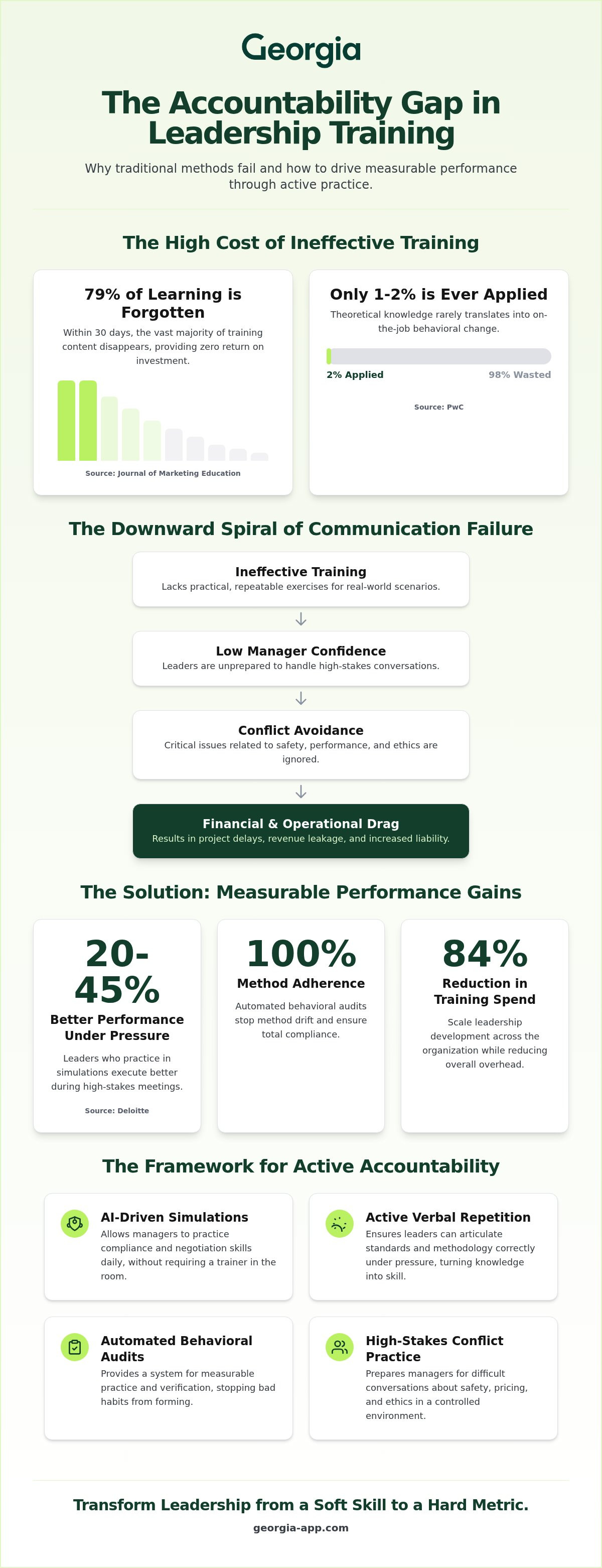
In the aggregates and concrete industries, operational friction stems from communication failure. PwC research shows that only 1% to 2% of training is ever applied in real situations. Most accountability in leadership training fails because it prioritizes theory over measurable behavioral practice.
You recognize the cost of managers avoiding difficult conversations. The Journal of Marketing Education notes that 79% of learning is forgotten within 30 days.
Stop guessing if your managers are leading effectively. This article provides a framework to measure their ability to handle high-stakes conversations with the same precision as a financial audit.
You will learn to scale practice without increasing headcount. We will examine how to achieve 100% adherence to your core methodology.
You can ensure leaders perform 20% to 45% better under pressure as documented by Deloitte. This transition establishes leadership as a hard metric that drives your bottom line.
Key Takeaways
- Learn why only 1% to 2% of traditional training is ever applied and how to fix this operational failure.
- Implement active verbal repetition to ensure accountability in leadership training translates into real-world performance.
- Use automated behavioral audits to stop method drift and maintain 100% adherence to your training standards.
- Prepare managers for high-stakes conflict with simulations that improve performance under pressure by up to 45%.
- Scale your leadership development across the organization while reducing overall training spend by 84%.
Quantify the Financial Risk of Leadership Communication Gaps
Poor leadership communication acts as a hidden tax on your operational efficiency. It creates friction in the supply chain and stalls project timelines. Research from PwC indicates that only 1% to 2% of traditional training content is ever applied in real customer or team interactions. This means the vast majority of your development spend provides zero return on the job site.
When leaders fail to hold teams accountable, the organization suffers from immediate revenue leakage. Identifying the gap between theoretical knowledge and behavioral execution is the first step toward recovery. Effective accountability in leadership training must bridge this divide through measurable practice. You cannot solve a behavioral problem with a slide deck.
To better understand this concept, watch this helpful video:
Analyze the Cost of the Forgetting Curve
Training that doesn't stick is a waste of capital. Data from the Journal of Marketing Education shows that 79% of what salespeople and leaders learn is forgotten within 30 days. This rapid decay makes one-off workshops a structural failure in your business model. Organizations must transition from event-based training to continuous reinforcement models to protect their ROI. Stop paying for information that expires before the next billing cycle.
Evaluate the Impact of Managerial Avoidance
Managers who lack confidence in their communication skills often avoid difficult conversations entirely. This silence is expensive. In the building materials sector, a manager who avoids a safety correction or a pricing dispute creates a liability that compounds over time. You are essentially subsidizing poor performance by failing to provide leaders with the tools to speak up. This avoidance results in a measurable loss of productivity and increased turnover costs.
Lack of clear accountability creates a vacuum where performance standards erode. Without a system for measurable practice, your managers will continue to choose the path of least resistance. You cannot afford to hope for better results while relying on a 2% application rate. Modern accountability in leadership training requires a shift from passive listening to active, audited performance. This is the only way to plug the leaks in your leadership pipeline.
Replace Classroom Lectures with Active Leadership Accountability Exercises
Static toolkits and passive videos cannot prepare a leader for the stress of a real conflict. Information is not skill. Leadership accountability exercises must involve active verbal participation to be effective. If a manager cannot articulate a standard under pressure, they do not truly know it.
AI-driven simulations allow managers to practice compliance and negotiation skills every day without a trainer in the room. This approach ensures that every sales rep and every plant manager receives personalized coaching at scale. You eliminate the bottleneck of human coaching while maintaining high standards. This ensures no drift and no dilution of your core training methodology as it moves from the corporate office to the field.
Implement Simulation Based Practice
Design scenarios based on real world challenges such as responding to improper requests or maintaining ethical selling. Role-playing before live interactions allows leaders to perform 20% to 45% better under pressure according to Deloitte. This practice bridges the gap between knowing the rules and executing them during a high-stakes meeting.
Practicing on a phone via voice or chat provides the frequency needed for mastery. Consistency beats intensity in accountable leadership development. You can see how simulation scales your existing training methodology without adding headcount or travel costs. Stop bidding and praying that your managers will do the right thing and start verifying their performance through repetition.
Focus on Compliance and Ethics
Use modules that force leaders to respond to antitrust violations or protect confidential information. These scenarios must reflect the high stakes of the building materials and construction sectors. Building materials companies face intense regulatory scrutiny where a single verbal slip by a plant manager can lead to millions in fines or legal fees.
- Respond to a competitor proposing a price-fixing arrangement during an industry event.
- Manage a subcontractor requesting an off-books payment for expedited delivery.
- Protect proprietary plant production data during a site visit from a potential partner.
- Address a safety violation on a job site where the supervisor is a personal friend.
- Negotiate a supply contract while adhering strictly to internal ethical guidelines.
Traditional accountability in leadership training often ignores these specific, high-risk interactions in favor of vague soft skills. You must replace theory with repetition to ensure these behaviors become instinctive. Repetitive practice on these specific compliance triggers turns a liability into a controlled variable. If a manager cannot articulate a refusal in a simulation, they will fail in the field.
Eliminate Method Dilution with Automated Behavioral Audits
Traditional training often suffers from method drift as it moves from the classroom to the field. Standards erode. Precision fades. Georgia ensures your method is applied exactly as designed every time. You move from hopeful observation to active behavioral auditing.
Use a manager dashboard to monitor activity and performance across the entire organization. This visibility allows leadership to identify specific coaching needs before they become systemic failures. A dashboard transforms subjective feedback into hard data. You see exactly which plant managers are mastering the material and which ones are avoiding the simulator. This platform functions as a rigorous performance audit.
Protect Your Training Methodology
Methodology integrity is non negotiable for the Craftsman leader. There is no drift and no dilution of your core principles. Every participant experiences the method exactly as the trainer built it. This consistency is vital in high stakes environments like concrete production or aggregate sales. Variance increases your risk profile. Georgia acts as a stabilizer for your intellectual property.
This creates a scalable engine that delivers consistent outcomes without the need for constant supervision. You stop relying on the charisma of a single trainer. You build a culture of accountability based on repeatable, audited behaviors. Efficiency increases as variance decreases across your leadership team.
Measure Real World Application
Completion rates are vanity metrics. Watching a video fails to prove a plant manager can handle a labor dispute or a safety violation. You must move beyond completion rates to track how leaders handle specific objections. Accountability in leadership training requires data that proves behavioral change. If you cannot measure the speech patterns of your managers, you cannot manage their impact on the business.
Use data to prove that participants feel 275% more confident versus classroom only training, as reported by PwC. This confidence results from repeated, measured practice. You track the following performance metrics to ensure your investment is working:
- Measure the average response time to high pressure compliance triggers in the simulation.
- Track the adherence percentage to the approved verbal script for conflict resolution.
- Monitor the frequency of self paced practice sessions completed per manager each month.
- Audit the accuracy of industry specific terminology used during simulated negotiations.
- Evaluate the incremental improvement in behavioral scores over a rolling 90 day window.
Data replaces guesswork. You have the audit trail to prove the training worked. This level of rigor ensures accountability in leadership training delivers operational results. Mastery is a quantifiable metric.
Build Executive Confidence Through High-Stakes Verbal Repetition
Confidence is a byproduct of repetition and mastery. Leaders must rehearse their responses to difficult situations until the correct behavior becomes instinctive. Hesitation during a crisis usually results in lost initiative. Mastery requires the conversion of theoretical knowledge into muscle memory.
Immersive simulations cut time to proficiency by 60% according to Deloitte research. This acceleration is critical for organizations scaling rapidly or replacing retiring plant veterans. You must ensure new leaders find their voice quickly. Rapid repetition ensures they are ready to lead on day one.
This approach reduces the anxiety associated with performance reviews and conflict resolution. Anxiety stems from uncertainty. Practice removes the unknown and empowers your managers to act with authority. Professional accountability in leadership training turns stressful interactions into routine operations.
Rehearse the Objection Before the Call
High stakes conversations require verbal fluency that only comes from repeated practice. You must prepare your team for the specific objections they will face in the yard or the boardroom. Direct practice reduces revenue loss from poor conversations and unforced errors. A single fumbled negotiation in the aggregates sector can erase the profit margin of an entire project.
Managers often fail to execute when the pressure is high despite knowing what they should say. This gap between knowledge and speech is a significant financial liability. You can address this by auditing and fixing your revenue leaks through targeted role play. Fluency is the bridge between a training manual and a successful contract.
Utilize AI for Safe Practice
AI personas provide a safe space for managers to fail and learn without real world consequences. Traditional role play with peers often feels awkward or judgmental. This social friction prevents leaders from taking the risks necessary to improve. AI removes this barrier by providing a tireless, objective partner for repetition.
This environment encourages leaders to refine their approach to difficult interactions. They can test different strategies for holding subordinates accountable without risking team morale. Effective accountability in leadership training relies on this psychological safety to drive behavioral change. As one client noted:
"Retention scores tripled in 60 days. Leadership stopped questioning the program." , VP Sales Enablement, B2B SaaS.
Moving the failure point to a simulation protects your real world relationships and your bottom line. You ensure that when a manager finally enters a high stakes conversation, they are speaking from a position of experience. They are executing a practiced skill.
Scale Managerial Proficiency Without Increasing Training Overhead
Traditional scaling is a logistical failure. You add trainers and travel costs to reach more plants. This linear growth model is unsustainable. Digital simulation allows for an 84% lower training spend compared to traditional methods. You break the link between headcount and overhead. Accountability in leadership training becomes a scalable asset rather than a growing liability.
Organizations save approximately $12.6 K per 10 rep team by switching to automated practice. This capital is better spent on market expansion or equipment upgrades. For the Driver profile, this efficiency allows for rapid entry into new territories without inflating the training budget. You maintain total control over message quality regardless of geographic distance.
Transition to Self Paced Practice
Scheduling large group workshops creates operational downtime. You pull managers away from the production floor for sessions they will likely forget. This friction stalls projects and irritates high performers. Self paced modules allow leaders to practice when it fits their specific schedule. They can refine their skills between site visits or during transit.
This removes the friction of coordination. Managers engage in high-frequency practice during natural gaps in their day. Consistency produces better results than intensive, one-off events. You can visit georgia-app.com to see how self-paced practice integrates with your existing leadership development programs. Automated systems ensure your standards are met without human oversight.
Maximize Training ROI
The math on traditional coaching does not work. You spend $1,500 per rep for a single event with a 2% application rate. This is an unacceptable waste of resources. A $240 basic annual subscription provides year-round reinforcement for a fraction of the cost. You move from a high-cost event to a low-cost, high-impact habit.
This investment builds a commercial compliance practice that protects the business from liability. Effective accountability in leadership training ensures your managers can protect margins during tough negotiations. Saying no to a large customer who demands a sub-profitable discount is a skill that must be practiced. If a manager cannot say it in the simulator, they will cave in the field.
Mastery of these high-stakes conversations prevents revenue leakage. You turn a soft skill into a hard operational advantage. The result is a more resilient leadership team that executes with precision. You stop paying for attendance and start paying for performance.
Transition to a Performance-Based Leadership Culture
You cannot manage what you cannot measure. Stop relying on passive lectures that result in a 79% loss of information within 30 days, as reported by the Journal of Marketing Education. Transition your development strategy to high-frequency, audited practice that secures your operational standards. This approach eliminates the method dilution that often plagues field operations. You move from hopeful training to verified performance.
Effective accountability in leadership training requires a shift from theoretical knowledge to behavioral execution. Implementing AI-driven simulations delivers a 60% reduction in time-to-proficiency according to Deloitte. You also realize an 84% lower training spend per rep compared to traditional methods. This efficiency protects your bottom line while building a more resilient leadership team. It turns soft skills into hard assets.
You now have the data to stop bidding and praying. Start verifying that your managers can lead with precision in every high-stakes interaction.
Frequently Asked Questions
How does accountability in leadership training impact employee retention?
Accountability reduces the friction caused by poor communication and unaddressed conflict. A 2025 Gallup survey shows that managers who rate their leaders high in accountability are three times more likely to be engaged. When leaders practice these skills through measurable simulations, they build a culture of clarity. This engagement directly reduces turnover costs and protects your labor investment. Clear performance standards ensure that high performers stay and low performers are held to account.
What are the best leadership accountability exercises for remote teams?
Digital role-play simulations are the most effective tool for distributed teams. These exercises allow managers at different plants or job sites to practice high-stakes conversations on their phones via voice or chat. You eliminate the need for travel while ensuring 100% adherence to your training methodology. This approach provides a scalable way to maintain accountability in leadership training across a national footprint. It ensures consistent performance regardless of geographic distance.
Can AI role-play really improve how managers handle difficult conversations?
AI role-play provides a safe, objective environment for repetition without social friction. Deloitte research indicates that leaders who role-play before live interactions perform 20% to 45% better under pressure. Managers can fail and refine their approach against AI personas until the correct behavior becomes instinctive. This repetition builds the verbal fluency required to handle real-world conflict with authority. You move from theoretical knowledge to audited behavioral mastery through consistent practice.
Why do traditional leadership workshops fail to produce lasting behavior change?
Traditional workshops fail because they rely on passive listening rather than active execution. Data from the Journal of Marketing Education shows that 79% of learning is forgotten within 30 days. PwC research indicates that only 1% to 2% of training is ever applied in real situations. Without continuous practice, accountability in leadership training never translates to the field. One-off events represent a significant waste of training capital and provide zero visibility into performance.
How can I measure the ROI of my leadership development program?
You measure ROI by tracking the reduction in training spend and the speed to proficiency. Switching to digital simulations results in an 84% lower training spend compared to traditional methods. Deloitte research shows that immersive practice cuts time to proficiency by 60%. Use a manager dashboard to monitor behavioral scores and compliance adherence. This visibility allows you to quantify the impact of your development program on the operational bottom line.
What is the cost difference between traditional training and AI-driven simulation?
The cost gap is significant and measurable. Traditional training spend averages $1,500 per rep, while a basic Georgia annual subscription is only $240 per rep. This shift saves approximately $12.6 K per 10-rep team. You achieve better outcomes with a fraction of the capital investment. Don't pay for high-cost events that yield poor results. Start investing in continuous, scalable proficiency that protects your profit margins and reduces operational risk.