

Every time a site manager softens a performance conversation to avoid a confrontation, your margin leaks. Soft leadership is a structural failure in your leadership pipeline. You can fix this by implementing accountability role play scenarios for leaders that focus on high-stakes execution.
You know that standard operating procedures are useless if your supervisors lack the stomach to enforce them. You've seen inconsistent standards across sites lead to production delays and lost revenue. Research from PwC shows that only 1% to 2% of traditional training is ever applied on the job. This gap between theory and execution is a financial liability.
You will transform accountability into a measurable operational habit. This article shows you how high-pressure AI simulation builds the verbal fluency required to stop the performance friction. You'll learn to treat communication with the same rigor as a financial audit.
We will examine why traditional training fails, how to bridge the gap between knowing and doing, and the specific mechanics of digital rehearsal. We'll also cover how to use data to audit leadership conversations across your entire organization.
Key Takeaways
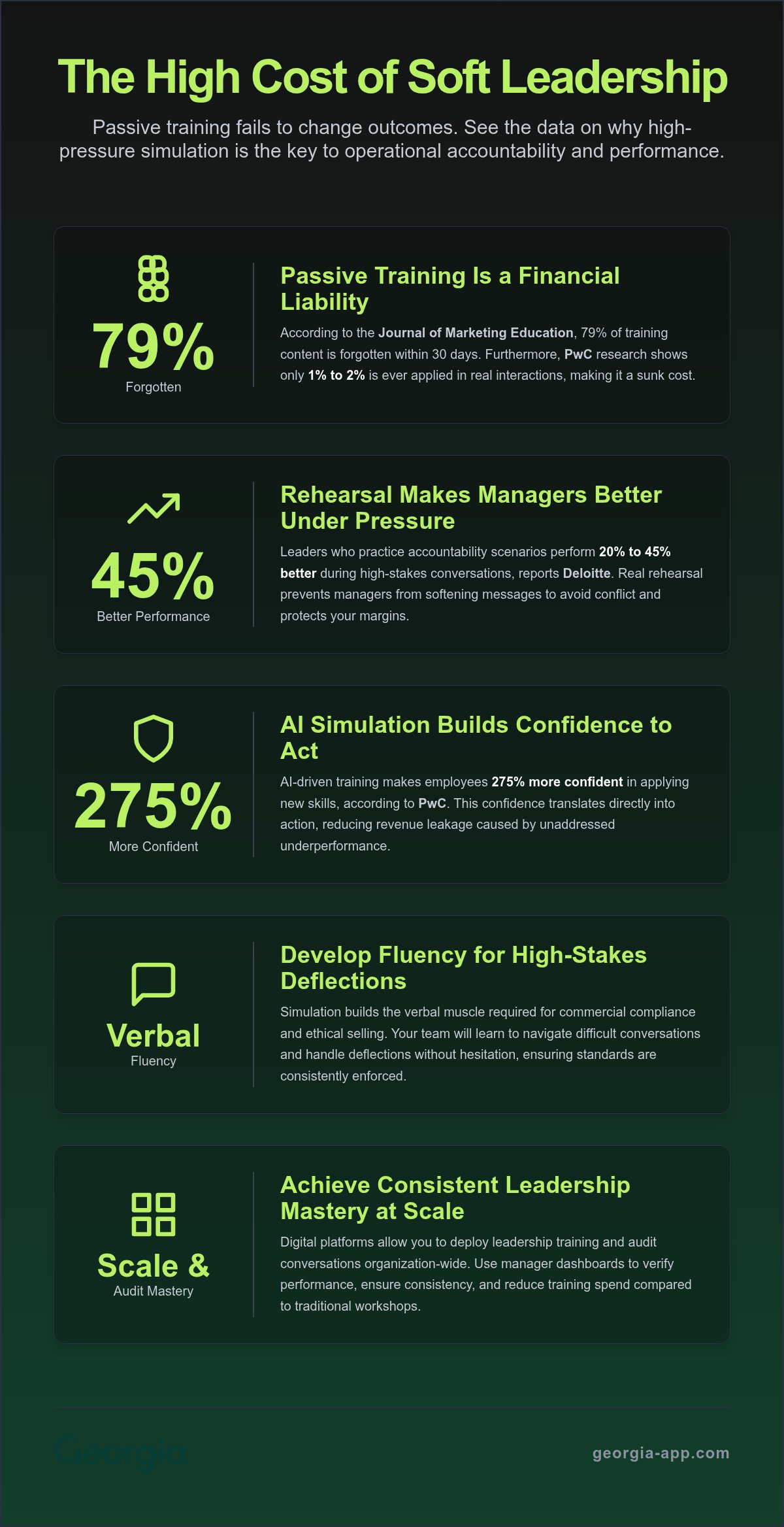
- Passive training is a financial liability because 79% of content is forgotten within 30 days according to the Journal of Marketing Education. PwC research shows only 1% to 2% of training is ever applied in real interactions.
- Practicing accountability role play scenarios for leaders makes managers 20% to 45% better under pressure according to Deloitte. Real rehearsal prevents leaders from softening messages to avoid conflict.
- Simulation builds the verbal fluency required for commercial compliance and ethical selling. Your team will learn to handle high-stakes deflections without hesitation or friction.
- AI-driven training makes employees 275% more confident in applying new skills according to PwC. This confidence reduces revenue leakage caused by unaddressed underperformance.
- Digital platforms scale leadership mastery and allow you to audit conversations through a manager dashboard. You can achieve these results while reducing training spend compared to traditional workshops.
Stop Relying on Passive Leadership Training Models
Passive leadership training is a financial leak. You spend capital on workshops that provide a temporary morale boost but fail to change operational outcomes. Research from the Journal of Marketing Education shows that 79% of what leaders learn is forgotten within 30 days. This is a structural failure in your development pipeline. You are paying for information that never reaches the job site.
Traditional methods prioritize attendance over execution. PwC research indicates that only 1% to 2% of training content is ever applied in real interactions. You are buying completion certificates while your site managers continue to soften their messages. Implementing accountability role play scenarios for leaders ensures a transition from theoretical knowledge to daily operational practice. Practice prevents managers from reverting to avoidant behaviors when conflict arises.
Soft leadership is a liability in the building materials industry. When a plant manager fails to address underperformance, production schedules slip and margins erode. You solve a performance crisis by building the verbal muscle of your leadership team through consistent practice. Consistent rehearsal protects your revenue from the costs of unaddressed incompetence.
Confront the 79% Retention Failure Rate
The forgetting curve is a direct cost to your management team. Classroom environments fail to simulate the stress of a real performance review. You must prepare managers to perform under pressure by moving beyond slide decks. The gap between knowing what to say and saying it correctly is where revenue is lost. Proficiency is the result of high-stakes repetition.
Role-playing in training helps bridge this gap by simulating real-world friction. Most training fails because it lacks the heat of a live site conflict. Managers must practice the specific language of accountability to avoid reverting to corporate pleasantries when the pressure rises. High-pressure simulation forces them to navigate deflections and excuses in a controlled environment before they face the real thing.
Measure Behavior Change Instead of Attendance
Stop tracking attendance and start measuring verbal performance. Completion certificates are vanity metrics that hide inconsistent standards across your sites. Attendance records track presence. They fail to validate the ability to lead a difficult conversation. You need data that proves your managers can hold the line on safety, quality, and output.
Regular use of accountability role play scenarios for leaders provides the necessary rehearsal to ensure standards are met. You must track the frequency of these rehearsals across every plant and department to ensure consistency. Use the AI Role-Play Platform to audit these conversations. Performance is a measurable metric. It is a verifiable data point. When you quantify verbal fluency, you can identify which leaders are assets and which are liabilities.
Rehearse the Underperformance Conversation Under Pressure
Theoretical knowledge vanishes when a site supervisor faces an aggressive subordinate. Deloitte reports that leaders who practice under pressure perform 20% to 45% better during real-world interactions. You cannot rely on a manager's instinct to carry a difficult conversation. High-pressure rehearsal is the only way to ensure your performance standards are met without compromise.
Accountability fails when managers soften the message to avoid interpersonal friction. Rehearsing the specific language of accountability reduces this urge. It replaces hesitation with a structured sequence of facts. This mechanical approach removes the emotional variability that leads to inconsistent performance across different sites.
Practice Addressing Missed Deadlines Without Softening
Effective accountability conversations follow a rigid sequence to prevent the employee from hijacking the narrative. Use these steps during accountability role play scenarios for leaders to build consistency:
- State the specific performance gap using objective data points.
- Describe the operational impact of the missed deadline on the rest of the team.
- Ask the employee to explain the discrepancy without accepting vague excuses.
- Agree on a specific corrective action and a follow-up date for review.
This structure prevents the conversation from devolving into a debate about feelings. It keeps the focus on the bottom line. Managers who master this sequence stop bidding and praying for better results and start enforcing them.
Use AI to Simulate Employee Pushback and Deflection
Underperforming staff often use deflection tactics to shift blame or create confusion. Managers must practice handling these diversions before they happen on the plant floor. AI simulation allows you to program a defensive persona that pushes back against the manager. This creates a safe but high-stakes environment to test their composure.
Repeated exposure to these simulations leads to a 60% faster time to proficiency. Managers learn to maintain professional authority even when an employee attempts to deflect. This level of verbal fluency is impossible to achieve through passive reading or traditional workshops. You can schedule a demonstration to see how simulated stress prepares your team for real-world conflict.
Enforce Accountability Scenarios for Compliance and Ethical Selling
Compliance failure in the concrete and aggregates sector is a terminal risk. On May 21, 2026, the Department of Justice required Taiheiyo Cement to divest plants to settle antitrust concerns. More recently, on August 7, 2026, the DOJ filed a civil merger case against CRH plc in Tennessee. This level of scrutiny means accountability role play scenarios for leaders must prioritize commercial ethics over sales volume. You cannot afford a sales rep who prioritizes a quota over a legal requirement.
Managers must move beyond quarterly check-box training. PwC research indicates that simulation-trained employees are 275% more confident in applying new skills. This confidence is critical when a rep must decline a lucrative but improper request from a major account. Rehearsal ensures that ethical selling is an operational habit rather than a theoretical concept.
Simulate Responses to Improper Requests from Customers
Practice the exact phrasing required to decline an improper request from a high-volume client. Sales teams often feel pressure to accommodate special requests that violate pricing or competition policies. Rehearsal builds the verbal fluency to say no without losing the relationship. Every rep must know how to pivot the conversation back to standard commercial terms while documenting the interaction for the manager dashboard. You must verify that reps can handle these high-stakes moments without hesitation or concession.
Practice Escalating Concerns Through Proper Channels
Role play the conversation between a rep and their manager regarding a suspected violation. Barriers to reporting often stem from a lack of practice or fear of retaliation. You must verify that all leaders follow a standardized escalation protocol across every site. This consistency prevents information leakage and ensures that risks reach the executive level before they become liabilities. Managers must identify the common barriers that prevent employees from reporting ethical dilemmas:
- Reps often fear losing a key account commission if they refuse an improper request.
- Employees frequently experience confusion regarding the specific boundaries of commercial policy.
- Team members feel pressure from peers to ignore minor infractions to maintain site harmony.
- Staff members lack trust in the management response and fear retaliation for reporting.
Addressing these barriers through simulation ensures that your team acts with precision when the stakes are highest. Use the AI Role-Play Platform to verify that these protocols are being followed in every department. Standardized responses eliminate the friction that occurs when managers interpret rules differently across various sites.
Build Verbal Fluency to Handle High-Stakes Deflections
Verbal fluency is the ability to speak clearly and decisively without hesitation during a conflict. It is a mechanical skill that separates effective leaders from those who avoid friction. Most managers fail because they cannot move past the awkward phase of a confrontation. PwC research shows that participants feel 275% more confident when they use simulation compared to classroom-only training. This confidence allows them to enforce standards without hesitation.
Standardizing these interactions ensures every leader uses the same methodology across the firm. You cannot allow different versions of accountability at different plants. Consistency is the foundation of operational excellence. Using accountability role play scenarios for leaders provides the blueprint for this consistency across your entire organization.
Master the Transition from Excuse to Execution
Leaders must neutralize deflections quickly to maintain control of the conversation. If a manager allows an excuse to stand, they validate the operational failure. Rehearsal prepares your team for common deflection patterns by providing a structured response for every excuse. This preparation ensures that the manager remains the authority figure throughout the interaction.
When an employee attempts a blame shift, the manager must acknowledge the external factor but return the focus to individual responsibility. Vague commitments require a demand for specific dates and numbers instead of accepting a promise to try harder. The silent treatment is neutralized by using strategic pauses to force a substantial answer. Aggressive pushback is handled by maintaining a calm, data-driven stance to de-escalate the interaction.
Reduce Time to Proficiency Through Repetitive Simulation
Skill building requires high-frequency repetition. Annual workshops fail to build the muscle memory necessary for real-world execution. Practice sessions must be short and frequent to maximize retention. Focus on one specific scenario per week to ensure deep mastery. This methodical approach leads to a 60% faster time to proficiency according to Deloitte.
The manager dashboard allows you to audit performance and provide targeted coaching. It identifies which leaders are struggling with specific deflections and which are ready for higher-stakes scenarios. This dashboard replaces intuition with objective data regarding site-level leadership. You are auditing verbal performance with the same precision as a financial report.
Schedule an AI simulation demo
Adopt AI Role Play to Scale Leadership Mastery
Traditional workshops are a logistical bottleneck for organizations with multiple concrete plants or quarries. They require travel, significant downtime, and expensive facilitators. Switching to digital simulation eliminates these overhead costs. Organizations save approximately $12.6 K per 10-rep team when they replace traditional workshops with AI role-play. This transition turns a high-cost event into a scalable operational habit.
Workshops are a static solution to a dynamic problem. They provide a single point of data in a year of operational challenges. AI-driven simulation allows every manager to practice the same methodology without a trainer in the room. It ensures your core leadership framework is applied exactly as designed every time. You are replacing a one-time expense with a permanent capability.
Digital role-play provides a safe space for managers to make mistakes before they speak to their teams. This environment allows for the repetition necessary to achieve proficiency without risking employee relations. High-stakes conversations require a level of precision that only comes from repeated, simulated stress. You must provide your leaders with the tools to fail safely so they can succeed on the job site.
Eliminate Method Drift in Large Management Teams
Leadership standards often dilute as training moves from corporate headquarters to local plants. A methodology that works in the boardroom often fails on the plant floor because of inconsistent interpretation. You must prevent this method drift to maintain operational excellence. Every supervisor must use the same language and framework for accountability.
Standardizing accountability role play scenarios for leaders ensures your management method remains intact across different regions. When supervisors at different sites interpret accountability differently, you create a fragmented culture. This fragmentation leads to safety lapses and quality variances. Digital rehearsal removes the human variability from the training process to ensure a unified approach.
Provide Continuous On-Demand Feedback for Every Leader
Effective training requires a frequency that workshops cannot provide. Leaders can practice difficult conversations on their phones during downtime or between site visits. This on-demand access ensures that skills stay sharp and ready for immediate application. Managers receive immediate feedback on their tone, clarity, and adherence to company policy. You can visit Georgia's AI role-play platform to see how simulation scales leadership development across your entire firm.
Stop Bidding and Praying for Leadership Consistency
You can no longer afford to treat leadership as a soft skill. Passive training models fail because retention is non-existent. Implementing accountability role play scenarios for leaders transforms accountability from a vague concept into a measurable operational habit. Deloitte research shows that practicing under pressure makes leaders 20% to 45% better during real-world interactions. You reduce training spend by 84% while ensuring every site supervisor enforces the same commercial standards.
"Retention scores tripled in 60 days. Leadership stopped questioning the program." – VP Sales Enablement, B2B SaaS
Final Thought
You will now stop accepting inconsistent performance across your plants. You will replace vague workshops with high-frequency AI simulation. You will audit every leadership conversation through a data-driven dashboard. This shift ensures that your margins are protected by a team that speaks with authority and precision. You are moving from theoretical knowledge to verifiable operational proficiency. Your leaders will handle conflict with the same rigor you apply to your financial audits.
Frequently Asked Questions
Why do traditional leadership role plays often fail?
Traditional role plays fail because they lack the high-pressure environment of real-world site conflict. Journal of Marketing Education research shows that 79% of what leaders learn is forgotten within 30 days of a classroom session. Most managers treat these exercises as corporate theater rather than operational rehearsal. Without simulated stress, the brain does not build the verbal muscle required to handle a defensive subordinate on a plant floor.
How many accountability scenarios should a leader practice each month?
A leader should practice at least four accountability role play scenarios for leaders each month to maintain verbal fluency. Weekly rehearsal prevents the skill decay that occurs when training is a quarterly event. Deloitte reports that practicing under pressure makes leaders 20% to 45% better during real interactions. Consistency is the only way to ensure that site managers don't revert to softening their messages during a performance crisis.
Can AI simulation really replace in-person leadership workshops?
AI simulation replaces workshops by providing scalable, measurable, and high-frequency practice that in-person sessions cannot match. Traditional workshops are expensive and often result in only 1% to 2% of content being applied according to PwC. Digital role-play allows for continuous on-demand rehearsal on a manager's phone. This method ensures your leadership framework is applied exactly as designed across every site without the travel costs of a live trainer.
What are the most common accountability scenarios for construction managers?
The most common scenarios involve addressing missed production deadlines, safety violations, and inconsistent quality standards. Managers must also practice declining improper customer requests and escalating ethical concerns through proper channels. These high-stakes moments require precise language to prevent margin leakage. Rehearsing these specific interactions ensures that supervisors prioritize commercial compliance and operational efficiency over maintaining social harmony with their teams on the job site.
How do you measure the ROI of accountability training?
You measure ROI by tracking the reduction in revenue loss from unaddressed underperformance and the decrease in training overhead. Organizations using AI simulation report an 84% lower training spend compared to traditional workshops. You can also monitor performance through a manager dashboard that audits verbal fluency and policy adherence. This data-driven approach treats soft skills with the same rigor as a financial audit to verify organizational behavior change.
How does digital role play improve confidence in new managers?
Digital role play builds confidence by providing a safe, repetitive environment to fail before facing a live team. PwC research indicates that participants feel 275% more confident when using simulation compared to classroom-only training. New managers use these scenarios to master the transition from excuses to execution. This rehearsal cuts time-to-proficiency by 60% and ensures that your newest leaders can hold the line on company standards.
What is the best way to handle an employee who deflects accountability?
The best way to handle deflection is to acknowledge the external factor briefly and immediately return the focus to individual responsibility. Leaders must avoid the trap of debating excuses. Require specific dates and numbers instead of accepting a vague promise to try harder. Maintaining a calm, data-driven stance prevents the conversation from becoming emotional. This structured approach ensures that the manager stays in control of the narrative and the outcome.
How can I standardize accountability across multiple business locations?
Standardization is achieved by deploying a unified AI role-play platform that delivers the same methodology to every supervisor. This eliminates the method drift that occurs when training is filtered through different regional managers. Every leader practices the same accountability role play scenarios for leaders to ensure a consistent experience for every employee. A centralized dashboard allows executive leadership to verify that standards are being upheld across all plants and departments globally.