

Every delayed call leaves a prospect untouched and makes pipeline activity harder to forecast. Cold calling anxiety solutions start with identifying what triggers the delay: uncertainty about what to say, fear of rejection, or pressure to perform. Each trigger disrupts a different part of the conversation.
Telling reps to make more calls won’t fix a weak opening or help them regain their focus after a blunt objection. They need practice with the moments they avoid, before those moments happen with a prospect. Rehearsal gives managers a practical way to address call reluctance as an execution gap.
This article shows you how to diagnose the trigger, compare fixes by the behavior they change, and build repeatable practice into your sales workflow. You’ll see how targeted scenarios, including self-paced AI role-play, can help reps rehearse challenging conversations and strengthen their performance under pressure.
Key Takeaways
- Diagnose whether uncertainty, rejection, or live-call pressure is driving avoidance before choosing a fix.
- Prepare each call with a clear objective, relevant account context, and flexible prompts that leave room to respond.
- Match cold calling anxiety solutions to the behavior reps need to practice, since dialing tools organize activity but do not rehearse conversations.
- Use a repeatable cycle of scenario practice, focused feedback, a retry, and application on real calls.
- Build rehearsal into existing team routines and track observable call behaviors alongside activity measures.
Diagnose the Cold-Call Anxiety Trigger Before Prescribing a Fix
Delayed prospecting leaves contractors, buyers, dispatchers, and project contacts untouched. Uneven call activity also makes it harder to qualify demand and forecast pipeline. Generic confidence advice won’t identify which behavior is getting in the rep’s way.
Call reluctance may come from uncertainty about what to say, anticipated rejection, or pressure during a live conversation. Call anxiety is an observable barrier to repeatable sales activity, shown in the moments a rep avoids, delays, or struggles to handle.
Workplace call reluctance alone doesn’t establish a clinical condition. For broader context, see this overview of social anxiety disorder.
Separate preparation gaps from rejection concerns
Look for observable patterns: postponed dialing, repeated rewriting of notes, or delayed follow-up. Ask which moment creates friction: dialing, opening, questioning, or handling a no. If the rep keeps rewriting an opener, the issue may be uncertainty about the message. If they start calls but struggle after an objection, the practice target is likely the response itself. Treat the answer as a work behavior to investigate, not evidence of personality or a clinical condition.
Find the pressure point in construction-related prospect calls
Pinpoint a recent moment. Did an unfamiliar account make the rep hesitate, or did they lack confidence in the offer or the next question? Ask them to name the exact point where the call stalled. For example, a rep may be comfortable reaching a buyer but unsure how to explore a change in material requirements. That detail gives you a specific scenario to address through preparation or rehearsal.
Prepare the Call Around a Clear Objective and a Few Flexible Prompts
Prepare for the next conversation, not every possible outcome. Set a clear objective, review the account context, then choose an opening and a few questions that fit the prospect’s role. For example, a rep contacting an aggregates account could aim to learn how the prospect handles an upcoming change in demand. That objective gives the rep a reason for calling and a direction for the conversation without assuming the prospect’s answer.
Set one achievable objective for each call
Choose an action the rep controls, such as asking about current requirements or identifying the right contact. A prospect’s decision or availability sits outside that control. Link the call objective to a practical next step: clarify a requirement, share relevant information, or determine who should be involved.
A useful prompt gives the rep direction; a word-for-word script gives them a line to recite. Flexible prompts leave room to respond when the prospect introduces new information. Before dialing, the rep should be able to state the call’s purpose in one sentence and identify the question that will help move toward it.
Build an opening that sounds prepared, not memorized
Prepare a concise reason for calling that connects to the account, then draft two relevant questions. One can establish context; the other can follow the prospect’s answer. Add a transition for common disruptions: ask to reconnect when the prospect is busy, clarify their concern if they’re skeptical, or close politely if there’s no fit.
Personalized, self-paced practice can help reps rehearse these scenarios. AI role-play practice gives sales teams a way to practice high-pressure communication. The APA’s overview of Cognitive Behavioral Therapy (CBT) provides broader context on structured approaches to thoughts and behaviors.
Compare Cold-Calling Anxiety Solutions by the Behavior They Change
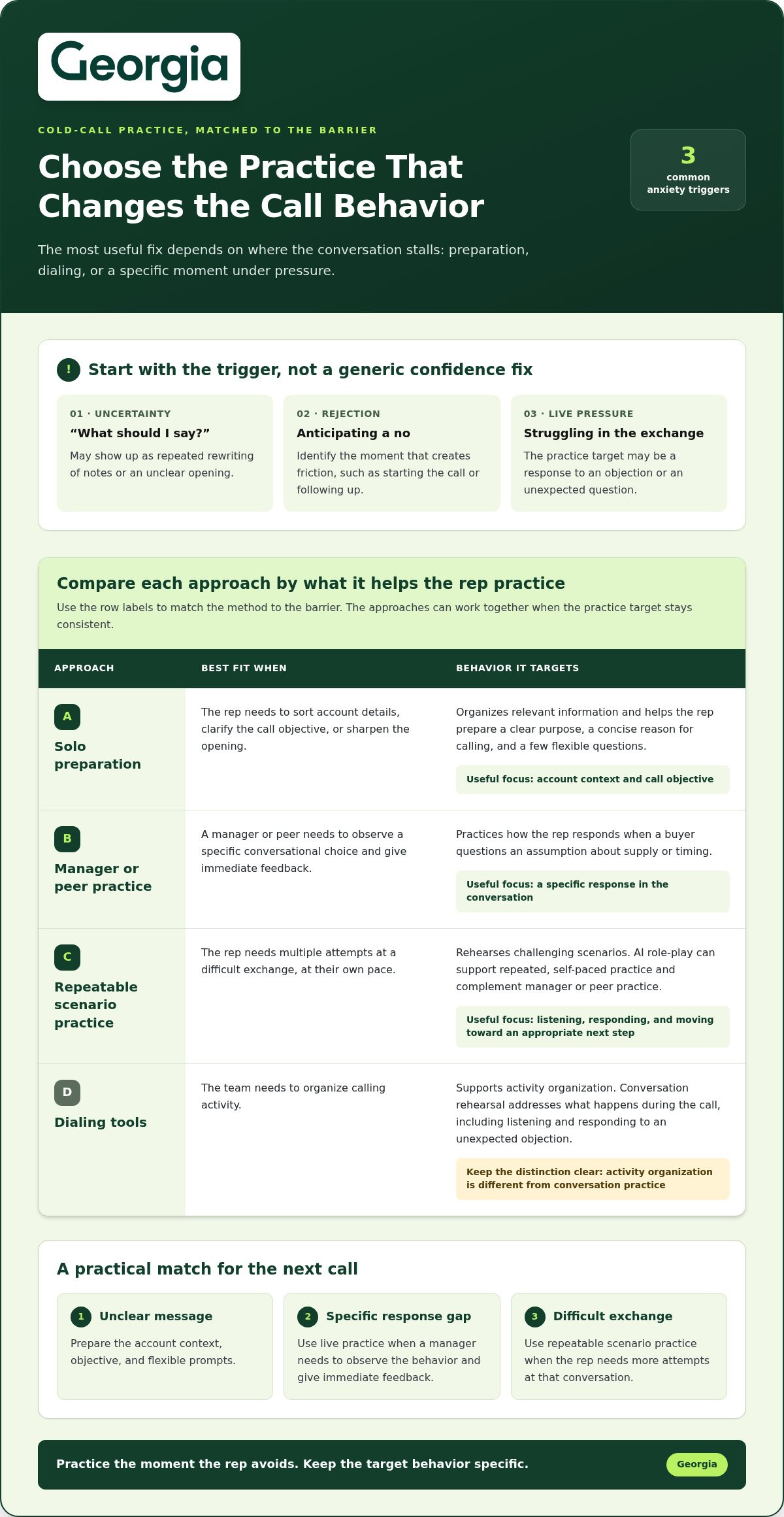
Choose practice by the behavior that needs work. A rep who lacks account context may need focused preparation. A rep who understands the offer but struggles to respond under pressure needs a chance to practice the exchange. When the issue is inconsistent activity, first identify whether the barrier is preparation, the act of dialing, or a particular point in the conversation.
Match the intervention to the trigger
Solo preparation helps reps organize relevant information and clarify their opening. Manager or peer practice lets them examine a conversational choice, such as how to respond when a buyer questions an assumption about supply or timing. Repeatable simulations give reps room to rehearse challenging scenarios at their own pace. Each option serves a different need, so match the method to the barrier rather than prescribing one fix for everyone.
Use solo preparation when the rep needs to sort account details or sharpen the call objective. Use live practice when a manager needs to observe a specific behavior and give immediate feedback. Use repeatable scenario practice when the rep needs multiple attempts at a difficult exchange. These methods can work together, with the practice target kept consistent across each format.
Distinguish call-volume tools from conversation practice
Dialing tools can organize calling activity. Rehearsal targets what happens in the conversation: listening, responding, and moving toward an appropriate next step. More activity alone won’t prepare a rep for an unexpected objection.
Use the practice format your team can sustain. AI role-play practice supports repeated, self-paced scenario work. It can complement manager or peer practice when reps need additional opportunities to work through high-pressure conversations. The useful comparison is whether the format helps reps practice the exact behavior they need on an upcoming call.
Build a Short Rehearsal Routine for the Calls Reps Avoid
Practice works when it targets a real call moment and gives the rep a chance to try again. A long, unfocused role-play can reproduce pressure without improving performance. Keep the routine short, specific, and connected to conversations your team actually handles.
Use the same cycle each time: choose a scenario, rehearse it, give focused feedback, retry, then apply the learning on a call. That structure gives managers a repeatable way to turn cold calling anxiety solutions into observable practice, without treating a difficult call as a personal failing.
Rehearse a realistic prospect response
Pick one difficult moment from the rep’s recent calls. A buyer may say they have no time, or a contractor may question why you’re calling. Set the context, state the prospect’s first response, and let the rep handle that moment. Keep the scenario close to your team’s actual conversations so the practice transfers to the next call.
After the first attempt, pause and identify what happened. Then have the rep try again with one adjustment. The retry matters: it turns feedback into a behavior the rep can test, rather than advice they’re expected to remember later.
Make feedback specific enough to use on the next call
Describe the behavior before recommending a change. For example: “You answered the objection before checking what the buyer meant.” Then select one target, such as asking a clarifying question before responding. Avoid correcting the opening, pace, tone, and follow-up all at once. Too many targets make the next attempt harder to execute.
Run the scenario again and listen for that one adjustment. If the rep asks the clarifying question, move the practice forward to the buyer’s answer. If they miss it, reset and retry. Self-paced communication practice can support repeated scenario rehearsal at the rep’s own pace.
Bring real call outcomes into the next practice round. If a prospect ended the call after a vague opening, build a scenario around making the reason for calling clearer. If the rep reached the right contact but failed to learn what happens next, practice a relevant follow-up question. Describe the call and the behavior, not the rep as “bad at calls.” That keeps the review useful and gives the next rehearsal a concrete target.
Apply the adjustment on a live call, then note what the prospect did and what the rep tried. The outcome may vary; the purpose is to gather a clearer example for the next practice cycle, not to promise a particular result. Over time, this gives managers a consistent way to connect rehearsal with day-to-day sales activity.
Turn Cold-Call Practice into a Team System That Managers Can Sustain
Practice loses value when it happens only after a difficult call or when a manager has spare time. Set a recurring rhythm inside an existing sales meeting or call workflow, then keep the routine consistent. Managers can select a scenario from recent calls, focus the team on one observable behavior, and carry that target into the next practice round.
Choose scenarios that reflect current work across building materials, concrete, aggregates, and construction sales. A rushed buyer, a skeptical contractor, or a project contact who gives an unexpected answer can each expose a different skill gap. Rotate the scenario based on what reps are encountering, rather than repeating a generic role-play that no longer reflects the calls they make.
Make progress visible without reducing people to call counts
Call volume shows activity. It does not show whether a rep prepared, opened clearly, listened, or followed through. Track those behaviors alongside activity measures, and keep them separate. A rep may place calls consistently while still struggling to ask a useful question or respond to an objection.
Use the same criteria in practice and real-call reviews. If the team is working on listening, look for whether the rep responds to what the prospect actually said. If the target is follow-through, check whether the agreed next step was handled. These observations help managers decide what to rehearse next. They don’t prove that anxiety has decreased, and activity totals alone can’t establish conversational readiness.
Give each manager a clear role in the process: select a relevant scenario, identify one practical improvement, then check whether the rep applies it in practice and on subsequent calls. Keep the review focused on observable actions, not labels about confidence or personality. When pressure centers on objections, negotiation practice can also address how reps respond, clarify the prospect’s concern, and keep the conversation productive. Link that work to your wider sales communication practice approach.
Final Thought: Rehearse the Moment Before It Costs the Conversation
Before the next call block, choose one difficult moment from a recent conversation and define the behavior you want the rep to test. Build a short rehearsal into an existing team routine, give feedback on that behavior, and review what happens on the next call. Targeted rehearsal gives reps a practical response to try. It does not guarantee a particular prospect reaction or business outcome. Consistent practice gives managers a clearer basis for the next adjustment.
Make the Next Call Block a Deliberate Test
Before the next call block, choose one behavior you want the team to make more consistent. Define what you’ll listen for, then use the next review to decide whether that behavior needs another practice round or a different approach. This turns cold calling anxiety solutions into an operational decision grounded in what reps do during real conversations.
Keep the standard clear and fair. Reps need a specific action they can attempt, managers need a way to observe it, and the team needs space to learn from outcomes that vary. You can’t control how a buyer responds. You can make preparation and practice a deliberate part of the sales workflow.
Georgia provides personalized, self-paced communication practice, including high-pressure sales conversations. A demo can show how its AI role-play platform fits into your team’s training priorities.
Start with one call moment. Give your team a clear behavior to test, then build from what you learn. Progress begins with a practical next step.
Frequently Asked Questions
Is cold-calling anxiety common among salespeople?
Yes, call reluctance is a workplace challenge for sales teams, and it can show up differently from rep to rep. One person may hesitate before dialing because they’re unsure how to begin; another may struggle after a prospect declines. Focus on the behavior, rather than assigning a clinical label. Identify the specific moment causing delay, then choose a practical preparation or practice response for that situation.
Can a cold-call script reduce anxiety?
A short, flexible prompt can reduce uncertainty about how to begin and what to ask next. A rigid script may leave a rep scrambling when a prospect raises an unexpected concern or changes the subject. Prepare a clear purpose for the call, a concise opening, and a few relevant questions. Treat those as reference points the rep can adapt, rather than lines they must deliver word for word.
How should a rep handle rejection during a cold call?
Separate the prospect’s response from a judgment of your ability as a rep. A buyer declining a conversation may still provide useful information, such as timing or a preference for another contact method. Record what’s relevant, end respectfully, and identify one adjustment for the next call. Address a specific objection when it merits a response, while recognizing that some prospects will simply decline.
What should a sales manager say to a rep who avoids cold calls?
Describe what you’ve observed and ask which part of the call feels hardest. For example: “I noticed the calls to new project contacts keep moving to later in the day. What’s making that first step difficult?” Agree on one manageable action, such as reviewing account notes or rehearsing an opening. Specific support gives the rep something practical to try; pressure to dial more offers no guidance on the barrier.
Can role-play help sales reps prepare for cold calls?
Role-play gives reps a chance to test an opening or response before using it with a prospect. Practice is most useful when the scenario reflects an actual sales conversation and feedback focuses on a clear behavior. Georgia’s AI role-play platform supports personalized, self-paced scenario practice for sales teams handling high-pressure conversations. It can complement manager input by giving reps another way to rehearse, while managers continue to guide the team’s practice priorities.
How can a team tell whether its cold-call anxiety interventions are useful?
Review observable behaviors over time alongside existing activity measures. You might note whether reps arrive prepared, open calls clearly, ask relevant questions, and follow through on agreed actions. These observations can help managers refine practice scenarios and coaching targets. They don’t prove anxiety has disappeared or establish that an intervention caused a revenue change. Use the evidence to guide development, not to rank reps by confidence.
Should sales reps make cold calls first thing in the morning?
A morning call block may help some teams establish a routine, while another schedule may fit your prospects and operating demands better. Test a consistent time that works with your team’s workflow, then observe whether reps prepare and begin calls more reliably. Compare the pattern across the schedule your team actually uses. No single time works for every sales team, so treat scheduling as an operational choice rather than a universal anxiety fix.