

Leadership role play exercises help managers prepare for conversations that affect team performance. Delayed feedback leaves performance gaps unresolved, while unclear accountability makes follow-through harder. Rehearsal gives managers a chance to plan their words and actions before a difficult exchange affects day-to-day operations.
These conversations matter, but practice can feel removed from operational pressure. Managers may have little opportunity to rehearse before the stakes are real, so preparation varies from one person to the next.
Use realistic scenarios, observable behaviors, and repeatable practice to prepare managers for consequential exchanges. The goal is practical: give managers a clear plan and specific actions to use on the job.
Key Takeaways
- Use leadership role play exercises to rehearse consequential conversations before they affect team performance.
- Build each scenario around a decision, a real workplace tension, and a clear outcome.
- Practice responses to underperformance, missed commitments, conflict, and changing priorities.
- Debrief with specific words and actions so managers can identify behaviors to adjust.
- Make rehearsal repeatable by choosing an upcoming conversation and defining the behavior to practice.
Leadership Role Play Exercises Expose the Conversations Managers Avoid
When feedback is delayed, performance gaps continue. Unresolved conflict complicates coordination, and unclear accountability leaves commitments open to interpretation. Each can affect the next operational decision or handoff.
A leadership role play exercise lets a manager rehearse a workplace conversation before handling it on the job. The wider practice of role-playing applies to training and education. In leadership development, its practical value is testing language and responses against situations managers recognize. Focus the rehearsal on a conversation the manager needs to handle, with a defined outcome to work toward.
Start with the conversations that create operational friction
Build scenarios from missed commitments, recurring performance gaps, or team conflict. A missed handoff may delay a decision, while repeated errors can make another team revisit its work. Use responsibilities participants encounter in their day-to-day work, and give the scenario a specific point of friction.
Set a behavioral objective before the role play begins
Choose one behavior, such as stating a clear expectation. Make it observable: an observer can listen for the manager to name the missed commitment and agree on a next step. Replace broad goals like “be a stronger leader” with evidence participants can hear or see.
Build Leadership Role Play Exercises Around Decisions, Not Scripts
Build each scenario around a decision the manager must make. Add pressure from competing priorities, limited time, or incomplete information. Then let the employee respond plausibly, so the manager has to listen and adapt instead of recalling fixed lines.
- Select a moment: Choose a conversation managers face, such as explaining a schedule change.
- Define a tension: Give each person a credible concern, such as maintaining coverage while managing a prior commitment.
- Add a response: Let the employee raise a question or constraint that requires the manager to adapt.
- Set an outcome: Decide what the conversation should establish without prescribing exact dialogue.
Give each participant a clear role and purpose
Tell the manager what responsibility they hold, and give the employee a real concern or an alternative point of view. Keep the background brief so participants can start quickly. One learning objective helps keep unrelated skills from crowding out the behavior you want to practice.
Use decision points to test leadership behavior
Add a moment that requires the manager to clarify, challenge, or adjust. Several responses may work. The practice should test judgment, not recall. For example, the manager could ask a question, explain a constraint, or explore an alternative. Assess the response against the behavioral objective and intended outcome.
Personalized, self-paced simulations help teams repeat scenarios and test different responses. Explore leadership conversation simulations as a way to build repeatable practice into leadership development.
Use These Leadership Role Play Exercises for High-Stakes Conversations
A scenario earns its place when it prepares a manager for a decision that affects coordination, ownership, or the next operational step. Keep the setup specific and the practice focused. Adapt the situations below to building materials, concrete, aggregates, and construction teams by changing the roles, handoff, and immediate pressure.
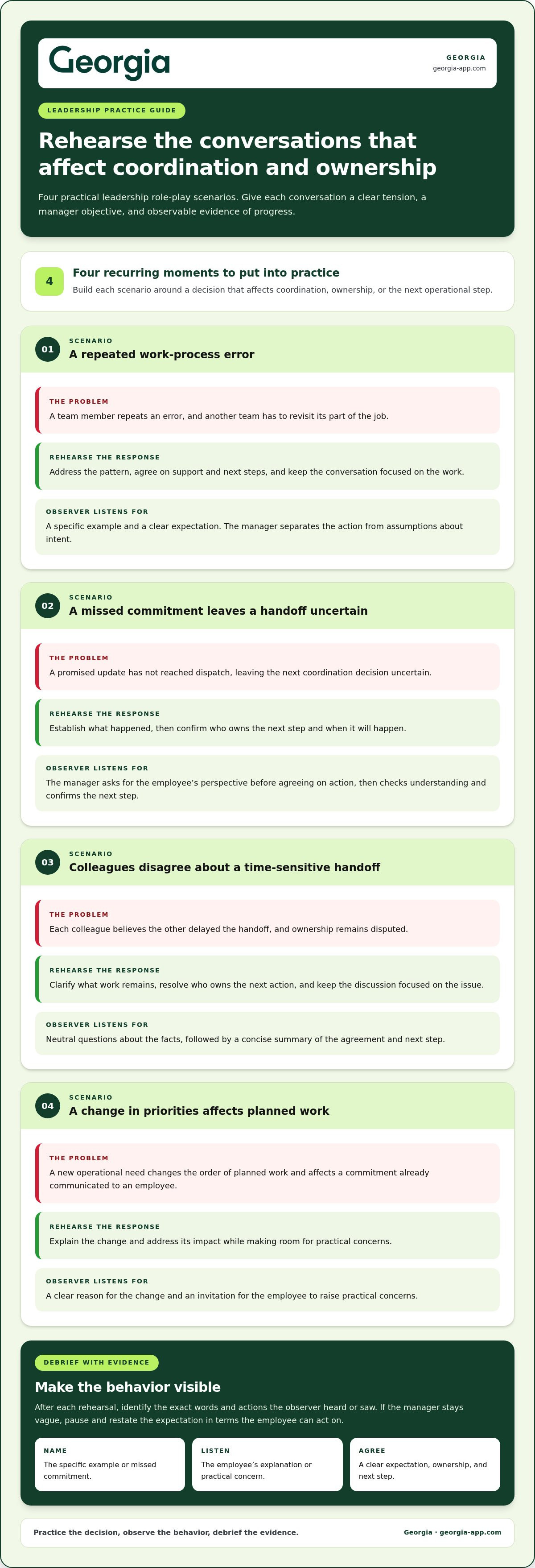
- Underperformance: A team member repeats a work-process error that requires another team to revisit its part of the job; the manager’s objective is to address the pattern and agree on support and next steps, while an observer listens for a specific example and a clear expectation.
- Missed commitment: A promised update has not reached dispatch, leaving the next coordination decision uncertain; the manager’s objective is to establish what happened and confirm ownership and timing, while an observer notes whether the manager asks for the employee’s perspective before agreeing on action.
- Colleague conflict: Two colleagues disagree about who owns a time-sensitive handoff, and each believes the other has delayed it; the manager’s objective is to clarify the immediate work and resolve ownership, while an observer watches for neutral questions that keep the discussion on facts and next steps.
- Changing priorities: A new operational need changes the order of planned work and affects a commitment already communicated to an employee; the manager’s objective is to explain the change and address its impact, while an observer listens for a clear reason and an invitation to raise practical concerns.
Rehearse an underperformance or accountability conversation
Use the first two scenarios to practice accountability without turning the exchange into an accusation. Give the employee a credible explanation: they may have misunderstood who owned the update, lacked a key detail, or faced a competing task. The manager needs to describe the gap with a specific example, hear the explanation, and agree on what happens next.
Observe whether the manager separates the action from assumptions about intent. Listen for a clear statement of responsibility, a question that checks understanding, and an agreed next step. If the manager stays vague, pause and ask them to restate the expectation in terms the employee can act on.
Practice conflict and changing-priority conversations
In the conflict scenario, give each colleague a reasonable account of the disputed handoff. The manager needs to establish what remains outstanding, clarify who will take the next action, and keep the exchange focused on resolving the issue. Watch for balanced questions and a concise summary of the agreement.
For the changing-priority scenario, introduce the shift after the manager has explained the original plan. This tests whether they can communicate the decision, acknowledge its effect, and confirm the revised next step. Keep each exercise centered on one observable behavior. Repeat the scenario with a different employee response to see whether the manager can adapt while keeping the outcome clear.
Debrief Leadership Role Play Exercises With Observable Evidence
A role play loses value when feedback stops at “that went well” or “you sounded defensive.” Those comments give a manager little to change. Debrief leadership role play exercises against the objective, using words and actions participants can recall and apply in a real conversation.
Use this sequence while the exchange is still fresh:
- Self-assessment: Ask the manager which moment changed the direction of the conversation and what they noticed in their own response.
- Observed behavior: Have observers cite a specific phrase, question, pause, or action tied to the exercise objective.
- Alternative response: Identify one different behavior the manager could try at that moment.
- Workplace commitment: Name an upcoming conversation where the manager will apply that adjustment.
Keep the feedback narrow. If the objective was to clarify ownership, discuss whether the manager named a responsible person and confirmed the next step. Avoid personality judgments such as “you’re too passive.” Describe the evidence instead: “You asked who would send the update, but you didn’t confirm when it would be sent.” That gives the manager an action to adjust.
Turn feedback into one observable adjustment
Start with the participant’s view: “Which moment changed the direction of the conversation?” Then invite observers to share what they heard or saw before anyone proposes a fix. An observer might note that the manager moved to a solution before hearing the employee’s concern.
Choose one adjustment, then replay that moment. The manager might ask a clarifying question before proposing the next step. Rehearsing the revised response immediately tests whether the adjustment is clear and practical. Keep feedback tied to the exercise objective.
Carry the practice into the next real conversation
Ask each manager to identify an upcoming conversation where the target behavior fits. Afterward, use a short reflection prompt: “What did I say or do, how did the other person respond, and what will I adjust next time?” This connects practice to the demands of high-stakes communication training for leaders.
Use the reflection to select the next scenario. If the manager clarified ownership but struggled to address a competing concern, build the next exercise around that decision point. Use practice results to guide development and select specific behaviors for further practice. Personalized, self-paced simulations help teams repeat relevant conversations and refine behaviors through leadership development practice.
Final Thought: Make Leadership Role Play Exercises a Repeatable Practice
Choose one consequential conversation managers will face soon. Define the behavior they need to demonstrate, then repeat the scenario as responsibilities and operational pressures change. Georgia’s AI-powered platform provides personalized, self-paced communication simulations for ongoing leadership practice. Build rehearsal into development so managers can prepare, reflect, and adjust before a difficult conversation.
Put the Next Difficult Conversation on the Practice Calendar
Your next consequential conversation is already taking shape. Choose one that matters to team performance, decide what the manager should do, and rehearse before the conversation happens. Carry that practice forward as roles, priorities, and team pressures change.
Leadership role play exercises become more useful when managers use them to prepare for real conversations. Start by identifying the next conversation and defining the behavior to practice. That gives managers a concrete action to apply to their work.
Make the next conversation a deliberate rehearsal, and give managers a clear starting point.
Frequently Asked Questions
What is a leadership role play exercise?
A leadership role play exercise gives a manager a structured way to rehearse a workplace conversation with another person acting in a role. The scenario gives both participants a reason to speak and respond, while a clear objective guides the practice. For example, a manager can rehearse delegating a task to an employee with competing responsibilities, then review whether the request made ownership clear.
How do you make leadership role play feel realistic?
Use a situation participants recognize and give each person a credible reason for their position. A manager might need to explain a revised customer commitment while a colleague raises a concern about what was promised earlier. Add a point where the manager must respond to new information. Keep background details limited to what affects the decision, and let the conversation develop through plausible replies instead of memorized lines.
Can leadership role play exercises work for experienced managers?
Yes. Leadership role play exercises can help experienced managers prepare for a new responsibility or examine a familiar conversation from another angle. For instance, ask a manager to delegate a task while making clear which decisions the employee can make independently. Set an appropriate practice objective, then invite feedback on the specific behavior. This respects the manager’s experience and gives them a concrete way to refine their approach.
How often should managers practice leadership conversations?
Set the cadence around the conversations managers need to handle and the time they have to apply what they practice. A team facing a new process may schedule rehearsal before managers explain the change. Another team may revisit a conversation after a recurring issue surfaces. Use those moments to decide when practice will be most relevant, and connect each session to a real responsibility.
What should observers look for during a leadership role play?
Observers should record evidence linked to the exercise objective. If the manager is practicing clear delegation, an observer could note whether the manager identified who owns the task and invited questions about the expected result. Brief notes help separate what happened from personal opinion. Afterward, compare observations with the objective and identify one behavior the manager can retain or adjust in a future conversation.
How can you adapt leadership role play for remote teams?
Remote teams can rehearse through a video or audio meeting, with participants joining from their usual work locations. Send role details beforehand so each person can prepare without exposing the other participant’s perspective. Ask observers to capture specific examples in notes, then discuss them after the scenario. Managers who cannot attend at the same time can use self-paced simulations to practice individually and revisit a conversation when their schedule allows.
How do you know whether a leadership role play exercise helped?
Check whether the manager used the intended behavior in a later workplace conversation. Ask for a specific example, such as how they clarified a decision or confirmed who would follow up. Compare that account with the exercise objective and note what the manager would change next time. One practice session cannot establish wider business impact on its own, so use an appropriate evaluation plan for broader program results.