

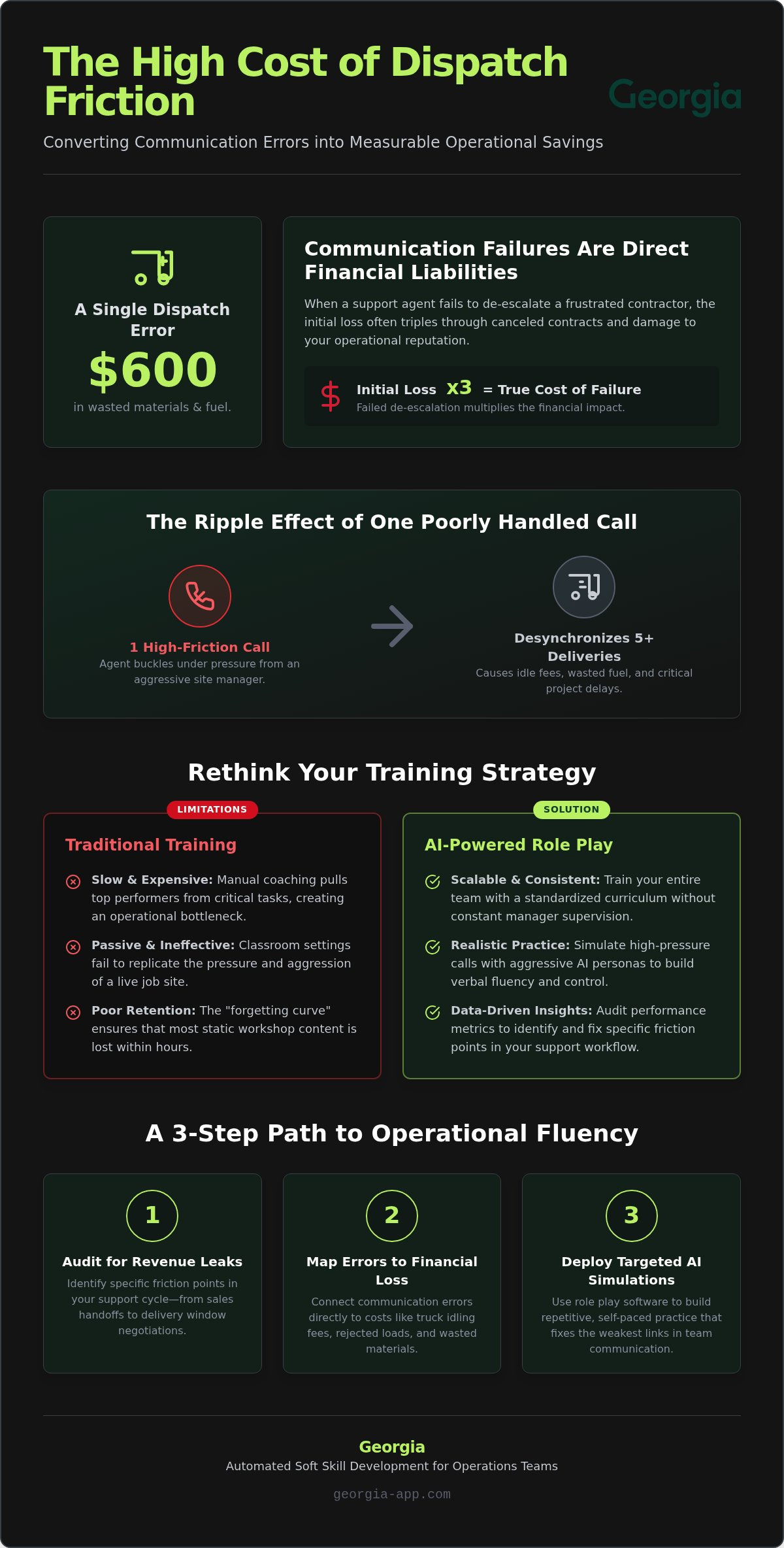
A single dispatch error in the concrete industry costs $600 in wasted materials and fuel. When a support agent fails to de-escalate a frustrated contractor, the loss often triples through canceled contracts. Implementing customer service role play software addresses these communication failures as direct financial liabilities on your balance sheet.
You understand that manual coaching pulls your best leads away from critical operations. It's impossible to monitor every new hire as they struggle through high-pressure calls. You require a system that identifies and fixes these errors before they impact your margins.
This article demonstrates how AI-driven simulations convert communication errors into measurable operational savings. You'll learn how these tools build verbal fluency and prepare teams for high-stakes interactions without constant manager intervention.
We'll examine the specific costs of support friction and the methods for implementing scalable training. This strategy ensures your team reaches operational fluency faster and maintains high performance standards.
Key Takeaways
- Communication failures in dispatch operations represent direct financial liabilities through wasted materials and truck time.
- You can use customer service role play software to simulate high-pressure interactions with aggressive AI personas before agents speak to live clients.
- Auditing verbal fluency and pressure response metrics allows you to identify specific friction points in your support workflow.
- Self-paced AI simulations reduce new hire ramp time by providing repetitive practice without requiring manager supervision.
- Converting communication errors into measurable operational savings provides a clear path to protecting your bottom line.
Communication Failures in Support Teams Create Direct Financial Liabilities
A communication breakdown is a line item loss on your balance sheet. In the concrete and aggregates industry, a single dispatch error often results in thousands of dollars of wasted material. When a truck arrives at the wrong site or with the wrong mix, your margins evaporate instantly. This represents a structural failure in your operations.
Soft skills directly impact your bottom line. Poor verbal execution leads to immediate operational waste. You must prioritize financial outcomes over corporate pleasantries when training your support staff. Every conversation is a financial transaction.
Manual coaching is a slow, expensive process. It fails to scale as your team grows. You cannot afford to pull your most experienced dispatchers away from the boards to provide one-on-one supervision. This creates an operational bottleneck that limits your capacity to handle higher volumes.
Audit Your Support Conversations for Revenue Leaks
Identify specific points in your support cycle where communication friction occurs. Focus on the handoff between sales and dispatch. Look at how agents handle delivery windows. Quantify the cost of every failed de-escalation. Every missed detail is a leak in your revenue stream.
Treat verbal fluency as a critical metric for operational efficiency. It is a measurable asset. Use customer service role play software to audit how your team handles these high-stakes moments. This data allows you to fix specific communication failures before they reach the job site.
Recognize the Limitations of Traditional Training Workshops
Classroom settings fail to replicate the pressure of a live dispatch call. Agents require environments that mimic the aggression of a job site. Traditional training is too passive. It lacks the intensity required for high-stakes support environments.
The forgetting curve ensures that most workshop content is lost within hours. Static training materials do not stick. Scalable training requires a digital infrastructure that allows for constant repetition. You need a platform that mimics the noise and stress of your actual operations.
Implementing customer service role play software provides this infrastructure. It allows your team to practice difficult conversations in a self-paced environment. This removes the need for constant manager intervention while ensuring every hire meets your performance standards.
Quantify the Cost of Verbal Friction in Dispatch Operations
Verbal friction is a mechanical failure in your dispatch chain. It occurs when an agent buckles under the pressure of an aggressive site manager. This failure leads to delayed responses. Unclear instructions result in concrete drying in the drum. You lose the load, the truck time, and the fuel. These are measurable financial hits to your daily operations.
Communication breakdowns often stem from a lack of situational control. An agent who cannot manage a high-stakes conversation will concede to unrealistic demands or provide vague timelines. This ambiguity creates a ripple effect across your entire fleet. One poorly handled call can desynchronize five following deliveries. High-stakes communication training for your leads eliminates these specific revenue losses.
Measure the time your team spends on call backs and dispute resolution. These are hours stolen from productive operations. Disputes regarding delivery times or product quality often trace back to a single verbal error. You are paying for the mistake and the time required to fix it. Precision communication turns a chaotic support desk into a reliable operational center.
Analyze the Mechanics of a Support Call
Break the conversation into specific tactical stages. Identify where the information flow breaks down. Look for structural failures in how agents convey technical mix specs or site directions. You must track the frequency of these communication errors with exact numbers. Audit your recordings to find the specific phrases that trigger site manager frustration.
Structural failures in support calls are often repetitive. An agent might consistently fail to confirm site access points or pour rates. These omissions lead to site congestion and idling fees. By isolating these stages, you can build targeted simulations in your customer service role play software. This precision allows you to fix the weakest link in the chain.
Map Communication Errors to Financial Loss
Establish a direct link between agent performance and operational expenses. Every minute of truck idling has a price. Every rejected load has a cost. Use this data to justify your investment in customer service role play software. Financial auditing of your conversations reveals the true cost of support friction.
Focus on reducing the friction that leads to customer churn. A contractor who feels ignored or misled will find a new supplier. You can audit your team's communication metrics to stop this leakage. Protecting your margins requires a rigorous approach to verbal fluency. High-stakes communication is a mandatory operational requirement.
Select Software That Simulates Real Dispatch Stress
Selecting the wrong training tool is a waste of capital. You need customer service role play software that mirrors the friction of your actual job sites. Stress-free simulations are expensive distractions. Effective training requires high-stakes scenarios that force agents to manage their physiological responses.
Real-world dispatching is loud, fast, and often confrontational. Your software must provide AI personas that mimic the aggression of an angry client. This creates a safe environment to fail before the financial stakes are real. Repetition in a controlled environment builds the muscle memory needed for live calls.
Evaluate AI Personas for Realism and Pressure
The AI must respond dynamically to agent input. Predictable scripts fail because real customers don't follow a teleprompter. Test the software for its ability to simulate high-stakes scenarios where the client is actively hostile. You need a system that requires vocal output and provides immediate, realistic pushback.
Avoid tools that rely on predictable or scripted responses. These "choose your own adventure" models don't build verbal fluency. They only teach agents how to click buttons. True training requires an agent to find their own words while a simulated site manager demands immediate answers.
Review the Analytics for Actionable Coaching Data
Look for software that provides an automated role play feedback loop. This data should highlight specific soft skills gaps in the team. Focus on metrics like response latency and the use of filler words during heated exchanges. These numbers tell you exactly where your team is losing control of the conversation.
Use these metrics to drive targeted performance improvements. If an agent's verbal fluency drops by 40% when a persona becomes aggressive, you have a specific training target. This turns coaching from a subjective opinion into a data-driven process. You can now audit communication with the same rigor as a financial report.
Prioritize platforms that offer self-paced soft skills practice for remote teams. This allows agents to rehearse difficult conversations during downtime between truck cycles. You achieve higher proficiency without scheduling a single meeting. Ensure the tool integrates into existing training programs without adding complexity. Your dispatchers already manage complex logistics software. The training platform must be accessible and require zero manual administration from your lead dispatchers.
Deploy Scalable AI Simulations to Reduce Ramp Time
A slow ramp time is a structural failure in your onboarding process. Every week a new hire spends shadowing is a week of unproductive overhead. You must accelerate this timeline by replacing passive observation with active simulation. Use customer service role play software to turn training into a high-speed production line.
Identify the most common communication failures in your current support team. Audit your recordings for missed site details, failed de-escalations, or incorrect mix confirmations. Load these specific scenarios into your customer service role play software. This ensures your new hires practice against the exact friction points that currently drain your margins.
Assign simulations to new hires before they handle live dispatch calls. This is your operational gatekeeper. Monitor the performance data to ensure every agent meets the fluency standard. You must verify their ability to maintain composure and clarity under stress. If they cannot handle a simulated angry contractor, they are not ready for a live dispatch board.
Standardize the Training Process Across All Locations
Standardize the training process across all regional offices. Human coaching is notoriously inconsistent. One lead dispatcher might prioritize speed while another focuses on technical detail. This variance creates a fragmented customer experience that damages your brand.
Use digital role play to ensure every agent receives the same quality of instruction. This eliminates the bias and fatigue associated with human-led sessions. You create a consistent baseline for communication excellence. Every employee operates from the same playbook regardless of their location.
Utilize Repetition to Build Muscle Memory
Muscle memory is the only defense against high-pressure communication failures. Repetition ensures soft skills stick when a site manager is demanding an immediate credit. Static manuals do not prepare agents for the physiological stress of a live conflict. They need reps.
Allow agents to practice difficult conversations in a safe digital environment. They build confidence through constant exposure to high-pressure scenarios. This preparation ensures they don't freeze during their first live interaction. High-frequency practice turns a hesitant new hire into a decisive operator who protects your bottom line.
Georgia Automates Soft Skill Development for Operations Teams
Georgia provides the AI role-play training platform needed to fix revenue leaks. It converts communication errors into measurable operational savings. The platform mimics high-pressure stress to improve verbal fluency. Your teams use Georgia to practice soft-skill conversations in a self-paced format.
Visit georgia-app.com to see how the platform reduces communication friction.
Integrate Georgia into Your Training Infrastructure
Manual coaching is a bottleneck for growing teams. Georgia scales practice without pulling managers off the floor. Every agent receives a personalized training path. These simulations ensure they practice the specific scenarios they encounter on the job.
Georgia provides the data needed to audit your team performance. You gain visibility into individual verbal fluency metrics. Targeted interventions replace broad, ineffective training workshops.
Stop Losing Revenue to Poor Conversations
Communication is a mechanical part of your business that requires maintenance. Structural failures in your support team lead to immediate margin erosion. Use customer service role play software to identify and repair these failures.
High-stakes conversations require the same level of auditing as your financial records. You must treat verbal execution as a core operational competency. Book a demo to start auditing your conversational ROI today. Protecting your revenue starts with fixing how your team speaks.
Secure Your Margins Through Verbal Precision
Communication friction is a structural failure that drains your operational budget. High-stakes support teams require a training approach that mirrors the pressure of a live job site. You must stop treating soft skills as optional pleasantries and start managing them as financial assets.
Implementing customer service role play software allows you to audit and repair these revenue leaks at scale. You replace inconsistent human coaching with data-driven AI simulations. This transition ensures every agent maintains verbal fluency during aggressive client interactions.
Georgia provides the infrastructure to build a resilient support operation and protect your revenue retention.
Final Thought
You will now treat every conversation as a financial audit. You will deploy customer service role play software to standardize training across all regional locations. This shift allows you to identify communication failures before they result in wasted materials or truck time. You are moving from passive observation to active operational control.
Frequently Asked Questions
How does customer service role play software improve agent performance?
Customer service role play software builds verbal fluency through constant repetition. It identifies communication friction points before they impact your margins. Agents practice high-pressure scenarios while protecting live revenue and customer contracts. This controlled environment ensures your team maintains situational control during aggressive client interactions.
Can AI simulations really mimic the pressure of a live dispatch call?
AI simulations use personalized personas to mimic the aggression and urgency of a job site. These scenarios create real physiological stress responses in your agents. They must manage their tone and clarity while the AI provides dynamic, unscripted pushback. You prepare your team for conflict while maintaining live customer relationships and protecting your brand reputation.
What metrics should I track when using soft skills training for employees?
You should track response latency and verbal fluency scores. Monitor the frequency of specific communication errors that lead to truck idling or rejected loads. These data points link agent performance directly to your operational expenses. Auditing these metrics provides a clear picture of your conversational ROI and identifies structural failures in your support chain.
Is digital role play more effective than in-person training workshops?
Digital role play provides constant repetition. Traditional workshops fail to provide this frequency. AI simulations allow for self-paced practice during natural operational downtime. You achieve a consistent baseline of excellence across your national footprint while keeping your best managers on the floor for critical operations.
How much time do agents need to spend in the simulator each week?
Most teams achieve measurable improvements with 15 to 30 minutes of simulation per week. Consistency is the priority over long, infrequent sessions. Short bursts of high-intensity practice build the muscle memory required for high-stakes dispatch calls. This schedule integrates into your existing workflow while maintaining full operational capacity and maximizing training efficiency.
Does the software integrate with existing learning management systems?
You can integrate Georgia into your current training infrastructure to centralize all performance data. This allows you to track soft-skills development alongside your existing compliance requirements. The platform functions as a specialized module within your broader operational training program. You maintain a single source of truth for all employee performance metrics across your entire organization.
How does Georgia help reduce the ramp time for new support hires?
Georgia replaces passive observation with active simulation to accelerate the onboarding process. New hires encounter your most difficult scenarios before they handle a single live dispatch board. This reduction in ramp time minimizes the overhead cost of unproductive shadowing periods. Every agent must meet your fluency standard before they are permitted to impact your bottom line.
Can I customize the scenarios to fit the concrete and construction industry?
You can build custom simulations using customer service role play software to reflect your specific operational friction points. Focus your scenarios on delivery windows, mix specifications, and site access disputes. This precision ensures your team practices against the exact communication failures that currently cause revenue loss. Customization turns generic training into a strategic tool that repairs the structural failures in your support team.