

Every unexamined concession reduces the value of a sale and makes pricing harder to manage consistently. Learning how to stop sales reps from discounting starts with identifying what happens in the conversation before a rep changes the price.
A buyer’s request may reflect a budget limit, a competing offer, uncertainty about value, or a difference in what each offer includes. Treating every request as a cue to cut price leaves the real concern unresolved.
Review recent deal conversations to spot the triggers, clarify approval boundaries, and identify the response reps need to practise. That gives you a practical basis for coaching price conversations across the team.
Key Takeaways
- Separate necessary commercial flexibility from automatic concessions, then identify which behavior is eroding margin.
- Compare what reps say caused a discount with the buyer’s actual words to locate the pressure point.
- Before discussing price, have reps clarify scope, timing, decision criteria, and what the buyer values.
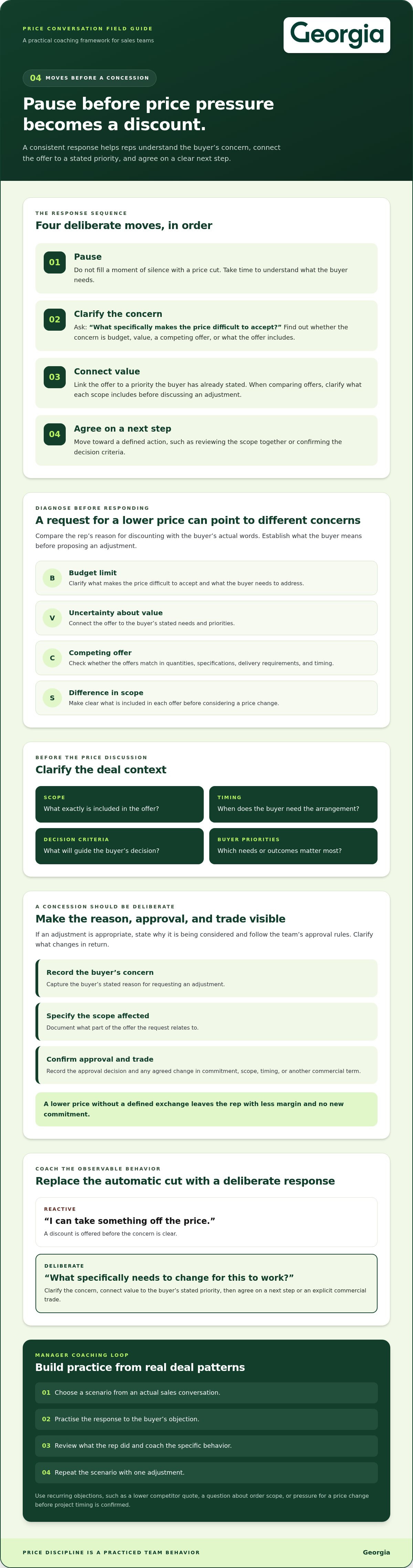
- Use a simple response sequence to pause, clarify the concern, connect value, and agree on a next step.
- To learn how to stop sales reps from discounting, rehearse recurring buyer objections and coach the specific behaviors reps need to improve.
Diagnose the discounting behavior before changing the rules
Unmanaged concessions erode margin and make pricing harder to manage consistently. Before changing approval rules, identify what happens in the conversation before a rep offers a lower price.
Review recent deal conversations and look for repeated triggers. Note whether the rep discounted after a direct price objection, a competitor comparison, silence, or a delay in making a decision. Separate necessary commercial flexibility from automatic cuts offered before the buyer’s concern is clear.
Watch this practical guide to responding to discount requests:
Trace the moment a rep reaches for a discount
Record the buyer’s stated concern alongside the rep’s exact response. Then check whether the concession secured a clear commercial exchange or was offered without one. For example, compare a lower price tied to a change in order scope with a price reduction offered simply because a buyer paused before answering.
Separate a pricing constraint from a confidence gap
Check whether the rep connected the offer to the buyer’s stated needs. Rushed answers, unsupported claims, or missed clarifying questions can signal a conversation skill to coach. A value-led response ties the offer to what matters to the buyer, as described in value-based pricing. Treat discounting as an observable pattern, then coach the specific behavior behind it.
Find the pressure point that makes reps discount
Compare the rep’s reason for discounting with the buyer’s actual words. A request for a lower price may point to a budget limit, doubts about value, a competitor’s offer, or a negotiation tactic. Each calls for a different response, so coach reps to establish what the buyer means before proposing an adjustment.
Identify the buyer objection beneath the price request
Coach reps to ask, “What specifically makes the price difficult to accept?” Before discussing price, they should explore scope, timing, decision criteria, and buyer priorities. In a building materials sale, for example, clarify whether the buyer is comparing the same quantities, specifications, delivery requirements, and timing. Connecting the offer to what the buyer values can sharpen the response. Harvard Business Review’s Elements of Value offers a framework for considering those priorities.
Check whether the team has usable concession rules
Clarify who can approve a concession and what information approvers need. Require reps to document the buyer’s concern, the scope affected, the reason for the request, and any proposed commercial trade. Consistent guidance prevents mixed manager messages from blurring approval boundaries. For related context, read this sales negotiation training guide.
Georgia’s AI role-play helps reps practise price conversations. See how Georgia supports sales practice.
Give reps a value-led response before approving a concession
A price request creates a decision point. Reps can cut the price immediately, or pause long enough to understand what the buyer needs. A consistent response sequence helps teams handle pressure: pause, clarify, connect value, then agree on a next step.
Rehearse a clear response to “Can you do better on price?”
Give reps language they can use without sounding defensive: “Before I respond, can you tell me what’s driving the concern about price?” The answer may reveal a budget limit, an unclear comparison, or a priority the rep has not addressed. A clarifying question keeps the conversation from turning into an unexamined concession.
Next, connect the offer to a priority the buyer has already stated. If timing matters, explain how the proposed arrangement addresses that requirement. If the buyer is comparing offers, clarify what each scope includes before discussing an adjustment. Then agree on a next step, such as reviewing the scope together or confirming the decision criteria. Silence alone is not a reason to fill the gap with a discount.
| Reactive response | Deliberate response |
|---|---|
| “I can take something off the price.” | “What specifically needs to change for this to work?” |
| Discount offered before the concern is clear. | Buyer’s concern clarified, then value connected to their stated priority. |
| Conversation ends with a lower price and no exchange. | Conversation moves to a defined next step or an explicit commercial trade. |
Make every concession deliberate and visible
If an adjustment is appropriate, require a stated reason and the approval your team’s rules call for. Ask what changes in return: commitment, scope, timing, or another commercial term. The trade should fit the deal and be clear to both sides. A concession without a defined exchange leaves the rep with less margin and no new commitment.
Document the buyer’s reason, the adjustment requested, the approval decision, and any agreed trade. Managers can then see whether concessions cluster around a particular objection, deal type, or point in the conversation. That record also gives coaching a concrete focus. Harvard Business School’s Sales Coaching and Value Creation reinforces the importance of coaching how reps create and articulate value, not only reviewing the final price.
Build discount resistance through practice and manager coaching
Price discipline breaks down in live conversations when reps have no practised response to pressure. A rule sets the boundary. Rehearsal prepares the rep to hold the conversation inside it. Use a repeatable cycle: choose a scenario, practise the response, review what the rep did, then repeat with one adjustment.
Turn real deal patterns into rehearsal scenarios
Build scenarios from objections you have heard in actual sales conversations. A buyer may cite a lower competitor quote, question the scope of a materials order, or press for a price change before confirming project timing. Keep each scenario focused on the point where the rep usually reaches for a concession. Vary the buyer’s priority so reps practise adapting their response instead of reciting a single script.
Georgia’s AI-powered role-play provides personalized, self-paced simulations for reps to practise high-stakes price conversations between formal training sessions. For broader practice context, read this overview of an AI role-play training platform.
Make practice specific enough to coach
Review observable actions, not personality. Did the rep ask a clarifying question before responding? Did they connect the offer to a buyer priority? Did they follow the team’s approval rules? Give one piece of direct feedback, then have the rep run the same exchange again with that improvement in focus.
Track those behaviors alongside deal reviews. Note whether the rep clarified the objection, explained relevant value, and documented or escalated a concession appropriately. Compare patterns across conversations over time. This gives managers a practical view of whether coaching is changing how reps handle price pressure, without assuming a specific margin result.
That’s the operating answer to how to stop sales reps from discounting: make the desired response repeatable, then review it consistently. Georgia’s AI role-play platform supports teams practising these conversations at their own pace.
Final Thought: Make price discipline a practiced team behavior
To stop discounting by reflex, follow a clear sequence: diagnose the trigger, clarify the buyer’s objection, rehearse the response, and coach what you can observe. Choose one recurring discount scenario from recent deal reviews for your next team practice. Agree on the questions reps should ask, then review upcoming conversations for evidence of those behaviors.
When a concession is considered, document the reason, scope, approval, and commercial trade. Georgia’s personalized, self-paced AI role-play can extend practice beyond a single session and support your sales training program. Book a Georgia demo to explore tailored sales role-play.
Make Price Discipline Part of the Sales Routine
To understand how to stop sales reps from discounting, trace what triggers the concession before rewriting pricing rules. Help reps clarify the buyer’s concern, connect the offer to stated priorities, and follow clear approval and trade expectations. Then rehearse recurring objections and coach the responses you can observe.
Choose one price conversation from a recent deal review and make it the next practice scenario. Georgia’s AI-powered role-play supports sales and commercial training with personalized, self-paced communication simulations, giving reps a way to practise under pressure and managers a consistent behavior to reinforce.
Each deliberate conversation gives your team a stronger chance to defend value and make concessions with purpose.
Frequently Asked Questions
Why do sales reps discount too early?
Sales reps often discount too early because they respond to price pressure before they understand the buyer’s concern. They may skip questions about priorities, rely on unclear approval expectations, or lack practice handling pushback. Review recent deal conversations to identify the trigger, the rep’s response, and what the buyer actually said. Then coach the specific behavior that led to the concession instead of treating every discount as a pricing problem.
How do you respond when a customer asks for a discount?
Pause and clarify what is driving the request before discussing a price change. Ask what makes the price difficult to accept, then connect the offer to the buyer’s stated priorities. If an adjustment is appropriate, define its scope, follow your approval process, and agree on a clear commercial exchange where possible. Document the reason and decision so managers can review whether the response addressed the buyer’s concern.
Should sales reps have the authority to discount?
Set discount authority according to your commercial process and make the boundaries explicit. Reps need to know which decisions they can make, when approval is required, and what information approvers need. Clear rules help managers assess exceptions consistently and give reps a practical path when they cannot change the price themselves. Require documentation of the buyer’s reason, proposed concession, approval, and any agreed trade.
How can sales managers coach reps to protect margin?
Review the conversation and pinpoint the moment the rep moved toward a concession. Ask what information was missing, then practise a stronger response to that buyer scenario. Give feedback on observable actions, such as asking a clarifying question, explaining relevant value, and following approval rules. Revisit those behaviors in deal reviews. Specific rehearsal connects coaching directly to the price conversations you want reps to handle differently.
Can role-play help sales reps stop discounting?
Role-play helps reps practise buyer pushback before they face it in a live deal. Build scenarios from recurring objections, then coach the rep’s questions, value explanation, and response to pressure. Repeat the conversation so they can apply feedback. Georgia’s AI-powered role-play platform provides personalized, self-paced communication simulations for sales and commercial training, supporting practice beyond a single scheduled training session.
How do you know whether discount coaching is working?
Track whether reps clarify buyer concerns before discussing price, follow approval rules, and document the reason for proposed concessions. Compare these behaviors over time alongside deal reviews, and use the findings to refine practice scenarios and manager coaching. A single win or loss does not prove the coaching worked. Look for consistent evidence that reps are handling the decision point with greater discipline and following the team’s agreed process.