

Building confidence for difficult conversations starts with practice. When a performance issue goes unaddressed, managers spend time working around it while expectations remain unclear. A missed delivery update, disputed quote, or unfulfilled commitment can delay decisions and create extra work across sales, dispatch, and site teams.
These discussions are part of the job, but pressure can make it harder to choose precise words, stay focused, and respond constructively when someone disagrees.
A repeatable preparation method gives you a practical way forward. Define the purpose, select relevant facts, prepare an opening, and rehearse likely responses. You can stay clear without memorizing a script or expecting one conversation to resolve every underlying problem.
Personalized, self-paced role-play simulations help sales, customer operations, and leadership teams practice workplace conversations before the stakes are live. Prepare with purpose, listen to the response, and agree on a specific next step.
Key Takeaways
- Define the operational issue clearly, such as a delayed delivery, disputed quote, or missed commitment.
- Set an outcome, select relevant evidence, plan your opening, anticipate responses, and agree on next steps.
- Build confidence for difficult conversations by rehearsing key moves rather than memorizing a perfect script.
- When pressure rises, pause, listen, clarify the concern, respond to the issue, and confirm what happens next.
- Choose one upcoming conversation and define the outcome you need before you prepare.
Build confidence for difficult conversations by defining the operational issue
A disputed quote can hold up an order while a customer waits for a clear answer. Avoiding the discussion leaves the discrepancy unresolved and can create more follow-up work for sales and operations. Building confidence for difficult conversations starts with identifying the specific operational problem.
Confidence means being prepared to communicate, listen, and respond. It does not mean knowing exactly how the other person will react.
Watch this video for another perspective on leading a difficult conversation:
Name the business issue before choosing your words
Describe what happened, its effect, and what needs to change. “The quote lists a different rate from the agreed amount, and the customer has paused the order” gives the other person something specific to address. “You weren’t paying attention” assumes motive and turns the discussion toward blame.
Separate confidence from certainty about the outcome
Preparation helps you communicate clearly, but agreement depends on what both people learn and decide. Set a purpose, then listen for information that may change your understanding. For a foundation, review the core principles of interpersonal communication. Keep the exchange focused on the issue and the decision required.
Prepare for difficult conversations with a simple conversation plan
A plan keeps the discussion focused when pressure rises. A clear objective makes preparation more useful. Decide what needs to change, be decided, or become clear before choosing your opening words.
Use this sequence:
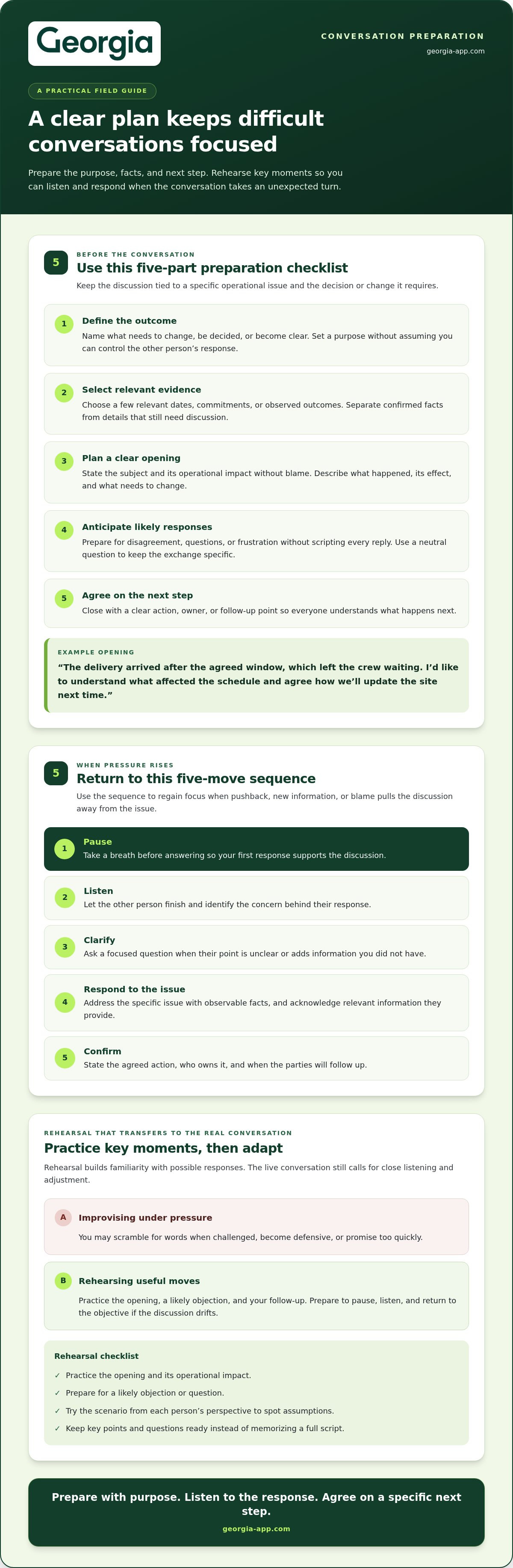
1. Define the outcome. Specify the decision or change you need. 2. Select evidence. Choose a few relevant dates, commitments, or observed outcomes. Separate confirmed facts from details that still need discussion. 3. Plan the opening. State the subject and its operational impact without blame. For example: “The delivery arrived after the agreed window, which left the crew waiting. I’d like to understand what affected the schedule and agree how we’ll update the site next time.”
4. Anticipate responses. Prepare for disagreement, questions, or frustration without scripting every reply. A neutral question such as “What information am I missing about the schedule?” keeps the exchange specific. 5. Agree next steps. End with a clear action, owner, or follow-up point.
Berkeley Executive Education offers additional guidance on how to have difficult conversations. To make preparation repeatable, rehearse the opening and likely responses with personalized role-play. You can see how conversation practice works.
Build confidence through rehearsal, not perfect scripts
Confident people can still feel tension before a difficult conversation. Building confidence for difficult conversations means practicing useful responses, not waiting for nerves to disappear or memorizing a speech.
Suppose a sales representative misses a commitment to clarify a pricing discrepancy, and the customer challenges the delay. Rehearsal gives the representative a chance to practice acknowledging the missed follow-up, hearing the concern, and avoiding another promise before checking the facts.
| Improvising | Rehearsing key moves |
|---|---|
| Scrambles for words when challenged. | Opens with the missed commitment and its effect. |
| May get defensive or promise too quickly. | Pauses, listens, and prepares a calm follow-up. |
Rehearse the moments most likely to derail the discussion
Practice the opening, a likely objection, and your follow-up. Try the scenario from each person’s perspective to spot assumptions about what the other needs to know. Role-play prepares you for possible responses, while the real conversation still calls for close listening and adaptation.
Keep the conversation adaptable
Prepare key points and questions rather than a full script. Practice pausing, listening, and returning to the objective if the discussion drifts. Georgia’s personalized, self-paced role-play simulations let sales, customer operations, and leadership teams rehearse relevant workplace scenarios and build familiarity with different responses.
Use a repeatable method to stay clear when pressure rises
Pushback can pull a conversation away from the operational issue. A colleague may challenge your account, add new information, or shift the discussion toward blame. Use the same sequence to regain focus: pause, listen, clarify, respond to the issue, and confirm the next step.
- Pause: Take a breath before answering so your first response supports the discussion.
- Listen: Let the other person finish and identify the concern behind their response.
- Clarify: Ask a focused question if their point is unclear or adds information you did not have.
- Respond: Address the specific issue with observable facts, and acknowledge relevant information they provide.
- Confirm: State the agreed action, who owns it, and when the parties will follow up.
Listening keeps your response tied to the issue rather than your assumptions. It also gives you the chance to correct your understanding before committing to an answer.
Respond to disagreement without abandoning the objective
Suppose a dispatch lead raises a missed internal update that affected how a load was coordinated. A team member says the schedule changed after the original handoff. Acknowledge the information first: “I hear that the schedule changed.” Then clarify what remains unresolved: “When was the change shared, and who had the updated information?”
This approach treats the new detail as relevant while keeping the purpose in view. If the exchange turns into judgments about who “always” misses updates, return to the record: what was communicated, when, and what decision needs to be made now. Restate the shared operational goal, such as keeping dispatch and the site aligned on current load information.
Close with an explicit next step
Before ending, summarize the decision, the owner, and the follow-up point. If the team agrees to use a revised handoff process, state who will communicate the change and how the team will confirm that the update reached the right people. If a detail remains disputed, name it plainly and leave it open. A proposal is not an agreement until both parties accept it.
Afterward, review the exchange. Note what helped you stay focused and what you will adjust next time. Practicing this sequence builds confidence for difficult conversations by giving you a reliable response path, even when you cannot control the other person’s reaction.
Final Thought: Build confidence for difficult conversations through practice
Start with one real conversation ahead. Write down the issue, the outcome you need, and the first sentence you will use. Set aside time to rehearse that opening and one likely response before the meeting. Afterward, note what worked and what you will adjust. That review turns each conversation into useful preparation for the next one.
Make Your Next Difficult Conversation More Deliberate
Building confidence for difficult conversations comes from preparation you can repeat. Define the operational issue and the outcome you need. Use relevant facts, prepare a direct opening, and rehearse how you will respond if the other person disagrees.
Under pressure, return to a simple sequence: pause, listen, clarify, address the issue, and confirm the next step. A clear purpose and practice with likely challenges help you respond without memorizing a perfect script.
Georgia provides personalized, self-paced conversation simulations for sales, customer operations, and leadership teams. Use role-play to prepare for workplace conversations where clarity matters.
Choose one conversation that is coming up and define the outcome you need. Then book a Georgia demo to see how personalized role-play can support practice for your team.
Frequently Asked Questions
How do you build confidence for a difficult conversation at work?
Prepare for the purpose and likely pressure points. State the operational issue, define the outcome you want, and choose relevant facts to support it. Plan a direct opening, then consider what the other person may ask or challenge. Building confidence for difficult conversations comes from practicing how to communicate, listen, and respond while accepting that you cannot control the other person’s reaction.
Can you prepare for a difficult conversation without sounding scripted?
Yes. Prepare a few anchor points rather than memorizing a speech: the issue, its effect, the question you need answered, and the next step you are seeking. Rehearse the opening and a likely response, then vary the wording each time. This builds familiarity while leaving room to listen and adapt. If new information changes the discussion, follow it while keeping the purpose in view.
What should you say at the start of a difficult workplace conversation?
Open with the specific issue and why it matters, using observable facts rather than blame. For example: “The load arrived after the agreed window, and the site team had to adjust its schedule. I’d like to understand what changed and agree on how we’ll communicate updates.” This makes the subject clear and invites relevant information. Avoid labels about someone’s attitude or intentions, which can shift attention away from resolving the work issue.
How do you stay calm when someone pushes back during a conversation?
Pause before responding, listen without interrupting, and clarify what the other person means. A focused question can help: “Which part of the timeline do you see differently?” Then respond to the point using facts you can verify. If the conversation shifts toward blame, restate the shared operational goal and return to what needs a decision. A practiced sequence gives you a way to respond when tension rises.
How can managers practice difficult conversations before they happen?
Choose a real upcoming conversation and rehearse its opening, one likely objection, and a follow-up question. Use a colleague or a role-play simulation to practice both the manager’s and employee’s perspectives. Keep the scenario tied to a recognizable workplace issue, such as a missed commitment or recurring handoff problem. After rehearsal, identify where the message became vague or defensive, then practice a clearer response.
What should you do if a difficult conversation does not reach agreement?
Summarize the points each person agrees on and name what remains unresolved. Confirm any immediate action, who owns it, and when you will revisit the open issue. Do not present a proposal as a decision if the other person has not agreed. If more information is needed, state what needs clarification and how it will inform the next discussion. A clear next step keeps disagreement from becoming ambiguity.
Can role-play help build confidence for difficult conversations?
Role-play helps you practice a realistic conversation before the stakes are live. Rehearse how you will open, respond to pushback, and return to the objective if the discussion drifts. Georgia provides personalized, self-paced conversation simulations for sales, customer operations, and leadership teams. Practice gives you options to draw on, while each real conversation still requires listening and adapting to what the other person says.