

Seventy nine percent of your sales training budget vanishes within thirty days because reps forget the content (Journal of Marketing Education). This represents a structural failure in your commercial strategy. Traditional sales negotiation training fails because it lacks the frequency required to change behavior. You're paying for knowledge that never reaches the negotiation table.
You recognize that procurement teams are trained to exploit hesitation and squeeze your margins. Your reps often concede on price because they lack the muscle memory to resist pressure in the moment. Consistent methodology across regional plants is the only way to prevent margin erosion. Protecting your bottom line requires a shift from passive learning to active performance.
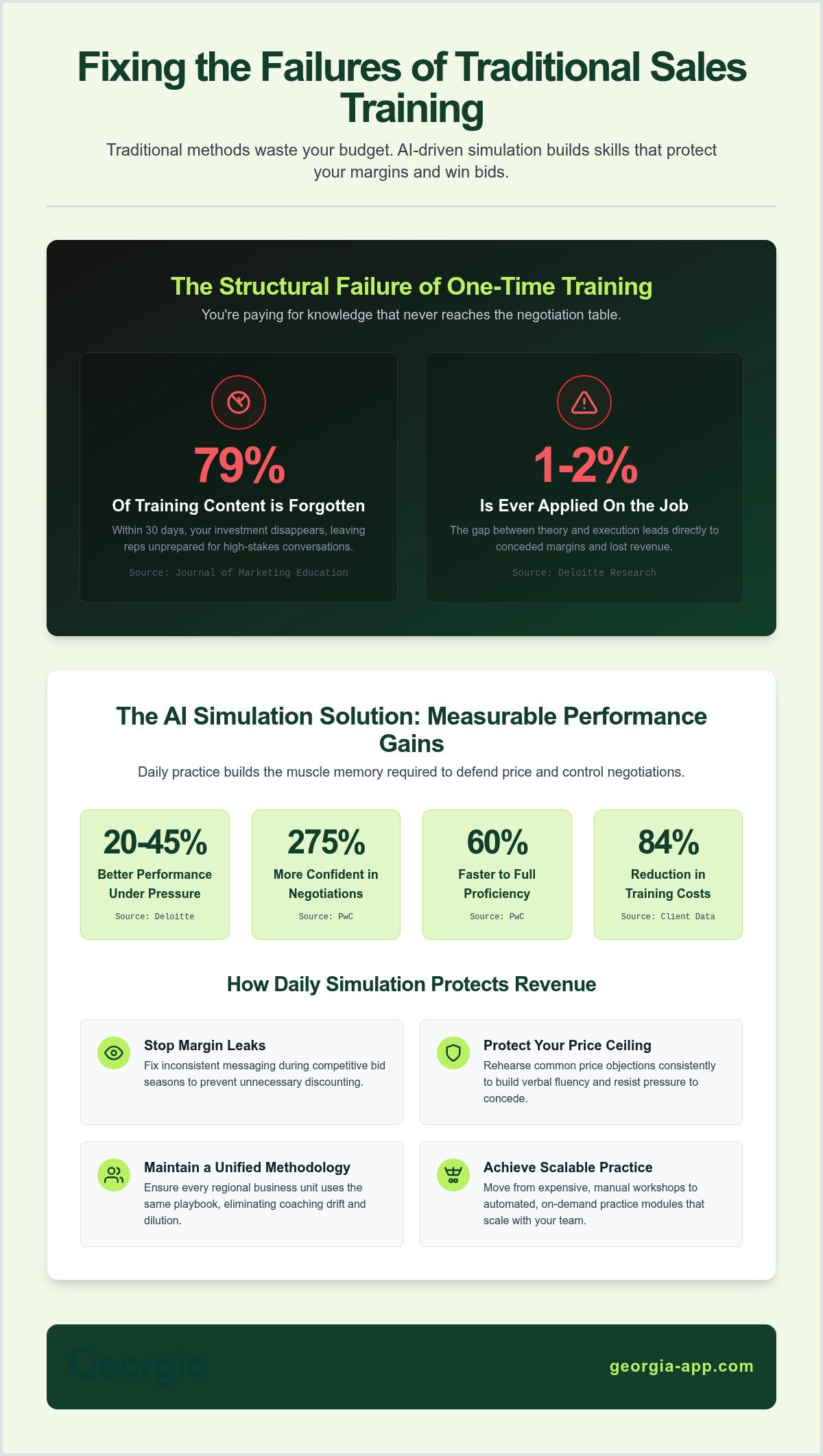
This article demonstrates how AI-driven simulations protect your revenue through daily practice. You'll see how to achieve an 84 percent reduction in training costs while ensuring your team performs 20 to 45 percent better under pressure (Deloitte). This approach makes your sales force 275 percent more confident and 60 percent faster to proficiency (PwC).
Key Takeaways
- Stop margin leaks by fixing inconsistent messaging during competitive bid seasons.
- Use daily AI simulations to prevent the 79 percent loss of content typical in standard sales negotiation training.
- Increase performance under pressure by up to 45 percent through consistent rehearsal of common price objections.
- Maintain a unified sales methodology across every regional business unit to eliminate coaching drift and dilution.
- Achieve an 84 percent reduction in training costs by moving from manual workshops to automated practice modules.
Stop Conceding Margins During High Stakes Bid Conversations
Poor sales communication acts as a hidden tax on every commercial transaction in the construction sector. It drains your bottom line silently. Inconsistent messaging leads to unnecessary discounting. You lose margins during bid season because your team lacks verbal fluency.
High pressure negotiations with procurement teams require precise execution. Most revenue loss stems from reps folding under aggressive contractor tactics. They concede on price because they haven't mastered the negotiation process. Commercial leaders must quantify the gap between current performance and desired financial outcomes.
Identify Revenue Leaks in Building Materials Sales
Reps often drop their price the moment a contractor mentions a competitor quote. This is a failure of preparation. Dispatch teams also lose value by failing to communicate logistical surcharges clearly to customers. These small leaks accumulate into significant financial liabilities over a fiscal year.
Identify the specific moments where conversations fail to convert to signed bids. Is it the initial discovery or the final closing? Without specialized sales negotiation training, your team relies on intuition. This lack of structure creates friction that procurement officers easily exploit.
Quantify the Impact of Communication Friction
Calculate the cost of every lead that fails to convert due to poor discovery. Friction in the sales cycle increases the time required to move a project from bid to delivery. This delay creates operational drag and increases overhead.
Every minute spent clarifying a poorly negotiated contract is a minute lost to new business. Most suppliers struggle to push prices beyond a 5 percent ceiling. This hesitation is a structural failure in your commercial strategy.
Reps who role play before live calls perform 20 to 45 percent better under pressure according to Deloitte. Proper sales negotiation training provides the verbal fluency needed to defend your margins. It eliminates the "bid and pray" mentality.
You move from defensive reacting to strategic control of the commercial conversation. Stop treating soft skills as optional extras. Treat them as a financial audit of your sales performance. Visit georgia-app.com to see how AI simulations bridge the gap between training and real world results.
Defeat the Forgetting Curve with Daily AI Simulation
Traditional classroom training is expensive theater. It fails to create lasting behavioral changes in sales teams because it treats learning as a one-time event. Research from the Journal of Marketing Education shows that 79 percent of training content is forgotten within 30 days. This is a structural failure in your commercial development process.
Deloitte research indicates that only 1 to 2 percent of training is ever applied in real situations. This massive gap between theory and execution acts as a drain on your profitability. Daily simulation ensures that your sales methodology remains fresh and actionable for every rep. You must close the distance between the training room and the negotiation table.
Replace Information Transfer with Behavioral Practice
Reading a sales manual does not translate to performance under pressure. Knowledge is useless if your reps cannot articulate it during a high stakes bid conversation. Simulated conversations allow reps to build muscle memory through active repetition. Use an AI role-play training platform to stop revenue leaks before they reach the bid stage.
High level Strategic Sales Negotiation Training requires more than passive observation. Reps need to feel the heat of a procurement officer's rejection in a controlled setting. Simulation builds the confidence required to defend your price push ceiling. This is where sales negotiation training becomes a measurable financial asset rather than a sunk cost.
Apply Methodological Reinforcement for Lasting Impact
Practice sessions must be short and frequent to maximize neural pathways. Digital role play provides the repetition necessary for mastery without the logistics of a live coach. You can scale this practice across your entire enterprise without adding headcount. This consistency ensures every rep follows the same playbook regardless of their location.
Georgia provides continuous on demand practice via voice or chat on the phone. Your team can sharpen their skills between site visits or during their morning commute. This frequency ensures they are always ready for a difficult price push conversation. You should book a demo to see how daily simulation repairs your training ROI.
Rehearse the Objection to Protect Your Price Push Ceiling
Building materials suppliers often hit a wall at the 5 percent price increase mark. Pushing beyond this ceiling without losing volume requires more than a standard pitch. It requires sales negotiation training that focuses on behavioral resistance. You must prepare your team to defend margins against professional buyers who are incentivized to break your pricing structure.
Sales reps who role play before live calls perform 20 to 45 percent better under pressure according to Deloitte. This improvement is not accidental. It is the result of habituating the response to conflict. Immersive practice allows your reps to maintain professional composure when customers demand deeper discounts.
Confidence in negotiation comes from having rehearsed the objection multiple times before the call. It is the difference between a panicked concession and a calculated defense. You cannot expect a rep to perform a new skill for the first time in front of a major account. Practice must happen in a safe, simulated environment first.
Rehearse High Stakes Negotiation Scenarios
Practice responding to improper requests for price matching with competitors. You cannot win a race to the bottom in a commodity market. Refine the delivery of value propositions to justify premium pricing. Your team must simulate the pressure of a major contractor threatening to walk away from a deal.
Rehearsal turns a panic response into a tactical maneuver. When a rep has heard a threat ten times in a simulation, the eleventh time in reality loses its power. This familiarity allows for clearer thinking and better decision making during the sales negotiation training process. You ensure that the response is consistent across the entire sales force.
Master the Art of Saying No to Large Customers
Saying no is the hardest part of commercial compliance and price protection. It feels counterintuitive to walk away from volume. However, unprofitable volume is a structural liability that drains your resources. Reps must practice the exact phrasing to use when declining a bid that erodes your margins.
Consistent rehearsal builds the mental muscle required to protect your bottom line. It replaces the impulse to please the customer with the duty to protect the company's profitability. You ensure that every refusal is delivered with authority and strategic intent. This discipline is what separates market leaders from those who simply trade on price.
Ensure Methodological Integrity Across Every Regional Plant
Decentralized operations create fragmentation in your commercial execution. Regional plants often operate as silos with inconsistent sales habits that vary by location. This leads to margin erosion when reps in one territory concede faster than those in another. You cannot protect your bottom line if your team uses different playbooks for the same products.
Regional managers lack the bandwidth to provide high quality coaching to every rep. They prioritize operational throughput and logistics over verbal performance. This gap allows your methodology to degrade over time. Coaching becomes a game of telephone where the original strategy is lost in translation.
Georgia ensures your method is applied as designed: every time. Digital simulations provide a unified sales negotiation training experience across highway, energy, and commercial construction sectors. You achieve a single source of truth for your sales methodology. This consistency prevents the dilution of your commercial policies regardless of geographic distance.
Eliminate Coaching Drift and Method Dilution
A signature sales experience requires every rep to follow the same strategic framework. AI platforms deliver consistent feedback that is free from individual manager bias. This objectivity is critical for maintaining high standards across multiple business units. You eliminate the risk of regional outliers creating their own rules for discounting.
Scalable training allows you to expand into new markets without increasing travel overhead. Reps are 275 percent more confident than classroom-only training (PwC), which is vital when entering aggressive new territories. You deploy the same sales negotiation training to a new plant in hours. This speed of deployment ensures that new hires are immediately aligned with your profit objectives.
Use Data to Focus Your Coaching Efforts
Manager dashboards show exactly where each rep is struggling in their conversations. You replace subjective guesswork with clear visibility into revenue leaks. Identify which plants are meeting performance benchmarks and which require additional support. This visibility allows for targeted interventions that fix specific behavioral flaws before they impact the quarterly report.
Performance scoring identifies reps who demonstrate mastery of the commercial policy. You can reward top performers and provide clear paths for improvement for those falling behind. This data driven approach ensures your coaching resources are deployed with maximum efficiency. You move to objective metrics for sales performance that treat communication as a measurable operational process.
Cut Training Spend by Eighty Four Percent with Scalable Practice
Traditional in-person workshops are a structural drain on your commercial budget. They cost approximately 1,500 dollars per rep annually when you account for travel, lodging, and lost productivity. A basic Georgia annual subscription costs 240 dollars per rep. This shift represents an 84 percent reduction in training spend. A 10-rep team saves approximately 12.6 thousand dollars by adopting digital role play.
Scaling sales negotiation training through manual workshops is impossible for growing enterprises. You pay for the same content repeatedly without seeing a permanent change in behavior. Digital platforms eliminate this recurring cost while providing a higher frequency of practice. You move from a high-cost event model to a low-cost performance model.
Reduce Time to Proficiency for New Hires
New sales reps in the building materials sector often take months to understand complex product lines and regional pricing structures. This delay acts as a friction point that slows your market penetration. Simulation-based training allows new hires to practice high-stakes scenarios before they ever speak to a customer. They build the required verbal fluency in a controlled environment where mistakes do not cost you accounts.
PwC research shows that digital simulation makes reps 60 percent faster to reach proficiency. This acceleration means your new hires start defending margins and generating revenue much sooner. You reduce the cost of learning that typically burdens your seasoned managers. Reps arrive at their first site visit with the confidence of a veteran because they have already survived dozens of simulated negotiations.
Practice Compliance to Mitigate Legal Liabilities
Commercial compliance is a critical component of sales negotiation training in the aggregates and concrete industries. The DOJ has issued fines exceeding 20 million dollars for antitrust violations in paving projects. A single rep engaging in improper price discussions is a massive financial liability. You must ensure that every member of your team understands the boundaries of legal commercial communication.
Digital simulations allow you to audit the compliance of your sales force at scale. You identify reps who fail to follow antitrust protocols and fix the behavior immediately. Participants feel 275 percent more confident in their skills after simulation training (PwC). This confidence allows them to stick to approved commercial policies even when faced with aggressive customer demands. You protect the company from both margin erosion and legal catastrophe through consistent, measurable practice.
Secure Your Profit Margins with Scalable Performance
Traditional training is a sunk cost that fails to protect your bid integrity. You need a system that ensures 275 percent higher confidence than classroom-only methods (PwC). Modern sales negotiation training must be as measurable as your production metrics to stop revenue leaks before they impact your quarterly reports.
You achieve a 60 percent reduction in time to proficiency for new hires (PwC). This efficiency is coupled with an 84 percent lower training spend compared to manual workshops. You move from a reactive discounting culture to a proactive margin defense strategy that scales across every regional plant.
Final Thought
You will now stop treating negotiation as an intuitive art and start treating it as a commercial compliance requirement. You will replace annual workshops with daily AI simulations that provide objective performance data. Every rep at every plant will follow the same margin protection framework. This shift ensures your team performs 20 to 45 percent better under pressure (Deloitte). Your path to protected margins starts with consistent, scalable practice.
Frequently Asked Questions
How much does sales negotiation training cost per rep annually?
Traditional in-person workshops cost approximately 1,500 dollars per rep annually. This figure includes travel, lodging, and instructor fees. A basic Georgia annual subscription costs 240 dollars per rep. This shift represents an 84 percent reduction in training spend. Switching to digital role play saves approximately 12.6 thousand dollars for a 10-rep team while providing continuous, on-demand practice on every rep's phone.
Can AI role play replace traditional sales workshops for construction teams?
AI role play replaces the need for expensive, one-time events that yield poor results. Research from the Journal of Marketing Education shows that 79 percent of training content is forgotten within 30 days. Daily simulation ensures your sales methodology remains fresh and actionable for every rep. It provides a scalable engine for consistent, measurable outcomes across all regional plants without the travel overhead or the method dilution of traditional workshops.
How do I measure the ROI of my sales negotiation program?
ROI is measured through reduced training spend and improved margin protection. You save 84 percent on upfront costs compared to manual training methods. Additionally, Deloitte research indicates that sellers who role play perform 20 to 45 percent better under pressure. You should track lead conversion rates and the frequency of successful price pushes beyond the standard 5 percent ceiling to quantify the financial impact of your sales negotiation training.
Is digital simulation effective for experienced building materials sales veterans?
Experienced veterans benefit from simulation by sharpening their response to modern procurement tactics. Even seasoned reps often forget 79 percent of new methodology within a month according to the Journal of Marketing Education. Digital simulation allows them to practice high-stakes scenarios and maintain professional composure when faced with aggressive contractor demands. PwC research shows that participants feel 275 percent more confident in their skills after using simulation training.
How long does it take to see results from daily negotiation practice?
Results in proficiency and confidence are measurable within the first few sessions. PwC research shows that digital simulation makes reps 60 percent faster to reach proficiency compared to traditional methods. You can observe behavioral changes in real-time through manager dashboards that track activity and performance scoring. Consistent daily practice ensures that new hires and veterans alike are immediately aligned with your commercial policy and your specific profit objectives.
What are the common compliance risks in sales negotiation for aggregates?
Common risks include antitrust violations, price signaling, and sharing confidential information with competitors. The DOJ has issued fines exceeding 20 million dollars for such violations in the paving and aggregates sectors. Georgia provides modules to practice responding to improper requests and maintaining ethical selling boundaries. You mitigate legal liabilities by ensuring every rep understands the exact phrasing required to maintain commercial compliance during high-stakes bid conversations and negotiations.
How do I stop my sales reps from discounting too much during bids?
You stop excessive discounting by habituating the response to price pressure through sales negotiation training. Reps often concede because they lack the muscle memory to defend your margins under procurement stress. Daily practice requires reps to rehearse the exact phrasing used to decline unprofitable bids. This rehearsal builds the mental muscle required to protect your bottom line and ensures that every refusal is delivered with strategic authority and intent.