

Building confidence for sales calls starts before you pick up the phone. A call can lose momentum when nerves make you miss a detail, rush a question, or overexplain price, leaving the next step unclear.
The challenge is staying composed when a buyer questions timing, value, or fit. Confidence under pressure comes from a clear purpose, a structure you can return to, and practice responding before the stakes are live.
This article covers how to prepare for a call, follow a repeatable structure, and rehearse likely objections. It also shows how sales managers can make practice part of team development with personalized, self-paced AI role-play. Use these steps to listen closely, ask better questions, and explain value without rushing or retreating.
Key Takeaways
- Define the call’s purpose before dialing so you can stay focused when pressure rises.
- Use a four-step structure to guide the conversation while responding naturally to the buyer.
- Build confidence for sales calls by rehearsing likely pressure points, not memorizing a script.
- Use a short pre-call routine and post-call review to identify what to practice next.
- Make role-play part of team development so reps can practice difficult conversations before they happen live.
Build sales call confidence by preparing for key moments
An unprepared call can turn a buyer’s concern about timing, price, or fit into a tangled explanation. The rep loses the thread, and it becomes harder to agree on a useful next step.
Sales-call confidence means communicating clearly, listening closely, and staying purposeful under pressure. Build it by preparing for the conversation in front of you, rather than relying on personality or hoping the call follows a familiar path.
See how confident language can sound in a sales conversation:
Separate product expertise from conversation readiness
Product and industry knowledge give you useful information, but they do not prepare you for every challenge a buyer may raise. Conversation readiness shows in what you do next: pause, listen, answer the concern directly, and clarify details before making a commitment.
Define a useful confidence target before the call
Sales-call confidence is the belief that you can listen, ask relevant questions, and respond clearly in a specific conversation. This connects to the psychological concept of self-efficacy. Set an observable objective, such as understanding a project requirement or agreeing on a next step. Then identify one likely pressure point, rehearse how you will handle it, and review the call afterward.
Build confidence for sales calls with a repeatable call structure
A simple structure gives you a route through the conversation when a buyer raises a concern or changes direction. It reduces the need to improvise without forcing you to sound scripted.
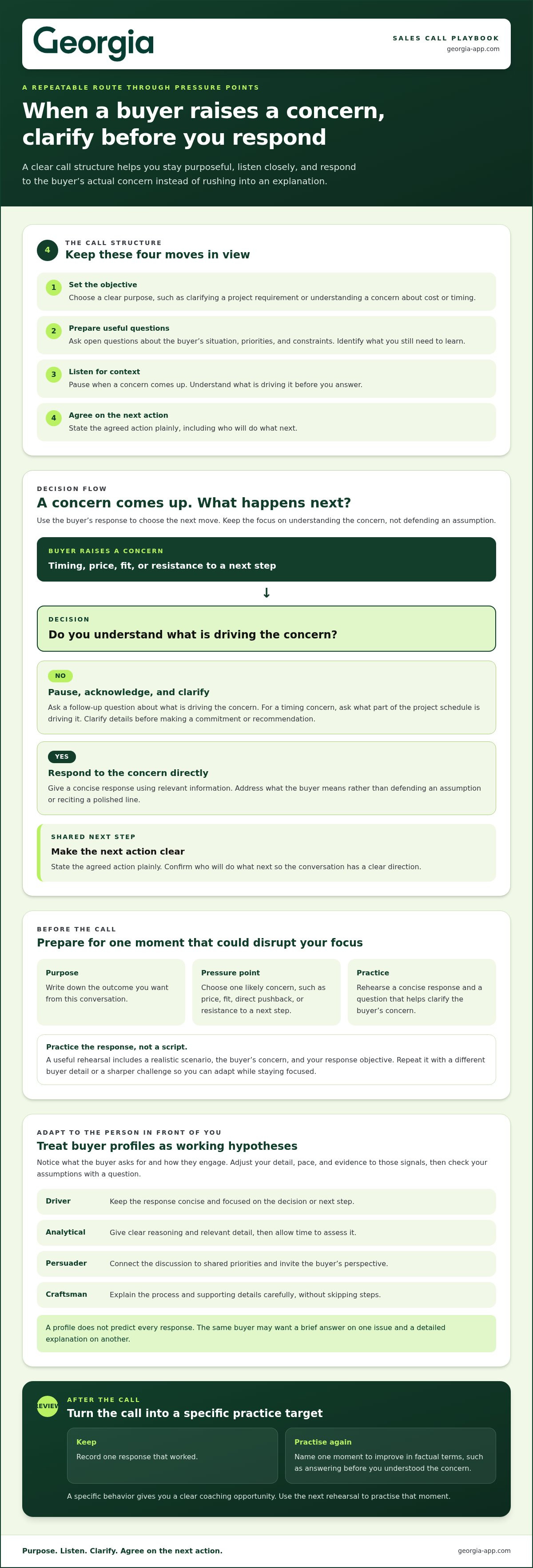
Set the objective, prepare questions, listen for context, and agree on the next action.
Set the objective and prepare useful questions
Choose a clear purpose, such as clarifying a project requirement or understanding a concern about cost or timing. Prepare open questions about the buyer’s situation, priorities, and constraints. Before recommending an action, identify what you still need to learn.
Listen, respond, and close with a clear next action
If a buyer raises a timing concern, pause before answering. Acknowledge it, then ask what part of the project schedule is driving the concern. That answer helps you respond to the actual constraint instead of defending an assumption.
Close by stating the agreed action plainly, including who will do what next. This sequence supports building confidence for sales calls while keeping the exchange responsive. Teams can add AI role-play for sales teams to an existing training program to practise challenging conversations.
Confidence improves when you rehearse the pressure points
Confidence develops through preparation and deliberate practice. Reps who wait to feel confident before handling a difficult conversation leave their responses to chance. Rehearsal builds familiarity with the situation, so they can think and respond instead of defaulting to a rushed pitch.
Practise the moments most likely to disrupt a call: a price objection, uncertainty about fit, direct pushback, or resistance to a next step. Aim for readiness, not a memorized script. A polished line can fall flat if it does not address what the buyer means.
Rehearse the objection without memorizing a script
Build each exercise around three elements: a realistic scenario, the buyer’s concern, and the response objective. For example, a buyer questions whether a proposed solution fits the project’s needs. The rep’s objective is to clarify the concern before explaining relevant information.
Have the rep acknowledge the concern, give a concise response, and ask a follow-up question. Then repeat the scenario with a different buyer detail or a sharper challenge. This variation helps the rep stay focused on the objective while adapting the answer. Practise price concerns as part of broader sales conversation practice, so reps can work through difficult exchanges before they happen live.
Adapt practice to the buyer without stereotyping
Buyer profiles can prompt reps to consider how they might adjust their communication. Treat each profile as a working hypothesis, not a fixed label. Pay attention to what the buyer asks for and how they engage, then adjust the level of detail, pace, and evidence to those signals.
- Driver: Keep the response concise and focused on the decision or next step.
- Analytical: Give clear reasoning and relevant detail, then allow time to assess it.
- Persuader: Connect the discussion to shared priorities and invite the buyer’s perspective.
- Craftsman: Explain the process and supporting details carefully, without skipping steps.
These distinctions guide observation; they do not predict a buyer’s behavior. A buyer may want a brief answer on one issue and a detailed explanation on another. Practise noticing the shift, checking your assumption with a question, and responding to the person in front of you. That flexibility is central to building confidence for sales calls.
Use a short practice routine to carry confidence into live calls
A practice routine works when reps can repeat it alongside a real sales schedule. Keep preparation focused: clarify the intended outcome, rehearse one likely pressure moment, and prepare a question that can lead to a clear next step. This keeps attention on the parts of the call most likely to cause hesitation.
Prepare before the call and review after it
Before the call, write down its objective and one concern the buyer may raise. Rehearse a concise response, then choose a question that will help you close with a clear next step. If the buyer may question timing, for example, prepare to acknowledge the concern and ask what part of the project schedule is driving it.
After the call, record one response that worked and one moment to practise again. Keep the review factual. “I answered before I understood the concern” identifies a behavior to change. “I was bad on the call” turns a specific coaching opportunity into a personal judgment.
Help managers make practice relevant to the team
Generic presentation drills rarely prepare reps for the conversations that affect their work. Build scenarios from recurring buyer concerns and team observations, such as a price challenge, uncertainty about fit, or a stalled decision. Ask reps to use the language they would use with buyers in building materials, concrete, aggregates, and construction.
Give feedback on the response and its effect. Did the rep acknowledge the concern? Did the answer address the buyer’s point? Did the rep leave room for a useful follow-up? Specific feedback gives the rep an action to adjust and try again.
Personalized, self-paced simulations can add repeated communication practice to an existing training program. Georgia’s AI role-play platform gives sales teams a way to rehearse pressure conversations, alongside product expertise and manager judgment.
Make building confidence for sales calls part of the working process: prepare, practise, review, and carry one learning into the next conversation.
Final Thought: Make confidence repeatable across every sales call
Before your next call, choose the moment you are least certain about. Rehearse a response, use it in the conversation, then note what worked and what to practise next. That is how building confidence for sales calls becomes a working habit: preparation followed by relevant practice and review.
Georgia offers personalized, self-paced AI role-play simulations for sales teams to practise communication under pressure within existing training programs.
Make Your Next Sales Call More Deliberate
Building confidence for sales calls starts before the conversation. Set a clear objective, use a repeatable structure to guide the discussion, and rehearse the pressure point most likely to throw you off course. After the call, note what worked and what deserves another practice round.
This routine prepares you for buyer questions while helping you stay responsive instead of relying on a memorized script. For teams, Georgia’s personalized, self-paced AI role-play simulations provide a way to practise communication under pressure. Sales and commercial training modules support that work within an existing training program.
Choose one upcoming conversation and prepare for its hardest moment. Then use the call review to choose what you will practise next. For a team, book a Georgia demo to see how AI role-play can fit into your training program.
Frequently Asked Questions
Is sales-call confidence something you can learn?
Yes. Sales-call confidence develops through preparation and repeated practice. Before a call, set a clear objective, anticipate one difficult moment, and rehearse a response in your own words. Afterward, review what worked and what you want to handle differently next time. This gives you specific actions to improve, making building confidence for sales calls more practical than relying on a general feeling of readiness.
How can I feel more confident before a sales call?
Prepare the parts of the conversation you can control. Write down the call’s purpose and what you need to learn from the buyer. Prepare relevant questions, identify one likely concern, and rehearse a concise response. Decide how you will open the conversation and what next step you hope to agree on. This gives you a clear starting point without requiring you to predict every turn.
Can role-play help build confidence for sales calls?
Yes. Role-play lets you practise communication before a difficult conversation happens live. Use realistic buyer concerns and focus on listening, pausing, and answering clearly. Repeat the scenario with a different buyer response so you practise adapting rather than reciting. Georgia offers personalized, self-paced AI simulations for communication practice under pressure, which sales teams can use as part of a broader training program.
What should sales reps practice before a difficult call?
Practise the moment most likely to disrupt the conversation, such as a price concern, uncertainty about fit, or resistance to a next step. Rehearse acknowledging the concern, asking a useful follow-up question, and answering directly. Keep your response flexible. Memorizing a full script can make it harder to respond to the buyer’s actual concern, so practise the communication goal in your own words.
How can sales managers help reps become more confident on calls?
Build practice around conversations your team encounters. Choose a specific buyer concern or communication skill, run a focused role-play, and give feedback on observable actions such as listening, clarity, and whether the response addressed the concern. Then change the buyer’s reaction and ask the rep to try again. This keeps coaching practical and focuses feedback on the conversation, not the rep’s personality.
Does an AI role-play platform replace sales coaching?
No. An AI role-play platform gives salespeople a repeatable way to practise conversations at their own pace. It can complement your training program with personalized simulations focused on communication under pressure. Managers still identify team priorities, connect practice to real buyer conversations, and guide development. Use simulations to strengthen preparation and practice, alongside sales expertise and manager judgment.
How should I adapt my approach to different buyer profiles?
Use the Driver, Analytical, Persuader, and Craftsman profiles as prompts for observation, not fixed labels. Notice whether the buyer asks for a concise decision path, supporting detail, discussion, or a careful explanation of the process. Ask questions and adjust your communication to their responses. A profile can suggest what to listen for, but the buyer’s actual words should guide how you proceed.