

AI sales role play gives reps a place to rehearse high-stakes conversations before they affect live deals. A weak response to a customer’s challenge on price, fit, or timing can add friction and leave the next step unclear.
For sales leaders in building materials, concrete, aggregates, and construction, the cost of an unprepared conversation can show up as a stalled discussion or a missed opportunity to clarify what the customer needs. Managers cannot observe every difficult exchange, so practice needs to help reps prepare before those conversations happen.
Use personalized, self-paced simulations to focus rehearsal on specific communication behaviours, such as clarifying fit or responding to a timing objection. A repeatable routine gives reps a chance to practise and gives managers a consistent way to reinforce the skills that matter.
Key Takeaways
- Use ai sales role play to give reps focused practice before high-stakes customer conversations.
- Build each simulation around a specific situation, the customer’s position, and one communication objective.
- Evaluate practice by scenario relevance, personalization, self-paced access, and fit with team priorities.
- Start with one upcoming conversation, review the practice, and refine the scenario before expanding the routine.
Stop Sending Reps Into High-Stakes Sales Conversations Unprepared
A weak response to a customer’s challenge can add friction, delay a decision, or leave the next step unclear. Sales and training leaders in building materials, concrete, aggregates, and construction can help reps prepare by identifying the conversations that matter and practising them before they affect live deals.
Identify the conversation where deals lose momentum
Start with a recurring pressure point from manager observations and team priorities. It might be price pushback, uncertainty about product fit, delivery constraints, or a change in project requirements. Choose a specific moment to practise, such as asking a clarifying question before responding to a price challenge.
Keep the exercise tied to what your team actually hears. A broad topic such as “negotiation” gives a rep little direction; a defined customer concern and a clear communication objective make the rehearsal easier to apply to a real conversation.
Explain what AI sales role-play adds
AI sales role-play is simulated conversation practice where a rep rehearses with an AI counterpart before speaking with a customer. It applies role-play simulation to a particular customer situation, giving the rep a chance to practise a response in context. Advice explains what to do; rehearsal lets reps practise choosing and delivering a response. The purpose is preparation for a conversation, not a guaranteed deal outcome.
Build Practice Around the Sales Conversation, Not a Generic Script
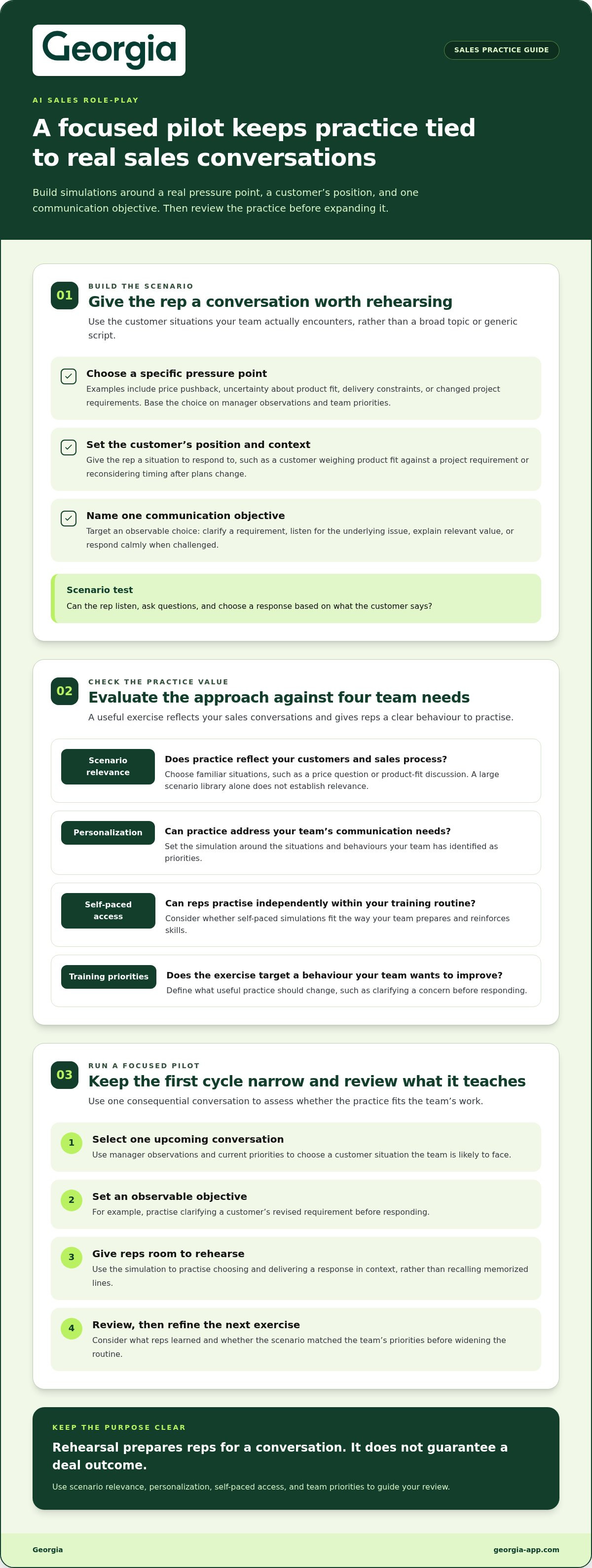
A simulation is useful when it reflects a conversation your team needs to handle. Build it around three elements: a clear situation, the customer’s position, and one practice objective. Together, these give the rep a reason to listen, respond, and make a deliberate communication choice.
Choose a realistic pressure point for the simulation
Start with a conversation pattern managers want reps to handle more effectively. Draw on your own call observations and team priorities. For example, a customer may question whether a material fits the project, push back on price, or raise a delivery constraint. These are starting points; your team’s actual conversations should set the agenda.
Next, define the context and the decision the rep needs to practise. A customer might be weighing product fit against a project requirement, or reconsidering timing after a change in plans. Give the scenario enough detail to make the exchange relevant, while leaving room for the rep to ask questions and respond to what the customer says.
Practise communication choices, not memorized lines
A rigid script can give a rep words to repeat without preparing them for the customer’s next concern. Set the objective around a behaviour instead: listen for the underlying issue, clarify a requirement, explain relevant value, or respond calmly when challenged. The scenario gives that behaviour a practical context.
Conversation rehearsal develops the ability to choose a useful response; memorizing a pitch builds recall. That difference matters when a customer changes direction or introduces a concern the rep did not expect. Personalized, self-paced simulations let teams focus practice on communication needs rather than asking every rep to work through the same generic script.
Explore Georgia’s AI role-play training platform to see how simulated practice can support sales and commercial training. Set the scenario around your team’s priorities and give reps a clear communication objective before the next customer conversation.
Evaluate AI Sales Role-Play by Scenario Fit and Practice Value
Begin with a real team conversation and a specific practice objective. Then assess whether the approach fits the way your team trains and the communication behaviours it wants reps to practise.
| Criterion | Evaluation question |
|---|---|
| Scenario relevance | Does practice reflect your customers and sales process? |
| Personalization | Can practice address your team’s communication needs? |
| Self-paced access | Can reps practise independently within your training routine? |
| Training priorities | Does the exercise target a behaviour your team wants to improve? |
Assess whether scenarios reflect the team’s sales conversations
Use situations managers recognize, such as a price question or a product-fit discussion. A large scenario library does not establish relevance on its own. Select examples based on the customer conversations your team handles and the points where reps need more practice.
For a related communication focus, explore sales negotiation training.
Define what useful practice should change
Choose an observable behaviour, such as clarifying a concern before responding. Ask reps and managers where they expect that behaviour to matter in live conversations. Georgia provides personalized, self-paced AI simulations for sales and commercial training. Assess how the practice aligns with your objective without treating rehearsal as a guarantee of conversion or revenue results.
Run a Focused AI Role-Play Pilot Before Expanding Practice
A focused pilot helps you assess whether practice fits your team’s work before adding it to a wider training routine. Keep the first cycle narrow: select one consequential conversation, set a communication objective, let reps practise, review what they learned, then refine the next exercise. This sequence keeps the evaluation tied to actual sales priorities.
Start with one consequential conversation
Choose a conversation your team is likely to face in upcoming work, based on manager observations and current priorities. Set an objective the rep can act on, such as clarifying a customer’s revised requirement before responding. “Build confidence” is too broad to guide a useful rehearsal. A clear behaviour gives the rep a target and helps the manager assess whether the scenario was relevant.
Keep the first exercise focused on one conversation and one objective. That makes it easier to identify whether the scenario reflects the team’s needs, without mixing several practice goals. Explain why the team is rehearsing this situation and how it connects to customer discussions. Relevance helps reps see the purpose of the exercise.
Make practice repeatable without adding process noise
Fit practice into your existing training program. Georgia’s AI-powered, personalized, self-paced simulations give reps a way to practise communication under pressure. Give each exercise a clear purpose and keep the review straightforward: ask reps whether the situation felt relevant and which part of the exchange challenged them. Managers can add observations about the target behaviour.
Use those reflections to choose the next scenario or refine the objective. If the practice felt disconnected from current customer conversations, adjust the situation. If the scenario fit but the objective was too broad, narrow the behaviour for the next round. This feedback helps you decide whether to expand ai sales role play to more conversations or continue refining the initial exercise.
To see how Georgia’s platform can fit your training program, book a Georgia demo.
Final Thought: Put AI Sales Role-Play Before the Next High-Stakes Call
Choose one upcoming or recurring customer conversation. Name the pressure point, then set one behaviour for the rep to practise, such as clarifying a concern before responding. Georgia’s personalized, self-paced AI simulations support sales practice before live customer conversations. Book a demo to see how the platform can fit your team’s training program.
Put Rehearsal Before the Next Customer Call
High-stakes sales conversations need preparation that reflects the customer and the decision in front of the rep. Start with one recurring or upcoming pressure point, define the communication behaviour to practise, and use manager and rep observations to refine the scenario. This gives each rehearsal a clear purpose tied to the sales work your team faces.
Evaluate ai sales role play by scenario relevance, personalization, self-paced access, and fit with your training priorities. Georgia provides personalized, self-paced AI role-play simulations and sales and commercial training modules, giving your team a way to rehearse communication before customer conversations. Keep the evaluation focused on how practice fits your team’s needs.
Choose the next conversation for rehearsal and set a specific practice objective. A focused first scenario gives your team a practical starting point for a repeatable routine that prepares reps before a conversation carries live consequences.
Make the next important customer conversation one your team has already practised.
Frequently Asked Questions
What is AI sales role-play?
AI sales role-play is simulated conversation practice where a sales rep rehearses communication with an AI-powered counterpart. Practice can focus on a customer situation and a specific behaviour, such as clarifying a concern or explaining value. Georgia provides personalized, self-paced simulations for soft-skills practice, helping teams prepare for communication under pressure before a live customer conversation.
How does AI sales role-play help reps prepare for customer calls?
AI sales role-play gives reps a chance to practise how they communicate before a customer call. They can focus on listening, asking clarifying questions, and responding to a challenge rather than relying only on advice or a memorized pitch. Personalized, self-paced practice can fit the team’s training needs and give reps a place to prepare for consequential conversations.
Can AI role-play simulate sales objections?
Yes. Teams can use role-play practice to rehearse conversations about objections such as price concerns, timing challenges, or questions about product fit. Set a clear customer position and choose the communication behaviour the rep should practise in response. Keep the scenario tied to objections your team actually encounters, then review whether the exercise addressed the intended objective.
How can sales managers choose useful AI role-play scenarios?
Choose scenarios from your team’s real sales conversations and current priorities. Identify the moment where the exchange becomes difficult, define the customer’s position, and set one observable behaviour for the rep to practise. For example, the goal might be to clarify a product-fit concern before explaining value. A large scenario library alone does not show whether practice fits your team’s needs.
Is AI sales role-play useful for building materials and construction sales teams?
It can support communication practice for teams in building materials, concrete, aggregates, and construction. Reps can practise situations relevant to their sales process, such as responding to price questions, discussing product fit, or clarifying changing customer requirements. The value depends on scenario relevance and a clear practice objective. Use your team’s customer conversations to decide which situations merit rehearsal.
How often should sales reps practise with AI role-play?
Set a practice rhythm that fits your team’s training program and sales priorities. Schedule rehearsal around an upcoming customer conversation or return to a recurring pressure point as needed. Review whether reps find the scenario relevant and whether the objective remains useful. Use manager observations and learner reflections to adjust the frequency to your team’s needs.
What should a team evaluate in an AI sales role-play platform?
Evaluate whether practice fits your team’s sales conversations, supports personalization, allows self-paced access, and aligns with training priorities. Define the scenario and communication objective first, then assess the platform against those needs. Georgia provides personalized, self-paced AI simulations and sales and commercial training modules. Book a demo to see how they fit your program.