

How to boost sales performance starts with fixing the conversations that stall deals, rather than adding more calls to the calendar. A rep who misses a key requirement or leaves the next step unclear can turn customer activity into lost opportunity.
Activity alone does not guarantee revenue. The harder task is locating where a deal loses momentum: a rep pitches before understanding the job, misses a concern about price or delivery, or leaves the next step vague. These moments give managers practical evidence to act on.
This article lays out a system to diagnose conversation breakdowns, rehearse challenging customer exchanges, and track behavior change alongside relevant commercial outcomes. Connect what managers hear in calls to focused practice and measures such as win rates, deal size, and revenue. That way, performance reviews identify actions reps can use in their next customer conversation.
Key Takeaways
- Learn how to boost sales performance by linking conversation quality to commercial outcomes, not activity totals alone.
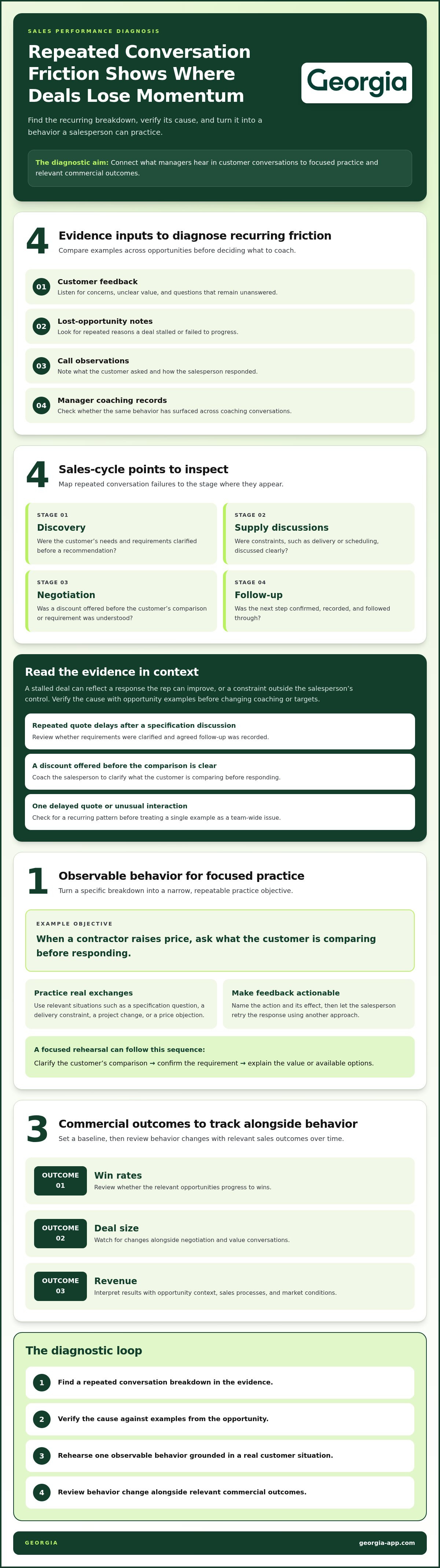
- Use customer feedback, lost-opportunity notes, call observations, and coaching records to find recurring deal friction.
- Turn one observable behavior into a focused practice objective grounded in real customer situations.
- Set a baseline, then track behavior changes alongside relevant sales outcomes over time.
- Choose one recurring conversation breakdown, rehearse it, and review the evidence for improvement.
Treat Sales Performance as an Operational Outcome, Not an Activity Score
Calls, visits, and quotes consume selling time. When conversations fail to move customer decisions forward, the team spends effort without advancing commercial priorities.
Define sales performance through the quality and consistency of execution linked to outcomes. Activity counts show what reps did; opportunity progression and deal quality show what followed. Market conditions, sales processes, and customer interactions all shape results, so interpret activity alongside the context of each opportunity.
For a broader view of the factors involved, see Sales effectiveness. This video offers another perspective on sales execution:
Separate Activity Measures From Evidence of Progress
Use existing CRM stages to find where opportunities stall, decisions get deferred, or quotes receive no response. Compare activity with stage progression and the actions agreed with the customer. A high call count can show effort, while an unchanged pipeline may point to a problem with qualification, follow-up, or the conversation itself.
Review patterns across opportunities before drawing conclusions. One delayed quote may reflect a customer’s project timing; repeated delays after the same kind of discussion may indicate a behavior the team can address.
Find the Operational Cost of Repeated Sales Friction
Track recurring delays, unclear next steps, avoidable discounting, and weak follow-up. A concrete quote awaiting a response about scheduling can disrupt planning. An aggregates deal discounted before requirements are clear can erode value.
Make the cost visible by recording what stalled, where it happened, and what action was left unresolved. Explore soft-skills training and revenue leakage to connect conversation behaviors with commercial loss.
Diagnose the Conversation Breakdowns That Weaken Sales Results
Map repeated conversation failures to the sales stage where they appear. Review customer feedback, lost-opportunity notes, call observations, and manager coaching records to identify patterns across discovery, supply discussions, negotiation, and follow-up.
Separate skill gaps from process constraints, product issues, and market conditions. A stalled deal may reflect an unclear response from the rep, or a constraint the salesperson cannot control. Verify the cause with examples from the opportunity before changing coaching or targets.
Locate Friction Across the Sales Cycle
Look for repeated signs such as unclear value, premature discounting, unanswered customer concerns, or unconfirmed next steps. Compare examples from successful and stalled opportunities at the same stage, including what the customer asked and how the salesperson responded. This helps reveal patterns without treating one unusual interaction as a general rule.
Check whether the same friction appears at a particular handoff or stage. If quotes regularly stall after a specification discussion, for example, review whether the customer’s requirements were clarified and whether the agreed follow-up was recorded.
Turn Observations Into Coachable Behaviors
Describe what the salesperson said or did, not a personality label. “Discounted before clarifying the customer’s comparison” points to an action that can change. A stronger response could clarify the comparison first, then address the concern in context.
For negotiation exchanges that break down under pressure, use examples from the team’s actual conversations to define what to rehearse. Personalized, self-paced AI role-play practice can help salespeople rehearse specific customer scenarios.
Coach Sales Behaviors Through Relevant, Repeatable Practice
A diagnosis matters when it changes what happens on the next customer call. Turn the observed breakdown into one practice objective, then give the salesperson a realistic chance to try a stronger response before the pressure is live.
For example, if a rep discounts as soon as a contractor raises price, set a focused objective: ask what the customer is comparing before responding. Keep the target narrow. One rehearsal should develop one behavior the manager can observe and the salesperson can apply.
Build Practice Around Real Customer Situations
Use situations your team encounters: a specification question that needs clarification, a delivery constraint, a change in project requirements, or an objection to price. Ground the scenario in your sales environment while removing customer names and details that identify a specific account.
Give each practice a clear outcome. The salesperson might clarify the customer’s needs before recommending a product, explain a constraint while keeping the discussion productive, or respond to a commercial objection without surrendering value too quickly. Realistic details make rehearsal relevant; a defined objective makes it coachable.
Keep each scenario focused on the difficult exchange. A customer raises a concern, the salesperson responds, and the conversation continues. Repeating the scenario with a different response helps the rep prepare for pressure without relying on a memorized script.
Make Coaching Specific Enough to Apply on the Next Call
Feedback should identify an action and its effect. “You agreed to a discount before confirming the volume requirement” gives the salesperson something concrete to examine. “You need to be more confident” offers no observable next step.
Ask the salesperson to retry the response using another approach. For instance, clarify the customer’s comparison, confirm the requirement, then explain the value or available options. This turns feedback into applied practice and supports stronger negotiation under pressure.
AI role-play can provide personalized, self-paced simulations for teams to rehearse these soft-skill conversations repeatedly. For more on connecting practice with revenue leakage, explore the related article on AI role-play training. To see how AI role-play practice can support your team, review Georgia’s platform.
Measure Behavior Change Alongside Sales Outcomes
If you introduce coaching without recording a baseline, you cannot tell whether execution changed. Before the new practice cycle starts, capture the current behavior and the commercial measures connected to the problem.
For example, if reps often leave quote discussions without confirming a next step, review a sample of current calls or records and note how often that behavior appears. Pair it with an existing outcome, such as quote progression or win rate. The goal is a useful comparison, not a claim that one training approach caused every change.
Choose Measures That Match the Diagnosed Problem
Pick a behavior indicator managers can observe and salespeople can act on. If the diagnosed gap involves discovery, track whether reps clarify the customer’s requirements before recommending a solution. Pair that measure with a relevant pipeline or sales outcome already used by your organization.
Keep the set small enough to guide a decision. Activity totals can provide context, but they do not show whether the targeted behavior improved or whether opportunities moved forward.
| Leading indicators | Lagging indicators |
|---|---|
| Whether reps confirm requirements, summarize concerns, and agree on next steps | Opportunity progression, win rate, deal size, or revenue |
| Whether the target behavior appears in call observations and CRM records | Results across comparable teams, periods, or opportunity types |
Use Review Findings to Adjust the Next Practice Cycle
Review behavior measures and sales outcomes together. If the target behavior appears more often while opportunities continue to stall, inspect call observations and CRM records for other friction, such as a process constraint or a customer requirement the team cannot meet.
Compare patterns across similar teams or periods, and account for changes in market conditions, product availability, pricing, and sales processes. The evidence can show where results moved and what to investigate next. It cannot isolate training as the sole cause of a commercial change.
Use the findings to choose the next practice objective. Personalized, self-paced role-play can support repeat practice across a team while managers continue to review observable behaviors and relevant outcomes.
Final Thought: Put Better Sales Conversations Into Practice
To decide how to boost sales performance, choose one recurring friction point supported by team evidence. Define the behavior managers and salespeople should recognize, rehearse it, then review call observations and existing sales measures at a set point.
Georgia’s AI-powered role-play platform uses personalized, self-paced simulations to help teams practice sales conversations, including communication under pressure. Make the next step specific: explore the platform and book a demo.
Make Conversation Improvement Part of Sales Operations
Sales activity creates commercial value when customer conversations move opportunities forward. To improve performance, trace recurring friction to a specific stage, coach an observable behavior, and review that behavior alongside relevant pipeline and sales outcomes. This gives you a practical way to understand how to boost sales performance without mistaking activity totals for progress.
Build the next practice cycle around evidence from your own team. Georgia’s AI-powered role-play platform supports sales and commercial training modules through personalized, self-paced communication simulations, giving salespeople a way to rehearse relevant conversations and communication under pressure.
Choose one conversation breakdown, give your team a clear behavior to practice, and use the evidence to decide what comes next. Better sales execution starts with that deliberate step.
Frequently Asked Questions
How can sales managers improve sales performance without simply increasing activity targets?
Sales managers improve performance by fixing a specific execution gap rather than raising activity targets by default. Review customer interactions to locate where conversations stall, then coach one observable behavior, such as confirming the buyer’s requirements before discussing price. Calls and visits still provide context, while opportunity progression and conversation quality show whether work is advancing. Compare relevant outcomes over time and treat any change as evidence to investigate, not a guaranteed result.
What should a sales manager measure to understand performance?
Measure activity, leading indicators, and lagging commercial outcomes as separate signals. Calls and visits show effort; observable behaviors, such as confirming next steps, show execution; pipeline progression, win rate, deal size, or revenue show commercial results. Choose measures that match the diagnosed problem and use existing CRM or coaching records to interpret them. Several factors affect sales outcomes, so avoid attributing a change to training alone.
How do you identify why a sales team is losing opportunities?
Review lost-opportunity notes, customer feedback, observed conversations, and stalled pipeline stages to find recurring patterns. Check where the deal stopped and what happened in the relevant interaction. A rep may have left a next step unclear, while a process constraint, product issue, or market condition may also explain the loss. Validate the diagnosis with specific examples before changing targets or training, so the response addresses the source of the friction.
Can role-play help improve sales performance?
Role-play gives salespeople a structured opportunity to rehearse specific customer conversations and receive focused feedback. It is most useful when scenarios reflect real situations and connect to a clear coaching need, such as clarifying requirements or responding to a price objection. Personalized, self-paced simulations can support repeated communication practice. Practice alone cannot resolve process or market constraints, and it does not guarantee a particular revenue result.
How can sales teams improve objection handling under pressure?
Choose common objections from actual customer interactions, then rehearse responses that clarify the concern and preserve commercial value. For a price objection, a salesperson might first ask what the customer is comparing, then respond to that specific concern. Review how the behavior appears in later conversations and adjust practice as needed. Scenarios should reflect your team’s products, customers, and operating conditions. One script will not fit every objection or account.
How do you know whether sales training is improving performance?
Record a baseline before training, track the targeted behavior, and compare relevant sales outcomes over time. For example, review whether reps confirm next steps in customer conversations alongside opportunity progression in CRM records. Call observations and coaching notes add context to the numbers. Commercial results can shift for several reasons, including market conditions and process changes, so treat a relationship between training and outcomes as evidence to assess, rather than proof that training alone caused the change.