

A price objection can turn a solid construction sale into an unnecessary discount when a rep has no practiced response. Objection handling practice software gives your team a place to rehearse the conversations that put margin and momentum at risk.
One-off training sessions are difficult to repeat across a dispersed team. Completion records show who finished a module, but they do not show how a rep responds when a customer challenges a quote or questions whether a proposed solution fits the project.
Evaluate practice against the conversations your team actually faces, then build rehearsal into the workweek. Focus on realistic scenarios, self-paced practice, and a clear way to identify development needs. The aim is to help reps prepare for the next customer conversation before it happens.
Key Takeaways
- Trace where price, delivery timing, or project-fit objections cause customer conversations to lose momentum.
- Build practice around real objections, customer context, rehearsal, review, and repetition.
- Evaluate objection handling practice software by scenario fit, personalization, repeatability, and progress visibility.
- Start with a recurring objection and assign focused practice before or between relevant customer conversations.
- Use practice observations to identify where each rep needs more development.
Identify the Revenue Friction Behind Each Objection
An unprepared response can turn a customer’s price concern into an unnecessary discount. When a rep answers before understanding the issue, the conversation can lose momentum or move toward a concession the customer did not request.
Evaluate objection handling practice software against the pressure points your team actually hears. Start by identifying which customer exchanges stall, what the customer says, and how the rep responds.
Watch this example of a sales response to an objection:
Map the objections that interrupt real sales conversations
Group objections by concern: price, timing, or project requirements. A price challenge might involve a competing quote; a timing concern might follow a change to the pour schedule. Capture the customer’s actual phrasing and the point at which the exchange slowed. Those details give practice a useful starting point and connect it to your team’s sales conversations and wider sales techniques.
Separate training activity from conversation readiness
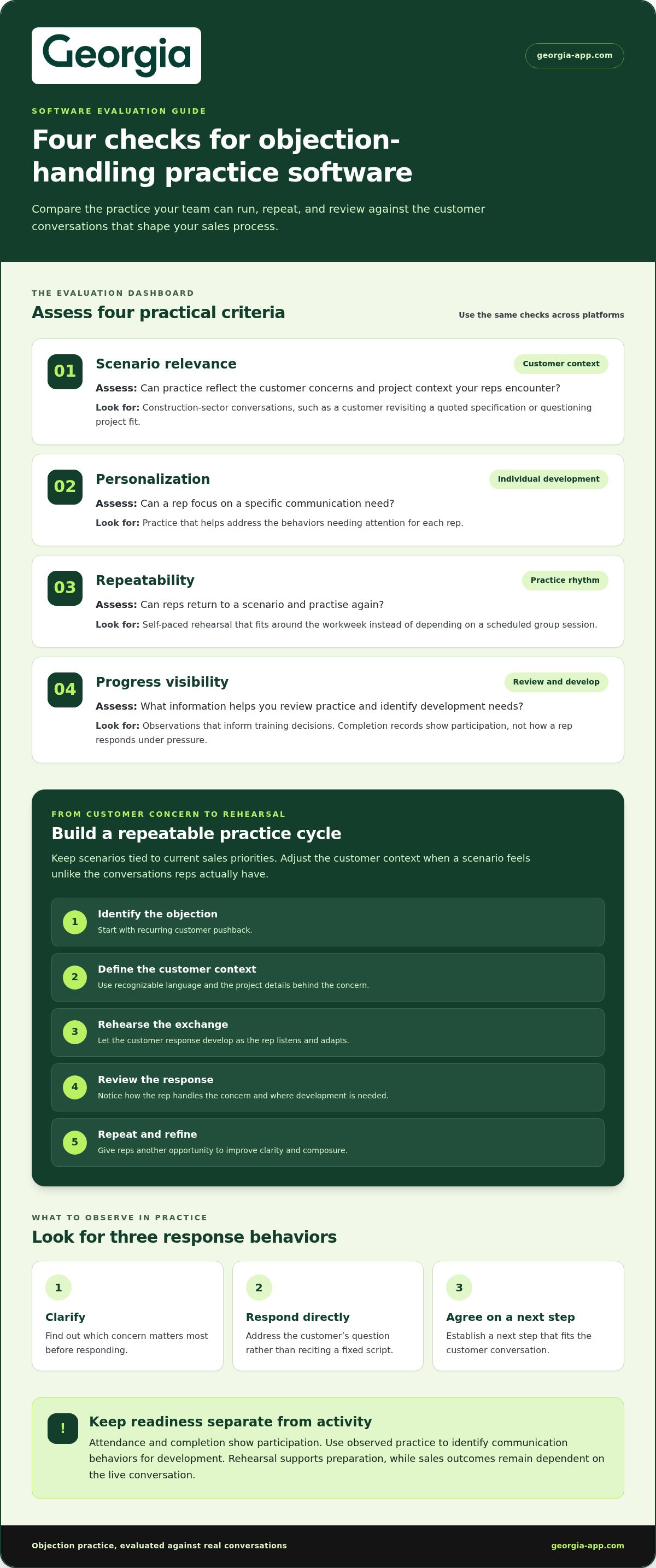
Attendance shows participation, not how a rep responds under pressure. Look for observable behaviors: does the rep clarify the concern, answer the question directly, and agree on an appropriate next step? Rehearsal gives reps a setting to work on those behaviors, while managers can use what they observe to direct development. Practice supports preparation, though it cannot guarantee a sales outcome.
Georgia’s AI role-play practice lets teams rehearse soft-skill conversations through personalized, self-paced simulations. Build scenarios around recurring objections and give reps repeated opportunities to practise a response before the next customer conversation.
Build Objection Handling Practice Around Real Conversations
Give practice a clear route from a customer objection to a response the rep can refine: identify the objection, define its context, rehearse, review, and repeat.
A useful scenario recreates a recognizable customer concern and the business context behind it. The rep should have to listen, clarify, and adapt their response as the exchange develops.
Turn recurring customer pushback into focused scenarios
Build each scenario around one objection your team regularly hears. For example, a customer challenges a quote, then explains that project timing has changed. The rep needs to find out which concern matters most before responding. Use customer language your team recognizes, and let the exchange develop in response to what the rep says. That tests judgment and listening rather than recall of a fixed script.
Repeat practice until the response becomes usable
Repeated attempts give reps room to improve clarity and composure. Review whether they clarify the concern, respond directly to it, and establish a relevant next step. Personalized, self-paced simulations let reps practise without waiting for a scheduled group session. Georgia’s AI role-play platform supports repeatable rehearsal around real objections.
Choose objection handling practice software that fits this cycle and keeps scenarios connected to current sales priorities. If a scenario feels unlike the conversations reps have, revise its customer context and objection before assigning it again.
Compare Software by Scenario Fit, Repeatability, and Visibility
Feature lists can make different platforms look similar. Base your evaluation on whether reps can practise the conversations that shape your sales process, repeat them, and focus on communication behaviors that need development.
Compare scenario relevance, personalization, repeatability, and progress visibility: does practice reflect your customers, adapt to individual development, support repeated attempts, and help you identify where communication needs work?
| Criterion | What to assess | What it means for your team |
|---|---|---|
| Scenario relevance | Can practice reflect the customer concerns and project context your reps encounter? | Scenarios should fit construction-sector sales rather than rely only on broad, industry-neutral examples. |
| Personalization | Can a rep focus practice on a specific communication need? | Individual development can address the behaviors that need attention. |
| Repeatability | Can reps return to a scenario and practise again? | Rehearsal can fit around the workweek instead of depending on a scheduled group session. |
| Progress visibility | What information helps you review practice and identify development needs? | Use information that helps inform a training decision, rather than treating activity alone as readiness. |
Check whether scenarios fit construction-sector sales
Broad sales examples can help reps practise general communication. Your team also needs scenarios that reflect its own sales context, such as a customer revisiting a quoted specification or questioning how a proposed solution fits project requirements. Compare the conversation itself, not the feature label attached to it.
During evaluation, consider whether practice can reflect your team’s customer context and whether the buyer’s responses leave room for the rep to listen and adapt. Useful detail makes rehearsal relevant to the work without turning the scenario into a script with only one acceptable answer.
Look for evidence of practice and progress
Assess how reps repeat a scenario and whether they can focus practice on individual development needs. Then consider what information is available to review their practice. Useful observations can help you identify communication behaviors to strengthen. A completion record shows that a rep took part; it does not establish how they will handle a live conversation.
Use consistent criteria to assess AI role-play alongside your wider sales training, including sales negotiation training. The value of objection handling practice software comes from connecting practice to real team conversations and giving reps a repeatable way to improve.
Put Practice Into the Sales Team’s Operating Rhythm
Practice loses its place when it depends on a calendar slot that keeps moving. Give it a recurring place in the workweek, tied to objections reps are hearing now and conversations they expect to have soon.
Start with one practical practice cycle
Choose one recurring objection and define the response behavior you want reps to practise. For example, focus on whether they clarify the customer’s concern before offering an answer. Assign individual, self-paced rehearsal before a relevant customer interaction, then review the scenario together during an existing team check-in.
Use the review to identify the next practice need. If reps respond before they understand the concern, make clarification the focus of another scenario. If they understand the concern but struggle to explain their response clearly, adjust the next exercise to target that behavior. Build each cycle from what you observe in practice, without treating rehearsal as a promise of a particular sales result.
Make practice relevant to each sales role
Reps need realistic opportunities to rehearse their own customer conversations. Trainers need a clear way to shape scenarios around team priorities. Managers need to spot patterns and decide where to direct attention. Keep scenarios anchored to the same business context, then tailor each person’s practice to the communication behavior they need to work on.
The four buyer profiles, Driver, Analytical, Persuader, and Craftsman, can guide how you frame a practice scenario and the feedback that follows. Use each profile as a prompt for adapting the learning experience, then assess the rep’s actual response. Personalized, self-paced simulations make it possible for a dispersed team to practise on its own schedule.
Use Georgia’s AI role-play platform to extend conversation practice beyond scheduled sessions. Keep the process simple: select a relevant objection, assign focused rehearsal, review what the practice reveals, and choose the next development priority. That gives objection handling practice software a defined role in team operations.
Explore AI role-play practice for your sales team
Final Thought
Evaluate objection handling practice software against the objections your team hears, the scenarios reps can repeat, and the practice observations that help you target development. Georgia’s personalized, self-paced AI simulations give sales teams a practical way to rehearse realistic conversations as part of their training program.
Bring a recurring team objection to your evaluation. Decide what response behavior reps should practise, then see how rehearsal can fit into the team’s routine.
Build Rehearsal Into the Next Sales Conversation
Start with a recurring objection that puts pressure on your sales conversations. Shape practice around the customer context, give reps repeated opportunities to rehearse, and review the communication behaviors that need more attention.
Evaluate objection handling practice software by scenario fit, repeatability, and useful visibility into development. A completed session shows participation. Practice grounded in real customer exchanges gives you a clearer basis for deciding what the team should work on next.
Georgia offers personalized, self-paced AI simulations for sales, customer support, and leadership teams. Explore how this practice can fit your sales training and help reps prepare for customer conversations before they happen.
Choose a real objection, set a focused practice goal, and give your team a repeatable way to develop its responses. Book a demo of Georgia to see how AI role-play practice can fit your sales training program.
Frequently Asked Questions
What does objection handling practice software do?
Objection handling practice software gives sales reps a structured way to rehearse responses to customer pushback before live conversations. Depending on the platform, reps can work through simulated scenarios, repeat practice at their own pace, and review how they communicate. Managers can use observations from practice to identify development needs. The aim is to build preparation for real conversations, not to promise a particular sales outcome.
How can sales reps practise handling customer objections?
Start with an objection the rep regularly hears and define the customer context around it. Have the rep practise clarifying the concern, responding directly, and agreeing on a relevant next step. For example, a buyer challenges a quote and then explains that project timing has changed. Give the rep room to listen and adapt as the conversation develops, rather than repeat a fixed answer regardless of context.
Can AI role-play simulate difficult sales conversations?
AI role-play provides simulated conversations for reps to practise communication under pressure. A scenario can present a customer concern and respond to what the rep says, giving them opportunities to refine their approach. Georgia provides personalized, self-paced simulations for soft-skill conversations. Reps can use this format to rehearse challenging exchanges, while managers focus development on the communication behaviors that matter to their team.
What should sales managers compare when choosing objection handling software?
Compare scenario relevance, personalization, repeatability, and progress visibility. Check whether reps can practise objections that match your customer conversations, focus on individual development needs, repeat scenarios, and review practice usefully. Feature labels alone reveal little about fit. For construction-sector sales, assess how well scenarios reflect conversations around price, project requirements, or timing, and whether practice can fit into your team’s routine.
How can objection practice support construction-sector sales teams?
Objection practice lets reps rehearse customer conversations tied to their work, including price pressure, changes to delivery timing, and questions about project fit. Reps can practise clarifying the buyer’s concern before choosing a response. Sales managers and trainers can use recurring objections to shape relevant scenarios, then direct attention toward communication behaviors that need more development across the team.
How often should sales reps practise handling objections?
Set a repeatable cadence around the objections your team is hearing and the customer conversations reps expect to have. Reps can practise individually before or between relevant calls, then revisit a scenario when the objection recurs or practice reveals a skill to strengthen. Self-paced simulations make repetition easier to schedule across a dispersed team. Keep each session focused on a specific response behavior.
How can managers tell whether objection handling practice is improving?
Review observable behaviors across practice attempts and relevant customer conversations. Look at whether reps clarify the concern, respond to what the customer actually said, explain their position clearly, and establish a sensible next step. Completion data shows participation; repeated practice and manager review give you a more useful view of development. Use the patterns you observe to adjust scenarios and choose the next communication skill to practise.