

A rep who loses control of a pricing or supply conversation can put a valuable account at risk. When you compare sales training platforms, the deciding factor is whether reps can practise those high-stakes moments before they happen with a customer.
A course can explain a sales process. The harder test is whether a rep can use it under pressure, with different customers and in different roles. Course completion alone won’t tell you that.
This comparison framework helps you assess platforms against observable sales behaviors, choose a delivery model that fits your team’s schedule, and identify what to verify before you commit. The goal is to find an option that supports more consistent handling of the conversations your reps face.
We’ll compare structured learning, practice-based options such as AI role-play, and the reinforcement each approach supports. You’ll leave with practical questions for vendor evaluations and a way to judge fit by the conversations your reps need to handle, not by a feature list.
Key Takeaways
- Compare sales training platforms by the conversations reps need to handle, including objections, value discussions, and margin pressure.
- Check whether learners can practise realistic scenarios and access training in a way that fits their schedules and roles.
- Match platform types to the job required, from structured courses to AI role-play and conversation review.
- Use a real customer scenario in the demo to test the learner and manager workflow, not just the feature presentation.
- Document the use case, demo findings, and pilot measure before selecting a platform.
Compare Sales Training Platforms by the Conversations They Help Reps Handle
When reps struggle to explain value, handle objections, or protect margin, the consequences can show up in a deal. A sales training platform may support learning, practice, coaching, or performance review. The label alone won’t tell you which job it does well.
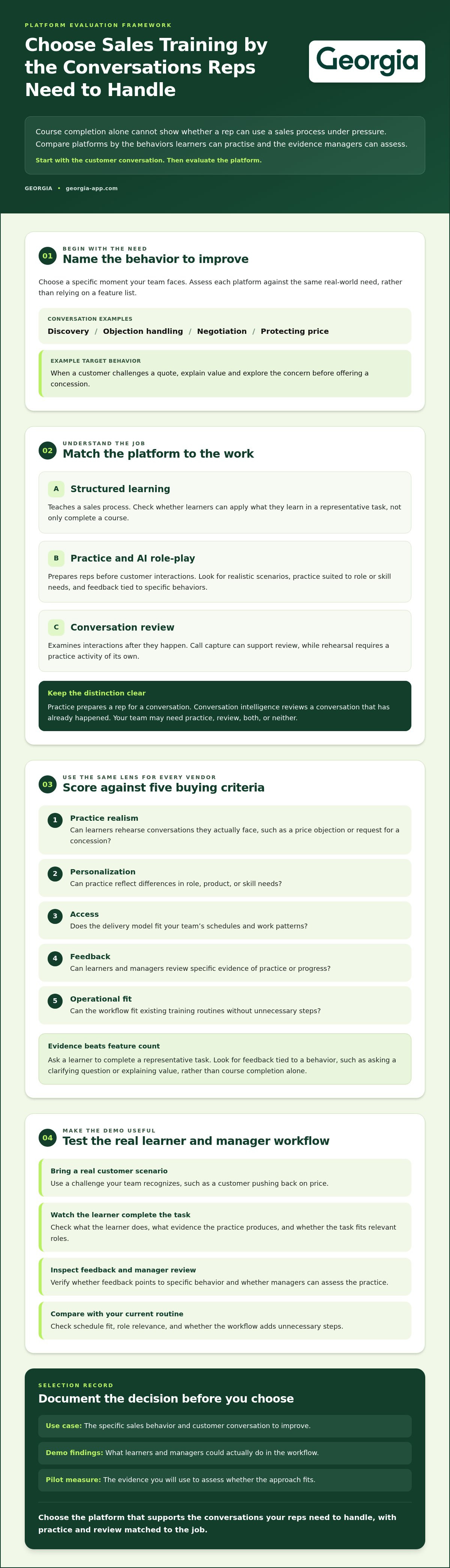
Some platforms teach a sales process. Others let reps practise conversations or help teams review completed calls. To compare sales training platforms, start with the behavior your team needs to improve. Then check whether learners can practise it and whether managers can assess it.
Use vendor-comparison content as a starting point, then evaluate each platform against your team’s actual workflow:
Separate Sales Training from Sales Conversation Intelligence
Conversation practice prepares a rep before a customer interaction. Conversation intelligence examines an interaction after it happens. Call capture can provide material for review, but it does not give reps rehearsal by itself.
Your team may need practice, call review, both, or neither. Decide based on the gap. If reps know the process but struggle to respond under pressure, look for a way to rehearse. If managers need to examine completed conversations, assess review capabilities. The broader discipline of sales management includes planning and reporting, but those activities don’t automatically prepare reps for difficult dialogue.
Define the Behavior the Team Needs to Change
Choose a specific sales moment before you assess vendors: discovery, objection handling, negotiation, or protecting price. Tie it to a challenge your team recognizes. For example, if reps concede margin when customers challenge a quote, define the target behavior as explaining value and exploring the concern before offering a concession.
A fit-for-purpose platform lets reps practise a defined sales behavior and gives managers a way to assess what they can demonstrate. Use that standard to look beyond feature lists. Ask what learners actually do, what evidence their practice produces, and how the activity relates to the customer conversations your team handles.
Score Sales Training Platforms Against Five Buying Criteria
Apply the same criteria to every vendor. Ask for a demonstration of relevant capabilities, and record any claims you haven’t been able to verify.
- Practice realism: Can learners rehearse conversations they actually face, such as a price objection or a request for a concession?
- Personalization: Can practice reflect differences in role, product, or skill needs?
- Access: Does the delivery model fit the team’s schedules and work patterns?
- Feedback: Can learners and managers review specific evidence of practice or progress?
- Operational fit: Can the workflow fit existing training routines without creating unnecessary steps?
Research on training approaches, including effective sales training, can inform your evaluation. Use your own requirements to assess vendor claims, and request a demonstration when details are unclear.
Prioritise Practice and Feedback Over Feature Count
Ask a learner to complete a representative task in the platform. Check whether any feedback points to a specific behavior, such as asking a clarifying question or explaining value, rather than simply recording course completion. If a feature claim is important to your decision, ask the vendor to show it in the workflow.
Test Fit for Your Team’s Commercial Scenarios
Choose scenarios that reflect your team’s sales conversations, then check whether people in different roles can practise situations relevant to their work. Compare the learner and manager workflow with your current routines. You can use a Georgia platform demo to assess whether its personalized, self-paced simulations fit your evaluation criteria.
Match Each Sales Training Platform Type to the Job It Performs
Each platform type supports a different part of sales development. Compare the learner activity, the evidence it provides, and what it doesn’t cover before deciding whether tools need to work together.
| Type | Activity and best fit | Evidence and limitation |
|---|---|---|
| Course platform | Lessons and knowledge checks for structured content | May show completion, not whether a learner can handle a conversation |
| Conversation intelligence | Reviews completed calls | Verify vendor evidence and review functions; it does not provide rehearsal by itself |
| Live learning | Facilitated instruction and group development | Ask how participation is assessed; scheduled sessions require coordination |
| AI role-play | Simulated conversation practice at an individual pace | Verify what feedback is available; a simulation is not the same as a customer call |
Compare Courses, Conversation Analysis, and Role-Play
Courses deliver structured information. Conversation intelligence examines actual calls, though capabilities vary by vendor. AI role-play gives reps a way to practise simulated conversations. For each format, check whether its activity matches the skill gap you’re trying to address and whether the scenarios reflect interactions your team handles.
Choose a Blended Approach Only When the Workflow Supports It
Map tools to preparation, rehearsal, coaching, and post-call review. Give each tool a defined purpose and owner so activities don’t overlap without a reason. If self-paced simulation fits a specific need, assess an AI role-play training platform against your criteria.
Run a Sales Training Platform Demo With Real Scenarios
Give every vendor the same realistic scenario and learner task. Ask a rep and manager to try the workflow rather than just watch a feature presentation. A customer challenging a quote or pushing for a concession can show whether the practice reflects conversations your team needs to handle.
Use the Same Scenario With Every Vendor
Set one target behavior, such as clarifying a concern before responding. Have learners complete the same task in each demo. Record what the platform supports, what evidence it provides, and where managers still need to coach. Using a consistent task makes it easier to compare learner experience across platforms.
Ask Questions That Expose Operational Fit
Ask how learners access and revisit practice, what feedback they receive, and what managers can review. Request a demonstration of each capability that matters to your decision, and confirm any setup requirements. Before a pilot, write down the use case and an observable success measure based on your team’s needs.
Final Thought
Choose the platform that lets reps practise the behavior your team needs to change. That test cuts through feature lists and keeps the decision tied to the work.
Before selecting, document the use case, what each demo showed, and the measure you’ll use in a pilot. Keep the evidence focused on the behavior learners can demonstrate.
If your team is evaluating personalized, self-paced AI role-play, explore Georgia’s AI role-play platform and assess whether it fits your training needs.
Choose the Platform That Changes Rep Behavior
To compare sales training platforms, start with the customer conversations your reps need to handle. Score each option on realistic practice, useful feedback, operational fit, and evidence of observable behavior. Then use the same scenario in every demo to compare the learner experience against a consistent standard.
Before you select a platform, document the use case, demo findings, and pilot measure. Georgia offers personalized, self-paced simulations for practising soft-skill conversations, alongside sales and commercial training modules. Assess whether this approach fits your team’s roles and training routine.
Make the decision around what reps can practise and demonstrate. A clear use case gives your team a stronger basis for choosing training that supports better customer conversations.
Frequently Asked Questions
How do I compare sales training platforms?
Start with the sales behavior your team needs to improve, such as handling objections or protecting value. Then compare sales training platforms on realistic practice, useful feedback, learner access, and manager visibility. Give each vendor the same scenario during a demo. Record what learners can do, what evidence managers can review, and where existing coaching remains necessary. This keeps the decision tied to the work reps need to perform.
What features should a sales training platform have?
The right capabilities depend on the training job. Check for relevant learning content, realistic practice, feedback, learner progress review, and practical administration. Ask each vendor to demonstrate its claims with a scenario from your sales operation, such as a customer challenging a quote. Focus on functions your team will use. A feature list describes a product; a practical evaluation shows whether its workflow supports the behavior you want to change.
Can AI role-play help sales reps practise difficult conversations?
AI role-play can give reps simulated conversations in which to practise communication skills. Georgia provides personalized, self-paced simulations designed to help people practise communication under pressure. During a demo, try a scenario your team recognizes and ask what feedback learners receive. Confirm specific platform functions with the vendor, then assess how the practice fits alongside manager coaching and other training your team already uses.
What is the difference between sales training software and conversation intelligence?
Sales training platforms support learning and practice, while conversation intelligence generally focuses on capturing or analysing completed sales conversations. The first can prepare reps for customer dialogue; the second can help teams review interactions afterward. Some teams may need both. Compare each option by the activity it enables, the evidence it provides, and the sales problem it is intended to address.
Are self-paced sales training platforms suitable for busy sales teams?
Self-paced delivery can let reps practise around operational schedules when the team can’t attend the same session. Fit still depends on scenario relevance, practice quality, and how managers connect learning to sales expectations. Ask learners to complete a realistic task before you commit. Flexible access can reduce scheduling friction, but it won’t resolve adoption concerns if the activity feels disconnected from the conversations reps handle.
How can I measure whether a sales training platform is working?
Set a measure before rollout and connect it to the behavior the training targets. Depending on your process, you could assess scenario performance, manager observations, or an existing sales measure. Define your baseline and review period internally. Compare the evidence with the behavior you aimed to change, and consider other factors affecting performance. Vendor claims alone can’t show whether a platform caused a result in your team.
Should sales teams use courses, live training, or AI role-play?
Choose the format that fits the learning task. Courses can deliver structured information, live training can support facilitated development, and AI role-play can provide simulated conversation practice. These formats can complement one another when each has a defined purpose. Map your team’s preparation, rehearsal, coaching, and review needs first. Then decide whether one platform covers the required work or whether distinct tools have a clear role in the workflow.