

Bad news rarely breaks a client relationship on its own. A vague explanation, delayed update, or missing next step can do more damage. If a delivery, price, or project timeline has changed, a clear breaking bad news to a client script helps you put the facts first and explain what happens next.
It’s reasonable to worry that directness will make a difficult conversation worse. But softening the news until it sounds evasive creates more friction. Explain what changed, acknowledge the possible business impact, and take responsibility for the next action without promising what you can’t control.
This article gives you an adaptable script for difficult client updates, plus practical guidance on choosing a channel, assigning ownership, and preparing for follow-up questions. You’ll also see how teams can rehearse high-pressure conversations with personalized, self-paced AI role-play before speaking with a client. The goal is to deliver the news clearly, agree on a practical next step, and keep the message consistent across your team.
Key Takeaways
- Spot how delayed or unclear updates can add friction when a client commitment changes.
- Use the breaking bad news to a client script framework to organize the conversation around facts, impact, ownership, and a next step.
- Adapt a fill-in template to the confirmed details, including who owns the follow-up and when the client will hear from you.
- Choose a live conversation, phone call, or written update based on urgency, complexity, and how much discussion the issue needs.
- Rehearse difficult updates so colleagues can communicate consistently and handle follow-up questions clearly.
Recognize the Operational Stakes Before Breaking Bad News to a Client
A vague or delayed update creates operating friction. The client may keep planning around a commitment that has changed, while your team fields avoidable questions or tries to reconcile different versions of the story. The longer the facts stay unclear, the harder it is for the client to make the next decision.
A delivery change, project issue, or service disruption might affect scheduling or coordination with other parties. The specific impact depends on the situation. Before you contact the client, establish what is confirmed, what remains uncertain, and what decision or action the client may need to take. A strong breaking bad news to a client script gives you a direct way to explain the update, own the follow-up, and agree on a practical next step.
This video offers another perspective on delivering difficult news clearly:
Identify the business impact before choosing your words
Separate verified facts from assumptions, internal explanations, and details still being checked. For example, if a delivery commitment changes, confirm the revised commitment and what information is still unresolved before explaining the cause. Don’t present an internal theory as fact.
Then identify the client’s decision or coordination need. They may need to revise a schedule or align with another party. The SPIKES protocol offers a structured, empathetic approach to difficult news. Its medical origins differ, but its emphasis on preparation and clear communication can inform a client conversation.
Prepare the outcome of the conversation
Before contacting the client, define what your team can commit to and what still needs confirmation. Don’t turn uncertainty into a promise. Decide who will verify open details, who will communicate them, and when the client should expect the next update. Be specific about the follow-up, such as confirming a revised date or reporting what is still unknown.
One accountable owner prevents follow-up from drifting between teams. Leaders can reinforce this discipline through high-stakes communication practice, including repeatable rehearsal for difficult client conversations. The aim is a consistent message and a clear handoff, not a script delivered mechanically.
Build a Breaking Bad News to a Client Script Around Five Clear Moves
A difficult update needs structure, not polished wording. The sequence should keep the facts visible, recognize the client’s position, and prevent the conversation from ending without an owner or next step. Adapt the language to the situation, but keep the order steady.
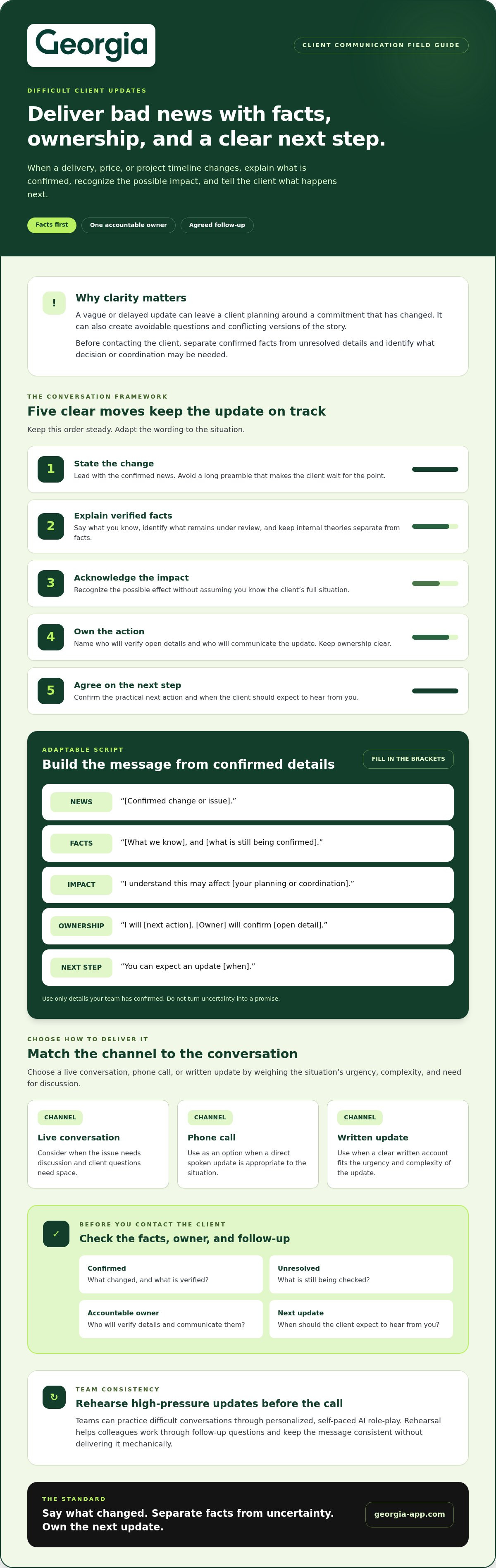
State the change, explain verified facts, acknowledge the client’s impact, own the action, and agree on the next step. These five moves create a reliable backbone for a breaking bad news to a client script without making every conversation sound identical.
Use direct language to state the news
Lead with the confirmed change. “The delivery date we confirmed has changed” is clearer than a long preamble that leaves the client waiting for the point. Then explain what you know and separate it from what remains under review. The framework for difficult conversations reinforces the value of preparing, listening, and managing emotion rather than relying on perfect phrasing.
Keep the explanation brief and specific. If a detail is still unknown, say so plainly and identify when the client will receive an update. Avoid vague language that hides the change or implies certainty your team doesn’t have.
Acknowledge impact and establish the next move
Recognize the potential consequence without assuming you know the full effect: “I understand this may affect your planning.” Then move to action. Identify what your team is doing, who owns it, and when the client can expect contact. Under pressure, discussions about options can drift into commitments the team hasn’t verified. Sales negotiation training can help teams hold clear boundaries while responding to client concerns.
Labelled script template:
News: “[Confirmed change or issue].” Facts: “[What we know], and [what is still being confirmed].” Impact: “I understand this may affect [client activity or decision].” Action and owner: “[Name or role] is responsible for [specific action].” Next step: “We’ll [agreed action] and update you by [confirmed time or milestone].”
Use the template as a prompt, not a speech to recite. Ask what the client needs to coordinate, listen to the answer, and adjust the next step accordingly. Teams can rehearse variations through AI role-play practice to build consistency before a high-pressure client conversation.
Use This Client Script, Then Adapt It to the Situation
A script should steady the conversation, not make you sound rehearsed. Use this breaking bad news to a client script as a working template, then replace every bracket with information your team has verified. If a detail is still open, label it clearly and say when and how you’ll confirm it.
Adapt the template for a changed commitment
Template: “The commitment we agreed on has changed: [confirmed news]. We’ve confirmed [verified facts and cause, if known]. [Unresolved detail] is still under review. I understand this may affect [known or possible client impact]. We’re taking [specific action], owned by [person or role]. I’ll update you by [confirmed time or milestone], even if we’re still verifying the full answer.”
For a hypothetical delivery change, replace the first placeholder with the confirmed revision to the commitment. Include the cause only if it’s established. State an available next step, such as checking an alternative plan, only if your team can actually take that action. Don’t imply the alternative will work until it’s confirmed.
The script must name both the issue and the next action so the client can understand what changed and what happens now.
Handle the client response without becoming defensive
After delivering the update, pause. Listen for the operational concern behind the response. The client may be focused on a decision, a coordination dependency, or the effect on their own commitments. Acknowledge the concern before responding, and avoid arguing over whether the impact is justified.
Answer with confirmed facts. If the client asks something you can’t yet verify, say so directly and identify who will check it and when you’ll report back. That keeps uncertainty visible without leaving responsibility unclear.
Blame adds friction. Avoid making a colleague, supplier, or circumstance the reason the client has no answer. Explain the verified cause when appropriate, then return to the action your team owns. Before the conversation ends, confirm the client understands the next step and the update timing. Adapt the wording to the relationship and the issue, but keep the commitments precise.
Choose the Right Delivery and Rehearse Before the Client Call
The channel affects how quickly you can clarify the issue, how much room the client has to respond, and whether the details are easy to revisit. Choose based on urgency, complexity, and the discussion the update requires. A breaking bad news to a client script can help keep the message consistent across channels, but it shouldn’t dictate one channel for every situation.
Match the communication channel to the client situation
Use this comparison to weigh the trade-offs before you contact the client:
| Channel | Useful when | Limit to consider |
|---|---|---|
| Live conversation | The issue is complex, sensitive, or likely to prompt detailed discussion, and both parties can meet promptly. | It may take coordination, and spoken details can be harder to refer back to. |
| Phone call | The client needs a timely conversation, but a live meeting isn’t practical. | You can clarify in real time, but you won’t have visual cues. |
| Written update | The facts are straightforward, the client needs a clear record, or the update can be communicated without immediate discussion. | Tone can be misread, and questions may remain unanswered until someone responds. |
For a complicated change that needs immediate dialogue, start with a conversation and send a concise written summary afterward. Include the confirmed change, agreed action, owner, and timing. If the update is straightforward and the client mainly needs a reliable record, a written message may be the better fit.
Practise difficult client conversations before they happen
Before the call, check four things: the confirmed facts, the accountable owner, likely client questions, and the follow-up you can commit to. Practise answering questions briefly and factually. If an answer is unknown, rehearse how you’ll say that and who will verify it. This can help reduce inconsistent explanations when pressure rises.
AI role-play training for high-stakes teams can provide repeatable practice with difficult client conversations. Georgia offers personalized, self-paced AI role-play simulations, giving teams a way to rehearse the script and likely responses before a real conversation.
Final Thought
Before your next difficult call, verify the facts, state the client impact, name the owner, and confirm when follow-up will happen. A breaking bad news to a client script gives the team a consistent structure, while rehearsal helps people respond clearly when real questions arise. Connect this practice with your existing communication training. Georgia is an AI-powered, self-paced role-play platform teams can use to rehearse realistic client conversations.
Make the Next Difficult Update Clearer
A changed commitment can put the client’s decisions at risk when the message arrives late, hides the facts, or leaves ownership unclear. A strong breaking bad news to a client script keeps the conversation focused: state what changed, explain what’s confirmed, acknowledge the impact, own the action, and agree on the next update.
Before the call, verify the details, prepare for likely questions, and assign one person to follow through. Choose a channel that fits the urgency and complexity, then confirm the agreed next step in writing when a clear record will help. Consistent practice can also help teams handle recurring difficult conversations with a steady, direct approach.
Georgia’s personalized, self-paced AI role-play simulations are designed to help teams practise communication under pressure. Rehearse the conversation before it reaches the client.
Clear facts. Clear ownership. A specific next step. Make that the standard for your next difficult update.
Frequently Asked Questions
How do you tell a client bad news professionally?
Tell the client promptly, state the confirmed news plainly, and explain what it means for their work. Acknowledge the impact without assuming every consequence, then identify the action your team will take and who owns it. If details remain unresolved, say what’s unknown and when you’ll follow up. Clear facts and a specific next step sound more professional than excessive reassurance or a long explanation.
What should you say when a project commitment changes?
State the change first, then explain only what you’ve confirmed. For example: “The commitment we agreed on has changed. We’ve confirmed [fact], and we’re checking [open detail]. I understand this may affect [client activity]. [Owner] is taking [action], and we’ll update you by [time or milestone].” Replace each placeholder with verified information. Avoid presenting a possible solution or revised date as certain until your team confirms it.
Can you give bad news to a client by email?
Yes, if the update is straightforward and a written record suits the client’s needs. For complex or sensitive news, a phone or live conversation may make it easier to explain, hear concerns, and clarify details. Consider urgency, complexity, and how much discussion the client needs. When you speak first, follow with a concise written summary of the confirmed facts, owner, agreed action, and follow-up timing.
How do you respond when a client becomes angry about bad news?
Stay measured and listen before defending your position. Acknowledge the concern directly, then clarify the practical issue the client needs resolved. Respond with verified facts, not guesses or blame. If you can’t answer a question yet, say who will confirm it and when the client will hear back. Don’t promise an outcome to end the tension. Close by confirming the next action and its owner.
What should a bad-news client script include?
A useful breaking bad news to a client script includes the confirmed change, a brief explanation of verified facts, recognition of the client’s likely impact, and the action your team will take. Name the person responsible and agree on the next contact point or update timing. Keep the wording adaptable to the situation. Mark unresolved details clearly rather than filling gaps with assumptions or unsupported promises.
How can a team practise difficult client conversations?
Rehearse realistic scenarios and likely client questions before a difficult update. Have team members practise delivering the facts, acknowledging impact, handling unknowns, and confirming ownership and follow-up. Review where answers become vague or inconsistent, then refine the wording without turning it into a rigid script. Georgia provides personalized, self-paced AI role-play simulations for practising communication under pressure, giving teams an option for repeatable conversation practice.