

Accountability Conversation Training Prevents Missed Commitments From Becoming Costly
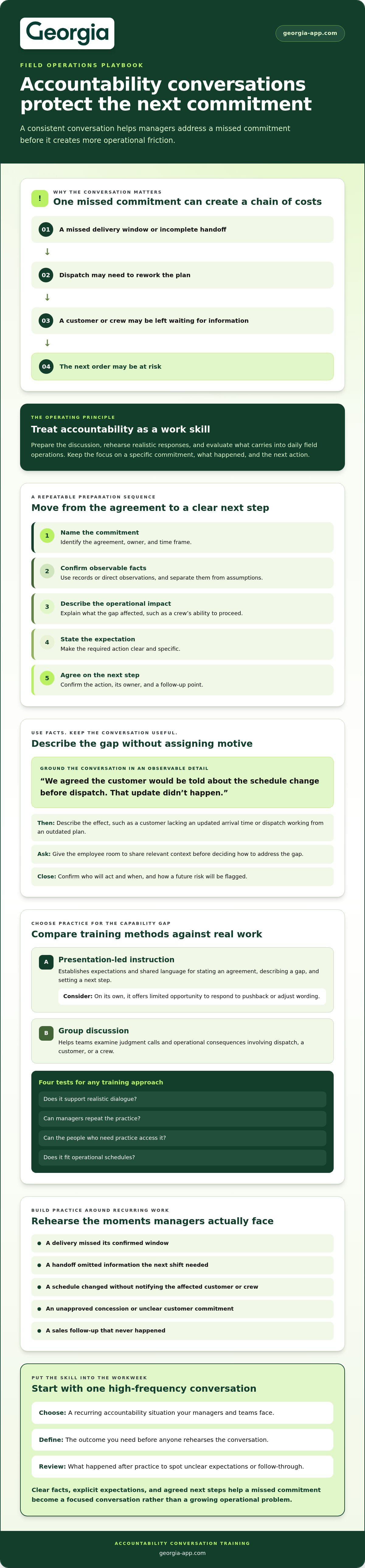
A missed commitment can keep costing you after the original deadline passes. Dispatch may have to rework the plan, a customer may be left waiting for an update, and the next order may be at risk. Accountability conversation training gives managers a way to address the miss before it creates more operational friction.
You already know the conversation matters. The problem is that managers often delay it, or approach it differently across teams and locations. Generic advice about “holding people accountable” rarely prepares anyone for a real discussion about a missed delivery, an incomplete handoff, or a sales follow-up that never happened.
This article lays out a repeatable system to prepare, practise, and evaluate those conversations. You’ll learn how to anchor the discussion in observable facts and agreed expectations, rehearse difficult responses, and assess whether a training approach can carry into daily field operations. The goal is consistency: clear conversations before a missed commitment turns into a larger operational or commercial loss.
Key Takeaways
- Use a consistent preparation sequence to keep accountability conversations grounded in commitments, observable facts, and clear next steps.
- Compare training methods by how well they support realistic dialogue, repeatable practice, and field schedules.
- Build accountability conversation training around recurring situations your managers and teams actually face.
- Review what happens after practice to identify where expectations or follow-through still need clarification.
- Choose one high-frequency accountability conversation and define the outcome you need before rehearsing it.
Treat Accountability Conversation Training as an Operational Skill
A missed delivery window can leave a customer waiting and force dispatch to rebuild the day’s plan. An incomplete handoff can leave a crew without information needed to keep work moving.
Accountability conversation training gives managers deliberate practice addressing expectations and follow-through. It turns a difficult exchange into a work skill they can prepare for, rehearse, and apply consistently. The principle of accountability means being answerable for actions and decisions. In field operations, start with a specific commitment and discuss what happened.
Identify the operational moment that needs a conversation
Choose the point where an agreed commitment and actual follow-through diverged. A delivery missed its confirmed window. A handoff left out a change the next shift needed. A schedule changed, but the affected customer or crew wasn’t told.
Commercial work creates similar moments. A salesperson may offer an unapproved concession or leave a customer commitment unclear. Address the gap promptly, identify who owns the next action, and confirm what must happen now.
Separate accountability from blame
Anchor the conversation in the agreement and observable facts: “We agreed the customer would be told about the schedule change before dispatch. That update didn’t happen.” Avoid assumptions about intent or labels such as “careless.” Then describe the effect, such as a customer lacking an updated arrival time or dispatch working from an outdated plan.
Vague requests to “do better” leave the expectation unclear. Public reprimands can shift attention away from the work. Keep the discussion direct and private, focused on what was agreed, what occurred, and the next action.
Prepare Accountability Conversations With Facts and Clear Expectations
Prepare the sequence before you meet: identify the commitment, confirm what happened, describe the operational impact, state the expectation, and agree on a next step. Use one scenario to make each point concrete. For an incomplete handoff, specify the information that was due, what the receiving team lacked, and how the handoff should be handled next time.
- Commitment: Name the agreement, owner, and time frame.
- Observed facts: Use records or direct observations, and separate them from assumptions.
- Operational impact: Explain what the gap affected, such as a crew’s ability to proceed.
- Expectation: State the required action clearly.
- Next step: Agree on an action, owner, and follow-up point.
State what happened without assigning motive
Use neutral, verifiable language: “The handoff was due before the shift change, and the updated specification wasn’t included.” Avoid labels such as “careless” or “uncommitted.” Ask the employee for relevant context before deciding how to address the gap.
Close with an explicit commitment
Confirm who will provide the missing information and when. Agree how the person will flag a risk before a future handoff is due. For more guidance on communication under pressure, read high-stakes communication training for leaders. Training decision-makers can also book a platform demo to assess fit with their program.
Compare Training Methods by Their Relevance to Real Conversations
Choose a training method based on the gap you need to close. A team that lacks shared expectations needs a different starting point from managers who understand the standard but hesitate when an employee disputes a missed commitment. Compare each approach by four tests: realistic dialogue, opportunity to repeat, access for the people who need practice, and fit with operational schedules.
Match the practice method to the capability gap
Presentation-led instruction establishes expectations and gives managers common language. It can explain how to state an agreement, describe a gap, and set a next step. By itself, it offers limited opportunity to respond to pushback or adjust wording.
Group discussion helps teams examine judgment calls and operational consequences. Participants can consider how a commitment affects dispatch, a customer, or a crew. Discussion surfaces different perspectives, but it may not give each manager a chance to practise saying the difficult part aloud.
Manager coaching can focus on an individual’s specific conversation and help them prepare for its context. Its reach and repeatability depend on how your organization delivers it and the time managers can make available. Scenario-based rehearsal gives participants a chance to practise exact words and responses. It is especially relevant when the gap appears during the exchange itself, such as staying specific when the other person becomes defensive.
No single format serves every need. Accountability conversation training may combine instruction for shared standards, discussion for judgment, and rehearsal for dialogue under pressure. Review AI role-play training approaches for broader context on using role-play platforms.
Check whether scenarios resemble actual work
A scenario should include the roles involved, the commitment at issue, the pressure shaping the exchange, and competing priorities. A sales manager may need to address a customer promise that conflicts with approved commercial terms. A dispatch lead may need to practise a direct exchange about an uncommunicated schedule change. The details should match the participant’s responsibilities.
Ask whether the practice allows realistic back-and-forth, repeat attempts, and access that works around field schedules. Then check the transfer point: can the participant name the next relevant conversation where they will apply the approach? Georgia’s AI role-play platform supports personalized, self-paced practice for communication under pressure. Assess its fit by comparing a relevant scenario with the conversations your managers actually handle.
Build a Repeatable Rehearsal Loop for Managers and Teams
A single practice session rarely changes how a team handles recurring pressure. Build a loop that connects a real work situation to rehearsal, field application, and review. Accountability conversation training becomes practical when managers can see what they need to say, practise the exchange, then check how the commitment was handled at work.
Start with one recurring accountability scenario
Choose a situation that comes up in your team’s work, such as a sales representative leaving ownership of a customer follow-up unclear after discussing a commercial exception. Define the purpose of the conversation before anyone rehearses: establish who owns the follow-up, what must be confirmed, and how the customer will receive an accurate response.
Adapt the scenario to each role while keeping the expectation consistent. A manager may practise addressing an unclear handoff; a sales representative may practise clarifying ownership with a colleague. Keep the situation specific enough to prompt realistic dialogue, including the pressure or competing priority that makes the conversation difficult.
- Select: Choose one recurring missed commitment or unclear handoff from actual team work.
- Define: State what the conversation must resolve and what commitment should be clear at the end.
- Rehearse: Practise the opening, relevant questions, response to pushback, and confirmation of next steps.
- Apply: Use the approach in the next relevant work conversation and record the agreed action and owner.
- Review: Identify what was clear, what stayed ambiguous, and what the next practice scenario should address.
Review practice and carry learning into work
Measure observable behaviors, not confidence alone. Did the manager state the original commitment accurately? Did they ask for context before drawing conclusions? Did they name the required action, owner, and follow-up point? These checks give managers something specific to improve on the next attempt.
After a real conversation, record the agreed next step and follow-up commitment using the team’s normal process. Review recurring friction points, such as uncertainty about approval or ownership, and use them to sharpen the next scenario. That keeps rehearsal connected to current operating demands instead of generic role-play prompts.
For commercial discussions where accountability overlaps with negotiation, explore sales negotiation training practice. Georgia’s AI-powered role-play platform supports personalized, self-paced practice for conversations under pressure.
Final Thought: Put Accountability Conversation Training Into the Workweek
Choose one role and one recurring accountability conversation. Define the outcome, then check whether your practice approach uses realistic scenarios, supports repeatable rehearsal, and fits participants’ access and schedules. Prepare from observable facts, rehearse the exchange, and confirm the commitment. Georgia offers personalized, self-paced simulations through an AI-powered role-play platform for communication under pressure. Use a demo to assess how the platform could fit your existing training program.
Make the Next Accountability Conversation Easier to Handle
Make accountability conversation training part of how your managers prepare for field conversations. Start with one recurring situation, define the outcome, and ground the discussion in agreed expectations and observable facts. Then give managers a chance to rehearse the exchange and review whether the next commitment was clear.
The training method should fit the work. Realistic scenarios help managers practise relevant language, while repeatable practice gives them another opportunity to refine the conversation. Georgia’s AI-powered role-play platform offers personalized, self-paced simulations for communication practice under pressure. A demo lets you assess how that approach could fit your existing training program.
Choose the conversation your team needs to handle next. Prepare it, practise it, and carry that clarity into the workweek.
Frequently Asked Questions
What is accountability conversation training?
Accountability conversation training helps managers practise addressing missed commitments, unclear expectations, and follow-through. It combines a clear conversation structure with realistic practice, so managers can state what was agreed, describe observable facts, discuss work impact, and confirm next steps. In field operations, scenarios might involve an incomplete handoff, a customer update that was missed, or a commercial commitment that needs clarification.
How do you conduct an accountability conversation with an employee?
Start with the specific commitment, the person responsible, and the relevant time frame. Describe what you observed and the effect on the work without assigning motive or using broad labels. Ask for the employee’s context before deciding next steps. Then agree on a clear action, an owner, and a follow-up point. Clarify how the employee should raise a risk before another commitment is missed.
Can accountability conversations be practised before they happen?
Yes. Choose a recurring situation from the team’s work and define what the conversation needs to resolve. Practise opening with the facts, responding to likely pushback, and confirming an action and owner. After the real conversation, review what was clear and what remained ambiguous. This connects rehearsal to actual responsibilities and gives managers specific behaviors to refine before similar situations arise.
What should accountability conversation training include?
Effective accountability conversation training should cover how to identify the original commitment, separate confirmed facts from interpretations, explain operational impact, and state the expectation going forward. It should also give managers practice responding to context or disagreement, then closing with an explicit next step. Use scenarios drawn from the participants’ work, such as a missed handoff or an unclear customer commitment, rather than generic prompts.
How is accountability training different from performance management training?
Accountability training focuses on the conversation around a specific expectation, commitment, or follow-through gap. Performance management training can address broader processes for setting goals, reviewing performance, and documenting progress. The two can complement each other. A manager may use performance processes to clarify standards, then use an accountability conversation to address a particular missed commitment and agree on what happens next.
Is AI role-play useful for practising accountability conversations?
AI role-play can provide a way to rehearse difficult soft-skill conversations before handling them at work. Georgia is an AI-powered role-play platform with personalized, self-paced simulations for communication practice under pressure. Its relevance depends on whether the scenarios reflect real responsibilities and the conversation challenges managers face. Consider how that practice could fit alongside your existing training approach.
How can managers tell whether accountability conversation training is relevant?
Check whether training addresses a recurring conversation your managers actually need to handle. Its scenarios should reflect the roles, commitments, and pressures in your operation, and its practice method should fit participant access and schedules. Look for observable behaviors to review, such as stating the agreed expectation and confirming ownership of the next action. A platform demo can help decision-makers assess fit with their training program.