

To improve team communication metrics, look beyond completion rates to what happens in real conversations. A training module may be completed while a dispatch handoff leaves a critical detail unclear or a customer call ends without a firm next step. That gap can create friction, rework, and missed opportunities.
Activity counts still have a place. They show who attended, practiced, or completed a module. They don’t show whether a salesperson clarified delivery requirements, a dispatcher confirmed the next action, or a manager handled a difficult conversation differently.
Measure observable behaviors in real work and connect them to operational outcomes carefully. A change in order accuracy or customer response may have several causes, so the data needs context before it becomes a verdict on training.
This article outlines a practical approach: choose conversation behaviors tied to work, track behavior changes separately from later business results, and use the findings to focus practice. You’ll get a clearer way to see whether communication is moving work forward, rather than simply generating activity.
Key Takeaways
- Choose indicators a manager can observe in real sales, dispatch, or service conversations.
- Pair early behavior signals with later business results to see how they relate over time.
- Treat a metric shift as a prompt to investigate specific moments, such as quote follow-up or delivery coordination.
- To improve team communication metrics, focus practice on one clearly defined behavior gap at a time.
- Review behavior and operational results separately before deciding whether a training change is working.
Improve team communication metrics by tracking work, not training activity
An unclear handoff can stall work while teams chase missing information. A customer conversation that ends without a clear commitment can lead to another round of follow-up.
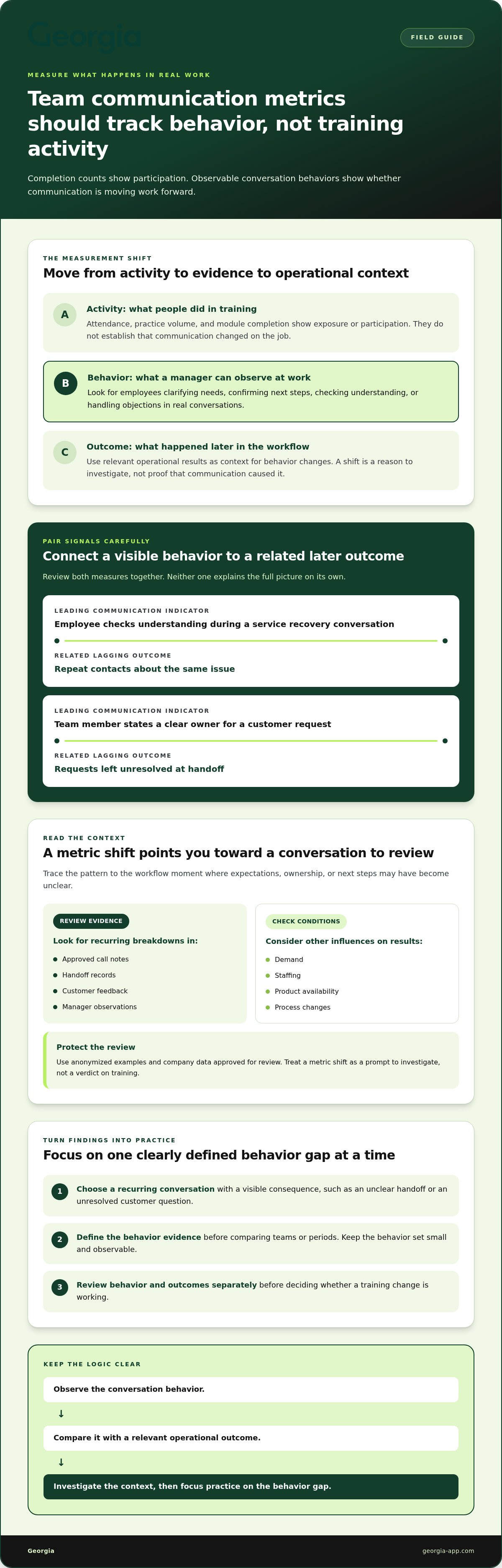
A useful team communication metric is an observable signal from a work conversation that connects to a process or outcome. A communication indicator measures a specific workplace behavior; an engagement measure tracks broader participation or sentiment. Course attendance shows exposure to training, not whether communication changed on the job.
For a concise overview of communication measurement, watch How to Measure Internal Communication from Haiilo:
Separate communication activity from communication performance
Practice volume records repetition, not workplace performance. Observe whether employees clarify needs, confirm next steps, or handle objections in real conversations. These behaviors provide specific evidence, though no single behavior explains every team outcome.
Start with the operational friction the team needs to reduce
Choose a recurring conversation with a visible consequence, such as an unresolved customer question or an unclear internal handoff. Then measure the behavior that could reduce that friction. For broader context on information flow, see Organizational communication. If the gap is in sales conversations, make it a focused topic for sales communication training.
Pair leading communication indicators with lagging business outcomes
Leading indicators capture behaviors close to the work. Lagging outcomes show what happened later. Pairing them helps you examine whether a communication behavior and an operational result change together.
Review behavior and outcome measures together. Neither one explains the full picture alone.
| Leading communication indicator | Related lagging outcome |
|---|---|
| Employee checks understanding during a service recovery conversation | Repeat contacts about the same issue |
| Team member states a clear owner for a customer request | Requests left unresolved at handoff |
Choose leading indicators managers can observe
Keep the behavior set small and define what counts as evidence before comparing teams or periods. Research on a validated scale for communication behaviors can inform your approach, but choose indicators that fit your workflow. Avoid unsupported universal scores or targets.
Use lagging indicators as context, not proof of cause
Use existing measures that match the work, then account for other influences such as demand, staffing, product availability, or process changes. A shift in both measures is a reason to investigate, not proof that communication caused the outcome. Apply the same care when assessing communication training ROI.
To improve team communication metrics, compare clearly defined behaviors with relevant outcomes, then review the operating conditions around them. Explore whether Georgia’s practice simulations fit your team.
Interpret team communication metrics in the context of real conversations
A metric shift gives you a reason to investigate, not a verdict about communication. Trace the pattern to the point in the workflow where expectations, ownership, or next steps may have become unclear.
Find the conversation behind the number
Review approved call notes, handoff records, customer feedback, or manager observations to identify recurring breakdowns. For example, a service recovery issue may begin when a customer’s concern is acknowledged but responsibility for follow-up remains unclear. Keep examples anonymized and use only company data approved for review. UC Berkeley’s guidance on building an effective team offers useful principles for reducing confusion through open communication.
Avoid comparisons that distort the signal
Before interpreting a pattern, account for changes in staffing, customer mix, workload, or workflow that could affect conversations. If those conditions shifted, record them alongside the results. This helps distinguish a possible behavior gap from operational changes and makes soft skills performance tracking more useful. Use the evidence to decide what to examine or practice next, rather than treating a metric change as proof of cause.
Turn communication findings into focused practice and follow-up
A metric creates value when it changes what the team practices next. Start with one recurring work problem, define the behavior that could reduce friction, select an indicator, practice the behavior, then review what shows up on the job.
- Select a specific sales, dispatch, service, or leadership problem.
- Define one behavior a manager can recognize in a real conversation.
- Choose a behavior indicator and a related operational measure.
- Practice the behavior in a scenario that reflects the work.
- Review the same indicators and decide what to adjust.
Keep the target narrow. For example, in a delivery-change conversation, focus on whether the dispatcher confirms the next action and who owns it. That gives a manager a clear behavior to notice. “Communicate better” gives the team no observable action to practice or measure.
Set a baseline before changing the training approach
Before introducing a new practice approach, record current observations and the operational measure tied to the problem. Use the same definitions and observation rules you plan to apply later. Note relevant changes in staffing, customer mix, demand, or workflow so you can interpret the comparison carefully.
Choose a review point that fits the work cycle and gives the behavior a chance to appear in actual conversations. Set it based on your operating context, not a universal timeline or borrowed performance target.
Review behavior and outcomes before choosing the next intervention
At review, compare the same behavior indicator and outcome measure. If the target behavior appears more often but the operational result stays unchanged, investigate other constraints, such as product availability or a process bottleneck, before changing the training. If neither measure shifts, check whether the scenario matched the real conversation, whether the behavior was clearly defined, and whether staff had opportunities to practice it.
Repeated rehearsal can help teams prepare for high-stakes conversations. Personalized, self-paced simulations offer one way to practice a defined behavior, such as clarifying a customer’s requirements or confirming a handoff. Explore the AI role-play training platform as a practice resource, while keeping workplace observations and operational results as separate evidence.
Use this sequence to improve team communication metrics: observe the behavior, connect it to the work, then review the outcome in context.
Final Thought
Start with one recurring conversation, such as quote follow-up, and one behavior, such as confirming the customer’s next step. Agree on what counts as evidence before reviewing the data. Continue the practice if the behavior appears more often in real conversations, adjust it if evidence is mixed, and reconsider the target if it remains absent. Then review operational outcomes in context. This is how you improve team communication metrics: observe behavior, connect it to work, and assess results carefully. If a defined conversation gap needs rehearsal, book a demo to assess whether simulation practice fits.
Make Communication Measurement Part of the Way Work Runs
Communication measurement earns its place when it helps you make a better operational decision. Use consistent definitions, review the conversations behind the numbers, and treat business outcomes as context rather than automatic proof of cause. This helps you improve team communication metrics without confusing training participation with workplace change.
Start with the friction that matters most to your operation. Identify the behavior that could address it, then use evidence from real work to decide whether to continue, adjust, or replace the practice. The goal is a clear line from conversation to action, with enough context to make the next decision responsibly.
When a team needs repeated rehearsal for high-pressure conversations, Georgia offers personalized, self-paced simulations. A demo can help you assess whether that approach fits your communication practice.
Measure with care, practice with purpose, and keep attention on the behaviors that move work forward.
Frequently Asked Questions
Which team communication metrics should a manager track first?
Start with one observable behavior linked to a recurring work problem, then pair it with an existing operational measure. For example, track whether a rep summarizes a customer’s requirements before proposing a solution, alongside a relevant sales measure. To improve team communication metrics, define exactly what counts as evidence and which conversations belong in the review. Add measures only when they help you make a specific operational decision.
How can you measure communication quality at work?
Use a consistent observation guide to assess behaviors in real conversations. A manager might record whether an employee asks a clarifying question, checks the other person’s understanding, or confirms who owns the next action. Apply the same definitions across reviewers and review periods. Call notes, customer feedback, and manager observations can provide evidence where available. Attendance and message volume offer context, but they don’t show how well people communicate during work.
What is the difference between leading and lagging communication metrics?
Leading metrics track behaviors close to the conversation, such as whether a team member confirms a customer’s requirements. Lagging metrics capture later results, such as completed orders or repeat service contacts. Leading measures help you spot behavior patterns sooner; lagging measures show what happened operationally. Pair them to understand whether behavior and results move together. Neither measure alone establishes why a result changed.
Can communication training metrics prove that training caused better business results?
Training metrics can show participation or changes in observed behavior, but they rarely establish that training alone caused a business result. Sales, service, and workflow measures can shift with demand, staffing, product availability, pricing, or process changes. Compare consistent measures over relevant periods, record known changes, and review the conversations behind the numbers. Treat a positive pattern as evidence to investigate, then decide whether it supports continuing or adjusting practice.
How often should teams review communication metrics?
Set a review point that matches the workflow and gives people a fair opportunity to use the target behavior. A short-cycle dispatch process may call for a different review rhythm than a longer sales cycle. Keep observation windows and definitions consistent, then review often enough to identify patterns without reacting to isolated cases. If staffing, workload, or process changes, record them so the comparison remains useful.
How can sales managers measure whether reps handle customer conversations better?
Choose a defined part of the sales conversation and observe the behavior that matters there. For example, assess whether a rep explores a stated constraint before responding with an option, or confirms the customer’s agreed next step. Use a consistent review guide across sampled conversations, then compare the behavior with a relevant sales measure. Consider changes in lead quality, pricing, and product availability before interpreting movement in results.
Can AI role-play help teams improve communication metrics?
AI role-play can provide personalized, self-paced simulations for rehearsing high-stakes communication before employees face similar situations at work. Use it to practice a specific behavior, such as asking clarifying questions under pressure. Then assess whether that behavior appears in real conversations and review related operational measures separately. Georgia offers AI-powered role-play for sales, customer operations, and leadership practice. The platform supports rehearsal, while workplace evidence shows how communication carries into the job.