

Soft skills courses online waste budget when they leave sales and support behavior unchanged. Reps keep conceding too quickly, and avoidable customer issues still reach managers. Course completion alone won’t close that performance gap.
Your training needs to prepare employees for the conversations that carry real stakes. This article explains how to assess practice, connect training to workplace behaviors, and choose an approach your team can repeat.
You’ll learn how to spot communication friction, evaluate realistic simulations, and track whether practice changes the way your team handles difficult conversations.
Key Takeaways
- Measure training by what reps can say and do under pressure, not by course completion.
- When comparing soft skills courses online, look for realistic practice that builds verbal fluency through repetition.
- Identify where discounting and avoidable escalations expose communication friction in your operation.
- Choose self-paced simulations that let your team rehearse difficult sales and support conversations without risking real deals.
- Track changes in closing conversations and support resolution to see whether practice is changing behavior.
Theory Based Training Fails the High Stakes Stress Test
A framework can help a rep understand a conversation after the fact. Under pressure, the harder task is retrieving a useful response while listening, interpreting the customer’s concern, and deciding what to say next. That takes rehearsal in situations where the conversation can shift unexpectedly.
Soft skills describe abilities such as communication and collaboration. Their value at work depends on how employees use them in real interactions, not how well they can explain a model in a quiet study setting.
This presentation skills video illustrates how training can introduce useful techniques:
Video Lectures Do Not Build Muscle Memory
When a buyer interrupts or changes the objection, a memorized script may stop fitting. Practise adapting the message, clarifying the concern, and choosing the next question. Rehearsal gives employees a chance to develop that flexibility before a real conversation is at stake.
The Forgetting Curve Erases Passive Knowledge
Without application and feedback, learners may forget material or repeat ineffective habits. Georgia’s self-paced simulations give employees a way to revisit conversations, practise responses, and apply feedback over time.
Compare Traditional Soft Skills Courses to Interactive Simulation
Choose a training format by the decisions it lets employees practise. A static course can introduce a framework, while interactive simulation can present a changing scenario and require the learner to respond. For a sales rep, that might mean handling a new objection before agreeing on the next step.
Static Content vs Dynamic AI Personas
AI role-play adds conversational turns that a fixed lesson cannot provide. The learner must choose what to say as the scenario develops. This makes practice more relevant to calls where buyers introduce new concerns or shift priorities.
Completion Rates vs Skill Mastery
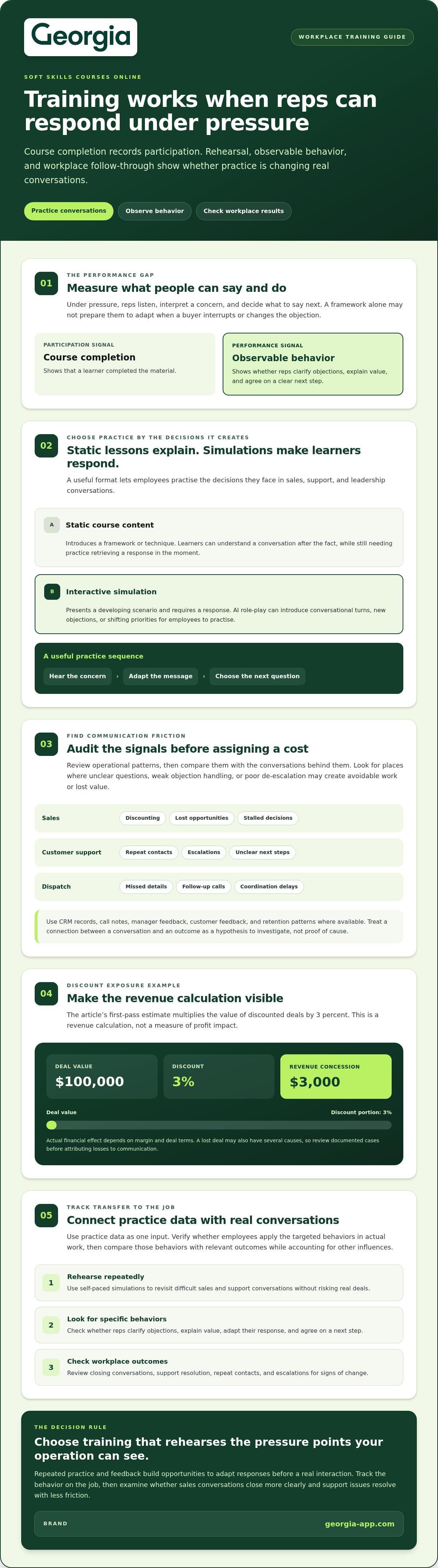
A completion report measures participation, not improved performance. Track observable behaviors instead, such as whether reps clarify objections, explain value, and agree on a clear next step. Compare those behaviors with sales outcomes, while accounting for other factors that influence results.
Also assess training spend against the specific performance gaps you want to address. Georgia’s AI role-play platform offers self-paced simulations for sales, support, and leadership practice. Use practice data as one input, then verify whether employees apply the targeted behaviors in real conversations.
Audit the Financial Cost of Communication Friction
A rushed concession reduces the value of a deal. A preventable escalation consumes support and management time. These are operational costs, even when your reports don’t label them as communication failures.
Audit the pattern before you assign a dollar value. Review discounting, lost opportunities, repeat contacts, escalations, and dispatch delays. Then compare those signals with the conversations behind them. The goal is to find where unclear questions, weak objection handling, or poor de-escalation are creating measurable friction.
Quantify Revenue Loss from Poor Sales Conversations
For a first-pass estimate of discount exposure, multiply the value of deals discounted by 3 percent. If a $100,000 deal receives a 3 percent discount, that concession is $3,000 in revenue. This is a simple revenue calculation, not a measure of profit impact. Your margin and deal terms determine the actual financial effect.
Next, inspect your CRM records for lost deals tied to price objections, stalled decisions, or unresolved concerns. Check call notes and manager feedback where available. Count documented cases before attributing losses to communication; a lost deal may have several causes. For practical guidance on pressure and sales conversations, consult Sales Communication Training.
Measure Churn Linked to Support Team Verbal Fluency
Support friction can threaten retention when customers repeat information, wait through avoidable handoffs, or leave an interaction without a clear next step. Compare repeat contacts and escalations with customer feedback and retention patterns. Treat the connection as a hypothesis to investigate, not proof that one conversation caused churn.
Dispatch communication deserves the same scrutiny. A missed detail or unclear update can trigger follow-up calls and delay coordination. Track where clarification becomes rework, then identify the response skills those situations require. Soft skills courses online should prepare employees for those specific exchanges, rather than asking you to assume that course completion will reduce friction.
Internal conflict adds another drain. The April 2026 research brief reports that managers spend an average of 4.44 hours per week dealing with disputes. Use your own manager time records to find the local pattern: recurring disputes, repeated clarifications, and issues that move between teams. Then target practice at the conversations driving the delay. AI role-play practice for business conversations can give employees a place to rehearse responses before those interactions affect live customers or deals.
Select Online Training Based on Realistic Pressure Replication
A training scenario earns its place when it resembles the conversations your team needs to handle. Generic customer-service prompts won’t prepare a sales rep for a contractor challenging a quote, questioning a delivery commitment, or pressing for a concession. Choose soft skills courses online by testing how closely their practice matches the pressure and decisions in your operation.
Scrutinize the Quality of Role-Play Scenarios
Review the scenarios before you commit. Look for the roles your employees actually encounter, such as a site manager questioning timing or a buyer pushing back on price. Check whether the learner must listen, ask clarifying questions, and adapt when the other person raises a new concern. A quiz can test recall. A realistic role-play makes the learner respond.
Industry detail matters because the right response depends on the conversation’s context. A rep needs to protect value while addressing a real concern; a support agent may need to clarify an issue before proposing a resolution. For more guidance on evaluating simulation practice, read AI Role-Play Training Platform.
Prioritize Repetition and Useful Feedback
A one-time training event can introduce a skill, but employees need opportunities to use it again after the session. Look for self-paced practice that lets a rep repeat a difficult negotiation and try a stronger response. That gives the learner room to build verbal fluency without putting a live deal at risk.
Check how the platform responds to practice. Does it provide specific feedback tied to the learner’s words and choices? Can a manager identify which behaviors need more work? Automated feedback can help teams practise at scale, but assess its usefulness against clear criteria, such as whether the rep acknowledged the objection, asked a relevant question, and explained value before discussing a discount.
Compare the full training cost with the time required to deliver repeat practice and review progress. Avoid assuming that any online course changes long-term behavior on its own. Build a process: select a real conversation, practise it, review the response, and revisit the skill in later training. Georgia provides personalized, self-paced AI role-play simulations for sales, support, and leadership practice. Evaluate the simulations against the conversations your team needs to handle.
Fix Revenue Leaks with Georgia AI Training Modules
Training should help employees practise the conversations that affect revenue and service. Georgia is an AI-powered role-play platform for sales, support, and leadership practice. Its personalized simulations give employees a place to rehearse difficult exchanges before they handle them with a customer.
That distinction matters when you assess soft skills courses online. Choose practice that reflects your team’s actual pressure points, then check whether employees apply those skills in live conversations. Treat simulation as rehearsal, and use operational results to judge whether it addresses the friction you identified.
Practice Sales Negotiation Without Risking Real Deals
Give sales reps a chance to practise a buyer’s price objection before the next quote is on the line. For concrete and aggregates sales, shape the rehearsal around situations your team recognizes: a buyer pushing for a concession, challenging value, or raising a concern that changes the discussion. The rep can test how to respond without risking a live deal.
After each practice, review the rep’s choices. Did they clarify the objection? Did they explain value before discussing price? Did their wording keep the conversation moving? These are practical criteria managers can use to guide further practice. For related guidance, read Cold Call Simulation Software.
Train Support Teams for Difficult Conversations
Support teams can rehearse conversations with frustrated customers in a simulated setting. Repeated practice gives agents a chance to slow down, clarify a dispatch issue, and communicate the next step clearly. That preparation may help agents approach tense calls with more verbal fluency, without exposing a customer interaction to trial and error.
Set a clear practice target, such as acknowledging the concern before explaining a resolution. Then review real interactions for that behavior. Track repeat contacts, escalations, and customer feedback alongside practice activity; these measures help you assess whether training is changing service conversations without assuming it directly causes retention gains.
AI-supported practice can also give managers a repeatable way to address common conversation gaps. Use it to prepare employees for foundational scenarios, then focus manager time on the cases that require judgment and operational context. Review any feedback or performance measures a platform provides, and verify that they map to observable behaviors rather than activity alone.
Make Training Show Up in the Conversations That Matter
Choose soft skills courses online by the behavior they help your team demonstrate, not the content they consume. AI-powered simulations give employees repeated practice to build verbal fluency, while realistic scenarios can reflect the pressure your sales and support teams face. Track changes in actual conversations to see whether training is affecting performance.
Self-paced practice also gives employees a way to work on core skills independently, helping managers reserve coaching time for situations that need their judgment. Set a clear baseline, practise targeted conversations, and review the behaviors that follow. That turns training from a completed activity into an operating tool.
Start with the communication friction that costs your team the most. Build practice around it, then measure what changes.
Your next training decision can put practice closer to performance. Make it count.
Frequently Asked Questions
Do soft skills courses online actually improve sales performance?
They can improve sales performance when employees practise relevant conversations and managers check for changed behavior afterward. Course completion alone doesn’t show whether a rep can listen carefully, respond clearly, or maintain composure under pressure. Set a baseline using your existing sales measures, choose a specific communication behavior to improve, and review performance after training. Results depend on the training design and how consistently employees apply what they practise.
What is the difference between video training and AI role-play?
Video training presents information for employees to watch, while AI role-play asks them to participate in simulated conversations. A video can explain a communication approach; role-play gives a learner a chance to respond, adapt, and practise speaking. Georgia provides personalized, self-paced AI simulations for communication practice. Choose the format based on the skill gap: information delivery may suit learning concepts, while verbal fluency requires opportunities to speak.
How do you measure the ROI of online soft skills training?
Compare training investment with relevant operational measures before and after practice, while avoiding claims the data cannot support. Choose indicators tied to the training goal, such as conversion performance, discount patterns, customer escalations, repeat contacts, or manager time spent addressing recurring issues. Establish a baseline and track the same measures over time. Consider other factors that may affect results before attributing a change to training alone.
Can AI simulations really mimic the pressure of a real client call?
AI simulations can provide practice responding to changing conversational cues, but they cannot reproduce every consequence or complexity of a live client call. Their value is rehearsal: employees can practise listening, choosing words, and responding to objections without putting an active customer relationship at risk. Use scenarios based on conversations your team actually faces, then assess whether the skills transfer to real interactions.
How much time should employees spend on soft skills practice each week?
There’s no universal weekly duration that fits every role or skill gap. Set a schedule your team can sustain, then base practice on upcoming conversations and observed performance needs. A rep preparing for negotiations may need different rehearsal from a support agent working on clear customer updates. Review whether employees are practising consistently and applying the target behavior before increasing or reducing the time allocated.
Why do traditional soft skills workshops fail for remote teams?
One-time group sessions can be difficult to coordinate across remote schedules, and employees may have few chances to repeat the practice afterward. The format can introduce ideas without building consistent speaking habits across a distributed team. Remote training works better when employees can access relevant practice independently and managers can review progress. Evaluate the method by its repeatability and connection to workplace behavior, not attendance alone.
What are the best soft skills for sales reps in construction?
Prioritize active listening, clear questioning, negotiation, composure, and concise communication. A rep needs to uncover what matters to a buyer, explain value in terms the buyer can assess, and respond calmly when priorities shift. Follow-through also matters: confirm the next step and communicate it clearly. Use call reviews to identify which skill is creating friction, then target practice at that specific behavior.
How does Georgia AI differ from generic online courses?
Georgia is an AI-powered role-play platform that provides personalized, self-paced simulations for sales, customer support, and leadership teams. Generic online courses may focus on presenting concepts through lessons or quizzes. Georgia’s approach centers on practising soft-skill conversations, helping employees build verbal fluency under pressure. Teams can use simulations to rehearse relevant interactions and support communication training within their existing programs.