

Soft skills practice at scale can help high-stakes teams prepare for conversations that affect customer outcomes and work coordination. A workshop can introduce a useful response, but attendance alone won’t show whether a dispatcher, sales representative, or supervisor can use it under pressure.
Live conversations have operational consequences. The challenge is to reach employees consistently, give managers a practical way to reinforce skills, and check whether practice changes behavior.
This article provides a case-study framework for building that system. You’ll learn how to define a conversation worth rehearsing, compare options for realistic and repeatable practice, and track behavior indicators before cautiously connecting them to operational measures. Self-paced simulations, including AI role-play, can extend practice between existing training sessions. The key is to make sure scenarios match the conversations your teams face and to distinguish evidence of practice from evidence of business impact.
Key Takeaways
- Choose a high-stakes customer, dispatch, or sales conversation where inconsistent execution can disrupt work.
- Build soft skills practice at scale around repeatable scenarios and consistent feedback, rather than treating course completion as proof of skill.
- Compare workshops, asynchronous courses, manager coaching, and interactive role-play by realism, reach, practice frequency, and visibility into learner performance.
- Start with one role, a small set of manager-approved scenarios, and a baseline for access, completion, feedback, and target behaviors.
- Expand after reviewing scenario fit and behavior indicators. Treat any connection to operational measures cautiously.
Start with the conversations where inconsistent execution costs work
A delivery change that reaches a customer late can create confusion across dispatch, sales, and the job site. If employees leave the revised plan or next step unclear, the team has to repair the conversation while managing the disruption.
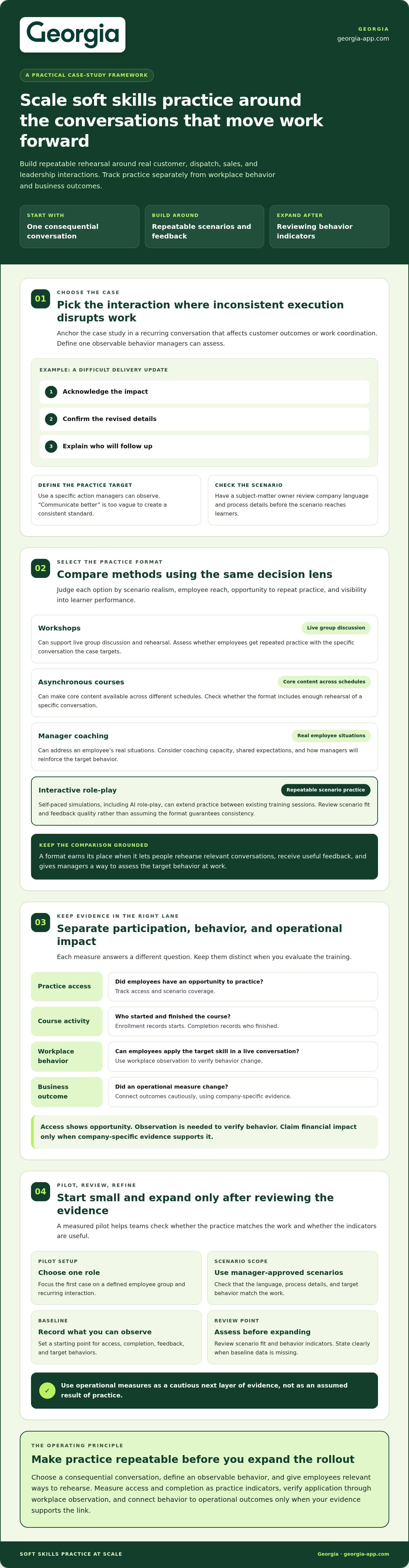
Start with one recurring interaction that affects customer outcomes or work coordination. For a dispatcher handling a difficult delivery update, for example, the target behavior might be to acknowledge the impact, confirm revised details, and explain who will follow up.
This video offers a short presentation-skills example. Use it to consider what employees need to practice in your own high-stakes conversations.
Choose a consequential conversation as the case-study entry point
Use an actual type of interaction, such as explaining a delivery change or responding to a commercial objection. Define one observable behavior managers can assess. “Communicate better” is too vague to provide a consistent standard.
Separate the training gap from the business outcome
Record current access to practice, coaching capacity, and scenario coverage. Then distinguish observed behaviors from outcomes such as fewer disputes or stronger retention. Claim financial impact only when company-specific evidence supports it. If baseline data is missing, state that clearly rather than implying an outcome.
Use this overview of soft skills as background, then ground the case in your own operation.
Scale repeated practice around real work, not generic course completion
Practice at scale gives employees repeatable access to relevant scenarios and consistent feedback. Enrollment shows who started a course; completion shows who finished it. Neither demonstrates that an employee can apply a skill in a live conversation.
Practice access shows opportunity; workplace observation is needed to verify behavior change. Keep those measures separate when evaluating training.
Turn operational friction into a practice scenario
Build scenarios from recurring sales, dispatch, customer, or leadership conversations. Define the employee’s role, the goal, and the pressure. For example, a sales representative may need to respond to a customer challenging a quote while clarifying the next step. Ask a subject-matter owner to check the scenario’s company language and process details.
Make repetitions and feedback manageable across teams
Self-paced simulations can give employees opportunities to practice between manager-led training and coaching conversations. They can widen access while managers continue to set expectations and reinforce behaviors. Review the feedback across scenarios to see whether it is consistent and useful. Don’t assume the format guarantees consistency.
Review scaling soft skills training as you plan how repeatable practice fits your program. Georgia offers personalized, self-paced AI role-play simulations. Assess the scenarios and training fit in a Georgia demo, without assuming labor savings or business results.
Compare practice methods by realism, reach, and usable evidence
Choose a method based on the practice it enables, the employees it can reach, and the evidence it gives managers. For soft skills practice at scale, course enrollment is a weak comparison point. Ask whether employees can rehearse a relevant conversation, receive useful feedback, and demonstrate the target behavior at work.
Use a consistent comparison framework
Workshops can support live group discussion and rehearsal. Asynchronous courses can make core content available across different schedules. Either may offer limited repetition of a specific conversation unless practice is built into the format. Manager coaching can address an employee’s real situations, but access and feedback may vary with manager capacity. Interactive role-play can provide repeatable conversation practice, so assess how closely its scenarios match your operation.
Compare each option against the same criteria:
- Practice: Can employees rehearse the actual customer, dispatch, sales, or leadership conversation?
- Reach: Can employees participate around their work schedules, and how much coordination does the method require?
- Feedback: Does the guidance identify observable actions the learner can change?
- Visibility: Can the training owner review participation and practice feedback without confusing activity with proficiency?
These criteria make trade-offs easier to see. A completion record shows course activity. A simulation record may show rehearsal and feedback. Assessing workplace behavior requires observation outside the training platform.
Test whether AI practice fits your operation
Generic scenarios can make practice less relevant. Ask whether a tool can reflect your company’s language, employee roles, customer expectations, and operational pressures. Have a subject-matter owner review a sample scenario, then inspect the feedback. Does it point to a specific behavior, such as clarifying the issue or confirming the next step, or give a score without explaining what to improve?
Set your evidence requirements before selecting a platform. Decide which activity records will help you manage access and practice, then define how managers will observe behavior on the job. For related guidance, see the article on online soft-skills courses and behavioral change. If interactive practice is under consideration, review AI role-play practice for scenario fit and how it could complement your existing training.
Selection rule: Choose the method that matches your real scenarios, gives employees actionable feedback, and provides evidence suited to the decision you need to make.
Run a measured pilot before expanding practice across teams
A pilot tests whether practice fits the work before you widen access. Choose one role or team, then assign a small set of scenarios approved by managers who understand the conversations. Set the measurement period in advance so you can compare the same indicators throughout the pilot.
Before launch, record a baseline for employee access, scenario completion, feedback review, and the specific behavior you want to observe. Keep these measures distinct. Platform activity shows whether employees accessed and completed practice. Workplace observation shows whether the target behavior appeared in real conversations.
Build the case-study evidence trail
Document the initial problem, target behavior, pilot scope, and measurement period. For a sales conversation, for example, specify the behavior managers will observe, such as clarifying the customer’s concern before responding. Record how it will be assessed and who will review the evidence.
Keep approved qualitative observations separate from quantitative outcomes. A manager’s note about clearer next steps can inform scenario revisions. A change in customer or operational measures needs its own documented data and a defensible connection to the pilot. If you lack a baseline or verified result, label the outcome unmeasured. Don’t fill the gap with an industry statistic.
Apply the same discipline when reviewing guidance on measuring communication behaviors and team metrics: define the measure before interpreting a change. This makes a case study useful without overstating what the practice caused.
Expand only after the practice fits the work
Review learner and manager feedback before changing scenarios or extending access. Ask frontline managers and subject-matter reviewers whether the scenarios reflect current roles, company language, and operational pressure. Check whether employees can fit practice into their work routines and whether managers can review feedback consistently.
Then decide whether to revise scenarios, adjust feedback, or expand to another team. Pressure-focused practice can also apply to sales conversations, as explored in the related virtual sales training article. Use the pilot to establish fit, not to promise a result the evidence cannot support. That’s how you build soft skills practice at scale on a defensible foundation.
Final Thought: Make practice repeatable before you expand the rollout
Choose one high-stakes conversation and define the behavior employees need to demonstrate. Before rollout, check that the scenario reflects real work, the feedback gives actionable guidance, and the pilot distinguishes practice activity from observed workplace behavior.
For an evaluation, bring an operational scenario, the intended learner audience, and questions about fitting personalized, self-paced AI role-play into existing training. Agree internally on what evidence would support expanding the pilot. Georgia’s AI role-play platform is one option to assess for repeatable practice. Review its fit against your criteria before deciding whether it can support soft skills practice at scale.
Make Your Next Practice Cycle Measurable
Start with one high-stakes conversation and define the behavior your team needs to demonstrate. Build practice around a realistic scenario, compare methods by access, feedback, and evidence, then pilot before expanding. Course completion can show participation; workplace observation is needed to assess behavior change.
That’s the foundation of soft skills practice at scale: repeatable opportunities to rehearse relevant conversations, paired with a clear way to review practice and evaluate behavior on the job. Keep those measures separate, and use company-specific evidence before connecting training to operational results.
Georgia offers personalized, self-paced AI role-play simulations for sales, customer operations, and leadership practice. Evaluate whether the scenarios fit your team’s conversations and how the practice could complement your existing training program.
Choose the conversation. Define the behavior. Review the evidence. That gives you a practical starting point for building practice your teams can repeat with confidence.
Frequently Asked Questions
How can organizations scale soft-skills practice across distributed teams?
Give employees repeatable access to role-specific scenarios and use consistent feedback criteria across teams. Select conversations employees regularly face, such as resolving a customer concern or coordinating a delivery change. Self-paced practice can fit around work routines, while managers review feedback and reinforce the target behavior. Track access separately from workplace performance so participation records don’t become a proxy for capability.
Can AI role-play help employees practice high-pressure work conversations?
Yes. AI role-play can let employees rehearse challenging conversations in a simulated setting and receive feedback before handling similar situations at work. Its value depends on whether scenarios reflect the employee’s role, company language, and operational pressures. Review the scenario and sample feedback before assigning practice. Simulation activity can show that practice occurred, but managers need separate workplace observations to assess whether behavior carries over.
What should a company measure in a soft-skills practice pilot?
Set a baseline for employee access, scenario completion, feedback review, and one observable communication behavior. For example, managers might assess whether employees clarify a customer’s concern before proposing a next step. Keep practice and behavior measures separate from operational indicators such as customer issues or delivery coordination. Connect training to those outcomes only when company-specific evidence supports the relationship, and label unmeasured results clearly.
How do online courses compare with interactive role-play practice?
Online courses can deliver shared concepts and reference material across locations. Interactive role-play adds conversation rehearsal, letting employees try a response and review feedback. The formats can serve different purposes within the same training program. Compare them by scenario realism, access, practice frequency, feedback quality, and manager visibility. Course completion or simulation activity indicates participation; workplace observation is needed to assess how employees communicate on the job.
How can managers make training scenarios relevant to daily operations?
Build scenarios from recurring conversations that create friction in customer service, sales, dispatch, or leadership. Specify the employee’s role, the intended outcome, and the pressure that makes the interaction difficult. Define a behavior managers can observe, such as confirming key details or agreeing on a follow-up. Ask frontline managers and subject-matter reviewers to check the scenario’s language and process details before employees use it.
Does scaling practice require replacing workshops or manager coaching?
No. Organizations can use scalable practice alongside existing workshops, courses, and manager coaching. Shared training can introduce expectations, while manager coaching can address specific employee needs. Self-paced simulations can add repeatable rehearsal between those activities. Decide what each method should accomplish, then check whether employees receive relevant practice and consistent feedback. The right mix depends on your team’s scenarios, access requirements, and manager capacity.
How can a team tell whether practice is changing workplace behavior?
Define the target behavior before practice begins, then have managers observe it in relevant work conversations using consistent criteria. Compare observations with a baseline and record the context, such as the type of customer interaction. Keep platform records, learner feedback, and workplace observations distinct. Changes in commercial or operational measures require separate analysis. Avoid attributing them to training without company-specific evidence that supports the connection.
To assess whether personalized, self-paced AI role-play fits your training program, book a Georgia demo.