

An untested sales conversation can leave an objection unanswered and an order stalled. In customer operations, a poor response can turn a solvable issue into repeat contact. Virtual role play training software gives teams a way to rehearse these moments before they affect live conversations.
A script can teach the sequence, but it cannot prepare someone for every objection, frustrated caller, or change in tone. Repeated simulations help people practise the communication habits these moments demand.
This comparison covers feedback quality, instructor-led practice, integrations, and contact center simulations. It explains which capabilities matter for sales and which support high-pressure customer operations, so you can choose based on the conversations your team needs to improve.
Key Takeaways
- Compare feedback on what people say, how they sound, and the nonverbal cues the tool can assess.
- Use AI practice for repetition, then bring instructors into the process to guide judgment and address recurring gaps.
- Match simulations to the conversations your team needs to rehearse, from sales calls to customer support and leadership scenarios.
- Assess how CRM, LMS, and conversation-intelligence integrations fit your current training and performance workflows.
- For contact center training, prioritize realistic simulations that prepare agents for the situations they face on live calls.
Behavioral feedback across verbal, vocal, and nonverbal dimensions
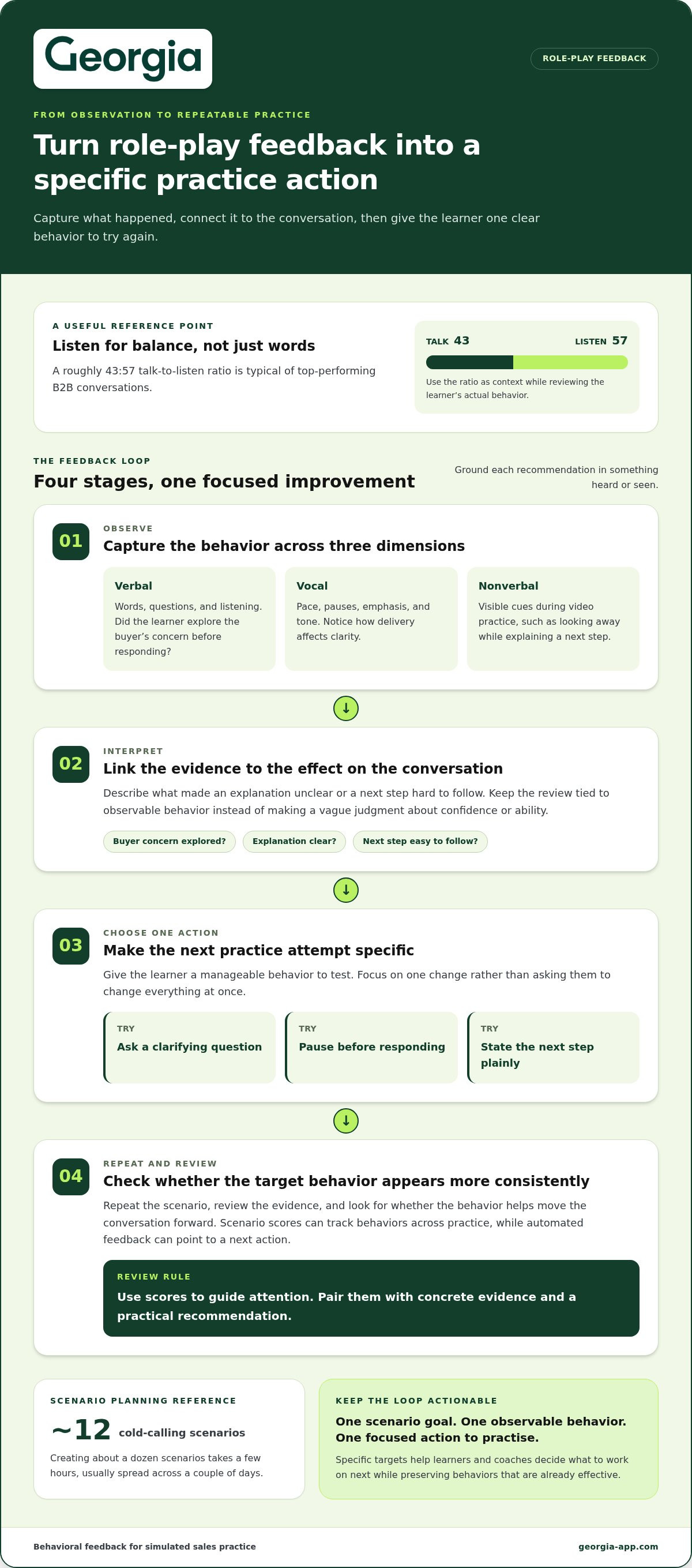
Behavioral feedback identifies what happened and what to practise next. A roughly 43:57 talk-to-listen ratio is typical of top-performing B2B conversations.
Watch a practical demonstration of simulated sales practice:
Verbal Behavior Feedback
Verbal feedback assesses word choice, questions, and listening. It can show whether the learner explored a buyer’s concern before responding.
Vocal Behavior Feedback
Vocal feedback examines pace, pauses, emphasis, and tone, highlighting how delivery affects the clarity of an explanation.
Nonverbal Behavior Feedback
For video practice, nonverbal feedback can flag visible cues, such as looking away while explaining a next step.
Scoring and Performance Analytics
Scoring and analytics track behaviors across scenarios. Automated feedback can point learners toward a specific next practice action.
| Feedback option | Evidence captured | Best use |
|---|---|---|
| Verbal | Words and questions | Message clarity |
| Vocal | Pace and tone | Delivery control |
| Nonverbal | Visible cues | Video practice |
| Analytics | Scenario scores | Progress review |
Choose feedback that links observable behavior to a clear practice action.
Make feedback useful by tying each observation to a behavior the learner can try again. Instead of calling an explanation unclear, identify whether the learner responded before understanding the buyer’s concern or made the next step hard to follow. Then suggest a focused practice attempt: ask a clarifying question, pause before responding, or state the proposed next step plainly. This keeps feedback grounded in what was heard or seen, rather than turning it into a vague judgment about confidence or ability. It also gives the learner a way to test whether changing their wording, vocal delivery, or visible behavior makes the exchange easier to understand.
Scenario design can support focused practice. The page estimates that creating about a dozen cold-calling scenarios takes a few hours, usually spread across a couple of days. Scenarios can address distinct conversational challenges, such as opening a call, exploring a concern, or agreeing on a next step. Set a clear practice goal and use feedback to identify the behavior to work on, rather than asking learners to change everything at once. When a learner repeats a scenario, look for whether the target behavior appears more consistently and helps move the conversation forward. A specific, observable target makes the review more actionable.
Scores can add structure to review, but they are most useful when paired with concrete evidence and a practical recommendation. The page says its reviews score each tool from 1 to 5 across five criteria. Treat a score as a prompt to examine the behavior behind it, not as a substitute for coaching. If a result points to a weak area, revisit the relevant words, vocal delivery, or visible cues and agree on a manageable practice action. Feedback should also distinguish between a behavior that needs attention and a behavior that is already working, so learners can preserve effective habits while developing others. Linking scenario results to repeated practice gives both learner and coach a clearer basis for deciding what to work on next.
Blending AI practice with instructor-led learning
AI simulations make practice repeatable; instructors add context and judgment. Use each where it adds the most value.
Branded Practice Environments
A branded environment places practice within your organization’s visual identity. Compare that with instructor-led sessions, which can focus directly on team standards and specific examples.
AI Buyer Simulations
AI buyer simulations let learners practise responding to changing objections. A sales representative can rehearse discovery, then review the exchange with an instructor to discuss their choices and missed opportunities.
Leadership and Conflict-Resolution Practice
Leadership simulations can help supervisors rehearse accountability or conflict conversations. Unlike buyer scenarios, these focus on working relationships and team decisions. Georgia’s Leadership Development Practice addresses communication under pressure.
Objection Handling and Discovery Practice
Sales scenarios can target a defined skill, such as asking about a buyer’s concern before responding. AI enables repetition; an instructor can examine the reasoning behind the response and set the next practice priority.
A manager responsible for 10 agents cannot listen to, grade, and coach every practice call at scale. Use simulations for repeatable rehearsal, then reserve instructor time for complex situations and targeted feedback. Teams exploring self-paced conversation practice can review AI role-play practice.
That flexibility can make practice easier to schedule between instructor sessions, while recorded role-play gives learners a way to revisit their delivery and reflect before coaching. The simulation software market is projected to double in value by 2032.
AI role-play simulators are available 24/7 for contact-center training, allowing learners to rehearse when instructors are unavailable. These options can complement, rather than replace, instructor guidance on judgment, team standards, and complex conversations.
What is AI sales role-play software?
AI sales role-play software creates simulated conversations where learners can practise communication skills. Teams use it for sales, onboarding, customer service, and leadership, then compare practice behavior with actual workplace outcomes.
Sales and Related Use Cases
Sales teams can rehearse discovery, pricing discussions, and next-step commitments. During onboarding, a new representative can practise explaining a product before speaking with an actual buyer. Customer service teams can simulate a complaint, while supervisors can rehearse giving employee feedback. Each use case involves conversation, but requires distinct scenarios and success criteria.
Custom Personas and Sales Playbooks
Custom AI personas represent different conversation partners, such as a buyer focused on delivery timing or a customer disputing an invoice. Sales playbooks provide the approved questions, language, and process for each scenario. Together, they connect practice to the situations your team faces. Compared with generic simulations, tailored personas and playbooks make it easier to practise specific behaviors and identify gaps against internal standards.
AI-Powered Sales Simulations
AI-powered simulations let learners respond in their own words while the simulated buyer reacts to the exchange. A learner might ask about a project schedule, then handle a concern about supply or delivery. Unlike scripted drills, where each response follows a fixed path, the conversation can develop based on the learner’s choices. Set an objective first, such as uncovering the buyer’s priority, then review whether the learner’s responses moved the conversation toward it.
Sales Roleplay Performance Measurement
Measure observable behavior, such as whether the representative asked discovery questions, addressed the stated concern, and agreed on a next step. A score is useful when it points to a specific moment and an action the learner can repeat. Track practice performance alongside on-the-job outcomes over a full quarter to assess training effectiveness. This connects learning activity with actual sales behavior instead of treating completion as proof of skill.
When comparing tools, assess the simulation experience separately from the measurement process. Check whether scenarios match your sales process, feedback identifies specific behaviors, and managers can use results to guide coaching. A platform for onboarding may emphasize consistent practice; one for ongoing sales development may need a wider range of buyer situations. Match the tool to the conversations your team handles, then define how managers will use its feedback.
CRM, LMS, and conversation-intelligence integrations
Look for realistic simulations, behavior-based feedback, learner reporting, and integrations suited to your existing systems. For an enterprise rollout, map how a practice assignment, completion record, and coaching action move through your enablement workflow.
Connect LMS Assignments to Practice
An LMS integration can place a role-play exercise within an existing learning journey. For example, assign a scenario after product onboarding and record completion alongside the related course. Check how learners access the exercise, how managers view results, and whether feedback returns to the same learning record. A clear handoff helps prevent practice becoming a separate task supervisors have to track manually.
Link CRM Scenarios to Sales Work
A CRM connection can align practice with the stages and customer conversations your team handles. For example, build a discovery scenario around the questions representatives need to ask before moving an opportunity forward. Decide which information should pass between systems, such as learner identity or scenario completion. Keep customer records separate from practice unless the workflow requires specific data. This limits clutter and keeps the exercise focused.
Use Conversation Intelligence with Care
Conversation-intelligence tools can help teams identify recurring call patterns and turn them into practice priorities. A manager might notice repeated interruptions during discovery, then assign a scenario targeting listening behavior. Define how call insights inform scenarios and which teams can access the resulting records. Unlike conferencing integration, which may support virtual instructor sessions, conversation intelligence informs coaching and practice design.
Build Learning Journeys Across Systems
Map each step before choosing an integration: assign practice, complete the simulation, review feedback, and record the next coaching action. An ATS connection may support hiring or onboarding by linking a candidate or new hire to relevant exercises. Keep its purpose distinct from an LMS, which organizes ongoing learning. Assign an owner to each handoff to help prevent missing assignments or incomplete learner records.
Assess Enterprise Integration Requirements
Enterprise features should support the access controls, reporting, and administration your teams need. Test an avatar-based simulation with a representative learner account, then review what a manager can view and export. Check whether reports distinguish completion from demonstrated behavior, since these measure different outcomes. Include conferencing tools in the workflow only when instructor-led sessions need to be coordinated with self-paced practice.
Before rollout, document the source system, data passed, user responsible, and resulting action for every integration. This map exposes duplicate records and unused connections early. Prioritize integrations that reduce manual tracking or help managers act on practice results. Add other connections only when they serve a defined enablement step.
AI role-play simulation for contact center training
Contact center simulations let agents rehearse high-pressure calls before those conversations affect customers. AI role-play supports practice beyond scheduled coaching, giving managers a way to deliver repeatable sessions at any time.
Build scenarios around the calls agents must handle: a frustrated customer disputing an invoice, a caller seeking a delivery update, or a request that needs escalation. Each simulation should have a clear objective, such as confirming the issue, explaining the next step, or resolving an objection. The AI responds to the agent’s choices, so the practice follows the conversation rather than a fixed script.
First-call resolution gives contact center teams a practical performance lens. The industry benchmark range is 70-79%. Use simulations to rehearse the behaviors that support resolution, including clarifying the customer’s concern, explaining available options, and confirming the agreed action. A score can show practice performance, while live service metrics show whether those behaviors carry into actual calls.
Flexible access matters when shifts or staffing demands make shared training sessions difficult to schedule. Agents can practise before or after a shift, or repeat a scenario after coaching. Managers can assign a focused exercise for a recurring issue, then review the response and choose the next practice priority.
Realism is another selection criterion. Quantified reports a 92% realism rating from users. For your team, judge realism through the nature of the exchange: does the simulated customer react plausibly to interruptions, unclear explanations, or an unresolved request? A realistic objection should require the agent to listen and respond, not simply select a prepared answer.
Reported agent-retention rates have risen from 20-30% to over 70% at organizations that switched from traditional training to simulation. Treat that figure as context, not a forecast for your operation. Use a pilot to assess whether agents engage with practice, whether managers can act on the feedback, and whether live service outcomes move in the intended direction.
Structure the rollout around a clear coaching loop:
- Choose a recurring call type, such as a missed delivery update.
- Define the behavior agents need to demonstrate during that scenario.
- Assign practice and review the agent’s handling of the customer response.
- Coach one specific behavior, then let the agent repeat the exchange.
- Compare practice patterns with contact center outcomes over time.
Simulation works well for repeatable conversation practice across shifts; managers still decide which calls need direct human review.
Georgia: Sales & Commercial Training Modules
Georgia helps teams practise high-stakes conversations through its AI Role-Play Platform, which provides personalized, self-paced simulations. Turn to it when sales calls, customer interactions, or leadership conversations need deliberate rehearsal beyond scripts and course content.
Sales & Commercial Training Modules support practice for buyer conversations, while Customer Operations Training addresses customer-facing situations. Leadership Development Practice helps managers rehearse communication under pressure. These offerings focus on conversation skills, not technical task instruction.
If your priority is building repeatable practice around real workplace conversations, explore Georgia’s AI role-play platform and see how it fits your team’s training needs.
Turn Practice Into a Clear Operating Decision
Start by identifying the conversation where inconsistent execution creates the most friction. Define the behavior you need people to demonstrate, then decide how managers will use practice results to guide their next coaching action. This gives your virtual role play training software decision a practical test: does the tool support the conversations your team handles and the way you want to improve performance?
Georgia brings together an AI Role-Play Platform, Sales & Commercial Training Modules, and Customer Operations Training. Choose the starting point that fits the team and conversations you want to strengthen.
Make the next practice cycle deliberate. Choose a priority conversation, set a clear standard, and give your team a focused way to rehearse it.
Frequently Asked Questions
How do you measure if AI role-play training is working?
Measure whether learners apply the target behavior at work, then compare that with practice results. For a sales team, track whether representatives consistently confirm next steps after buyer conversations; for support, review whether agents document clear resolutions. Use the same behavior criteria in practice reviews and manager observations. This helps distinguish skill development from activity, such as completing simulations without changing work habits.
Can AI role-play replace human coaches?
AI role-play provides repeated practice, while managers and coaches remain responsible for judgment, context, and accountability. A simulation can help a new supervisor rehearse a performance conversation; a person can then discuss team history, policy, and the employee’s circumstances. Use AI practice to build familiarity with a conversation, then bring in human review when the situation requires nuance, a decision, or follow-through.
How do AI role-play tools handle GDPR and data residency?
Data handling varies by tool, so establish where conversation recordings and transcripts are processed and stored. Ask whether learner transcripts are used to train the vendor’s AI models, and review the data processing agreement. For GDPR-scoped use, assess whether the tool meets GDPR or the applicable regional equivalent. These details help your compliance and IT teams assess data flows before rollout.
Is data from AI role-play sessions kept private?
Privacy depends on the platform’s data practices and your organization’s configuration. Before learners begin, define who can access recordings, transcripts, and performance reports, and how long each is retained. For example, a supervisor may need a learner’s practice results, while the wider team may only need aggregated trends. Explain these access rules clearly so employees understand how practice data supports training.
What is AI roleplay training?
AI role-play training uses simulated conversations to help people practise workplace communication. A sales representative might respond to a buyer questioning a quote, while a dispatcher rehearses explaining a schedule change. The AI responds to the learner’s words, creating an interactive exchange. The exercise focuses on communication behaviors such as listening, clarifying, or setting expectations, rather than teaching technical job procedures.
Which tools give managers real skill-gap data?
Choose tools that connect a specific behavior to evidence from the learner’s response. For example, a manager should be able to distinguish missed discovery questions from unclear explanations, then assign practice for the relevant gap. Look for learner- and team-level views, consistent assessment criteria, and feedback tied to moments in the conversation. Completion reports show participation, not whether someone can apply a skill.
What is virtual role-play training software and how does it work?
Virtual role-play training software lets learners practise simulated work conversations through a digital platform. A manager selects or assigns a scenario, the learner responds to an AI persona, and the system provides feedback on the exchange. For instance, a building-materials salesperson could rehearse clarifying a contractor’s delivery concern. Managers can use the results to identify a follow-up coaching focus.
What are the best virtual role-play training platforms for businesses?
The best fit depends on the conversations employees need to practise and how managers will use the results. Compare platforms on scenario relevance, behavioral feedback, learner reporting, data handling, and fit with current training workflows. A sales organization may prioritize buyer simulations; a contact center may need customer-service scenarios. Georgia offers AI-based practice for teams working on high-pressure communication.