

AI training for customer support agents can prepare your team for conversations where a delayed order, disputed charge, or product issue risks customer confidence and creates repeat work. Rehearsal gives agents a chance to practise these exchanges before the stakes are live.
Knowing a process does not always make it easy to stay clear and composed under pressure. Course completion alone leaves that gap untouched. Agents need focused practice with conversations that carry real operational risk.
Identify which interactions deserve practice, choose a format that fits support operations, and build a repeatable approach to rehearsal. The goal is deliberate preparation for difficult customer conversations.
Key Takeaways
- Use AI training for customer support agents to practise communication in high-stakes customer conversations.
- Choose rehearsal activities that let agents try communication approaches before live interactions.
- Match each training format to its purpose: courses for knowledge, shadowing for observation, and role-play for rehearsal.
- Build a practice plan by identifying friction points, choosing relevant scenarios, and setting clear behavior goals.
- Use personalized, self-paced AI role-play to make communication practice easier to repeat.
AI training for customer support agents must target costly conversations
Inconsistent support conversations can lead to repeat work, escalations, and lost customer confidence. AI training for customer support agents gives teams a way to rehearse communication before difficult exchanges happen live.
Here, AI training means practising agent communication in simulated conversations, rather than training an AI system. AI role-play training uses simulated customer conversations to help agents rehearse how they listen, respond, and explain under pressure.
Identify the conversations where communication breaks down
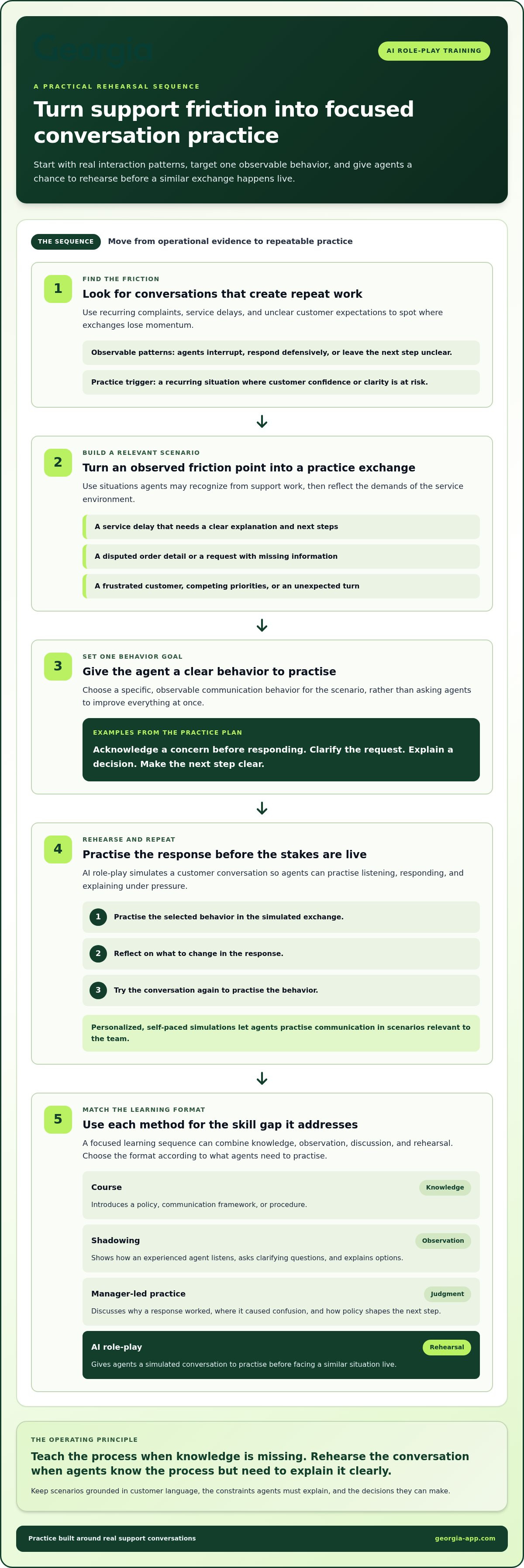
Use recurring complaints, service delays, and unclear customer expectations to identify where conversations lose momentum. Look for observable patterns: agents interrupt, respond defensively, or leave the next step unclear. Build scenarios around an observed friction point and one specific behavior agents can practise.
Separate agent practice from customer-facing AI automation
Chatbots use AI to handle customer requests. Role-play simulates an exchange for an agent to practise. A team may use both operational tools and communication practice, because automation does not rehearse an agent’s response to a difficult conversation. The broader artificial intelligence in customer experience overview describes AI’s role across customer interactions.
For example, a support team can practise explaining a service delay clearly and setting out the next steps. Georgia’s AI role-play platform provides personalized, self-paced simulations for communication practice under pressure.
Make AI practice prepare agents for pressure, not just course completion
Course completion shows that agents have encountered information. Rehearsal lets them practise applying it in a conversation before they face a customer. A simulation can focus on one behavior, such as clarifying a request or explaining a decision, and give the agent another opportunity to try it.
Personalized, self-paced practice can fit around support operations and focus on scenarios relevant to the team. It gives AI training for customer support agents a practical role alongside courses that introduce concepts and procedures.
Use repetition to strengthen specific communication behaviors
Choose an observable behavior, such as acknowledging a concern before responding. Ask agents to practise it, reflect on what they would change, and try again. Georgia provides personalized, self-paced simulations for communication practice under pressure. Teams can explore the format through Georgia’s AI role-play platform.
Rehearse conversations agents cannot control
Customer conversations can involve frustration, missing information, or competing priorities. These conditions can make listening and clear explanations harder. Build scenarios that reflect the demands of your service environment, then focus on how agents respond when the exchange takes an unexpected turn.
Compare AI role-play with courses, shadowing, and live practice
Training formats solve different problems. A course can introduce a policy or communication framework. Shadowing shows how an experienced agent handles a real exchange. Manager-led practice gives you a chance to discuss judgment and refine a response together. AI role-play lets agents rehearse a conversation before facing a similar situation live.
Choose the format based on the skill gap. If agents lack product or process knowledge, teach the relevant concepts first. If they know the process but struggle to explain it clearly, prioritize rehearsal. AI training for customer support agents works best as part of a learning sequence, with each method serving a distinct purpose.
Match the format to the skill gap
A course can cover the steps for handling a service complaint. Shadowing can help a newer agent observe how an experienced colleague listens, asks clarifying questions, and explains options. Role-play then gives the agent a chance to practise those behaviors in a simulated conversation.
Manager-led practice adds human judgment. A manager can discuss why a response worked, where it caused confusion, and how company policy shapes the next step. AI role-play can provide personalized, self-paced conversation practice between those discussions. Use the approaches together when the skill requires knowledge, observation, and repetition.
For a broader view of the method, explore an article on AI role-play training platforms. Use that perspective to frame the format, then assess whether the scenarios reflect the communication demands your support team faces.
Evaluate whether a simulation fits your support environment
Start with scenario relevance. Could an agent recognize the situation from customer interactions, such as a delivery concern, a disputed order detail, or a request that depends on information the agent does not yet have? Does the conversation require the agent to make the communication choices your team wants to practise?
Next, consider operational fit. Personalized, self-paced simulations give agents a way to practise without scheduling every rehearsal as a group activity. Decide how practice will sit alongside coverage needs, manager discussion, and existing training.
Finally, assess realism. Compare each scenario with the language customers use, the constraints agents must explain, and the decisions they can make. A simulation is useful when its practice task reflects the work. Georgia’s AI role-play platform provides personalized, self-paced communication simulations for customer support teams.
Build a focused AI training plan around real support scenarios
A useful practice plan starts with operational evidence. Choose conversations where customers repeatedly need clarification, handoffs lose context, or explanations create further questions. Build practice around those friction points instead of selecting scenarios only because they sound engaging.
Use a clear sequence: diagnose the friction, select a scenario, define one observable behavior, and review what agents practise. This keeps AI training for customer support agents connected to the work your team handles, from order updates to service coordination.
- Diagnose recurring friction in customer feedback, handoffs, and team observations.
- Select a scenario that reflects an important support interaction.
- Set one communication behavior for agents to practise.
- Review practice reflections alongside relevant team observations.
Choose scenarios from recurring support friction
Prioritize scenarios by operational relevance. For a building materials or aggregates support team, that might mean clarifying a partial order, explaining a change to a site delivery plan, or responding when a customer and an internal team have different information about an issue. Start with a recurring pressure point rather than a novel edge case.
Use customer interactions to understand the problem, then remove identifying details when adapting them into practice material. Preserve the communication challenge and the decisions the agent needs to explain. Exclude details that could identify a person, account, or project.
Keep the scenario focused. If agents struggle to explain what happens after a delivery concern is raised, make that exchange the practice task. Avoid combining unrelated issues in one simulation. A narrow scenario makes the target behavior easier to recognize.
Set a behavior goal before agents begin practicing
Define a behavior an agent can demonstrate during the conversation. For example, the agent summarizes the customer’s concern before responding, checks what information is missing, or clearly explains the next step. Give agents the goal before practice begins so the rehearsal has a defined target.
Afterward, ask the agent to reflect: did they use the behavior, what made it difficult, and what would they try differently? Managers can review those reflections alongside relevant observations from team interactions, such as recurring clarification or handoff issues. Track the behavior consistently, while treating those observations as context rather than proof that practice caused a change.
Use the review to decide whether the scenario, behavior goal, or supporting instruction needs adjustment. A repeatable plan gives managers a practical way to focus practice and review progress without assuming a particular outcome.
Use Georgia's AI role-play to make support practice repeatable
Training creates more value when agents can practise the communication demands they face with customers. Georgia is an AI-powered role-play platform for personalized, self-paced practice of soft-skill conversations under pressure. For support teams, its simulations provide a practice layer for interactions agents need to handle clearly and calmly.
AI role-play has a focused role in your program: giving agents a place to rehearse communication. Your team sets learning priorities, clarifies operating procedures, and uses manager judgment to guide development. The platform supports practice within that broader approach.
Show how role-play fits into an existing training program
Start with the communication priorities you have identified. If agents need to explain a process clearly, acknowledge customer concerns, or keep a difficult exchange focused, make those priorities the basis for practice scenarios. A simulation gives agents a chance to work through the conversation at their own pace.
Connect rehearsal to other learning methods. A course can introduce concepts or policies. Team guidance can clarify expectations. Role-play lets agents practise applying a communication behavior in a simulated interaction. Give each part a defined purpose, rather than expecting one format to address every training need.
Personalized practice lets you focus on conversations relevant to your support operation. A scenario might involve a customer who needs a clear explanation of a service issue, or an exchange where the agent must listen carefully before describing next steps. Ground practice in your team’s communication priorities, and keep operational knowledge and human judgment central to the broader training program.
Move from a training need to a product conversation
Before exploring a platform, write down the conversations your team wants to practise and the behaviors agents should use. Note where the friction occurs, what a clear response should include, and how you want agents to reflect after rehearsal. This gives your evaluation a practical focus.
For related team context, consider how customer service soft skills training supports communication expectations across the wider operation. Then assess how personalized, self-paced simulations can add a repeatable practice layer to your existing training. A demo lets your team explore Georgia’s platform in the context of its training priorities.
Put Conversation Practice on the Operating Calendar
Give communication practice an owner and a place in the support operation. Without both, rehearsal can become an occasional training activity that disappears when workloads rise. Decide who will maintain the practice priorities and when your team will revisit them.
Use that decision to assess how AI training for customer support agents fits your operating rhythm. Identify what the team needs to practise, how the approach will sit alongside existing development, and what would make the effort worth continuing. Georgia’s AI role-play platform gives teams personalized, self-paced simulations for communication practice.
Start with a specific training need, choose a conversation agents need to rehearse, and define the behavior they should practise. Book a Georgia demo to explore how personalized, self-paced role-play can support that practice in your training program.
Frequently Asked Questions
Is AI training for customer support agents the same as using AI chatbots to answer customers?
No. Chatbots use AI to respond to customer requests, while agent training uses simulated practice to develop people’s communication skills. The distinction matters when setting training goals: chatbot performance concerns how automated service handles a request, while practice focuses on how an agent responds. A team can use both, evaluating them against separate needs, such as handling routine inquiries and preparing agents for complex discussions.
Can AI role-play training help experienced support agents as well as new hires?
Yes. Experienced agents can use role-play to prepare for unfamiliar situations, changes in responsibilities, or conversations that occur less often but require careful judgment. For example, a senior agent might rehearse explaining a new service limitation in plain language. Keep practice relevant to the person’s role and experience. Repeating basic scenarios an agent already handles confidently takes time away from a genuine skill gap.
How much time should customer support agents spend on AI practice?
There is no single suitable duration for every team or scenario. Set practice time around the behavior you want agents to rehearse and the coverage your operation needs. A short, focused exercise may suit one communication goal, while a more complex situation may need additional reflection. Review whether agents can explain what they practised and what they would change. Use that evidence to adjust the schedule rather than assigning time without a purpose.
What happens if an AI simulation feels unlike a real customer conversation?
Treat the mismatch as useful information about the exercise design. Ask agents which part felt unrealistic: the customer’s wording, the sequence of events, or the choices available to the agent. Compare their comments with actual service interactions, then refine the scenario or choose a better-fitting exercise. A simulation should reflect the communication challenge you want to practise, while recognizing that it cannot represent every customer or operational condition.
Can AI training support customer service teams working across different channels?
It can support practice planning across teams that communicate by phone, email, or chat, provided each exercise targets the right channel-specific behavior. A phone conversation may call for attention to pacing and verbal clarity; written support may require concise wording and a clear record of next steps. Define the skill first, then use a practice format suited to it. Do not assume one scenario prepares agents for every channel.
How should managers handle customer information when creating practice scenarios?
Remove customer names, account details, contact information, and other identifying context before adapting a real interaction into training material. Check whether combinations of details, such as a distinctive project and delivery circumstance, could still point to a specific customer. Keep only the information needed to recreate the communication challenge. Follow your organization’s rules for handling customer data, and use fictional details when real ones add no training value.
Does AI training for customer support agents replace existing product or policy training?
No. Agents still need accurate product, process, and policy knowledge to give customers reliable answers. Role-play helps them practise communicating that information, but it does not establish what the correct answer should be. For a policy update, teach the approved guidance first, then build a rehearsal around explaining it clearly or responding to likely customer concerns. Keep the source of operational guidance authoritative and current.