

A communication breakdown occurs when the right information does not reach the right person in a usable form. In construction and materials operations, a vague instruction, buried update, or unanswered concern can stall decisions and strain customer relationships. Effective solutions to communication breakdown in the workplace start with identifying whether the problem lies in the message, the channel, or the handoff.
You already know that missed details create rework. The wider cost reaches productivity and retention: in Grammarly’s State of Business Communication report, 81% of surveyed knowledge workers said poor communication reduced their productivity. A breakdown is a business problem with operational consequences.
This article explains how to give specific, timely feedback, choose channels that fit the work, and spot structural causes such as unclear ownership or one-way updates. You’ll also learn how breakdowns affect trust, productivity, and retention, and how deliberate practice can help teams handle difficult conversations more clearly.
Key Takeaways
- Make feedback specific, timely, and tied to an action the employee can take.
- Close the feedback loop by telling employees what changed or why a suggestion cannot be acted on.
- Match the channel to the task: use real-time communication for quick coordination and durable records for decisions and processes.
- Look for structural causes such as unclear ownership, scattered updates, and documents that are difficult to find.
- Track how communication affects follow-through, trust, and retention, then address repeated breakdowns through deliberate practice.
1. Make Feedback Specific, Timely, and Actionable
Improve workplace communication by linking feedback to an observed action, its effect, and a clear next step. For example: “The revised order missed dispatch. Record changes before confirming the delivery plan.”
Address misunderstandings by asking each person to explain what they understood, then agree on the action and who owns it. For practical communication dos and don’ts, watch this video from Business Training Media:
Give employees a private way to share sensitive feedback and hold regular team check-ins about shared blockers. Psychological safety matters when workers need to raise concerns before they disrupt a handoff. Invite questions, then address the issue rather than blaming the person who raised it.
Close the loop by telling employees what changed after their feedback, or explaining why a suggestion cannot be adopted. A clear response shows how their input informed the decision and what happens next.
2. Choosing effective communication channels
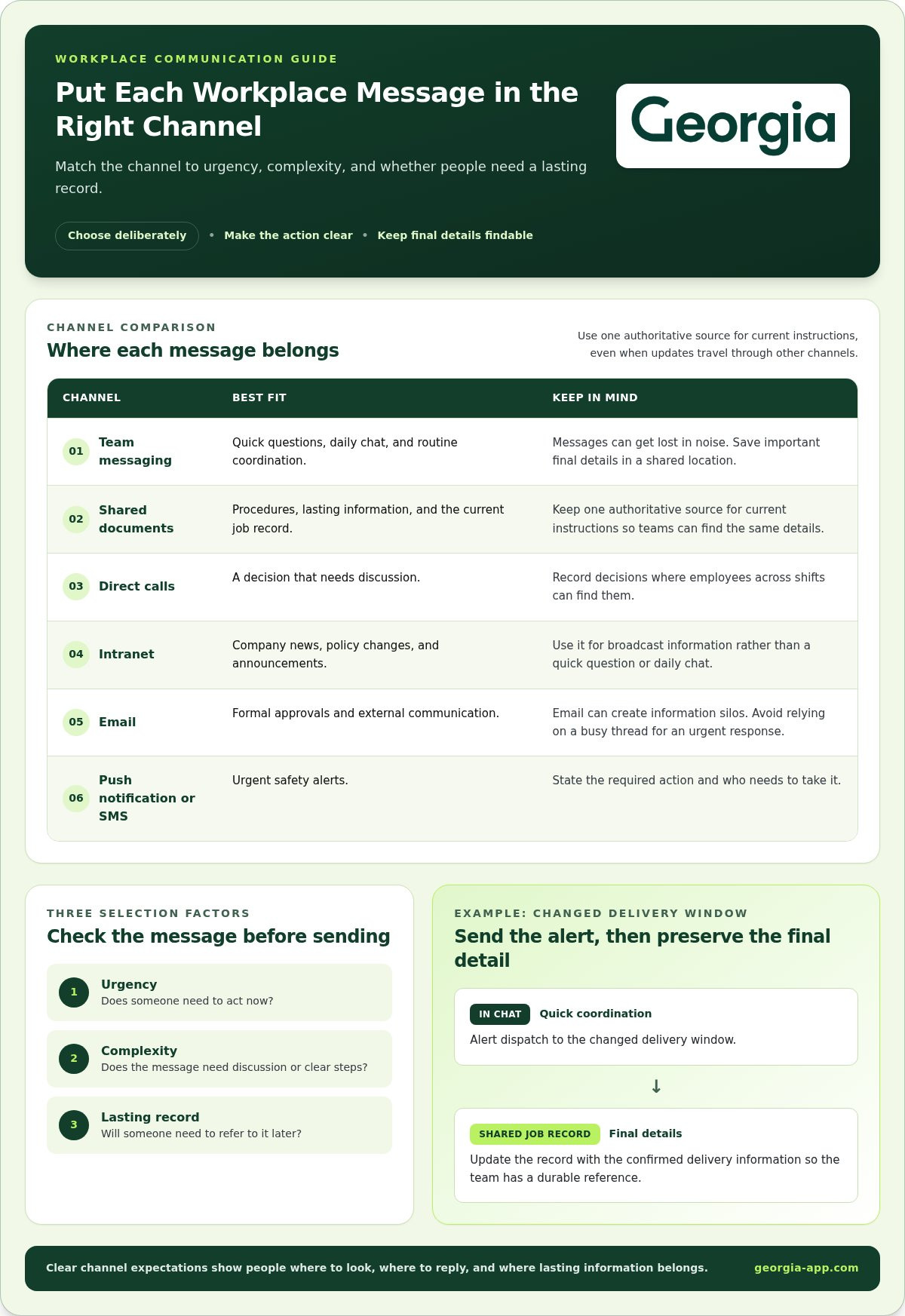
A mismatch between the message and its channel can cause delays and conflicting instructions. Choose a channel based on urgency, complexity, and the need for a lasting record. Use team messaging for quick coordination, shared documents for procedures, and direct calls when a decision needs discussion.
Keep one authoritative source for current instructions. For example, alert dispatch to a changed delivery window in chat, then update the shared job record with the final details. Leadership should establish where decisions are recorded so employees across shifts can find the same information.
For time-sensitive updates, state the required action and who needs to take it. Break complex instructions into steps that are easy to find and follow. Before sending, consider whether the recipient needs to respond immediately or refer to the information later. This distinction helps keep important details from getting buried.
If managers need to practise choosing and delivering messages across channels, Georgia’s leadership practice can help them prepare; discuss workplace communication practice with Georgia.
A channel plan should also account for the different ways information travels through a workplace. Organizations have multiple broadcast channels, particularly following the rise of remote and hybrid work models in response to COVID-19 restrictions. Workplace communication tools can help employees share information regardless of where they work, but having several routes available makes it important to choose deliberately. Workplace communication guidance recommends using an intranet for company news, policy changes, and announcements; team messaging for quick questions and daily chat; email for formal approvals and external communication; and push notifications or SMS for urgent safety alerts. These roles give employees a practical starting point when deciding where a message belongs. They also reduce the risk of placing an announcement in a channel intended for a different kind of exchange. Email can create information silos, while chat is a channel where messages can get lost in noise. Treating every channel as interchangeable can therefore make it harder for a colleague to locate the information or response they need. A clear channel choice should be part of composing the message, rather than an afterthought.
Digital messages need extra care because teams working across time zones may misread tone or intent. A message that seems obvious to its sender may leave the recipient unsure whether it is a request, a decision, or simply an update. Provide enough context to make the purpose clear, and specify any action or response needed. When information matters beyond the immediate exchange, save it in a shared location rather than relying on a busy conversation as the record. An urgent question buried in an email thread may be delayed, so choose a channel that suits the urgency instead of assuming another message in the same thread will get noticed. Team messaging works for routine coordination and quick questions; email provides a written route for formal approvals. Safety alerts call for push notifications or SMS. Familiar channel expectations help teams choose what fits the message and the recipient’s circumstances. They also make clear where to look, where to reply, and where lasting information belongs.
3. Protect Productivity and Trust Through Clear Communication
Poor communication wastes productive time on preventable corrections, delayed approvals, and duplicated work. If a customer order changes but the estimator and dispatch team work from different versions, employees may prepare conflicting plans and then spend time reconciling them.
Trust weakens when employees cannot explain why priorities changed or who made the decision. Managers can reduce uncertainty by documenting the reason for a change and naming the owner of the next action. Clear context helps employees act without guessing at leadership’s intent.
Measure communication through work outcomes. Track recurring corrections, delayed handoffs, and employee reports of unclear priorities. For mobile crews, check whether critical updates arrive before work begins. In meetings, record decisions and owners, then review whether the actions were completed. These signals reveal where communication supports productivity and where the process still creates friction.
One-way communication between employees and management
When managers issue instructions without providing a way to respond, frontline information stops moving upward. Thirty percent of employees said unclear communication from their bosses frustrated them. In a dispatch team, employees might spot a recurring loading conflict but have no practical way to flag it before schedules slip.
Make communication two-way. Ask employees what blocks the work, listen without interrupting, and confirm what you heard before deciding. Effective communication requires good listening skills, according to NIST. For example, if a driver says order changes arrive after departure, clarify where the handoff fails before changing the process.
Regular one-to-one meetings give managers a reliable opportunity to hear concerns employees may not raise in a group. Keep the discussion specific to the work: what is unclear, where instructions break down, and what would help the employee complete the next task. Record agreed actions and follow up at the next meeting so concerns do not disappear into informal conversation.
Remote and hybrid employees need the same access to context and decisions as onsite colleagues. Share updates in a consistent place, document decisions after calls, and invite remote staff to contribute before closing a discussion. A video meeting can clarify a sensitive issue, while a written summary gives employees across shifts a shared reference.
Trust erodes when managers request feedback but never explain what happened next. Close the loop by acknowledging the concern, naming the action owner, and communicating the decision. If a requested change is not possible, explain the constraint and identify an alternative step. Employees can then see how leadership handled their input, even when the outcome differs from their suggestion.
Silence can also hide risks to morale and attendance. When employees repeatedly receive conflicting priorities, frustration may show up as withdrawal, avoidable absence, or reduced effort. Ask about the work conditions behind the behavior instead of labeling someone disengaged. Then address the source, such as unclear approval authority or late updates.
Retention is another warning signal. Treat that figure as a prompt to examine whether strong employees can raise concerns and see action. In a FlexOS report, employees rated their managers seven out of 10 for effectively managing hybrid and remote teams. Use one-to-ones, pulse surveys, and follow-up records to find gaps between leadership messages and daily experience.
5. Common structural causes of workplace communication breakdowns
Communication failures often start in the operating design, not a single conversation. The Economist Intelligence Unit found 42% of respondents identified differing communication styles as the biggest cause of miscommunication at work. Teams need shared rules for turning messages into decisions, especially when sales, dispatch, and operations use different terms.
Unclear ownership creates another point of failure. Every goal, deadline, and assignment needs a responsible person, a due point, and a definition of completion. “Update the customer” leaves room for confusion; “the account manager sends the revised delivery window before dispatch release” clarifies the handoff.
Outdated or scattered documents leave employees guessing about which instruction applies. Keep current procedures and policies easy to find, and remove obsolete versions from common folders. If a dispatch lead finds two procedures for changing a load, employees may follow different steps while believing they are using the approved process.
Too many channels scatter attention, while too few can hide critical updates. Decide where final procedures, approvals, and live coordination belong, then apply that rule across departments. A chat message can alert a crew to a schedule change, while a shared job record holds the authoritative details everyone needs.
Organizational silos block information between departments. Sales may promise a delivery window without knowing about a dispatch constraint, while operations may lack the customer context behind a priority. Define a cross-department handoff that names the sender, recipient, required details, and point when ownership transfers.
Physical barriers can also make communication difficult. A noisy yard, separated work areas, or a distant break room can prevent quick clarification. Walk through the workflow, identify where employees struggle to hear or reach one another, and adapt the communication point or process to address the obstacle.
Leadership can diagnose structural causes by tracing a recent failure from beginning to end. Choose a missed update and record who created the information, where it went, who needed it, and where it stopped. Check whether each handoff had a clear owner, a current document, and a suitable channel.
Finally, review engagement signals alongside process failures. Repeated questions, duplicate work, and low participation in team updates can point to unclear expectations or hard-to-find information. Ask employees where the process breaks, compare their answers with the handoff record, and fix the recurring cause instead of sending another broadcast message.
Practice clearer leadership communication
When employees identify a breakdown, turn their account into a specific process correction rather than a general reminder. For workplace goals, project deadlines, and ownership assignments, state who is responsible, when the work is due, and what completion means. Then check the handoff against that shared standard: confirm the sender and recipient understand the task, the expected result, and where the final information belongs. If anything remains unclear, revise the assignment or procedure before the next transfer. This ties the correction to the point where the information became difficult to use.
Include the work setting in the review. Remove physical barriers to communication, and ask employees to identify where noise, distance, or separated work areas make clarification difficult. Adjust the communication point or process so people can reach one another and exchange the details needed for the handoff. Revisit the change with the employees who use it, and check whether the same questions or missed updates continue. Use their observations to improve the operating design, not to blame an individual.
Georgia: Sales & Commercial Training Modules
Georgia helps teams practise high-pressure conversations through personalized, self-paced simulations on its AI Role-Play Platform. Use it when employees understand the process but struggle to communicate clearly during customer objections, service issues, or leadership conversations.
Sales & Commercial Training Modules and Customer Operations Training support teams handling customer-facing conversations. Leadership Development Practice helps managers communicate expectations, respond to concerns, and guide difficult discussions. Employees practise realistic scenarios and develop their responses before the next high-stakes conversation.
To explore whether Georgia fits your team’s communication priorities, visit Georgia’s website.
Make the Next Communication Fix Part of the Operating Routine
Make your next communication improvement a repeatable management practice. Choose one recurring point of friction, assign someone to own the fix, and decide how the team will recognize progress. Keep the review grounded in actual work, such as whether handoffs include the details the next person needs.
This approach makes solutions to communication breakdowns in the workplace part of how your team operates, rather than a temporary response to a visible problem. Keep learning from missed messages and unclear expectations. Each resolved issue can strengthen future conversations and make responsibilities easier to carry out.
If your team needs structured practice for sales, customer operations, or leadership conversations, Georgia’s training modules and AI role-play platform can support that work.
Choose one conversation to improve, make the change deliberate, and build from there. Better communication starts with the next action your team takes.
Frequently Asked Questions
What Is a Communication Breakdown?
A communication breakdown occurs when a message fails to create the understanding or action its sender intended. The failure may happen during a handoff, interpretation, or follow-through. For example, a salesperson may record a requested delivery change, but dispatch may never see it. The key question is whether the responsible person received the information, understood it, and knew what to do next.
Why is Organizational Communication so Difficult?
Organizational communication is difficult because information crosses roles, priorities, schedules, and systems. A sales manager may focus on customer commitments while dispatch prioritizes available capacity. Each group can act logically based on the information it has and still create a conflict. Clarify who owns each decision, where updates belong, and which roles need to receive them before work moves forward.
What are the most common causes of communication breakdowns in the workplace?
Common causes include unclear ownership, inconsistent instructions, delayed updates, inaccessible records, and assumptions about shared understanding. To find solutions to communication breakdown in the workplace, trace one missed action backward: identify who sent the information, where it went, who needed it, and what prevented the next step. This reveals the process failure instead of blaming the last person in the chain.
What communication channels work best for different workplace situations?
The best channel depends on the task’s urgency, complexity, and need for a lasting record. A brief scheduling question may suit team chat. A revised operating procedure needs a maintained document. A sensitive disagreement may call for a private conversation, followed by a written record of decisions. Set channel expectations so employees know where to send each kind of message and where to find the final version.
How can teams improve communication across departments and time zones?
Teams can reduce cross-department and time-zone gaps by documenting decisions where everyone affected can access them. Include the decision, owner, next action, and relevant deadline. For example, a sales change affecting dispatch should state what changed and who needs to act. Write messages so employees can respond asynchronously, and reserve live meetings for issues that need discussion or rapid alignment.
What are best practices for giving clear feedback and setting expectations at work?
Describe an observable action, its effect, and the change required. Replace “be more responsive” with “acknowledge the customer’s revised order before confirming the new delivery plan.” State the expected outcome, responsible person, and timing. Ask the employee to explain the next step in their own words. This check reveals gaps before they lead to missed commitments or repeated corrections.
How can employers measure workplace communication and identify gaps?
Measure communication by tracking operational signals alongside employee input. To identify solutions to communication breakdown in the workplace, review recurring corrections, missed handoffs, repeated requests for clarification, and delays caused by incomplete information. Compare patterns across teams or shifts to locate where messages fail. Then ask affected employees which step created the gap. A useful measure connects the communication issue to a work outcome instead of counting messages or meetings alone.
What role do listening skills and psychological safety play in workplace communication?
Listening helps managers identify the actual problem before choosing a fix. NIST identifies good listening skills as necessary for effective communication. Psychological safety helps employees raise concerns, ask for clarification, and report errors early. For example, invite a team member to explain a confusing instruction without interrupting, then confirm what you heard. Respond to the information rather than penalizing the person who raised it.