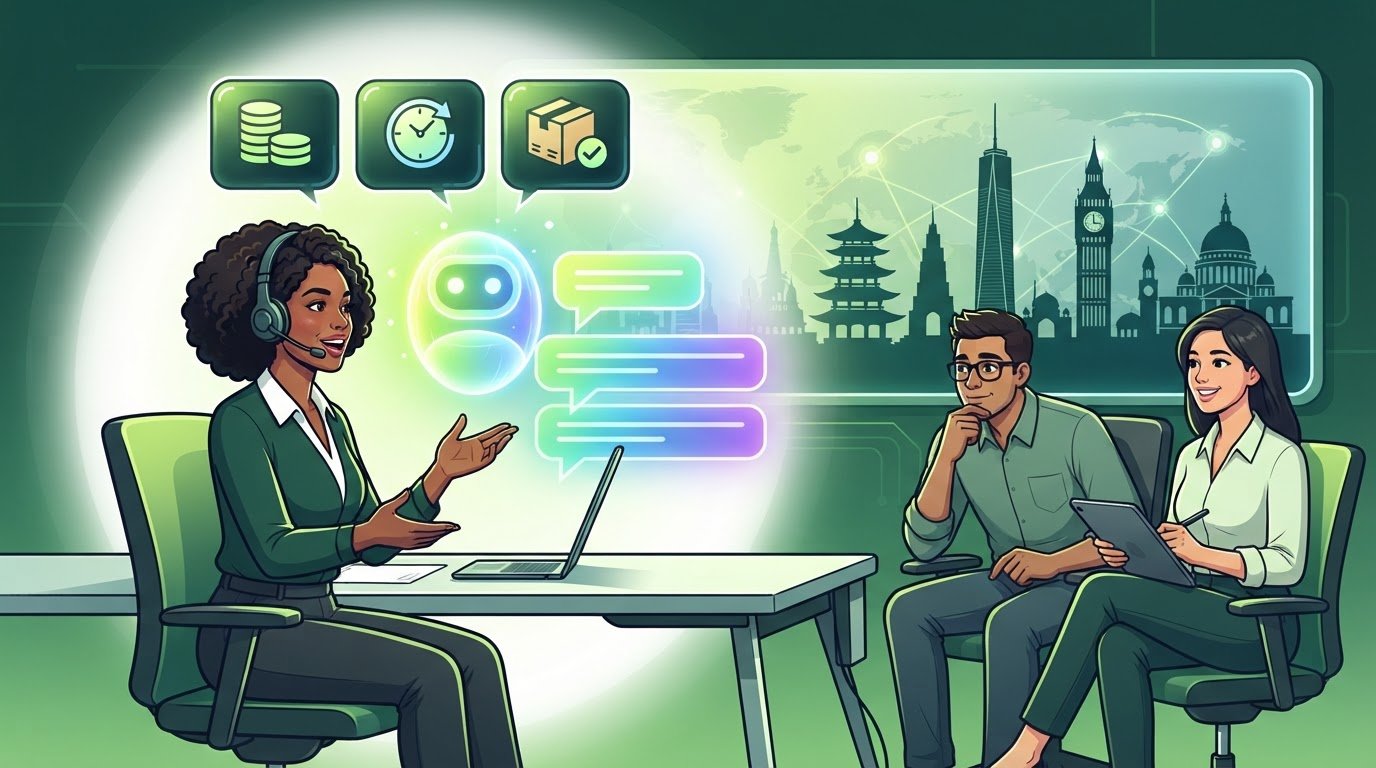

A leadership conversation can affect whether a customer stays, a crew raises a concern, or a performance issue is resolved before it disrupts work. Managers often face these moments with little chance to rehearse. AI powered leadership development earns its place when it gives leaders repeatable practice for conversations with operational consequences.
A course or framework can explain what good leadership looks like, but it cannot guarantee that managers will apply it under pressure. Leaders need to practise giving direct feedback, handling conflict, and responding to challenges before those moments arrive. The practical challenge is creating relevant rehearsal without taking managers away from the work that depends on them.
This article shows how to build leadership development around workplace conversations, create self-paced opportunities to rehearse, and assess whether AI role-play fits your program. You’ll see how to select scenarios, connect practice to workplace behaviour, and review progress without assuming that participation equals performance. The goal is to help leaders enter consequential conversations prepared to make clearer decisions and keep work moving.
Key Takeaways
- Identify leadership conversations that stall decisions, weaken alignment, or escalate conflict, then focus practice on those situations.
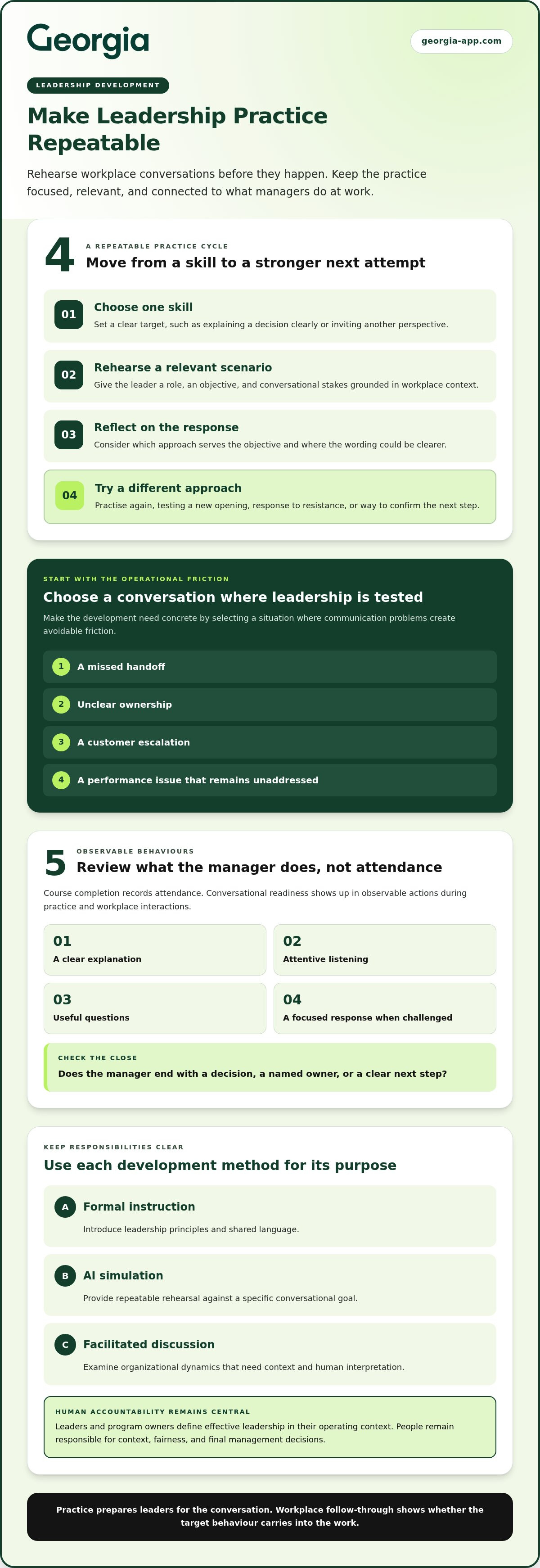
- Build AI powered leadership development around a repeatable cycle: choose a skill, rehearse a scenario, reflect, and practise again.
- Use AI simulations to provide repeatable rehearsal while leaders and program owners retain responsibility for context and judgment.
- Start with one team or conversation type, then review whether leaders apply the target behaviour at work before expanding.
- Use personalized, self-paced role-play as a practice layer within leadership development, alongside instruction and workplace follow-through.
Treat Leadership Conversation Gaps as an Operational Risk
A stalled leadership conversation can delay a decision, leave teams misaligned, or allow conflict to disrupt coordination. One-off instruction may give managers a principle to remember, but little opportunity to apply it under pressure. The practice gap is the distance between knowing a leadership principle and using it clearly in a difficult conversation.
AI powered leadership development can help close that gap by giving leaders structured practice in realistic workplace interactions. Start by identifying where communication problems create avoidable friction: a missed handoff, unclear ownership, a customer escalation, or a performance issue that remains unaddressed. These examples make the development need concrete and help you choose a scenario with a clear purpose.
For a broad explanation of the technology, see Artificial intelligence (AI).
For another perspective on AI and people leadership, watch this episode:
Identify the conversations where leadership performance is tested
Feedback can clarify a performance concern and establish what happens next. Conflict discussions can surface disagreement before it affects coordination. Accountability conversations confirm ownership, while change discussions explain what teams need to do differently and give people a chance to raise concerns.
Separate attendance from applied leadership capability
Course completion records attendance, not conversational readiness. Look for observable behaviours: a clear explanation, attentive listening, useful questions, and a focused response when challenged. In workplace interactions, check whether the manager closes with a decision, a named owner, or a clear next step.
Build AI-Powered Leadership Development Around Rehearsal
AI powered leadership development connects a leadership objective to structured practice. A simulation gives a leader a scenario to work through, reflect on their choices, and try a different approach. Your organization sets the learning goals and defines what effective leadership looks like in its operating context.
Content explains a principle; conversational rehearsal lets leaders test how they use it. A framework may be clear on the page and still feel difficult to apply in a live exchange. Rehearsal gives managers room to practise the opening, listen to a challenge, and choose a response before a similar conversation happens at work.
Turn leadership competencies into realistic scenarios
Choose one observable behaviour, such as explaining a decision clearly or inviting another perspective. Shape the scenario around the leader’s role, objective, and conversational stakes. For example, a supervisor could practise responding when a team member questions a change to responsibilities, or a manager could clarify ownership after a missed handoff.
Keep the exercise focused on one capability so the learner knows what to practise and what to adjust. Include enough workplace context to make the exchange relevant, but leave out details that distract from the learning goal. A well-defined scenario also gives the program owner a clear basis for reviewing the exercise.
Use repetition to prepare for pressure
Self-paced simulations provide repeatable chances to practise. Leaders can test different ways to open a conversation, respond to resistance, and confirm a next step. Reflection helps them consider which response better serves the objective and where their wording could be clearer.
Rehearsal supports preparation, while real conversations still require attention to the people and circumstances involved. Georgia’s AI role-play practice provides personalized, self-paced simulations for soft-skill conversations, including leadership development practice. Use it as a practice layer within your broader development approach.
Pair AI Practice With Human Judgment and Relevant Evidence
AI powered leadership development works best when each method has a defined purpose. Formal instruction introduces principles and shared language. AI simulations give leaders repeatable practice against a specific conversational goal. Facilitated discussion can help people examine organizational dynamics that require context and human interpretation.
These methods address different needs. A lesson can explain a behaviour without giving managers a chance to practise it. A simulation can rehearse a scenario, while people remain responsible for deciding what the organization should do. For a wider view of communication development, see high-stakes leadership communication training.
Decide which work belongs in simulation and which needs human facilitation
Use simulations when the development goal is clear and leaders need repeated rehearsal. A manager can practise opening a difficult conversation, responding to a challenge, or clarifying a next step. The repeatable format gives the learner room to try different approaches and consider how each one serves the goal.
Keep consequential interpretation with people. Questions about team history, organizational priorities, or the effect of a decision on specific employees require leadership and program oversight. AI can support practice; leaders remain accountable for context, fairness, and the final management decision. Use formal instruction to establish principles, and facilitated discussion for issues that extend beyond a defined practice scenario.
Choose evidence that reflects behaviour at work
Set a baseline before practice begins. Define the behaviour the program intends to develop, then decide how you’ll recognize it in a real interaction. If the goal is clearer accountability, look for managers who state the commitment, confirm ownership, and establish what happens next.
Participation information shows whether learners use the practice opportunity. To assess application, pair it with relevant manager observations or workplace indicators, such as whether follow-up actions are clear after a team discussion. Keep the evidence close to the target behaviour so the review remains useful.
Review the program against four practical tests:
- Scenarios reflect conversations leaders actually face.
- Leaders can access and complete practice without unnecessary friction.
- Participation shows that learners are engaging with the exercises.
- Workplace observations provide relevant signs of application.
Compare those signals with the baseline and use the findings to adjust scenarios or practice goals. Avoid attributing a business result to AI practice unless your evaluation supports that conclusion. The decision standard is practical: use AI for structured rehearsal, assign human judgment where context matters, and evaluate the behaviours the program set out to develop.
Roll Out AI Leadership Practice in a Four-Step Cycle
A rollout stalls when nobody owns the scenarios, practice schedule, or follow-through. Keep the first test narrow: one team or one conversation type tied to an existing leadership development objective. AI powered leadership development is easier to evaluate when the program starts with a defined behaviour and a clear workplace use.
Choose the behaviour, define the scenario, schedule practice, then review its application at work. Assign an owner to keep scenarios relevant, monitor participation, and connect practice to workplace observations. This sequence gives you a manageable way to assess the approach before expanding to other teams or skills.
Start with a defined development need
Select a recurring conversation where leaders need more preparation. A manager might need to clarify responsibilities after a missed handoff or deliver feedback about a specific work behaviour. Focus on one capability and describe the expected action in observable terms, such as stating the issue clearly and confirming the next step.
Link that behaviour to an existing development objective so simulation adds practice to the program. A training manager or designated program owner can check that the scenario reflects real roles and priorities. Team leaders can identify conversations that deserve attention and explain the operating context.
Make practice repeatable and review its application
Set a practical cadence that fits the development program and managers’ work. The aim is a repeatable opportunity to practise that can sit alongside operational duties. Give participants a clear expectation for when to complete the simulation and how the exercise connects to the skill they are developing.
After practice, ask leaders to reflect on the approach they chose, the response it invited, and what they would change in another attempt. Then check whether the leader used the target behaviour in a relevant workplace conversation. A manager’s observation can distinguish participation from application while keeping the review focused on evidence.
Keep ownership visible throughout the pilot. The scenario owner maintains relevance, the program owner tracks participation and gathers feedback, and the leader’s manager looks for application in normal work. Review what the process reveals before adding another team or conversation type. If the scenario feels detached from daily decisions, revise it. If leaders engage but workplace use remains unclear, strengthen the follow-through.
Georgia’s personalized, self-paced AI role-play simulations can provide the practice layer for this cycle. Use the pilot to assess how well the scenario fits the team’s development objective and whether the routine supports meaningful rehearsal.
Use AI-Powered Leadership Development to Make Practice Routine
A practice plan matters when leaders can use it within the development approach you already run. Georgia provides an AI-powered role-play platform with personalized, self-paced simulations for soft-skill conversations. Its leadership development practice gives managers a structured way to rehearse conversations under pressure, while your program retains responsibility for objectives, context, and follow-through.
Review how AI role-play can sit alongside your existing leadership development work. Consider where conversational practice fits across team roles, then select a recurring leadership conversation and connect it to a development goal. Establish how learners will practise and how you’ll review application, so the exercise has a clear purpose beyond completion.
Fit practice into an existing leadership program
Keep the simulation connected to work already underway. If a program develops clearer accountability, use a scenario that lets managers practise confirming ownership and next steps. A personalized, self-paced format gives each leader an opportunity to rehearse at a suitable point in the program.
Set the boundaries before introducing the exercise. Specify the skill it supports, who will use it, and how reflection or manager observation will connect practice to workplace conversations. This keeps the platform focused on rehearsal while your organization retains responsibility for judgment and program design.
Move from program design to a practical next step
Bring a specific use case to a demo. Identify the leadership conversation that needs rehearsal, the behaviour you want managers to practise, and a cadence that fits your program. Decide what evidence will help you assess fit, such as learner participation, scenario relevance, and manager observations of workplace application.
That preparation keeps the discussion grounded in your operating needs. You can assess whether personalized, self-paced role-play suits the intended learners and the conversation you’ve selected. Use the demo to examine the practice approach against your program requirements.
Final Thought
Make prepared conversations the unit of leadership development. Choose one recurring interaction, define the behaviour that matters, and build a repeatable practice routine around it. Then review whether the scenario fits and whether leaders apply the behaviour at work. AI role-play adds rehearsal opportunities; program owners and managers remain accountable for context, judgment, and the connection between development and operating demands.
Make the Next Leadership Conversation Your Starting Point
Choose an upcoming leadership moment where preparation could improve the discussion. Give the manager time to clarify their intention, practise a direct approach, and prepare to listen and respond. That makes AI powered leadership development part of how your team prepares for work, rather than an activity detached from it.
At your next program review, decide where rehearsal belongs and what evidence will show that the practice is relevant. Keep the focus on the decisions and working relationships your leaders influence. Start with one specific conversation and a deliberate next step.
Your leaders face consequential conversations every day. Give them a practical way to prepare. Book a demo of Georgia’s AI role-play platform and explore how it can support leadership practice in your program.
Frequently Asked Questions
Can AI-powered leadership development replace human coaching?
No. AI practice gives leaders repeatable opportunities to test phrasing and responses in a defined scenario. Human facilitation and management oversight address nuance, accountability, and organizational history. A simulation cannot decide how a restructuring, employee concern, or team conflict should be handled. Keep managers responsible for decisions, and use human judgment to interpret what practice reveals and determine where further support is appropriate.
Is AI-powered leadership development useful for experienced managers?
Yes. Experienced managers can use AI powered leadership development to prepare for an unfamiliar conversation or sharpen an approach to a recurring issue. A veteran supervisor stepping into a new role, for example, may need to discuss changed responsibilities with a former peer. Let each leader choose a relevant challenge, since tenure alone does not show which conversations feel difficult or unfamiliar.
How do organizations choose leadership conversations for AI practice?
Choose a recurring conversation tied to a current development objective, then name a behaviour you can observe. If managers need to improve shift handoffs, a scenario could focus on confirming ownership and surfacing missing information. Ask team leads where conversations tend to stall, then prioritize situations with a clear decision or working relationship at stake. Keep the initial selection narrow enough to review.
What happens if leaders find an AI simulation unrealistic?
Pause the exercise and diagnose the mismatch before adding detail. Check whether the roles, stakes, language, and likely responses resemble situations participants actually face. Verify that the scenario tests the intended skill rather than an unrelated issue. Ask learners what felt implausible and what context was missing, then revise the prompt or narrow the objective. Use participant feedback to assess whether the updated scenario feels relevant.
Can AI leadership simulations address sensitive workplace conversations?
Yes, with clear boundaries set before scenario design. Use fictionalized details, exclude names and identifiable employee or customer information, and align exercises with your organization’s privacy, HR, and conduct policies. Define which topics simulations can cover and which require established internal processes. Keep practice focused on communication behaviours, such as asking clarifying questions, rather than asking a simulation to decide a sensitive workplace case.
How should a company introduce AI practice to skeptical leaders?
Frame the exercise as rehearsal for a real work conversation, with feedback focused on practice rather than personal worth. Start with a familiar, relevant scenario and invite participants to identify what would make it credible. Gather feedback on scenario fit, ease of use, and whether the exercise helps them consider a different response. Share what you change based on that input, and describe early observations carefully without promising results.