

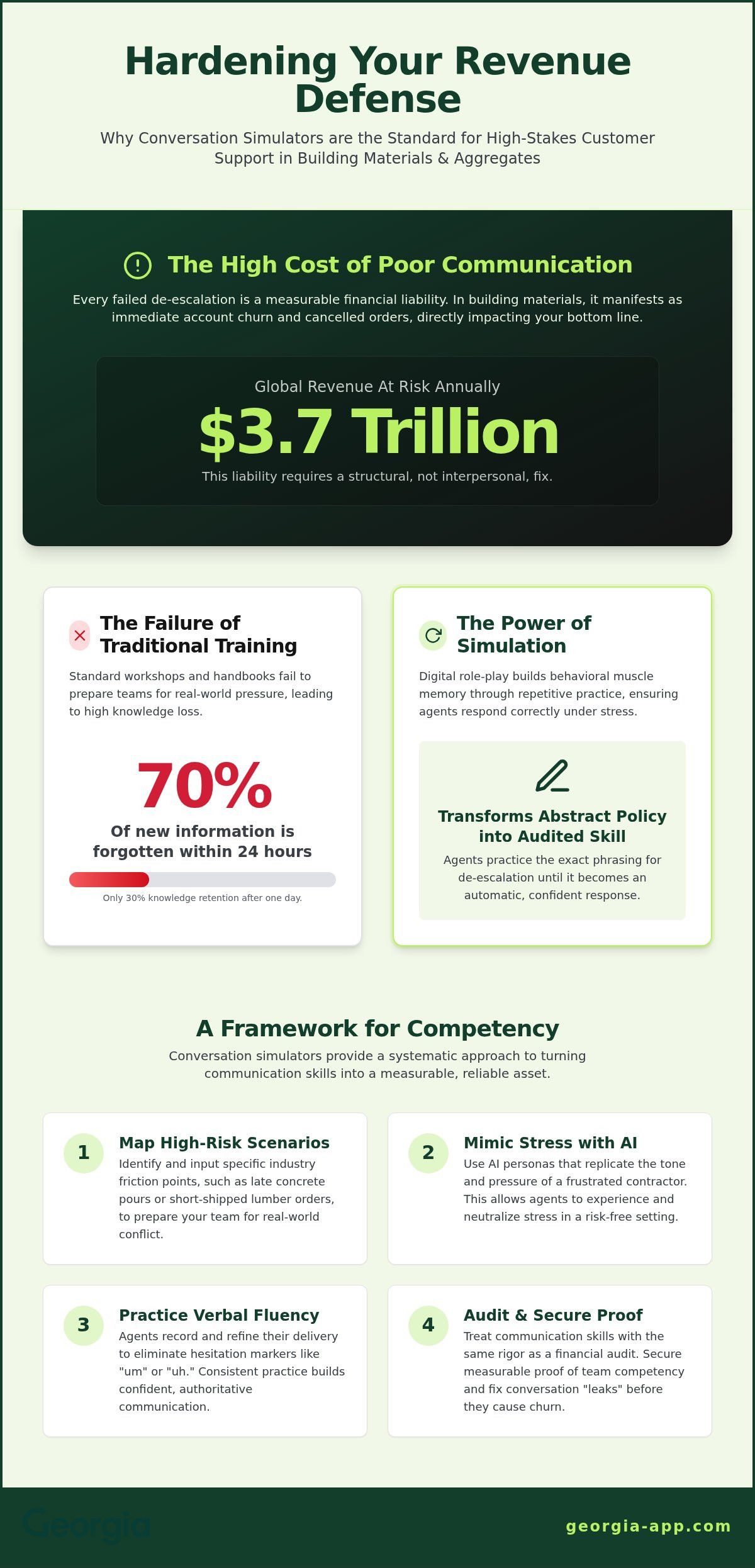
Poor customer service puts 3.7 trillion dollars in global revenue at risk annually. In the building materials and aggregates industry, this liability manifests as lost accounts and cancelled orders. Every time a dispatch lead freezes under pressure or an agent fails to de-escalate a frustrated contractor, your profit margin bleeds out. Communication skills are a critical financial safeguard for your operations.
Traditional classroom training fails to stick. Research shows that learners forget approximately 70 percent of new information within 24 hours of a session. Your team requires more than a handbook. They need a customer support conversation simulator to build the behavioral muscle memory that holds up when the stakes are high. This technology transforms abstract policy into a repeatable, audited skill set.
You will learn how to use simulation to identify specific communication friction points and protect your bottom line. We will cover the methodology of high-stakes role-play and the data required to prove agent competency. This guide provides the framework to turn your support desk into a hardened revenue retention engine. Every conversation is an opportunity to either secure a customer or lose them to the competition.
Key Takeaways
- Identify how poor de-escalation in dispatch leads to immediate account churn. Communication failures are financial liabilities that require a structural fix.
- A customer support conversation simulator builds behavioral muscle memory through repetitive practice. This ensures agents recall the correct response naturally during stressful live calls.
- Standard workshops lose 70 percent of their impact within one day. Digital role-play provides the reinforcement needed to overcome the forgetting curve.
- Map the highest-risk scenarios in your service line to neutralize stress. Inputting specific industry friction points into simulations prepares your team for real-world conflict.
- Audit conversation leaks to secure measurable proof of team competency. This approach treats communication skills with the same rigor as a financial audit.
High Pressure Interactions Drain Your Service Revenue
Every failed interaction at the dispatch desk is a measurable financial liability. In the building materials sector, a single botched de-escalation leads to immediate account churn. Contractors working on tight margins don't tolerate delays or incompetence. Friction in your service line slows down operational cycles and erodes your bottom line. Traditional training models treat these moments as minor interpersonal issues. They are structural failures in your revenue protection strategy.
Quantify the Cost of Support Friction
Identify the specific points where money leaves your business. Churn rates are often directly tied to service complaints that your team handled poorly. Calculate the time lost when a simple delivery dispute escalates to a supervisor call. These minutes add up to significant operational overhead. In the building materials industry, one lost account represents thousands in recurring revenue. You pay for the privilege of losing customers when your staff is unprepared for conflict. Auditing these interactions reveals a clear pattern of revenue leakage.
Identify Friction in Construction Service Lines
Construction timelines are unforgiving. When a contractor calls about a late concrete pour, the pressure is immediate and intense. This is where verbal fluency often fails. Dispatchers who lack training for high-intensity conflict often freeze or become defensive. This friction is a byproduct of outdated training methods that rely on manuals rather than active practice. Modern dialogue systems provide the technological foundation for a customer support conversation simulator. This tool allows your team to rehearse these specific, high-stakes scenarios before they cost you a contract.
The aggregates and concrete sectors operate on a ticking clock. Every minute a truck sits idle or a site waits for a delivery, the financial pressure mounts. If your support team cannot communicate clearly under this stress, they become another bottleneck in the system. Recognizing this failure as a technical problem allows for a technical solution. A customer support conversation simulator provides a risk-free environment to stress-test your team's responses. You wouldn't send a driver out without a license. Don't put a dispatcher on the phones without verified communication competency.
Simulated Conversations Build Behavioral Muscle Memory
Execution under fire requires more than policy knowledge. Real behavioral change requires repetitive, high-stakes practice. In a crisis, your brain bypasses logical reasoning and relies on ingrained habits. If those habits aren't trained, your agents will freeze or revert to defensive, unproductive language.
A customer support conversation simulator bridges the gap between knowing what to do and actually doing it. It creates a controlled environment where repetition builds behavioral muscle memory. Your team practices the exact phrasing needed to de-escalate a situation before the pressure becomes real. This prepares them to act decisively when a major account is on the line.
Mimic High Stakes Stress with AI
Simulations must feel authentic to be effective. Use AI personas to replicate the specific tone of an angry contractor dealing with a site shutdown. These scenarios should focus on industry-specific friction, such as a delayed concrete delivery or a short-shipped lumber order. This allows agents to experience the physiological symptoms of stress in a risk-free setting.
They learn to neutralize stress by navigating these simulated confrontations repeatedly. Repetition hardwires the correct response into the agent's nervous system. This method protects your actual client relationships. You don't want your staff learning how to handle a hostile call on your most valuable account. AI provides the necessary resistance without the financial risk of a real-world failure.
Practice Verbal Fluency Under Pressure
Verbal fluency is the primary indicator of authority. During heated exchanges, hesitation markers like "um" or "uh" signal a lack of control to the customer. A customer support conversation simulator allows agents to record and refine their delivery until it is precise. They master the pitch and tone required for high-stakes meetings and dispatch calls alike.
Consistent practice eliminates the hesitation that leads to service friction. Mastering the mechanics of a response prevents the freeze reaction that occurs when an agent is overwhelmed. Clear delivery during a heated exchange maintains the professional image of your firm. It ensures that the conversation remains focused on solutions rather than escalating into a personal conflict.
When an agent has successfully navigated a scenario fifty times in a simulation, the fifty-first time, with a real client, is routine. You can see how these simulations build verbal fluency by exploring personalized role-play modules. High-stakes communication is an audited skill, not an innate talent. Reliable habits are the only defense against the chaos of a busy construction season.
Digital Role Play Solves the Forgetting Curve
Standard workshops are a waste of capital. Research indicates that without reinforcement, learners lose 70 percent of new information within 24 hours. By the end of a week, 90 percent is gone. This "forgetting curve" turns your training budget into a sunk cost. High-stakes communication requires more than a one-time seminar. It requires a system that forces the brain to retain what it has learned.
Replace Ineffective In-person Workshops
Ditch expensive sessions that lack long-term ROI. Peer-to-peer role-play is often awkward and unrealistic. Employees feel self-conscious practicing with colleagues. This prevents them from fully engaging with the scenario. They don't want to look foolish in front of their peers. This hesitation limits the effectiveness of the exercise. A customer support conversation simulator provides a private, safe space for managers and agents to fail without social consequences.
Failure in a simulation is a learning opportunity. Failure on a live call with a major aggregate account is a financial loss. Digital role-play allows for the high-intensity practice needed to master training for high-pressure conversations. It removes the performative aspect of traditional training and replaces it with focused, behavioral rehearsal. Your team needs to focus on the customer, not on how they appear to their coworkers.
Scale Training Without Human Coaching
Manual performance reviews are a bottleneck for growing organizations. You can't afford to have a coach listen to every call and provide immediate feedback. Digital simulations remove this constraint entirely. They allow employees to practice during operational downtime or between morning dispatch rushes. This flexibility ensures that every member of the team receives consistent practice regardless of their schedule.
A customer support conversation simulator provides consistent feedback loops that human coaches cannot match at scale. It identifies specific verbal patterns that lead to friction, such as defensive phrasing or slow response times. You get data-driven proof of competency instead of a trainer's subjective opinion. This structural approach turns communication into a hardened operational asset. It allows you to deploy personalized practice across the entire organization without increasing your headcount.
Use a Customer Support Conversation Simulator to Neutralize Stress
Neutralizing stress in your service line is a risk management strategy. It requires a precise calibration of your training tools to match the reality of your operations. You must identify the highest-risk scenarios where communication failure results in immediate financial loss. A customer support conversation simulator only delivers ROI when it targets the specific leaks in your revenue bucket. General practice is a waste of time. Targeted rehearsal is a financial safeguard.
Design Scenarios for Support Friction
Effective simulations mirror the actual conflicts your dispatchers face daily. Create role-plays that focus on price negotiations for large-scale construction projects. Simulate high-tension calls from site managers dealing with underperforming crews or delayed material drops. These specific friction points are where your profit margins are most vulnerable. Using customer service role play software allows you to replicate these industry-specific stressors without risking a real account. Your team should master the response to a short-shipped aggregate order before they ever speak to a frustrated contractor.
Measure Performance Through Data
Communication is an audited skill. You must set baseline metrics for verbal fluency and de-escalation speed. Don't rely on a manager's gut feeling about an agent's performance. Use a customer support conversation simulator to generate hard data on how well an employee maintains control under pressure. Track progress through automated feedback that flags hesitation, defensive language, or failure to follow protocol. This data creates a clear picture of team competency before they go live on the phones.
Audit your conversation quality with the same rigor you apply to your financial ledgers. Link simulation scores directly to your customer retention rates to see the impact of improved fluency. Require daily repetition of these scenarios until every agent achieves a mastery score. Consistency is the only way to ensure that your service quality remains high during the peak of the construction season. If an agent cannot pass the simulation, they are a liability you cannot afford to put in front of a customer.
Georgia Audits and Fixes Conversation Leaks
Georgia operates as a diagnostic tool for your communication infrastructure. It identifies the exact points where your team is losing money during service interactions. Communication failures are not just social errors. They are structural leaks in your revenue cycle. By implementing a customer support conversation simulator, you fix these failures before they hit the balance sheet. This platform treats verbal fluency with the same rigor as a financial audit. It exposes the friction that traditional training ignores.
Secure your operations by auditing every interaction for revenue slippage. Most firms ignore the cost of a poorly handled dispatch call until the account is already lost. Georgia provides a proactive defense. It maps the communication gaps that lead to churn and provides the specific modules needed to close them. You gain a hardened revenue retention engine that operates with mechanical precision. Conversational excellence is a measurable financial asset.
Integrate AI Role Play into Training
Integrate Georgia into your existing training stack to ensure operational consistency. Compliance modules alone do not prepare dispatchers for a hostile contractor on a job site. You need customer service simulation software to provide the necessary resistance. Practice difficult customer role play scenarios daily to keep skills sharp. This ensures that your team remains calm when the concrete trucks are late and the site manager is screaming. High-stakes communication requires constant maintenance.
The platform adapts to the specific friction points of the construction and building materials industry. It uses AI to mimic the high-pressure stress of a failing delivery window or a disputed invoice. Your team practices these scenarios in a self-paced environment until their responses are automatic. This repetition builds the behavioral muscle memory required to handle real-world conflict. You remove the bottleneck of manual coaching and replace it with a scalable, automated system.
Secure Your Revenue Base Today
Secure your revenue base by eliminating the urge to over-discount under pressure. Agents often offer credits or price breaks just to end a stressful conversation. This is a direct loss of profit margin. Georgia provides training for high pressure conversations that teaches agents to hold the line. Data-driven coaching replaces subjective feedback with measurable performance metrics. You can finally see which agents are protecting your margin and which are giving it away.
Stop guessing about the quality of your customer interactions. Improve team communication metrics by identifying where your team lacks verbal fluency. This targeted approach ensures that training time is never wasted on irrelevant soft skills. You focus on the interactions that drive the most significant financial impact. Book a demo to audit your team's communication gaps and stop the leakage. Protect your bottom line with a system designed for the high-stakes reality of industrial service.
Harden Your Communication Infrastructure
Communication friction is a direct threat to your profit margins. You have identified where poor de-escalation leads to account churn and how standard workshops fail to stop the bleed. Protecting your revenue base requires a systematic approach to training that emphasizes behavioral muscle memory over passive knowledge. A customer support conversation simulator provides the necessary resistance to prepare your team for the high-stakes reality of the construction season.
Final Thought
You no longer treat support as an unmeasurable soft skill. You view every interaction as a financial asset that requires auditing. Instead of relying on manual reviews, you verify team competency through personalized, self-paced simulations. You replace ineffective workshops with daily repetition to ensure knowledge sticks. This shift to data-driven coaching secures your revenue base and ensures your team maintains control under pressure. You are equipped to eliminate service leaks and protect your bottom line.
Frequently Asked Questions
How does a customer support conversation simulator improve retention?
A customer support conversation simulator improves retention by training agents to handle high-stakes conflict without losing the account. In the building materials industry, a single botched dispatch call results in immediate churn. Simulation allows agents to practice de-escalation until the correct response is automatic. This prevents the freeze reaction during live disputes. By verifying agent competency in a risk-free environment, you ensure that every customer interaction protects your long-term revenue base.
Can AI role-play mimic the stress of a real construction dispute?
AI role-play mimics the physiological stress of a construction dispute by using aggressive personas and strict time constraints. The platform replicates the tone of a site manager dealing with a late concrete delivery or a short shipment. These high-pressure scenarios force the agent to maintain verbal fluency while under fire. This level of resistance is impossible to achieve in standard role-play. It prepares your team for the reality of a busy construction site.
What is the ROI of high-pressure conversation training?
The ROI of high-pressure conversation training is measured in secured revenue and preserved profit margins. Agents who are untrained for conflict often offer unnecessary discounts to end a stressful call. This is a direct financial loss. By hardening your team's communication skills, you stop these leaks. Effective training protects major accounts that would otherwise churn due to poor service. You treat communication as a financial asset that requires a measurable return.
How do simulators solve the forgetting curve in corporate training?
Simulators solve the forgetting curve by providing the repetitive reinforcement needed for long-term retention. Research shows that learners forget 70 percent of new information within 24 hours without practice. A customer support conversation simulator forces the brain to move information from short-term memory to behavioral muscle memory. Self-paced, daily practice ensures that skills remain sharp over time. You replace one-time training events with a continuous, audited cycle of performance improvement.
Is digital role-play more effective than in-person workshops?
Digital role-play is more effective than in-person workshops because it eliminates social awkwardness and provides scalable feedback. Peer-to-peer role-play is often unrealistic and embarrassing for employees. This limits their engagement and learning. Digital simulations provide a private space to fail and learn from mistakes. They allow your entire organization to practice simultaneously without the logistical costs of a live seminar. You get data-driven proof of competency instead of a trainer's subjective opinion.
How long does it take to see results from simulation training?
Results appear the moment an agent achieves mastery in high-risk scenarios. Most teams see an immediate improvement in verbal fluency and de-escalation speed after a few days of daily repetition. Ramp time for new hires is significantly reduced because they can practice a year's worth of difficult calls in a week. This accelerated learning curve prevents the service friction that typically occurs during the onboarding process. Performance metrics provide real-time proof of progress.
Can I customize the simulator for specific building material scenarios?
The platform allows full customization to reflect the specific friction points of your industry. Scenarios can be designed around price negotiations for lumber, delivery disputes for aggregates, or quality complaints regarding concrete. This ensures that training is relevant to the high-stakes reality your team faces daily. You don't waste time on generic service scripts. Instead, you focus on the exact interactions that drive your revenue and determine your market reputation.
What metrics does the Georgia platform track for support teams?
The Georgia platform tracks objective performance metrics including verbal fluency and de-escalation success rates. It identifies hesitation markers and defensive phrasing that signal a loss of control during a conversation. These data points provide a clear audit trail of agent competency. You can link these scores to actual customer retention rates to measure the impact of your training. This allows leadership to make informed decisions based on hard data rather than anecdotal evidence.