

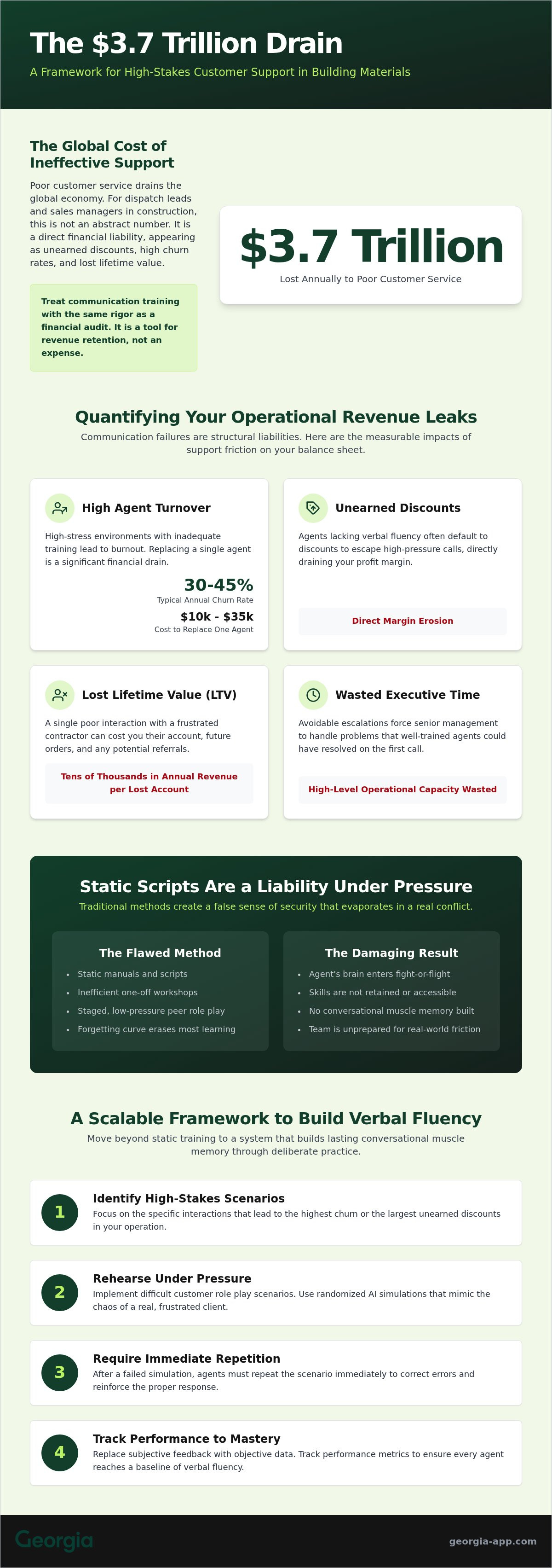
Poor customer service drains $3.7 trillion from the global economy every year. For a dispatch lead in building materials, this is a direct financial liability. You see the revenue leaks in the form of unearned discounts and high churn rates. Implementing difficult customer role play scenarios is the only way to audit your team's performance before the next crisis hits.
Traditional training methods fail because they lack the pressure of real-world friction. Static manuals and occasional workshops don't build the muscle memory required for high-stakes conflict. You've likely realized that manual coaching for every agent is impossible to scale. You need a system that treats verbal fluency with the same rigor as a financial audit.
You can close these communication gaps and stop the financial bleed. This article provides a scalable framework to identify specific verbal failures and fix them. We'll examine how to build measurable fluency and ensure a consistent support experience that protects your bottom line.
Key Takeaways
- Quantify the financial impact of poor support interactions to identify specific revenue leaks in your operation.
- Implement difficult customer role play scenarios to build the conversational muscle memory required for high pressure conflict.
- Master specific de-escalation tactics for operational disruptions to reduce customer churn and protect lifetime value.
- Replace manual coaching bottlenecks with AI simulations to provide data driven feedback at scale.
- Move beyond static scripts to a framework that ensures consistent verbal fluency across your entire support team.
Quantify the Financial Loss from Poor Support Interactions
Every poor support interaction is a measurable revenue leak. In the building materials and construction sectors, communication failures are structural liabilities. Support friction increases customer churn. It reduces lifetime value. Globally, businesses lose an estimated $3.7 trillion annually due to poor customer service. Your operation is part of that statistic if your team cannot handle high pressure conflict.
Inconsistent communication across your dispatch and support teams creates operational drag. You must treat communication training with the same rigor as a financial audit. It is a tool for revenue retention. Training is financial management. When an agent fails to de-escalate a frustrated contractor, the cost appears on your balance sheet. You lose the account. You lose the future orders. You lose the referral.
The True Price of Support Friction
Calculate the cost of a lost client in your sector. A single lost concrete contract can cost tens of thousands in annual revenue. Human support interactions cost an average of $17 per call. This cost skyrockets when agents lack the skills to resolve issues quickly. Agents often default to unearned discounts to escape high pressure calls. This is a direct margin drain. Poor verbal fluency increases resolution times. It forces your staff to spend more time on low value friction.
Consider these measurable impacts of support friction:
- Identify unearned discounts granted during heated delivery disputes.
- Calculate the lifetime value of accounts lost to a single poor interaction.
- Measure the cost of executive time spent on avoidable management escalations.
- Track the correlation between resolution speed and specific agent verbal fluency.
Audit Your Team for Conversational ROI
Measure the gap between your top and bottom performers. Your best agents protect revenue. Your worst agents leak it. Track how often calls escalate to management. These escalations waste high level operational capacity. Replace subjective manager feedback with objective data. Analyze the impact of friction on your reputation. Mishandled disputes poison contractor relationships. Implement difficult customer role play scenarios to find these leaks early. This process reveals which agents are liabilities before they cause churn.
High turnover in contact centers, often between 30% and 45%, adds further financial strain. Replacing a single agent costs between $10,000 and $35,000. Effective training reduces this turnover by giving agents the tools to handle stress. When agents feel competent, they stay. When they stay, your operational knowledge remains intact. You stop paying the price for the constant cycle of hiring and retraining.
Rehearse Under Pressure to Build Conversational Muscle Memory
Static scripts are a liability. They provide a false sense of security that evaporates the moment a client starts shouting. When a project manager is losing money on a stalled site, your agent's brain shifts into fight or flight mode. They won't remember a bullet point from a manual. They need conversational muscle memory.
True mastery requires repetition. You don't learn to drive by reading a book. You don't learn to de-escalate a major dispute by attending a seminar. You must simulate the physiological stress of an angry client to build genuine verbal fluency. Practicing in short, intense bursts allows your team to move beyond the forgetting curve and retain critical skills.
Why Traditional Workshops Fail Your Team
In-person workshops are an inefficient use of capital. Most participants forget the majority of the material within twenty four hours. These sessions often lack the individual pressure required for growth. Peer-to-peer role play feels staged and awkward. It fails to mimic the raw hostility of a real world conflict. You cannot build resilience in a comfortable environment. If you want to see how your team performs under fire, you need to simulate high pressure environments that challenge their instincts.
Steps to Build Lasting Verbal Fluency
Define the high-stakes scenarios your team faces daily. Focus on the interactions that lead to the highest churn or the largest unearned discounts. Use randomized variables to prevent predictable practice. A real customer doesn't follow a path. They interrupt. They pivot. They get personal. Your training must reflect this chaos.
Follow these steps to ensure training sticks:
- Identify the specific verbal triggers that cause agents to fold.
- Implement difficult customer role play scenarios that force agents to maintain control.
- Require immediate repetition after every failed simulation attempt to correct errors instantly.
- Track performance metrics to ensure agents reach a baseline of verbal fluency.
Repetition is the only way to replace panic with professional poise. If an agent fails a simulation, they must try again immediately. Delaying the correction allows the wrong response to settle. Speed is essential. Correcting the mistake in the moment builds the neural pathways needed for instinctive resolution. This is how you transform a support team from a cost center into a revenue protection unit.
Master the Most Common Difficult Customer Scenarios
Identify the specific interactions that most frequently lead to revenue loss. In the construction and building materials industry, these are rarely minor misunderstandings. They are high-stakes operational failures that threaten a client project timeline. You must use difficult customer role play scenarios to prepare your team for these specific points of failure.
Focus your training on de-escalation for clients facing major disruptions. Empathy is often a secondary concern in these moments. The client requires a resolution. They do not need a friend. According to industry data, 32% of customers switch to a competitor after just one poor experience. Your agents must project authority and provide concrete timelines to stop the churn before it starts.
The Aggressive Price Negotiator
Agents often default to unearned discounts to end uncomfortable calls. This is a direct drain on your margins. Train your team to defend your value without retreating on price. Practice holding the line on contract terms while under verbal fire. You can use customer service role play software to simulate these high-pressure negotiations.
A successful negotiation requires more than a script. It requires the ability to withstand hostility. If your team defaults to a manager escalation, they have already lost control. Ensure they understand the financial impact of every dollar they give away. Role play should focus on the transition from the customer complaint to the company value proposition.
The High Stakes Operational Failure
Rehearse the response to a late delivery that halts a client project. A contractor losing thousands in labor costs every hour does not want a vague apology. They want a truck number and an accurate ETA. Focus on clear, factual communication. Vague promises create more friction when they are not met.
Every agent must handle a technical failure crisis with authority. When the system goes down or the product fails, the support team is the only thing standing between you and account churn. Practice these difficult customer role play scenarios until the response is instinctive. The goal is to reduce the time spent in conflict. Efficient resolution protects your reputation and your revenue base.
Eliminate Training Bottlenecks with Automated Feedback
Manual coaching is a structural bottleneck. It prevents training at scale. If your training program relies on a manager's schedule, you are losing the battle against the Forgetting Curve. Most employees forget 70% of new information within twenty four hours. Without immediate and frequent reinforcement, your training investment is a total loss.
Subjective feedback from managers lacks the consistency required for a professional audit. Personal bias often skews the results of a training session. You cannot patch a revenue leak using a manager's "gut feeling" about an agent's performance. You need objective data to verify that your team is ready for high-stakes conflict.
Automated systems provide instant, objective analysis of agent performance. They remove the interpersonal friction inherent in peer to peer difficult customer role play scenarios. Agents perform best when they practice in a private, high-pressure environment. This neutrality allows for honest skill assessment without the social anxiety of performing for a colleague.
The Problem with Subjective Manager Coaching
Managers in the building materials and construction sectors are often overwhelmed by operational demands. They lack the bandwidth to provide the constant repetition required for skill mastery. Manual coaching sessions are too slow to keep pace with the high turnover rates in modern contact centers. Every day an agent waits for a feedback session is a day they continue to mishandle volatile contractor disputes. This delay is a financial liability that compounds over time.
Implementing Data Driven Performance Metrics
You must track specific metrics like verbal clarity and de-escalation efficiency with the same precision as your inventory levels. Aggregated simulation data allows you to identify team-wide skill gaps before they result in account churn. Use objective benchmarks to determine when an agent is ready to handle a major operational failure. This level of precision transforms soft skills into a hard asset that protects your bottom line.
Measure the conversational ROI of every training module. Compare the performance of agents who practice difficult customer role play scenarios daily against those who rely on occasional workshops. The data will show a clear correlation between frequent repetition and revenue retention. You need a system that functions around the clock without increasing your management headcount or slowing down your dispatch operations.
Deploy AI Simulations to Secure Your Revenue Base
AI role play allows for personalized, self-paced practice for every employee. It is a scalable solution that works without increasing your management headcount. You can deploy dynamic simulations that react to agent input in real time. This ensures every conversation meets your operational standards and protects your revenue base.
Traditional training is a one-off event. AI simulation is a continuous audit. It removes the variability of human trainers. It replaces subjective observation with hard data. You can now verify that every agent has the verbal fluency to handle high-stakes conflict.
The Benefits of Self-Paced AI Training
Agents practice in a safe environment. They don't fear judgment from peers or managers. This privacy encourages genuine skill development rather than performance for an audience. Consistent training ensures every contractor receives the same high standard of service regardless of which agent answers the phone.
Integrate customer de-escalation training software into your daily routine. This keeps skills sharp against the Forgetting Curve. High-stakes difficult customer role play scenarios become a standard part of the workday. Constant repetition builds the resilience needed for real-world friction.
Securing Your Long Term Operational Success
Build a culture of continuous improvement through digital simulation. You can reduce the time it takes to onboard new support representatives by weeks. New hires reach peak efficiency faster when they can rehearse difficult customer role play scenarios hundreds of times before their first live call. This speed to competency is a competitive advantage in high-turnover environments.
Focus on measurable outcomes. Participation trophies don't protect your margins. Data-driven benchmarks do. AI simulations provide a clear record of who is ready for the floor and who needs more work. You gain total visibility into the conversational ROI of your support team.
Stop relying on luck and manual oversight. Every mishandled call is a financial failure. Digital simulations provide the structural integrity your communication strategy lacks. They turn soft skills into a repeatable, audited process that secures your long-term success.
Stop the Financial Bleed from Support Friction
Treat every support interaction as a financial audit. Your team either protects your revenue or leaks it through unearned discounts and churn. Implementing difficult customer role play scenarios at scale is the only way to ensure consistent performance across your entire organization. You now have the framework to replace subjective coaching with objective, data driven simulations. This transition secures your margins and strengthens your brand reputation in a volatile market.
Final Thought
You no longer accept support friction as an unavoidable cost of business. You view conversational failures as structural flaws that require a mechanical fix. By deploying AI driven simulations, you provide your team with the high pressure practice needed to survive real world conflict. You focus on measurable ROI and verbal clarity to secure your long term success. Your support team is now an audited revenue protection unit that prevents churn and defends company profit margins.
Frequently Asked Questions
What are the most common difficult customer role play scenarios?
The most frequent interactions involve aggressive price negotiations, billing disputes, and operational failures such as late deliveries. Agents also struggle with customers who have unrealistic expectations or those who have violated contract terms. Training must focus on these high-stakes interactions because they represent the highest risk for churn and revenue loss. Using difficult customer role play scenarios to practice these specific moments builds the muscle memory required to stay professional under pressure.
How do you handle an angry customer in a role play?
Handling an angry customer requires maintaining authority while identifying a path toward resolution. The agent must avoid defensive language and focus on the facts of the situation. In a role play, the simulation should mimic the rising tension of a real call. This allows the agent to practice verbal fluency and de-escalation techniques until they can navigate the conflict without escalating the situation or offering unnecessary discounts to escape the stress.
Why is role playing important for customer service?
Role playing is critical because it bridges the gap between knowing a policy and executing it under stress. Most training fails because it lacks active participation. Role playing forces agents to use their verbal skills in real time. This builds the neurological pathways needed for consistent performance. It turns abstract concepts into practical habits that protect the company's revenue during every interaction. Consistent practice ensures that agents don't freeze when facing a hostile contractor.
Can AI really replace human role play partners?
AI provides a more consistent and scalable solution than human partners. It eliminates the social anxiety of peer to peer practice and allows for objective data collection. AI personas can be programmed to react with specific levels of aggression or confusion. This provides a range of challenges that a human colleague might struggle to replicate. This ensures that every agent receives the same high quality training regardless of their location or the time of day.
How long should a customer service role play session last?
Prioritize short, frequent sessions over long, rare workshops. Ten to fifteen minutes of high intensity practice is more effective than a three hour seminar. This approach respects the agent's time and aligns with how humans actually retain information. Frequent repetition in small doses helps to solidify skills and prevents the forgetting curve from eroding your training investment. Consistency is more valuable than duration when building the verbal fluency needed for revenue protection.
How do you measure the success of role play training?
Success is measured through objective performance metrics and bottom line results. Look for a reduction in escalated calls and improved resolution times. You should also see a decrease in the frequency of unearned discounts granted during disputes. Within the training platform, you can track verbal fluency scores and empathy ratings. Comparing these metrics against real world customer satisfaction scores provides a clear picture of the conversational ROI difficult customer role play scenarios are delivering.