

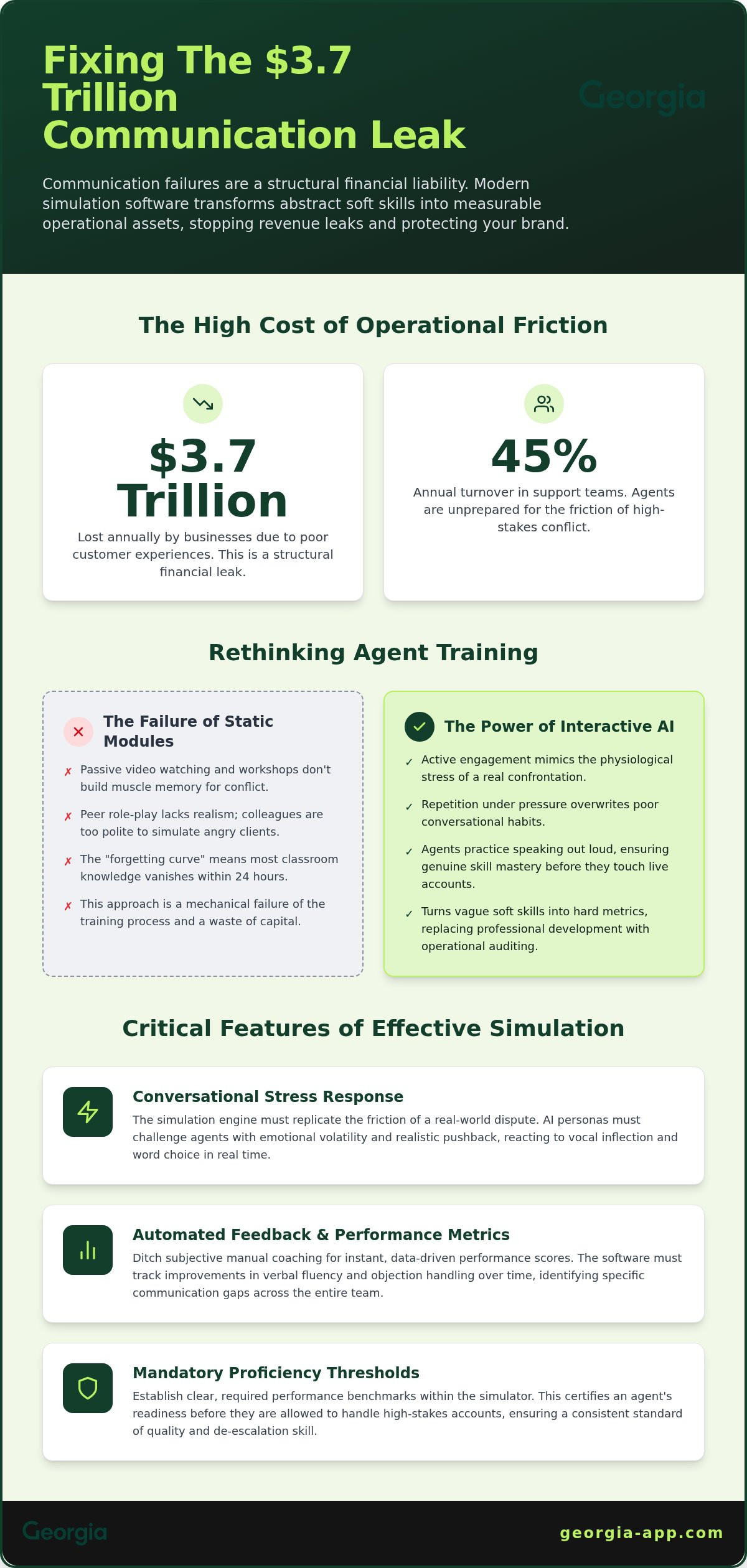
Businesses lose $3.7 trillion annually to poor customer experiences. This is a structural financial leak. Every unhandled objection represents a direct hit to your bottom line. You see it in your attrition rates. Support teams face 45% turnover because they are unprepared for the friction of high-stakes conflict.
You need a mechanism to audit and fix these communication failures before they reach your customers. The right customer service simulation software transforms abstract soft skills into measurable operational assets. It forces agents to rehearse under pressure until performance is a reflex.
This article identifies the critical features of de-escalation software that stop agent attrition and protect your brand reputation. We will show you how to reduce escalation rates and accelerate onboarding through rigorous role play. You will learn to treat communication with the same precision as a financial audit.
Key Takeaways
- Treat communication failures as structural financial leaks that require a rigorous audit.
- Select customer service simulation software that tests real-time conversational stress responses and vocal precision.
- Prioritize interactive simulations over static courses to ensure agents practice speaking out loud for genuine skill mastery.
- Establish mandatory proficiency thresholds in a simulator to certify agent readiness before they touch high-stakes accounts.
- Use self-paced AI role-play platforms to eliminate soft skill revenue leaks without disrupting your operational schedule.
Stop Treating Communication Friction as a Minor Nuisance
Every failed interaction with a frustrated client is a measurable financial liability. Communication challenges are structural failures in your revenue engine. Poor verbal fluency in high-stakes moments causes immediate account attrition. This is a direct hit to your bottom line. You wouldn't ignore a leak in your hydraulic system. Don't ignore a leak in your customer interactions.
Modern operations require a rigorous approach to auditing soft skill performance. You must treat conversational errors with the same gravity as accounting discrepancies. Implementing customer service simulation software identifies these gaps before they impact your brand. A single verbal misstep can derail a multi-year project agreement. If your team cannot execute under pressure, your brand is at risk.
Quantify the Cost of Support Friction
In the building materials sector, losing one concrete or aggregate contract due to a mishandled objection can cost six figures in annual revenue. Friction at the dispatch desk or support line drives agent burnout. High-pressure environments lead to 45% annual turnover in customer service roles. Replacing a trained agent costs thousands in recruitment and lost productivity. Your customer retention metrics are a direct reflection of your team de-escalation skills. If they can't handle the heat, you lose the client. This is a mechanical failure of the training process.
Revenue leakage occurs when agents fail to handle objections effectively. They default to discounts or concessions to end the conflict. These small losses compound across hundreds of calls. You are paying for their lack of preparation through diminished margins. High-stakes communication requires more than just a friendly attitude. It requires precision.
The Failure of Static Training Modules
Traditional workshops fail because they lack the repetition required for behavioral change. Passive video watching does not build the muscle memory needed for conflict. Standard role-play with peers lacks the realism of a truly angry client. Peers are too polite. Most classroom knowledge vanishes within 24 hours due to the forgetting curve. This is a waste of capital.
Effective training simulation requires active engagement. You need a system that mimics the physiological stress of a real confrontation. Using customer service simulation software allows you to stress-test agents before they speak to a high-value account. It turns soft skills into hard metrics. This platform provides the repetition necessary to overwrite poor conversational habits. It replaces vague professional development with operational auditing. You can find more about how Georgia automates this process to stop revenue leaks.
Evaluate Simulation Engines Based on Conversational Stress Response
Stress testing is the only way to verify agent readiness. If a simulation engine cannot mimic the aggressive tone of a project manager facing a job site delay, it is useless. High-quality customer service simulation software must react to vocal inflection and word choice in real time. It needs to provide a feedback loop that replicates the friction of a real-world dispute.
Soft skills are often treated as vague attributes. This is a mistake. Communication is a mechanical process that either succeeds or fails. Safe practice environments waste your budget. They fail to prepare agents for real-world hostility.
The Role of AI in Stress Simulation
AI personas must do more than follow a script. They must challenge agents with emotional volatility and realistic pushback. Frustrated customers in the building materials industry focus on financial loss. They are losing money because a concrete pour is late or a delivery is short. The engine must simulate this urgency.
Effective customer service simulation software measures response time and clarity under this specific pressure. It must handle industry terminology like slump, admixtures, or liquidated damages without breaking character. Compliant AI creates a training liability. You need a platform that pushes back until the agent masters the correct de-escalation sequence.
Automated Feedback and Performance Metrics
Manual coaching is an operational bottleneck. It is subjective and slow. You need software that provides instant performance scores based on verbal fluency and objection handling. Ditch the generic feedback for hard data. You can schedule a demo to see how automated scoring identifies specific communication gaps across your entire team.
Track improvements over multiple practice sessions to ensure behavioral change is actually happening. Data reveals which agents are ready for high-stakes accounts and which require more drills. This level of granularity allows you to manage your team like a financial portfolio.
You identify the underperforming assets and apply the necessary fix. Self-paced practice allows agents to reach proficiency without pulling managers away from core operations. Performance under pressure is a measurable skill that requires constant auditing.
Compare Interactive AI Simulations to Static Training Methods
Static training is a sunk cost. Interactive simulation is a strategic investment. Standard online courses focus on knowledge acquisition; however, knowledge does not stop a client from canceling a contract. You need behavioral change. Customer service simulation software forces agents to speak out loud, which is the only way to build conversational muscle memory.
Passive learning methods like reading or video watching result in a 15% retention rate. Simulation-based training drives that number to 75%. This is a 500% increase in training efficiency. If you are paying for training that agents forget within a week, you are leaking capital. Interactive tools ensure that the money spent on onboarding actually produces a capable agent.
Knowledge Acquisition vs Behavioral Change
Knowing what to say is different from saying it under pressure. Under stress, the brain defaults to instinct. If that instinct isn't trained through verbal repetition, the agent will fail. High-stakes de-escalation requires the physical act of speaking the words until they become a reflex.
This approach significantly reduces the nesting period for new hires. Instead of shadowing a senior agent for weeks, new recruits can resolve 50 simulated conflicts in their first three days. They enter the live environment with proven proficiency. You stop paying for learning time and start seeing conversational ROI faster.
Scalability of Digital Role-Play
Manual coaching is an operational bottleneck that cannot scale. A manager can only coach one person at a time. Digital platforms allow your entire team to practice simultaneously across multiple locations. You eliminate the wait time and the inconsistency of human feedback.
- Deploy consistent training standards across every regional branch.
- Remove the need for expensive, one-on-one manager interventions.
- Ensure every agent receives the same level of stress testing.
- Allow for 24/7 self-paced practice without disrupting operational flow.
Consistency is the foundation of a strong brand. When every agent uses the same proven de-escalation sequence, you eliminate the risk of rogue communication. Digital role-play ensures that your brand is represented accurately in every high-stakes interaction. You can see how this works at georgia-app.com.
Audit Agent Proficiency Before They Touch Live Tickets
Sending an unverified agent to handle a high-stakes account is an operational gamble. You wouldn't put an unlicensed driver behind the wheel of a cement mixer. The same logic applies to your customer support team. Implementing customer service simulation software allows you to establish a hard barrier between training and live interaction.
Set a minimum proficiency score that every agent must reach before they are granted access to live tickets. This score serves as a structural audit of their ability to maintain brand standards under pressure. You identify high-risk agents before their poor communication causes a revenue leak. Objective data replaces manager intuition.
Establish a Readiness Gate
Define the specific de-escalation scenarios an agent must master. For example, verify their ability to handle aggressive price negotiations or job site delays. Use automated role-play to ensure they can navigate these conflicts without defaulting to discounts that erode your margins. This is a mandatory certification step.
Link these simulation scores directly to your internal compliance and quality standards. If an agent cannot pass the simulator, they are not ready for the customer. This gate protects your brand from high-stakes communication failures. It ensures that every live interaction is handled by a proven professional.
Continuous Performance Tracking
Skills degrade without regular stress testing. Communication habits often slide back into ineffective patterns after the initial onboarding period. Schedule monthly audits to ensure senior agent performance remains at peak levels. This prevents the slow decay of service quality across your organization.
Compare simulation performance with actual customer satisfaction data to find correlations. If satisfaction scores drop, use the software to identify the specific verbal friction causing the issue. You can then deploy targeted drills to fix the leak. Rehearse new scripts or service recovery protocols in the simulator before they go live. This proactive approach ensures your team is always prepared for the next high-pressure scenario.
Deploy Georgia to Fix Your Soft Skill Revenue Leaks
Soft skills are not optional professional development. They are financial guardrails for your revenue base. Georgia provides the AI role-play platform needed for high-stakes communication mastery. Our customer service simulation software turns your support team into a revenue protection unit. It identifies conversational friction and replaces it with calibrated responses.
Every unhandled objection is a structural leak in your business. Georgia plugs these leaks by forcing agents to practice until performance is a reflex. Our simulations are personalized and self-paced to fit into busy operational schedules. You no longer need to halt dispatch or sales operations for ineffective group workshops. Training happens when it fits the workflow.
Stop losing accounts due to poor verbal fluency under pressure. Your brand reputation is too valuable to leave to chance. Georgia integrates into your existing training program to provide measurable ROI. You see exactly which agents are protecting your margins and which are putting them at risk. Data driven training replaces guesswork.
Master High-Pressure Conversations
Mastery requires a safe environment where the stakes are simulated but the stress is real. Agents must practice de-escalation before they face a volatile project manager on a job site. Georgia allows them to fail, learn, and retry without costing you a contract. This repetition builds the muscle memory necessary for conversational excellence.
Improve your team communication metrics by focusing on the mechanics of the interaction. You can read our guide on customer service role play software to understand the impact on support friction. Precision in speech leads to precision in operations. When your team speaks with authority, your clients stay loyal.
Secure Your Revenue Base
Reduce revenue loss from support friction by equipping agents with better tools. Traditional methods leave your team vulnerable during high-stakes disputes. Georgia enables your team to protect the brand during every interaction. They learn to navigate aggressive price negotiations and logistical failures with composure. This is how you secure your market position.
Equipping your team with customer service simulation software is an operational necessity. It ensures that your frontline staff can handle the specific pressures of the construction and building materials industries. You stop the cycle of agent burnout and customer churn. You build a resilient organization that thrives under pressure.
Book a demo with Georgia to see the simulation engine in action. See how we transform communication from a liability into a measurable asset.
Audit Your Communication and Stop the Leakage
Communication failure is a structural leak in your revenue engine. Static training fails to build the muscle memory required for high-stakes conflict. Real-world mastery requires repetition under simulated stress. You must treat every customer interaction with the same rigor as a financial audit.
Implementing customer service simulation software allows you to verify agent proficiency before they touch live tickets. This readiness gate protects your brand and reduces the attrition caused by burnout. You move from hoping for the best to ensuring conversational ROI through data-driven role-play.
Book a demo to stop your revenue leaks
You have the power to transform your support team into a resilient revenue protection unit. Start auditing your performance today.
Final Thought
You no longer treat communication as an interpersonal variable. It is a financial metric. You stop relying on passive workshops and start auditing performance through AI-driven stress testing. Every agent now passes through a simulation readiness gate before interacting with a high-stakes account. By deploying personalized, self-paced drills, you have eliminated soft skill revenue leaks and secured your revenue base against conversational friction.
Frequently Asked Questions
How does customer de-escalation training software improve retention?
Customer de-escalation training software improves retention by reducing the psychological friction that leads to burnout. Support roles in construction often face 45% annual turnover due to high-stress interactions. By using customer service simulation software, agents develop the muscle memory to handle aggression without taking it personally. This preparation turns a high-stakes conflict into a routine operational task. When agents feel competent under pressure, they stay with the company longer.
Can AI simulations really mimic the pressure of an angry customer?
Modern AI engines mimic pressure by reacting to vocal inflection and specific word choices in real time. The software doesn't just follow a script. It provides realistic pushback based on how the agent responds. If an agent stutters or uses weak language, the AI persona becomes more volatile. This replicates the emotional intensity of a frustrated project manager on a job site. It forces the agent to maintain composure to succeed.
What metrics should I track to measure de-escalation software ROI?
You should track escalation rates, concession costs, and account churn. Measure the frequency of senior manager interventions on red flag tickets. Successful training reduces the volume of credits or discounts issued to pacify angry clients. These are direct hits to your margin. By monitoring these financial metrics alongside simulation proficiency scores, you can quantify the conversational ROI of your team. This turns soft skills into a hard audit.
Is self-paced role-play as effective as human coaching?
Self-paced role-play is superior to human coaching because it eliminates the operational bottleneck. A manager can only coach one person at a time. customer service simulation software allows an entire team to practice simultaneously. It provides objective, instant feedback that human coaches often lack. Agents can complete dozens of high-pressure repetitions in a single afternoon. This volume of practice is the only way to ensure behavioral change.
How long does it take to see results from simulation training?
Proficiency improvements typically appear within the first week of consistent practice. You will see a measurable increase in verbal fluency and a decrease in response lag during conflict. Onboarding cycles are often reduced because agents reach readiness gates faster than through shadowing alone. Because the training is experiential, retention rates remain high long after the initial session. You stop paying for the forgetting curve and start seeing results.
Does this software integrate with my existing CRM or LMS?
Georgia is built to integrate into your existing training infrastructure. It provides the performance data needed to supplement your current LMS or CRM records. You can use the simulation data to trigger specific management reviews or performance plans. This creates a unified view of agent readiness across your organization. It ensures that soft skill auditing is not a siloed activity but a core part of your operational stack.
Can the software handle industry-specific jargon in building materials?
The AI is specifically calibrated for industrial and construction scenarios. It handles terminology like slump, admixtures, and liquidated damages with precision. The engine understands the financial urgency of a delayed concrete pour or a short shipment of materials. This industry focus ensures that the simulations feel authentic to your team. They aren't practicing generic customer service. They are practicing for the high-stakes reality of your business.
What happens if an agent fails the proficiency audit in the software?
If an agent fails a proficiency audit, they are restricted from live customer interactions. They remain in the simulator for targeted remediation. This readiness gate identifies a structural liability before it costs you an account. The software points to specific gaps in their de-escalation sequence or verbal clarity. The agent continues practicing until they hit the mandatory score. This protects your revenue and ensures only proven agents touch your clients.