

AI for practicing difficult conversations helps your team rehearse before the stakes rise. One poorly handled pricing objection can stall a sale, while a tense dispatch update can turn a delay into a strained customer relationship. Rehearsal gives employees a chance to prepare before friction reaches a live account or colleague.
Your team may know to stay calm, ask clear questions, and keep a discussion focused. Applying that advice under pressure is harder, especially when the other person interrupts, challenges an expectation, or raises an unexpected concern.
Use rehearsal to prepare for a consequential workplace exchange before it happens. This article explains how to set up practical scenarios, choose a format that fits the conversation, and make rehearsal part of existing training.
Key Takeaways
- Identify customer or team conversations where a poor response could waste time, strain relationships, or lead to avoidable escalation.
- Use AI for practicing difficult conversations to rehearse a live back-and-forth, not only to review advice or prepare a script.
- Choose practice that reflects the learner’s role, real constraints, and the ways the conversation may unfold.
- Before each simulation, name one behaviour to improve, review the attempt, and repeat with that adjustment.
- Build rehearsal into existing training so your team can prepare for consequential exchanges before they happen.
Treat difficult conversations as operational risks you can rehearse
A disputed commitment can prompt repeated calls and pull a manager into an account. Poorly handled performance feedback can shift attention from correcting an issue to managing defensiveness. Both situations consume time and can weaken working relationships.
Rehearse the specific interaction before it affects a customer, colleague, or team. Define what needs to change or be agreed, then practise the moments most likely to derail that outcome. The aim is preparation for a real exchange, with an outcome the learner can recognize.
Identify the interaction where poor communication creates friction
Start with a conversation that has a clear trigger. A customer disputes what was agreed. A manager needs to address a missed handoff. A team member challenges a decision that affects their work.
Map the operational consequence, then choose a practical objective. A disputed commitment may require colleagues to reconstruct the agreement and repeat information. Unclear feedback can leave a performance issue unresolved and add friction across the team. For understanding difficult conversations, consider how differing perspectives shape the exchange. Set an outcome the learner can work toward, such as clarifying an agreement or agreeing on a next step.
Separate knowing the point from handling the response
Knowing the facts and preparing an opening statement do not prepare someone for every reply. The other person may interrupt, challenge the account, or raise a concern the learner did not anticipate. A prepared message can lose focus as the exchange changes direction.
Message preparation sets out what the learner intends to say. Rehearsal tests how they respond under pressure. It shows whether they can keep their intent in view when the other person responds unexpectedly. Practise acknowledging the concern, clarifying what was heard, and returning to the conversation’s objective.
Use AI role-play to practise the exchange, not just the opening line
AI role-play places the learner in a simulated workplace exchange, responding to another party turn by turn. A drafted speech gives someone words to start with. Role-play tests whether they can adapt when the other person’s reply changes the direction of the conversation.
This distinction matters when the exchange brings an unexpected concern or a new priority. Advice offers a response to consider; role-play asks the learner to choose a response in the moment.
Build a scenario around a real workplace objective
Set the roles, the immediate issue, and the outcome the learner needs to reach. Include relevant constraints, such as limited time or a disputed expectation, while keeping confidential customer, employee, and company information out of tools that are not approved for it.
Keep the scenario focused. Give the learner enough context to make realistic choices, but leave room for them to find their own words. A useful prompt establishes the pressure and objective without scripting every line.
Practise adapting when the other person pushes back
Have the learner respond in their own words. The scenario partner should raise a plausible concern, ask for clarification, or shift priorities in response. Keep the exercise centered on one objective so the learner can judge whether their responses help advance it.
After the attempt, select one response to adjust and try again. To see how Georgia’s AI role-play platform can fit into your team’s training, book a Georgia demo.
Judge AI practice by realism, adaptability, and usable feedback
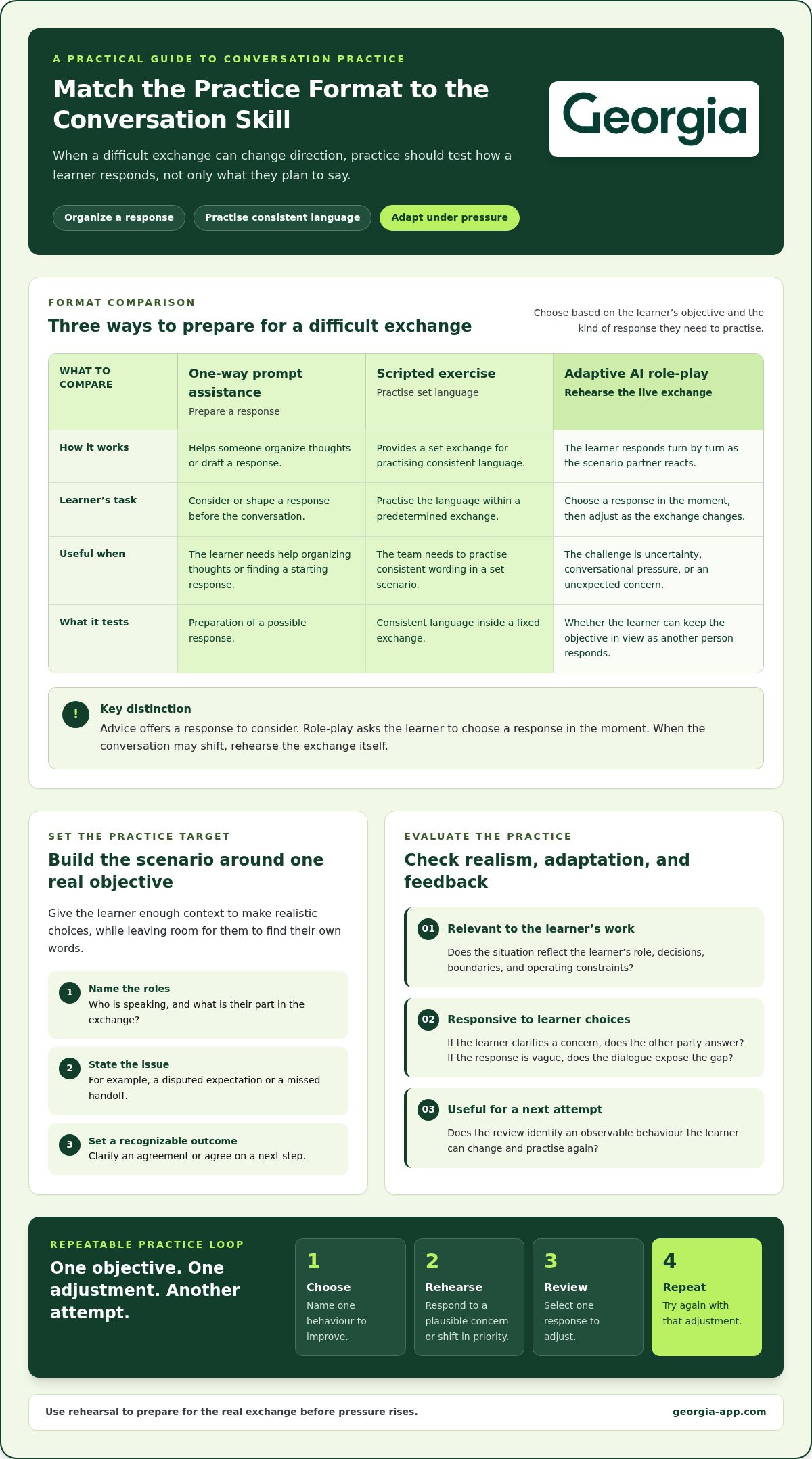
A practice tool earns a place in training when it prepares employees for conversations they actually face. Assess it against three criteria: whether the scenario fits the learner’s work, whether the other person responds to the learner’s choices, and whether the review helps shape a useful next attempt. A polished interface cannot make up for a simulation that misses those tests.
One-way prompt assistance can help someone organize thoughts or draft a response. A scripted exercise provides a set exchange that can help learners practise consistent language. Adaptive AI role-play lets the learner respond turn by turn as the scenario partner reacts. Each format serves a purpose. When the challenge is uncertainty and conversational pressure, the learner needs room to make choices and see where they lead.
Check each scenario against the learner’s role and operating constraints. A customer-facing employee may need to respond to a disputed expectation while keeping a clear next step in view. A manager practising performance feedback needs a scenario that reflects the workplace issue and the employee’s likely concerns. Generic settings leave out the decisions, boundaries, and pressures that make a conversation difficult.
Check whether the simulation changes with the learner’s responses
Look for meaningful variation. If the learner clarifies a concern, does the other party answer that question? If the learner gives a vague response, does the conversation expose the gap? Dialogue that follows the same path regardless of the learner’s words provides little preparation for uncertainty.
Realism comes from relevant conversational pressure, not theatrical complexity. The simulation should ask the learner to handle plausible resistance, new information, or a shift in priority. AI for practicing difficult conversations is useful when the exchange responds to what the learner says instead of moving through predetermined lines.
Demand feedback that leads to another attempt
Look for feedback that identifies an observable behaviour the learner can change. For example, if they answered a complaint before confirming what the customer meant, the next attempt could focus on clarifying first. Vague praise offers little direction. A score without an explanation may look precise while leaving the learner unsure what to do differently.
Useful feedback names a specific change the learner can apply in the next attempt. That keeps review manageable and makes repetition purposeful. Have learners identify the behaviour, practise the conversation again, and consider whether the adjustment helped move it toward the objective. Keep the learning loop clear, rather than relying on a performance label detached from the work.
Build a repeatable practice loop around one difficult conversation
Practice becomes useful when each attempt informs what the learner does next. Tie the routine to an upcoming or recurring workplace interaction, such as handling an objection, addressing a service concern, or giving performance feedback. A repeatable loop makes AI for practicing difficult conversations part of training, rather than an isolated exercise.
Prepare the scenario without scripting every sentence
Set the context, stakes, other person’s likely concern, and desired next step. Before the simulation begins, identify one behaviour to practise, such as asking a clarifying question before explaining a decision. Keep the setup concise. The learner needs enough detail to understand the situation, with room to choose language that fits their role.
For example, a sales representative could practise responding when a customer challenges an expectation. The objective might be to clarify the concern and agree on a next action. Establish the relevant pressure without dictating every line. That keeps practice focused on judgement and delivery instead of reciting a script.
Turn the debrief into a specific second attempt
After the exchange, review what happened. Which response helped move the conversation toward its objective? Where did the learner lose clarity, make an assumption, or respond before understanding the concern? Use those observations to select one adjustment. Trying to change several behaviours at once makes it difficult to see what improved.
Run the scenario again with that adjustment in mind. The other person can renew an objection or respond differently, giving the learner a chance to test a changed approach. Record the behaviour to carry forward, such as summarizing the concern before offering a solution. Keep the loop practical: attempt, review, adjust, repeat.
Use AI rehearsal as one part of team training
Connect individual simulations to an existing sales, customer operations, or leadership training objective. A manager can then discuss how the learner’s practice relates to workplace expectations, including which decisions they can make and which commitments they need to clarify. Personalized, self-paced simulations can sit alongside your current training routine and give employees a way to rehearse between planned learning activities.
For a wider training perspective, see AI Role-Play Training Platform: Auditing and Fixing Your Revenue Leaks. Georgia’s AI role-play platform gives teams a place to practise workplace conversations through personalized, self-paced simulations.
Final Thought: Put AI conversation practice to work before the next high-stakes exchange
Choose one upcoming conversation your team would benefit from rehearsing. Define what is at stake, set a clear objective, practise the exchange, then repeat it with one specific adjustment. This makes preparation a deliberate part of work, before friction has already surfaced.
Match practice to the conversation your team needs to handle
Georgia provides personalized, self-paced AI role-play simulations for communication practice under pressure. Connect each scenario to a training need: a sales representative responding to an objection, a customer operations employee handling a service concern, or a leader addressing a performance issue. Keep the practice tied to the actual conversation and the behaviour the learner needs to apply.
For leadership conversations, High Stakes Communication Training for Leaders Eliminates Revenue Loss From Poor Verbal Fluency offers a related training perspective. The same principle applies across roles: choose the exchange, prepare for the response, and identify what the learner will change on the next attempt.
Make the next step a focused demonstration
Bring one current training need to a demonstration. Consider which conversation your team needs to handle, who needs the practice, and how simulation could fit into the training you already run. This gives you a concrete basis for assessing how Georgia’s platform fits your team’s training.
Define the stakes. Practise the exchange. Repeat with one adjustment. That is how you make AI for practicing difficult conversations a repeatable training routine before the next high-stakes interaction.
Explore Georgia’s AI role-play platform
Put your next difficult conversation on the training agenda
Choose the next exchange where a poor response could create avoidable friction. Identify what your team needs to practise, whether that is listening before responding, handling resistance, or keeping the discussion focused on a clear outcome. This gives AI for practicing difficult conversations a defined purpose in your training program.
Track the behaviour you want to strengthen, then use practice to make that behaviour deliberate before the live interaction. Over time, the scenarios your team finds challenging can show where training needs more attention. Keep the focus on observable actions and a practical next attempt.
Use a Georgia demo to see how AI role-play fits the conversations your team needs to handle.
Start with one conversation. Give your team a chance to prepare, practise, and approach the next exchange with greater control.
Frequently Asked Questions
Can AI help me practise a difficult conversation at work?
Yes. AI role-play lets you test an approach before a live workplace exchange. For example, a dispatch lead could practise explaining a schedule change while responding to a customer’s concern about its impact. Use AI for practicing difficult conversations to prepare for likely turns in the exchange, then note where you need more information or a clearer response. Treat the simulation as rehearsal, since the real person may respond differently.
How do I prompt AI to practise a difficult conversation?
Describe the situation, your role, the other person’s perspective, and the outcome you need. Ask the AI to play that person and raise plausible concerns, such as questioning a revised expectation or asking who will follow up. Keep confidential employee, customer, and company details out of tools that are not approved for them. After practising, identify one response to change and run the exchange again.
Can AI replace a manager or coach for difficult conversations?
No. AI can provide repeatable rehearsal, while a manager brings knowledge of team standards, work history, and organizational context. Use a simulation to prepare language for a routine objection or feedback discussion. In sensitive situations, involve a manager when the history between people or the consequences of a decision require judgment. Rehearsal and management judgment serve different purposes within a training routine.
What makes an AI difficult-conversation simulation realistic?
A realistic scenario reflects the learner’s job, the actual issue, and pressures that could shape the exchange, such as limited time or conflicting expectations. The other person should respond to what the learner says. If an employee asks for clarification, the simulation should provide a relevant answer instead of repeating the same objection. Dramatic dialogue adds little when it does not resemble the choices employees face at work.
How often should employees practise difficult conversations with AI?
Schedule practice around work that needs attention, rather than setting a frequency without a training purpose. An employee might rehearse before a customer meeting, then practise again after identifying a response to improve. For recurring exchanges, include simulations in the team’s regular learning plan. Keep each session centered on one objective so employees can compare attempts and focus on a specific change.
What should I do after an AI role-play conversation?
Review the point where the exchange became unclear, stalled, or shifted away from its purpose. Choose one action to change, such as checking the other person’s understanding before explaining the next step. Then practise the same situation again and see how that choice affects the dialogue. A general rating may offer little direction on its own. Record the behaviour to carry into a live conversation.
Is AI practice useful for sales, customer support, and leadership teams?
Yes, when the scenario matches the work and the skill employees need to practise. A sales representative could rehearse a response to an objection, while a customer operations employee practises explaining a service decision. A leader could prepare to address a missed expectation with a direct report. Each scenario should reflect the role’s responsibilities and give the learner a clear purpose for the exchange.
Book a Georgia demo to explore personalized AI role-play for your team’s sales, customer operations, or leadership training.