

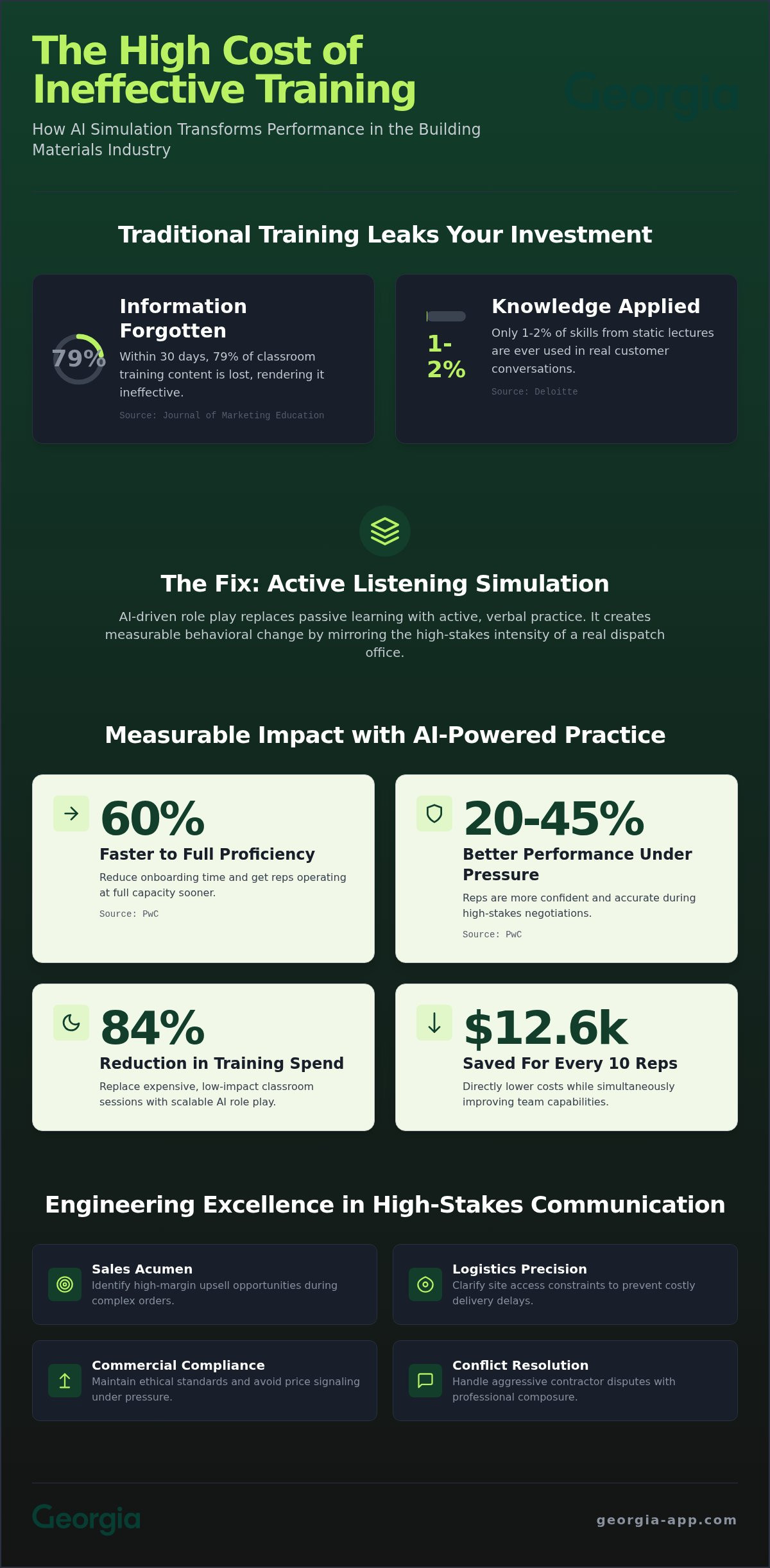
Traditional classroom training is a sunk cost that leaks capital every hour your dispatchers spend in a chair. According to the Journal of Marketing Education, 79 percent of information is forgotten within 30 days. This lack of an active listening simulation for customer service means only 1 to 2 percent of traditional training is ever applied on the job, according to Deloitte.
A single misinterpreted request for a concrete pour can derail an entire project schedule. Miscommunication is a structural failure in your revenue chain. Wasted loads and lost accounts. You need a team that processes orders with total accuracy under high-pressure conditions.
Simulating high-stakes scenarios before reps talk to a real buyer stops this friction. You will reduce your time to proficiency by 60 percent and improve performance under pressure by 20 to 45 percent, according to PwC.
This article details how AI-driven simulations replace ineffective lectures with measurable behavioral change and lower your training spend by 84 percent. Stop bidding and praying.
Key Takeaways
- Stop the 79 percent knowledge loss cited by the Journal of Marketing Education by implementing an active listening simulation for customer service.
- Reach full operational proficiency 60 percent faster according to PwC research by moving practice from the classroom to a scalable AI platform.
- Use stress testing simulations to improve performance under pressure by 20 to 45 percent, a metric verified by PwC.
- Capture an 84 percent reduction in training spend while saving 12.6 thousand dollars for every ten reps on your team.
- Maintain commercial compliance and avoid price signaling through automated, high frequency verbal drills.
Replace Static Training with Active Listening Simulation for Customer Service
Poor communication in dispatch is a financial liability. One missed detail on a concrete mix design leads to rejected loads and wasted fuel. Misinterpreting a contractor's delivery window results in idle crews and back-charges. You cannot afford to treat verbal clarity as a secondary priority in the building materials industry.
An active listening simulation for customer service is an immersive AI environment where reps practice responding to real world scenarios. It replaces the passive nature of lectures with active, verbal engagement. This method forces reps to process information and respond in real time, mirroring the intensity of a busy dispatch office or a high-stakes sales call.
Traditional training fails because it lacks reinforcement. The Journal of Marketing Education reports that 79 percent of what salespeople learn is forgotten within 30 days. Deloitte research shows that only 1 to 2 percent of classroom content is ever applied in real customer conversations. Static slides fail to change behavior. Repetition builds the necessary habits.
The High Cost of Verbal Friction
Poor active listening skills cause incorrect claims and improper requests in the building materials sector. A rep who fails to catch a specific delivery instruction creates a chain of logistics failures. These errors erode margins and damage long-term contractor relationships. Every misunderstood specification is a potential structural failure or a lost account.
- Reps fail to identify high-margin upsell opportunities during complex orders.
- Dispatchers ignore specific site access constraints that cause delivery delays.
- Sales teams provide verbal quotes that conflict with established price ceilings.
- New hires struggle to maintain professional composure during aggressive contractor disputes.
Financial liability increases when a team cannot maintain ethical selling under pressure. If a rep cannot deflect an improper request for price signaling or confidential information, the company faces significant regulatory exposure. You must stop bidding and praying for good outcomes. Start engineering them through controlled, simulated practice that treats communication with the same rigor as a financial audit.
Why Role Play Must Be Scalable
Managers lack the capacity for manual coaching across every plant and every week. Traditional role play is inconsistent, awkward, and time-consuming. It often becomes a check-the-box exercise rather than a rigorous performance audit. When training is not scalable, your newest hires are often your highest risk factors.
AI role play provides personalized practice for every rep without a trainer in the room. The platform analyzes responses and provides immediate feedback on tone, accuracy, and commercial compliance. Reps use their own phones to practice via voice or chat. This continuous cycle ensures skills stay sharp regardless of their location or the time of day.
Deploy Simulations to Reach 60 Percent Faster Proficiency
Immersive training environments accelerate the learning curve. You can reduce your time to proficiency by 60 percent, a figure validated by PwC research. Traditional onboarding relies on shadowing, which is slow and inconsistent. An active listening simulation for customer service provides a standardized path to mastery.
Analytical leaders require objective data to justify training investments. Simulation scores provide hard benchmarks for performance that manual observation cannot match. You see exactly where a rep fails to validate a customer concern or misses a commercial detail. This precision allows for targeted interventions rather than broad, ineffective lectures.
Craftsmen in the industry value the integrity of the process. This training method ensures your proven sales methodology is applied exactly as designed every single time. There is no drift in quality between locations or shifts. Every rep follows the blueprint for high-value communication.
Step One Identify Core Compliance Scenarios
Start by selecting scenarios that present the highest financial risk. This includes antitrust violations and the protection of confidential information during bid cycles. Use real world building materials dispatch challenges to build the simulation logic. Your simulations must reflect the specific methodology of your existing sales trainers or internal coaches to maintain consistency.
Step Two Integrate Daily Practice into the Workflow
Consistency drives behavioral change. Require every rep to complete one simulation before they take their first live call of the day. This routine ensures their verbal skills are calibrated for high-pressure interactions. Participants who engage in this level of immersive practice feel 275 percent more confident than those who receive classroom only training, according to Deloitte data.
- Reps open the app on their phone.
- They select a specific communication module.
- The AI persona initiates a high pressure customer scenario.
- Reps respond using voice or chat.
- The platform provides immediate scoring based on compliance and sales skills.
Confidence translates directly to higher accuracy and better project outcomes. You can schedule a platform walkthrough to see these performance benchmarks in action. Stop relying on luck and start enforcing a repeatable standard for every customer interaction.
Practice High Pressure Negotiation to Improve Performance by 20 to 45 Percent
Sellers who role play before live calls perform 20 to 45 percent better under pressure based on PwC research. This performance gap represents direct revenue leakage in the building materials industry. An active listening simulation for customer service mimics the psychological stress of a 5 percent price push ceiling or a contractor demanding an immediate discount. Reps must learn to say no to their largest accounts without severing the commercial relationship.
Drivers understand that pressure testing is a prerequisite for profitability. If a dispatcher folds under the weight of a complex order, your margins evaporate. High stakes communication requires the same technical precision as managing inventory or fleet logistics. You cannot afford a team that guesses when the stakes involve seven figure contracts. Controlled practice ensures that every rep maintains the price floor regardless of the customer aggression.
Master the Art of Responding to Improper Requests
Simulations place reps in scenarios where customers demand confidential competitor data or sensitive bid details. These requests are tactical traps. An active listening simulation for customer service allows a rep to identify the customer underlying pressure point without violating commercial compliance. They learn to redirect the conversation toward project value rather than illegal price signaling or market sharing.
Our Sales & Commercial Training Modules help reps escalate these concerns through the proper internal channels. Identifying a compliance risk in a drill prevents a catastrophic failure in the field. You protect the firm by ensuring every verbal response is legally and commercially sound before the call begins. It is about building a defensive perimeter around your sensitive data through disciplined verbal habits.
Build Verbal Fluency in Commercial Construction Sales
Dispatch teams often make inaccurate claims about lead times or material availability when under stress. These errors lead to project delays and liquidated damages. Repetition in a safe, simulated environment removes the fear of making mistakes on a live line. It builds the verbal fluency required to handle aggressive contractors with authority and accuracy. Reps who practice feel more prepared for the volatility of the construction site.
This level of practice is the only way to insulate your organization from DOJ enforcement cases and million dollar fines. Verbal errors are documented and discoverable. Implementing a rigorous simulation program ensures that your team represents the company with total compliance. You move from a culture of bidding and praying to one of controlled, measurable performance. Excellence in communication is a structural requirement for long term stability.
Save 12.6 Thousand Dollars per Team with Scalable AI Role Play
Traditional training is an inefficient capital drain. In-person workshops are expensive and unscalable. Moving to an active listening simulation for customer service delivers an 84 percent lower training spend. You save 12.6 thousand dollars for every ten-rep team by replacing analog methods with digital simulations.
A basic Georgia annual subscription costs 240 dollars per rep. Traditional training averages 1500 dollars per rep. This fundamental restructuring replaces marginal improvements with significant cost recovery. You capture higher margins by eliminating the friction of logistics and travel.
- Eliminate travel costs for trainers and sales reps.
- Remove the need for expensive in person workshops.
- Reduce the time managers spend on basic communication coaching.
- Lower the turnover rate by increasing rep confidence by 275 percent according to Deloitte research.
- Scale the training to every plant and every rep simultaneously.
Quantify the ROI of Soft Skill Mastery
Analytical decision-makers require visibility into the training engine. Stop guessing which reps are prepared for the next bid cycle. Our manager dashboard tracks team activity and identifies performance gaps in real time. You see who is practicing and who is failing to meet the commercial standard. This visibility allows for targeted coaching focus on high-risk interactions.
An 84 percent spend reduction provides the capital needed for expansion. You can enter new markets without increasing your training headcount or sacrificing quality. Performance tracking turns communication from a vague soft skill into a measurable operational asset. Data-driven insights replace the uncertainty of traditional coaching sessions.
Eliminate Method Drift and Dilution
Craftsmen prioritize precision and consistency. Traditional manual coaching leads to method drift where every plant manager teaches a different version of your sales process. AI role play ensures your sales methodology is applied as designed every single time. There is no dilution of the message as it passes through different regional layers.
The active listening simulation for customer service maintains the integrity of your process. It prevents the slow erosion of standards that occurs with manual role play. Every rep receives the same high-stakes feedback regardless of their location. You lock in a repeatable standard of excellence across the entire firm.
"Retention scores tripled in 60 days. Leadership stopped questioning the program." – VP Sales Enablement, B2B SaaS.
Maintain Commercial Compliance Through Continuous Verbal Practice
Compliance is a non-negotiable operational requirement. Georgia for Building Materials specifically targets high-risk compliance scenarios in the highway and energy sectors. Verbal slips during customer interactions often lead to antitrust violations. Price signaling. Market sharing. An active listening simulation for customer service provides the high-frequency practice needed to mitigate these liabilities. You create a safe space for reps to fail before they face an unethical request in the field. Georgia improves measurable compliance behavior through disciplined repetition. It does not guarantee the avoidance of DOJ penalties.
Traditional compliance training is a passive exercise that fails the moment a rep picks up a phone. Static videos cannot simulate the adrenaline of a high-stakes negotiation. You need a platform that forces verbal responses. This active engagement bridges the gap between knowing the rules and following them under pressure. Reps who practice these scenarios feel more prepared to handle aggressive or unethical customers. Consistency is the only defense against regulatory friction.
Protect Confidential Information in High Stakes Deals
Protecting confidential information is critical during complex bid cycles. Our simulation modules train reps to identify probing questions from competitors or aggressive contractors. They learn to deflect requests for sensitive data without stalling the commercial process. Active listening helps reps recognize the intent behind a question and provide a compliant, professional response. This verbal boundary protects your firm from accidental data leakage. You must verify specific local requirements with a regulator to ensure full legal alignment for your region.
Every recorded interaction in a simulation provides a benchmark for your compliance officer. You move from a culture of hope to a culture of audited performance. This visibility is essential for managing risk in multi-plant operations. You ensure that a rep in one location isn't compromising the entire firm legal standing. Data-driven feedback replaces the uncertainty of manual oversight.
Manage Ethical Selling in Dispatch and Sales
Ethical selling requires more than a static handbook. Reps need a dedicated module for maintaining integrity when faced with improper requests. The simulation allows them to practice the exact verbal sequences required to escalate concerns to management. They learn to flag suspicious activity immediately. This proactive stance reduces the friction of internal audits and protects your reputation. Reps gain the confidence to push back on unethical demands without losing their professional composure.
Deploy Georgia for Building Materials to standardize these defensive habits across your entire team. Stop the verbal leakage that leads to regulatory exposure. Consistent practice ensures that every rep understands the price floor and the legal ceiling. You build a team that operates with total transparency and commercial rigor. High-performance teams don't leave compliance to chance.
Secure Your Competitive Advantage Through Verbal Discipline
Traditional training methods are a structural failure in the building materials industry. They leak capital and leave your dispatchers vulnerable to high-pressure errors.
Implementing an active listening simulation for customer service fixes these operational gaps by replacing passive lectures with immersive AI practice. You capture an 84 percent lower training spend while reaching full proficiency 60 percent faster, according to PwC research.
Your team gains 275 percent more confidence compared to classroom only training based on Deloitte data. This confidence translates directly into higher accuracy on the job.
Your proven sales methodology is applied as designed: every time. There is no drift in quality between locations and no dilution of your commercial standards as you scale.
High-performance teams don't rely on luck. They rely on disciplined, simulated practice to maintain their price floor.
You have the data to justify the change. Start protecting your revenue and your reputation with a platform built for industrial results.
Final Thought
You will now stop relying on passive training and start treating verbal skills as a measurable asset. You will deploy simulated practice to every dispatcher and sales rep to lock in your price floor.
Instead of hoping for compliance, you will use AI-driven data to audit performance. You will prioritize high-stakes verbal fluency to protect your firm from regulatory risk and revenue loss.
Frequently Asked Questions
How does an active listening simulation for customer service differ from traditional role play?
An active listening simulation for customer service provides a standardized, scalable engine that eliminates the inconsistency of manual coaching. Traditional role play is often awkward and lacks measurable data. AI simulations ensure your methodology is applied exactly as designed every time. This digital approach removes the need for a trainer to be in the room, allowing for continuous practice on a mobile device.
Can AI simulations really improve performance under pressure for sales teams?
Sellers who role play before live calls perform 20 to 45 percent better under pressure according to PwC research. High-stakes simulations mimic the stress of aggressive price negotiations and improper requests. This practice builds the verbal fluency required to maintain your price floor during volatile customer interactions. Repetition in a safe environment ensures that reps don't fold when the project margins are at risk.
What is the expected ROI for implementing digital soft skills training?
Organizations achieve an 84 percent lower training spend by moving to digital simulations. You save approximately 12.6 thousand dollars for every ten rep team when comparing traditional workshops to a basic subscription. The Journal of Marketing Education notes that 79 percent of classroom learning is forgotten within 30 days. Digital training stops this capital leakage by providing reinforcement that sticks to your bottom line.
How do active listening simulations help with commercial compliance in building materials?
An active listening simulation for customer service provides a safe space to practice responding to unethical requests and avoiding price signaling. Georgia for Compliance targets high-risk interactions in the highway and energy sectors. While the platform does not guarantee the avoidance of DOJ penalties, it improves compliance behavior through high-frequency drills. Reps learn to identify antitrust traps and escalate concerns to management through the proper internal channels.
How much does a basic Georgia annual subscription cost per rep?
A basic Georgia annual subscription costs 240 dollars per rep. This is a significant recovery of capital when compared to the 1500 dollar average spend for traditional in-person training. This low-cost entry point allows you to scale high-quality coaching to every plant and every location simultaneously. You eliminate the travel costs and lost productivity associated with off-site workshops while maintaining a high standard of training.
Does the platform allow managers to track rep performance and activity?
The manager dashboard provides total visibility into team activity and performance scoring. You no longer have to guess who is prepared for a high-stakes bid cycle. The dashboard identifies specific coaching focuses by highlighting where reps struggle with compliance or sales skills. This data-driven approach turns communication into a measurable asset that can be audited for accuracy across your entire organization.
Is the simulation content tailored to our specific sales methodology?
Georgia delivers simulations that are tailored to your specific methodology, compliance policies, and real-world scenarios. This ensures there is no drift or dilution of your message as it scales across the organization. Every rep experiences your proven framework exactly as you built it. You maintain total control over the quality of customer interactions regardless of the rep location or their level of experience.
How quickly can a team reach proficiency using AI role play?
Teams reach proficiency 60 percent faster using immersive AI simulations according to PwC research. Traditional onboarding relies on shadowing, which is slow and inconsistent. Our platform accelerates this process by providing immediate, automated feedback on every practice session. Reps feel 275 percent more confident versus classroom only training as reported by Deloitte, allowing them to handle live calls sooner and with greater accuracy.