

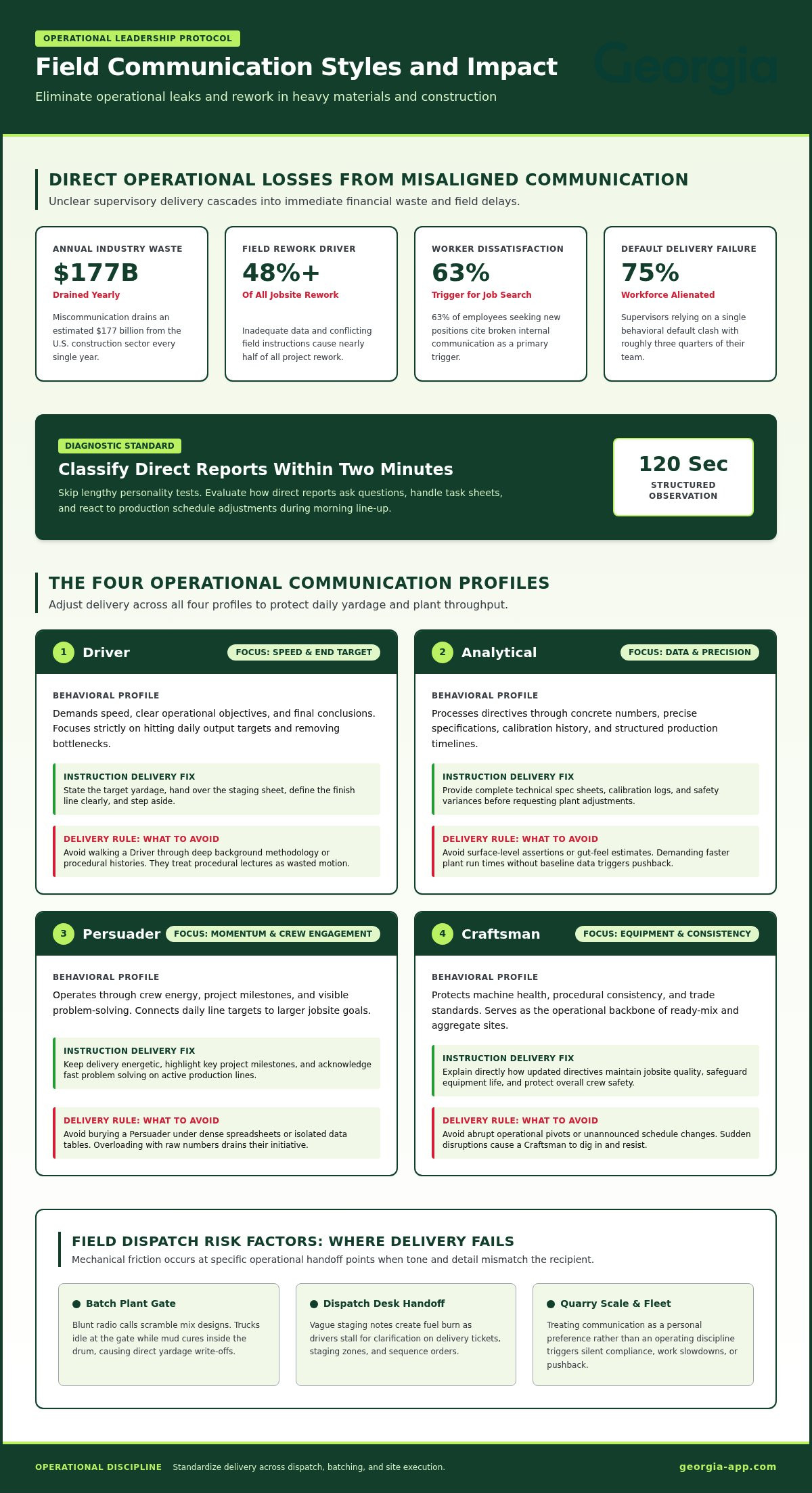
Miscommunication drains an estimated $177 billion from the U.S. construction sector every single year. Inadequate data and conflicting field instructions drive over 48% of all jobsite rework. In heavy operations, adapting communication styles for leadership is a calculated financial defense against lost yardage, missed cycles, and blown margins.
You already know the daily friction. A blunt radio directive alienates a crew lead, vague dispatch notes stall the batch plant, and trucks burn fuel while waiting for clarification. Traditional management seminars push academic concepts, but that theory dissolves the moment site pressure spikes.
This guide demonstrates how operational leaders identify communication mismatches across four core profiles: Driver, Analytical, Persuader, and Craftsman. You will learn how to read team member styles within two minutes of conversation, adjust directives in real time, and establish precise operational accountability that holds under pressure.
Key Takeaways
- Operational breakdowns trace back to supervisory delivery defaults that alienate three quarters of the team.
- Systematic execution of adapting communication styles for leadership protects plant throughput and prevents costly field delays.
- Classifying direct reports into Driver, Analytical, Persuader, and Craftsman profiles requires only two minutes of structured observation.
- High-stress field conditions trigger rigid behavioral defaults that multiply miscommunication and crew turnover.
- Automated simulation platforms build repeatable conversational muscle memory without risking active commercial contracts.
Recognize How Communication Mismatches Create Direct Operational Leaks
A single misunderstood instruction at the morning dispatch gate cascades into hours of equipment downtime. When a batch plant operator misreads a supervisor's blunt radio call, mix designs get scrambled. Trucks idle. Mud cures in the drum. Operational throughput drops when team leads interpret directness as aggression or detailed checklists as insulting micromanagement. Adapting communication styles for leadership protects production schedules and prevents this mechanical drain on field margins.
Supervisors who rely on a single behavioral default clash with roughly three quarters of their workforce. They treat communication as a personal preference rather than an operational discipline. That assumption carries a severe balance sheet impact.
Calculate the Hidden Price of Misaligned Supervisory Direction
Unclear operational handoffs produce immediate material scrap, delivery overruns, and avoidable safety infractions. When a field lead barks vague orders under pressure, crew leads freeze or guess. That confusion accounts for significant early ninety-day worker departures: 63% of employees seeking new jobs cite broken internal communication as a primary trigger. Stop attributing missed production targets to bad worker attitude. Audit your daily shift logs instead. You will find that stalled workflows, staging errors, and missing signatures stem from delivery mismatches at the point of task assignment.
Diagnose Why One Communication Style Fails in Complex Environments
Most supervisors speak the way they prefer to receive data. A fast-moving manager delivers brief, stripped-down directives and expects immediate compliance. When delivering orders to a technician who requires procedural context, that brevity causes confusion. The historical Situational Leadership model demonstrated decades ago that leadership output depends on aligning delivery with subordinate readiness. Modern heavy operations require the exact same mechanical flexibility.
Execution gaps multiply as instructions pass between dispatch desks, quarry scales, and active sites. Implementing adapting communication styles for leadership transforms delivery from an individual personality quirk into a standardized operating metric. When your supervisors calibrate tone, cadence, and detail to match the recipient, friction stops and plant throughput stabilizes.
Classify Your Team Across the Four Core Communication Profiles
Field supervisors cannot afford thirty-page personality assessments. Production moves too quickly. Instead, categorize personnel into four operating profiles: Driver, Analytical, Persuader, and Craftsman. Each profile handles operational pressure, authority, and tactical directives differently. Misjudging an operator triggers silent compliance, work slowdowns, or immediate pushback. Accurate profiling stabilizes daily yardage.
You can identify these profiles within two minutes of routine morning conversation. Look at how the worker asks questions, accepts task sheets, and responds to production schedule shifts.
Identify the Driver and the Analytical Team Members
Drivers demand speed, clear objectives, and final conclusions. State the target yardage, hand over the staging sheet, and get out of their way. Give them the operational objective and define the finish line clearly. Avoid walking a Driver through deep background methodology or procedural histories. They view procedural lectures as wasted motion.
Analyticals process tasks through numbers, specifications, and structured timelines. When assigning a mix design or a crushing circuit overhaul to an Analytical, hand them the complete technical spec sheet, calibration logs, and safety variances. Avoid surface-level assertions or gut-feel estimates. If you tell an Analytical to run a plant faster without presenting the supporting maintenance run-time numbers, they will push back until they see the baseline data.
Identify the Persuader and the Craftsman Profiles
Persuaders run on operational momentum and crew engagement. They connect daily targets to the big picture and want visible credit for solving problems on the fly. Keep your delivery energetic and focused on milestones. Avoid burying a Persuader under dense spreadsheets or isolated data tables, which drains their initiative.
Craftsmen protect equipment life, routine consistency, and trade execution. They are the backbone of aggregate plants, ready-mix yards, and heavy haul fleets. Craftsmen need procedural continuity. When introducing an operational change, explain how the new workflow maintains jobsite quality and crew safety. Avoid abrupt operational pivots or unannounced schedule changes. Sudden disruptions cause a Craftsman to dig in and resist.
Mastering adapting communication styles for leadership requires turning these observations into operational habits. Practicing these tactical conversations across various operational scenarios builds speed. Field managers looking to accelerate this capability can explore conversational simulation tools that drill these exact behavioral adjustments before morning shift meetings.
Execute Style Adaptation Across Four High-Pressure Scenarios
Executing tactical adjustments requires a repeatable conversational checklist. When field pressure spikes, structured execution beats intuition every time. Implement a four-phase protocol before addressing crew leads or dispatchers on the floor:
- Identify the operational profile of the recipient before keying the radio or stepping into the trailer.
- Strip out personal delivery habits that cause unnecessary friction or defensiveness.
- Deliver the primary operational directive using terms that match the recipient's decision framework.
- Demand an active verbal verification formatted to their profile to confirm full comprehension.
Applying this protocol standardizes adapting communication styles for leadership across active shifts. It eliminates the guesswork that leads to blown delivery windows.
Deliver Corrective Performance Feedback Without Derailing Motivation
When correcting a Driver, focus entirely on schedule recovery and volume targets. State the variance: "The crushing line ran 15% below target this morning. We need 400 tons per hour by 14:00 to meet the railcar loading deadline. Adjust the feed rate immediately." They want the operational problem and the finish line, nothing else.
Address an Analytical by bringing hard data to the table. Lay out equipment telemetry, load weights, and fuel consumption logs. Show the specific operational deviation on the maintenance record rather than debating opinions. They respect objective measurements.
When redirecting a Craftsman, protect the standard of work. Point to the shared crew expectations: "Our quality standard requires a slump test every fifty yards on this commercial pour. Bypassing that test puts the entire placement at risk. Let us reset the testing cadence together on the next truck." Frame the correction around trade integrity and jobsite safety.
Communicate Process Changes to Maintain Daily Shift Velocity
Process pivots routinely stall throughput if supervisory messaging fails. When pitching a new dispatch protocol to a Persuader, highlight crew efficiency and visible wins. Show them how the change eliminates waiting time at the scale house and makes the entire haul fleet run smoother.
Give your Craftsmen forty-eight hours of lead time before changing a plant maintenance sequence or loading pattern. Lay out the chronological steps. Detail how the change preserves equipment durability, protects crew safety, and integrates into existing routines without creating operational chaos.
Maintaining clear directive control during schedule collapses requires deliberate verbal execution. Implementing targeted high stakes communication training for leaders provides supervisors with the structured conversational reps needed to protect site throughput under severe production pressure.
Eliminate Supervisory Defaulting Under High-Stress Operational Conditions
Production crises destroy intellectual frameworks. When a primary crusher trips or twenty transit mixers stack up at an active highway pour, biological stress forces managers straight into their most rigid behavioral default. A Driver reverts to tyrannical barking. An Analytical retreats into silent analysis, freezing line decisions while searching for more data. Stressed Persuaders overpromise unrealistic delivery windows to appease dispatch. Stressed Craftsmen dig in, refusing necessary workflow adjustments out of stubborn devotion to standard routine.
Every default reaction amplifies operational friction. Maintaining true adaptability when delivery windows collapse demands deliberate behavioral conditioning, not passive good intentions.
Recognize the Physiological Triggers That Freeze Adaptive Behavior
Elevated heart rates trigger tunnel vision and narrow verbal output down to blunt, reactive commands. A plant manager under deadline pressure snaps at a Craftsman who paused production to inspect a suspect bearing. The Craftsman feels insulted, shuts down communication, and ignores the next minor equipment warning. That supervisory snap turns an hour of scheduled maintenance into catastrophic bearing failure three days later. Implementing adapting communication styles for leadership requires a five-second pause before issuing high-stakes operational directives.
Audit Management Interactions Against Measurable Production Benchmarks
Treat supervisory handoffs with the same analytical scrutiny applied to aggregate gradation curves. Track daily dispatch errors, rejected loads, and equipment staging delays against the supervisor on duty. If two shifts share identical equipment and crew sizes but show a 14% difference in load turnaround, inspect conversational handoffs between leads and operators. Evaluate shift handoff accuracy using explicit clarity and comprehension checks.
Reviewing modern soft skills training programs shows how structured verbal diagnostics reveal systemic execution leaks across heavy supply chains. Connecting verbal habits to hard financial outputs stops operational margin erosion permanently.
Rehearse Adaptive Communication in Safe High-Pressure Simulations
Classroom seminars teach leadership theories that vanish the moment a shift turns chaotic. Sitting through slide decks does not build real-time verbal control. Deliberate practice requires realistic conversational simulation where supervisors make mistakes without risking live project contracts. Scalable AI simulation allows managers to rehearse difficult interactions until profile-specific adaptation becomes an automatic reaction.
Theoretical knowledge collapses under field tension. Operational fluency requires repetitive verbal execution under simulated stress.
Stop Wasting Capital on One-Day Passive Seminars
Traditional management training loses seventy percent of its retention within twenty-four hours. Supervisors sit in hotel conference rooms, nod at leadership frameworks, and immediately revert to their default habits during Monday morning dispatch. Peer role-play is equally flawed: coworkers break character, laugh off tension, and avoid the authentic hostility found on active jobsites. Real behavioral transformation requires testing supervisory verbal precision against genuine resistance. Reviewing how AI training platforms must simulate high-stakes pressure reveals why conversational difficulty must mirror actual field conditions to permanently rewire supervisory habits.
Build Muscle Memory Using the Georgia Role-Play Platform
Deploying Georgia provides operations teams with an AI role-play platform designed for high-stakes leadership development practice. The platform delivers repeatable, self-paced conversational simulations tailored to dispatch conflicts, production disputes, and field safety confrontations. Supervisors practice adapting communication styles for leadership against realistic AI personas representing Drivers, Analyticals, Persuaders, and Craftsmen.
Immediate feedback loops grade tone, verbal fluency, and profile alignment directly after each conversation. Instead of guessing whether a supervisor can handle a confrontational crew lead, operations leaders track objective fluency scores. Supervisors run the scenario five, ten, or twenty times until they consistently strip out defensive defaulting and deliver clean directives. The platform bridges the gap between knowing a profile framework and applying it when equipment fails and delivery schedules compress.
Protect Shift Throughput Through Deliberate Conversational Practice
Operational friction is a direct balance sheet expense. Every misaligned handoff between dispatchers, batch plants, and site crews erodes project margins and stalls haul cycles. Systematic execution of adapting communication styles for leadership transforms supervisory delivery into a reliable production discipline across every operating crew.
Frontline supervisors build genuine conversational fluency without burning operational revenue on trial-and-error field mistakes. Purpose-built AI simulation eliminates the seventy percent training forgetting curve that cripples static management seminars. When supervisors rehearse high-stress interactions before entering the dispatch trailer, directives land cleanly and shift throughput stays protected.
Equipping your field leaders with profile-specific verbal habits secures jobsite safety, protects heavy equipment, and builds a dependable operational foundation for every scheduled pour.
Frequently Asked Questions
Why do traditional leadership communication workshops fail to change supervisor behavior on the floor?
Traditional workshops deliver passive intellectual concepts rather than physical conversational conditioning. Supervisors absorb slide presentations in clean conference rooms, but research shows seventy percent of that instruction decays within twenty-four hours. Real jobsite conditions involve radio static, line stoppages, and hostile pushback. Without high-repetition behavioral practice under genuine field tension, managers revert to their most rigid verbal habits the moment production schedules slip.
How does an operations manager quickly identify whether a direct report is a Driver or an Analytical?
Evaluate their reaction to operational targets within the first two minutes of routine morning interaction. A Driver cuts straight to production yardage, demands autonomy, and challenges slow decisions. An Analytical immediately asks for calibration logs, material specifications, and documented procedures. Adapting communication styles for leadership requires recognizing whether a direct report needs immediate target clarity or systematic operational data before assigning field responsibilities.
Can adapting communication styles make a leader seem insincere or inconsistent to their team?
Inconsistency stems from fluctuating production standards rather than adjusted delivery methods. Operational expectations remain completely identical across the entire plant: safety rules, tonnage quotas, and shift timelines never change. Adapting delivery simply means packaging the same non-negotiable instruction in a format the worker executes immediately without defensive resistance. Crews respect calibrated communication as clear, professional direction that keeps production moving forward.
What is the most common communication mistake managers make when speaking to a Craftsman profile?
The most damaging mistake is issuing abrupt procedural changes without technical context or sufficient advance notice. Craftsmen prioritize mechanical reliability, trade standards, and established workflow continuity. When a supervisor issues an unannounced schedule change or dismisses procedural concerns as insubordination, the Craftsman shuts down. Leaders protect throughput by explaining how the updated directive maintains equipment durability, ensures crew safety, and reinforces jobsite quality standards.
How does misaligned management communication turn into a measurable financial cost for industrial companies?
Unclear supervisory handoffs directly cause material scrap, idle machine hours, and chronic dispatch bottlenecks. When a batch plant operator misinterprets a supervisor's radio order, concrete batches cure in drums while staging yards stall. Haul equipment sits idle, trucks burn fuel unnecessarily, and missed delivery windows trigger contractual liquidated damages. Miscommunication acts as a mechanical defect that bleeds cash margin on every single cycle.
How does AI simulation train leaders to adapt communication styles faster than live human coaching?
AI simulation delivers scalable, on-demand conversational repetitions with instant objective diagnostics. Human coaching requires scheduling delays and cannot replicate the fast-paced friction of active dispatch trailers. Deploying automated simulation platforms lets managers practice adapting communication styles for leadership across dozens of realistic operational scenarios in twenty-minute sessions. Supervisors make their conversational mistakes in private software runs, building measurable fluency before stepping onto active quarry scales.