

Unprepared sales reps leak margin every time procurement pushes back on material pricing. When a contractor or buyer demands a discount, an unconditioned seller folds and surrenders your operational profit. Traditional sales communication training treats high-stakes negotiation as academic theory, leaving your field reps defenseless against aggressive commercial pressure.
You already recognize the recurring cost of static workshops and endless slide decks. Reps absorb information during class, but thirty days later they revert to old habits, burn pipeline leads, and leave customer discovery calls without identifying actual budget authority. Shadowing senior reps drags onboarding out for months without confirming whether the new hire can defend price.
Discover how simulation-based sales communication training replaces passive lecture memory with repeatable deal execution. The following blueprint demonstrates how targeted pressure testing shortens seller ramp times, standardizes verbal objection handling, and protects deal margins across your entire team.
Key Takeaways
- Unconditioned sales conversations bleed operating margins by defaulting to unearned discounts during tough procurement negotiations.
- Passive lectures cause rapid knowledge loss because silent reading fails to condition vocal reflexes for live buyer confrontations.
- Modern sales communication training requires stress inoculation to build steady verbal execution during high-friction price disputes.
- Effective simulation platforms require low-latency voice engines and adaptive dialogue paths that actively challenge evasive answers.
- Target your scenario practice directly at documented bid failure points to protect commercial profitability across the entire team.
Calculate the Revenue Loss Behind Failed Sales Conversations
Poor sales communication functions as an audited operational expense that directly reduces profitability. Every time an account executive stumbles during a price negotiation, your gross margin pays the penalty. Sales communication training operates as an operational hedge against revenue attrition by conditioning reps to defend contract value under severe friction.
When reps rely on passive learning, they hesitate during critical executive discovery calls. That hesitation signals uncertainty to buyers. Procurement officers detect that discomfort instantly, stalling deals and pressing for unnecessary price drops. Extended sales cycles drain internal dispatch and administrative resources, compound customer acquisition costs, and leave high-margin opportunities stranded in pipeline limbo.
Identify the Hidden Cost of Premature Price Concessions
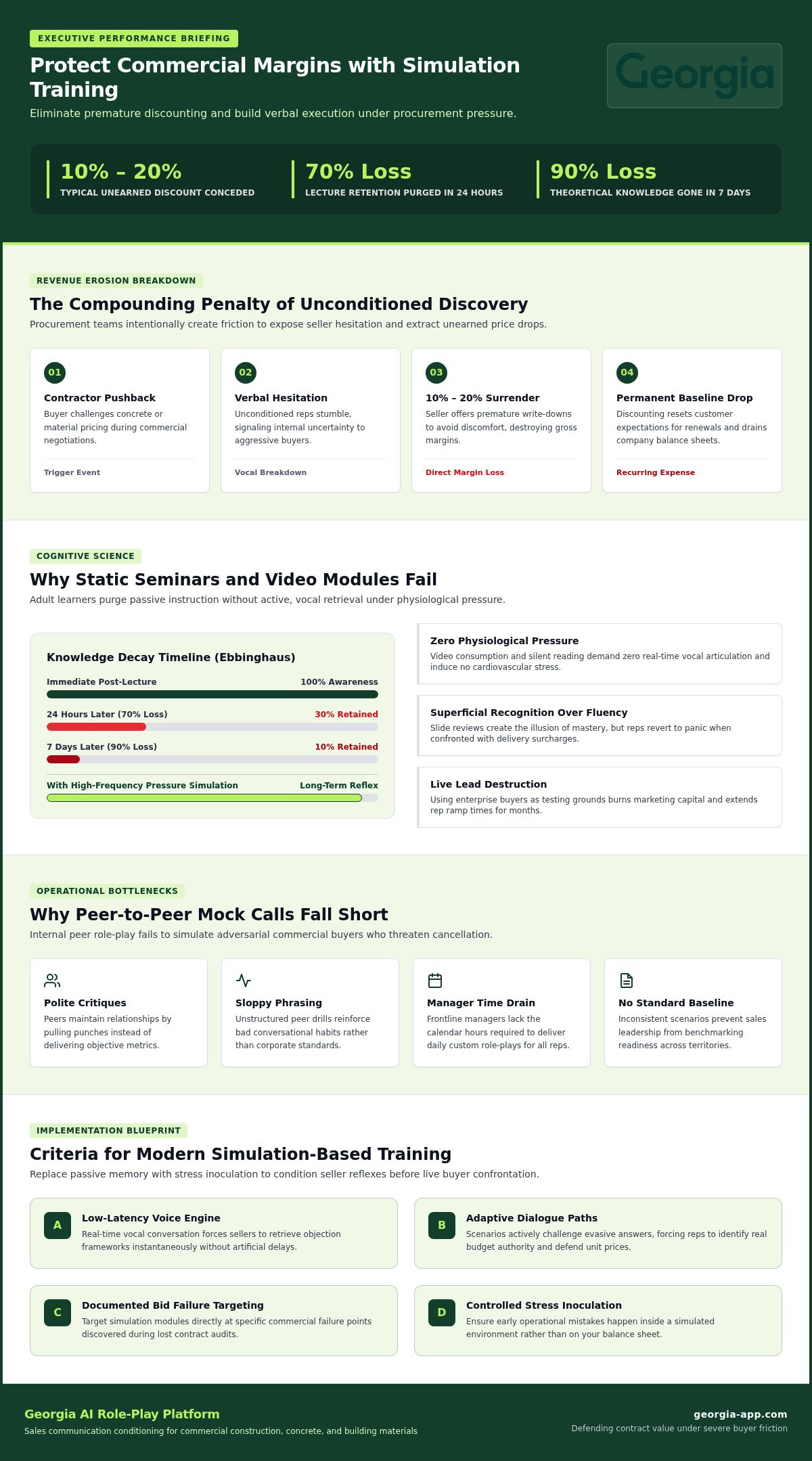
Unconditioned sellers frequently surrender 10% to 20% discounts the moment a contractor challenges a quote. That single concession destroys the net profitability of a commercial bid. Over an annual contract, routine discounting permanently degrades margins and resets buyer expectations for future renewals. Professional procurement teams deliberately create verbal tension to extract these unearned write-downs from timid sellers.
Eliminate Pipeline Burn Caused by Rookie Live Call Practice
Treating live customer accounts as testing grounds destroys marketing capital. New sellers without simulated practice burn through dozens of qualified enterprise leads before developing basic conversational competence. To break this cycle, modern commercial teams use the Georgia AI role-play platform to condition sellers before they speak with real prospects.
Grounding sellers through structured Stress Inoculation Training ensures that early operational mistakes happen inside a controlled environment instead of on your balance sheet.
- Protects top-of-funnel marketing investments from premature burn.
- Eliminates verbal panic when procurement challenges material quotes.
- Shortens the path to reliable revenue generation without live margin loss.
- Maintains strict pricing discipline across every account executive.
Expose Why Traditional Sales Seminars Fail the Retention Test
Traditional corporate seminars fail because the human brain purges passive information. Adult learners forget roughly 70% of lecture material within 24 hours and up to 90% within a week without active reinforcement. Cramming your commercial team into a conference room produces fleeting awareness while leaving operational behaviors untouched.
Watching passive video modules proves equally ineffective. Video consumption demands zero real-time vocal articulation. It induces zero cardiovascular stress. Effective sales communication training requires immediate physiological pressure, forcing the representative to retrieve phrases, defend margins, and respond while under scrutiny.
Overcome the Biological Realities of the Forgetting Curve
Hermann Ebbinghaus proved that retention drops exponentially without spaced retrieval practice. Silent reading and slide reviews build superficial recognition instead of vocal fluency. The moment an aggressive general contractor pushes back on a concrete delivery surcharge, the rep forgets theoretical advice and defaults to panic. Dynamic, high-frequency simulation locks negotiation frameworks into long-term memory through repeated active recall.
Recognize the Structural Limits of Peer-to-Peer Mock Calls
Internal peer role-play rarely fixes the problem. Colleagues share personal relationships, so they pull punches to keep the peace. A friendly peer cannot simulate an adversarial commercial buyer who interrupts, questions material specifications, or threatens to terminate the supply contract.
These exercises also collapse under operational limits: sales managers simply lack the calendar hours to run daily, custom role-plays for every rep. Teams seeking structured, measurable pressure repetition can test simulated sales scenarios to benchmark seller responses without draining frontline management time.
Peer drills consistently produce three major operational bottlenecks across building material sales teams:
- Peers offer vague, polite critiques rather than objective conversational metrics.
- Unstructured role-plays reinforce sloppy phrasing instead of corporate standards.
- Inconsistent scenarios prevent leadership from benchmarking readiness across territories.
- Reps focus on social performance instead of tactical objection handling.
Reconstruct Your Sales Communication Training Around Stress Inoculation
High-stakes negotiation triggers acute cognitive strain. When adrenaline surges during a contentious pricing review, unconditioned sellers suffer tunnel vision, accelerate their speech, and offer rapid discounts to relieve internal pressure. Stress inoculation counters this breakdown by exposing sellers to controlled conversational friction until autonomic panic responses subside.
Effective sales communication training demands audible, real-time vocal output under duress. Reading negotiation playbooks builds intellectual familiarity, but verbal repetition builds operational reflex. Automated role-play platforms give commercial teams unlimited sparring reps against demanding buyer personas without sacrificing valuable market pipeline.
Repeated vocal execution under pressure transforms fragile theory into predictable deal defense. Sellers condition their nervous system to absorb buyer pushback, pause deliberately, and articulate value statements without flinching.
Deploy Realistic Buyer Personas with Dynamic Friction
Simulations must mirror the abrasive operational realities of commercial contracting. Configure practice modules around impatient project estimators, aggressive procurement leads, and skeptical general contractors. These simulated buyers must interrupt, challenge delivery surcharges, and abruptly reject initial proposals. Reps learn to maintain posture, control cadence, and redirect the conversation rather than ceding commercial control.
Measure Objective Behavioral Signals Instead of Completion Checkmarks
Course completion checkboxes tell executives nothing about field competence. Modern commercial teams replace subjective manager reviews with audited conversational telemetry. Track response latency under pressure, pitch pacing, and filler word spikes during aggressive pricing inquiries.
Simulated modules track whether an account executive uncovered budget authority and project scope before proposing terms. Verifiable fluency metrics turn qualitative coaching into concrete performance benchmarks across the commercial organization.
Audit Essential Criteria for Modern Communication Simulation Platforms
Low-latency voice processing is mandatory for realistic negotiation simulation. Conversational pressure evaporates when software lags for two seconds after a spoken response. A procurement manager does not pause politely; they cut in, challenge lead times, and dismiss vague statements. High-fidelity audio engines replicate these real-time interruptions to keep the seller on edge.
Adaptive conversation trees must actively counter evasive tactics. When a sales rep evades a direct inquiry about aggregate hauling fees or material specifications, the engine must drill down rather than advance a canned script. Review the AI role-play training platform architectural framework to understand how dynamic branching exposes conversational vulnerabilities.
Centralized performance dashboards give commercial leadership direct visibility into team execution gaps. Objective scorecards highlight which branches struggle to defend price increases or identify budget owners before contract finalization.
Require Asynchronous Practice to Eliminate Manager Bottlenecks
Front-line sales managers spend less than 10% of their working hours coaching sellers. Daily dispatch coordination, customer fires, and administrative duties dominate their schedules. Effective sales communication training removes this logistical hurdle through self-paced execution.
Reps can run ten pressurized negotiation rounds before breakfast without booking manager time. Automated scoring models evaluate each attempt instantly, allowing commercial managers to direct their energy toward closed bids and high-level strategy.
Enforce Standardized Commercial Playbooks Across the Organization
Rogue messaging destroys enterprise profit margins. Untested reps often invent unauthorized freight concessions, deliver inaccurate mix guarantees, or surrender terms simply because they lack fluent playbook knowledge. Modern simulation environments solve this operational drift by testing reps against exact corporate commercial standards.
Every seller must pass verified verbal scenario benchmarks across your product catalog before entering the field. This requirement locks down message uniformity and ensures every account executive articulates your real commercial value when facing customer price resistance.
Implement Simulation Modules to Secure Deal Execution at Scale
Audit your win-loss logs before building a single simulation track. Identify where bids stall: discovery evasion, competitor matching, or procurement discount ultimatums. Teams that deploy cold call simulation software early insulate their outbound teams from pipeline waste while isolating specific conversational friction points.
Lock down inbound routing rules immediately. Set hard simulation pass rates so sellers cannot touch high-value commercial accounts until they demonstrate margin defense. Auditing verbal execution weekly keeps pricing discipline intact across all regional branches.
Establish Clear Certification Gateways for New Hires
Condition new hires before they handle live territory bids. Require new sellers to complete simulated discovery qualification and contractor price pushback scenarios. Tracking time to first closed deal confirms whether your sales communication training builds field capability or leaves sellers guessing during contract negotiations.
Integrate Practice into Continuous Revenue Operations
Commercial readiness requires ongoing operational conditioning rather than annual seminars. Run mandatory simulation tracks sixty days before major contract renewals and ahead of scheduled material price increases. Reviewing practice scores alongside your CRM pipeline reveals vulnerable bids weeks before an account executive folds on margin.
Final Thought
Commercial leaders treat sales communication training as an audited operational safeguard rather than a soft-skills workshop. You no longer tolerate unconditioned sellers burning margin on live accounts. Instead, you mandate simulated pressure testing to verify conversational competence before reps speak with buyers. Explore how Georgia transforms conversational training into continuous revenue protection, keeping your contract margins secure and your sales execution predictable across every commercial territory.
Stop Conversational Revenue Leaks Before the Next Bid
Surrendering unearned price concessions cuts directly into net operating profits. Traditional classroom seminars fail to protect deal margins because sellers cannot recall static slides during contentious procurement confrontations. Reconstructing your sales communication training around simulated stress exposure replaces panic and hesitation with conditioned commercial discipline.
Purpose-built Sales and Commercial Training Modules deliver the deliberate practice required to withstand intense buyer skepticism. Self-paced AI role-play simulations remove front-line manager coaching bottlenecks, using standardized verbal fluency metrics that quantify call readiness before sellers touch live pipeline. Your leadership team secures an audited performance benchmark that insulates contract value across every territory.
Equip your team to defend margins with steady composure and transform abrasive negotiations into dependable, profitable contracts.
Frequently Asked Questions
Why does traditional sales communication training fail to change rep behavior?
Traditional sales communication training fails because listening to a lecture does not condition vocal reflexes under pressure. Sellers understand high-level concepts intellectually, but their brains purge the material without immediate verbal application. When an adversarial contractor pushes back on a commercial quote, adrenaline spikes and the seller reverts to instinctual panic. Behavioral change requires dynamic repetition against realistic resistance, forcing the seller to articulate value while coping with genuine conversational friction.
How does AI role-play software differ from standard peer practice?
AI role-play eliminates the politeness and variability of peer drills. Colleagues naturally soften their pushback to protect internal working relationships, creating unrealistic conversational environments. Automated simulations deliver relentless commercial skepticism, challenging pricing, interrupting delivery terms, and exposing evasive answers on every run. The software also standardizes evaluation across the team, recording objective verbal fluency metrics that human peers cannot audit accurately.
What key metrics prove the financial ROI of conversational sales training?
Gross margin retention during procurement negotiations provides the primary proof of return. Track your average discount percentage on closed bids before and after deploying scenario practice. Secondary metrics include a compression in ramp time to a new seller's first contract, increased qualification accuracy during discovery, and higher win rates on competitive bids. These audited commercial outcomes show whether reps defend price or bleed margin under pressure.
How quickly can a sales team ramp up using automated simulation modules?
Sellers demonstrate measurable execution gains within two to three weeks of daily, ten-minute simulation sessions. Because reps run pressurized scenarios asynchronously, they complete months of conversational practice in days. New hires master key objection handling before their first live customer call. Structured sales communication training condenses traditional six-month onboarding cycles into several weeks of audited, verifiable deal readiness across regional territories.
Can simulated conversation tools adapt to complex enterprise objection scenarios?
Modern simulation engines utilize dynamic conversation trees to react directly to the seller's specific word choice. When a rep dodges a pricing inquiry or provides a weak justification for material surcharges, the simulation pushes back immediately. Platforms adapt across technical specifications, contract terms, and aggressive competitor comparisons. This capability ensures your enterprise team rehearses the exact commercial friction they confront in actual field negotiations.
Does simulation training replace sales managers during the onboarding cycle?
Simulation training preserves manager oversight while removing repetitive coaching bottlenecks from their daily schedules. Front-line leaders lack the hours to run dozens of live practice calls each month. Automated platforms handle verbal conditioning, playbook alignment, and fluency testing independently. Managers then use objective behavioral scorecards to diagnose specific skill deficits, focusing their limited calendar time on strategic deal architecture and active bid execution.