

Discounting is a reflex caused by a lack of verbal fluency and poor value based selling training. Sales reps cave on price because they lack the confidence to defend margins during live negotiations. This habit creates a significant financial liability for your bottom line. Every unearned discount is a direct leak from your EBITDA: a total loss of profit.
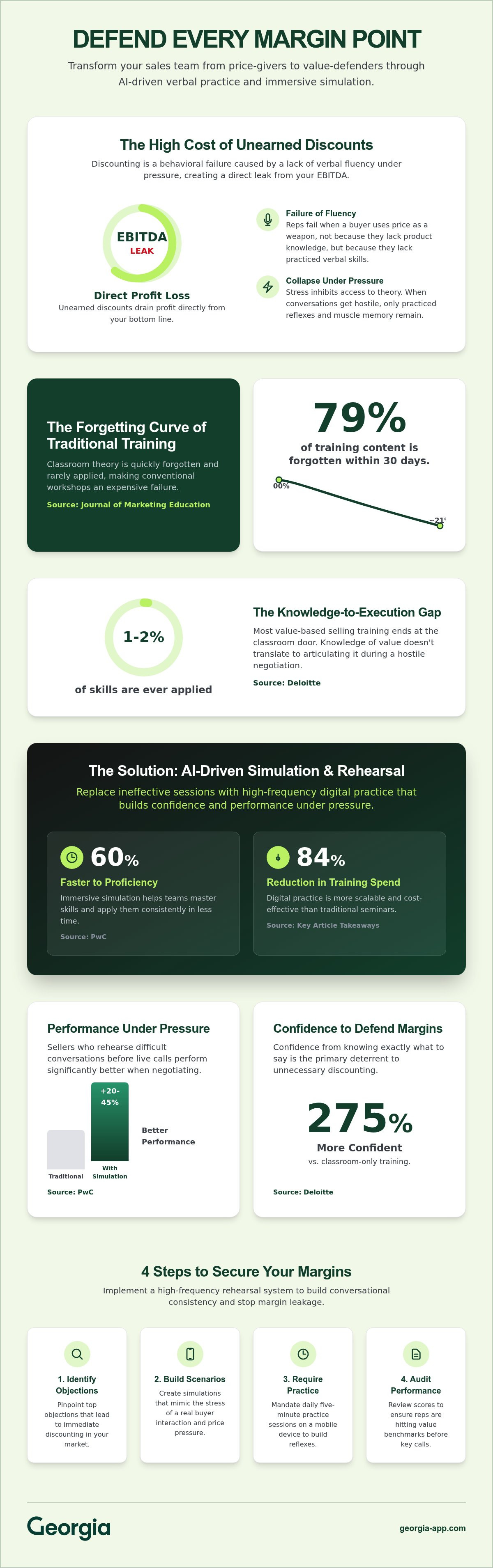
Mastering these skills requires a shift from passive theory to active simulation. Research from the Journal of Marketing Education shows that sales reps forget 79% of training content within 30 days. You can stop this structural failure by replacing ineffective classroom sessions with AI-driven verbal practice that builds confidence under pressure.
This article outlines how to transform your sales team into a unit that defends every point of margin. You'll learn to implement simulations that result in 60% faster time to proficiency according to PwC. We'll identify specific gaps in your training and replace them with high-stakes practice. You will discover how to eliminate the gap between knowledge and execution.
Key Takeaways
- Discounting is a behavioral failure caused by a lack of verbal fluency under pressure.
- Replace classroom theory with value based selling training simulations to build the confidence needed to defend margins.
- Prevent the 79% retention loss reported by the Journal of Marketing Education by using high-frequency digital rehearsal.
- Reduce training spend by 84% while reaching proficiency 60% faster than traditional methods according to PwC.
- Audit performance gaps across your entire organization to ensure sales and dispatch teams adhere to pricing strategies.
Recognize Discounting as a Behavioral Failure Rather Than a Lack of Knowledge
Discounting is not a knowledge gap. It is a failure of verbal fluency. Most sales reps can list your product benefits in a quiet office. They fail when a buyer uses price as a weapon during a live call. This lack of composure results in immediate margin erosion.
Knowledge of product value does not translate to the ability to articulate it during a hostile negotiation. Research from Deloitte indicates that only 1% to 2% of training content is ever applied in real customer conversations. Most value based selling training ends at the classroom door. It provides the theory but ignores the reality of high-pressure communication.
The "Stop Bidding and Praying" mindset requires a shift from hope to practiced execution. You cannot rely on a rep's mood or intuition to protect your EBITDA. Effective training treats sales as a performance discipline rather than a theoretical subject. Execution is the only metric that matters for the bottom line.
The Gap Between Knowing and Doing
Reps often understand value propositions but fail to recall them when a customer threatens to walk. Stress triggers a physiological response that inhibits access to complex cognitive frameworks taught in traditional workshops. When the brain enters a stress state, theory disappears. Only practiced reflexes remain.
Practicing in a safe environment allows reps to build the muscle memory needed for high-stakes moments. Verbal fluency is a mechanical skill. It requires repetition until the correct response is automatic. Without this rehearsal, your team will continue to default to the easiest path: the discount.
Commercial Compliance Practice for Building Materials Sales and Dispatch Teams
Dispatchers often face the most intense price pressure. They manage complex logistics while customers demand immediate concessions on delivery fees or unit pricing. A lack of structured practice leads to inconsistent pricing across different plants and regions. This friction creates a structural failure in your commercial strategy.
Georgia for Building Materials provides the specific scenarios these teams face every day. It forces reps to practice defending a price push in a simulated environment. This ensures that every member of the team, from sales to dispatch, maintains commercial compliance. Consistent execution across all locations is the only way to stop margin leakage. You can start building these skills at georgia-app.com to ensure your team is ready for the next negotiation.
Adopt Value Based Selling Training Through Immersive Simulation
Traditional workshops fail because they lack the repetition necessary to overwrite old habits. They operate as isolated events rather than continuous processes. Immersive simulation forces the brain to treat the practice session as a real-world interaction. This physiological engagement creates neural pathways that theory alone cannot touch.
Sellers who role-play before live calls perform 20% to 45% better under pressure according to PwC. This approach ensures that your value based selling training methodology is applied as designed every time. It eliminates methodology drift and dilution across your regional offices. You can see how simulation prevents margin erosion by standardizing your team's response to price pressure.
Four Steps to Implement Simulation Based Practice
Implementing value based selling training through simulation requires a focus on high-frequency rehearsal. You must move away from the "one and done" mentality of annual seminars. Use these four steps to secure your margins:
- Identify the top three objections that lead to immediate discounting in your specific market.
- Build these scenarios into a simulation platform that mimics the stress of a real buyer interaction.
- Require daily five-minute practice sessions on a mobile device to build conversational consistency.
- Audit performance scores to ensure reps are hitting value benchmarks before they talk to key accounts.
Building Confidence Through Repetition
Confidence is the primary deterrent to unnecessary discounting in the building materials sector. Participants feel 275% more confident versus classroom-only training according to Deloitte research. This confidence comes from knowing exactly what to say when a contractor demands a price match. Reps who have already won the argument in a simulation are less likely to fold during a live call.
Practice sessions allow for failure without the cost of a lost contract or eroded margin. Reps can refine their delivery and hear their own voice until the value proposition becomes second nature. It's better to fail in a simulation than to fail on the balance sheet. Constant rehearsal turns a nervous pitch into an authoritative defense of your price.
Rehearse Difficult Conversations to Build Verbal Fluency Under Pressure
Fluency is the difference between a closed deal and a lost margin. A script is a static document. Fluency is a dynamic skill. Effective value based selling training provides the environment to turn theory into a reflex.
Simulations allow reps to hear their own voice and refine their delivery in a low-stakes environment. Georgia for Sales Trainer turns your specific expertise into a scalable practice engine. Every rep receives personalized feedback based on their specific performance during the simulation. This feedback ensures that errors are corrected in the lab rather than on the job site.
Mastering the Price Push Ceiling
Industry data shows that only a small percentage of suppliers successfully push prices beyond 5%. Most reps fold the moment a customer pushes back. Practice helps reps navigate the "no" without damaging the long-term customer relationship. Internalizing value-based responses prevents the reflexive discount that many reps use to end tension.
Role Play with AI Personas
Construction buyers are not a monolith. AI personas mimic different buyer profiles to prepare your team for any interaction. Reps learn to tailor their value arguments to the specific personality they are facing. This variety prepares the team for the unpredictable nature of real-world negotiations.
- The Driver persona demands immediate results and pushes for the lowest price.
- The Analytical persona requires deep data and technical proof of value.
- The Persuader persona values relationships and long-term partnership potential.
- The Craftsman persona focuses on the quality of the materials and the reliability of the delivery.
A Driver buyer demands speed and immediate ROI. An Analytical buyer requires technical specifications and historical data. Georgia's platform forces reps to switch between these modes instantly. This builds the mental agility required to stop margin erosion in a commodity-heavy market.
Continuous practice leads to the 60% faster time-to-proficiency reported by PwC. It transforms a hesitant sales force into a confident commercial team. You stop guessing and start executing with precision. Your team moves from a state of bidding and praying to a state of controlled commercial execution.
Audit Training Retention Rates to Stop the Forgetting Curve
Traditional workshops are a sunk cost. The Journal of Marketing Education reports that 79% of what salespeople learn is forgotten within 30 days. This rapid erosion makes one-time events a financial liability for your organization. You are funding a temporary spike in knowledge that fails to change long-term behavior. Continuous application preserves professional skills.
Traditional training spend of $1,500 per rep is wasted without a reinforcement mechanism. You are paying for insights that never reach the negotiation table. Effective value based selling training requires a continuous loop to remain a functional asset. Skills must be maintained with the same rigor as your production equipment to prevent performance decay.
Measuring the Impact of Reinforcement
Tripling retention scores in 60 days is a common outcome for teams using structured simulation. Managers can focus their coaching on specific behavioral gaps identified by the AI scoring system. This precision eliminates the guesswork of traditional sales management. You can see exactly which reps are defending price and which are folding under pressure during live simulations.
A manager dashboard provides visibility into practice frequency and performance trends. You can audit performance as strictly as you audit financial records. This data allows you to intervene before a poorly prepared rep loses a major contract. Visibility is the only way to ensure commercial consistency across all plant locations and regional offices. Data-driven insights replace the subjective ride-along as the primary tool for performance evaluation.
Testimonial: Scaling Method Integrity
“Retention scores tripled in 60 days. Leadership stopped questioning the program.” – VP Sales Enablement, B2B SaaS.
This feedback demonstrates the power of consistent and measurable reinforcement. Transitioning to a continuous practice model ensures that skills are sharp when the next bid is due. High-frequency rehearsal produces more consistent outcomes than classroom hours. You achieve better results by making practice a daily operational requirement. This shift ensures your methodology survives the transition from headquarters to the local dispatch office.
Scale Methodology Across the Entire Sales and Dispatch Team
Large organizations often suffer from methodology dilution as training moves from headquarters to local plants. The core principles of your commercial strategy degrade as they pass through multiple layers of management. Digital simulation ensures that the Craftsman profile of value based selling training is maintained across the entire enterprise. Your specific method is applied as designed every time, regardless of the rep's location.
Practice is available on-demand via voice or chat. This flexibility allows reps to practice between customer visits or during downtime at the plant. This scalability allows a single trainer to manage the proficiency of hundreds of reps simultaneously. High-stakes rehearsal becomes a permanent part of the daily workflow.
Eliminating Method Drift
Method drift occurs when local managers introduce their own negotiation tactics. These unvetted methods are often less effective and lead to inconsistent pricing across your network. A centralized simulation platform acts as a single source of truth for commercial excellence. It ensures that a rep in a remote plant uses the same high-value arguments as your top performers at headquarters. You maintain absolute control over the narrative and the margin.
Consistent practice leads to a 60% reduction in time-to-proficiency for new hires according to PwC. You can onboard new dispatch and sales staff without waiting for the next scheduled workshop. This speed is critical in high-turnover environments where every day of sub-par performance is a day of lost revenue. Automated scoring identifies performance gaps before they can damage your market position or lead to unnecessary discounts.
Supporting Global Teams with Digital Infrastructure
Trainers can expand their impact to new regions without the need for constant travel. Digital tools provide the same impact as physical presence for skill development and performance auditing. Scalable licensing allows organizations to deploy practice modules to every plant in the network instantly. This ensures a unified front when dealing with national accounts or large-scale construction firms that operate across multiple territories.
A unified approach prevents customers from playing one plant against another for a lower price. You maintain control over the brand's value proposition regardless of geography. Digital platforms provide the infrastructure to support thousands of interactions without increasing administrative overhead. You replace expensive logistics with efficient, data-driven practice.
Replace Traditional Workshops with High-ROI Digital Practice
Traditional training is a financial sinkhole. The cost of traditional workshops is roughly $1,500 per rep. A basic Georgia subscription is $240 per rep. This represents an 84% lower training spend for a more effective, continuous solution. A 10-rep team saves approximately $12.6K by switching to a simulation-based model. These savings are immediate and measurable.
Investing in practice addresses the revenue leak caused by poor conversations. You stop funding the classroom and start funding the results. High-stakes rehearsal ensures your value based selling training delivers a measurable return. You replace a one-time expense with a permanent performance asset. Every dollar spent on simulation builds a lasting defense against margin erosion.
Comparing Traditional vs. Simulation Training
Traditional training offers high cost and low retention. Only 1% to 2% of content is ever applied in real customer conversations according to Deloitte. Managers have zero visibility into daily application. This lack of oversight allows bad habits to persist across your sales team. You are paying for attendance. Performance requires a different model.
Simulation provides low cost and high retention. You gain measurable performance data for every rep. Every interaction is recorded and scored for commercial compliance. You can identify who is protecting the price and who is folding under pressure. The choice for the Driver profile is clear: maximize ROI by cutting waste.
The Financial Case for Practice
Reducing discounting by even 1% has a massive impact on the bottom line of a building materials firm. Small margin improvements scale across thousands of transactions to create significant EBITDA growth. These gains are the direct result of superior verbal fluency and composure. You should calculate your own revenue loss from discounting to see the value of rehearsal. The cost of a single lost margin point often exceeds the entire cost of the training platform.
Practice is an operational investment. Theory is a corporate expense. You can learn how Georgia audits your revenue leaks to identify exactly where your margin is disappearing. Protecting your price is a matter of discipline and repetition. Mastering value based selling training through digital simulation provides the rigor your financial auditing requires. You transform a soft skill into a hard financial advantage.
Secure Your Margins Through Daily Rehearsal
Discounting is an operational liability you can no longer ignore. Transitioning to a simulation based model provides an 84% lower training spend while building the verbal fluency your team lacks. You can stop margin erosion by turning commercial strategy into a practiced reflex.
Effective value based selling training replaces passive theory with high stakes practice. Research from Deloitte shows that reps feel 275% more confident than those in classroom settings. You will achieve a 60% faster time to proficiency for new staff according to PwC. This confidence is the primary barrier between your price and a customer demand for a discount.
Final Thought
You will now stop treating sales training as a one time event and start treating it as a daily performance audit. You will replace vague scripts with AI driven simulations that build measurable verbal fluency. Every rep will be required to defend your price in a simulated environment before they speak to a key account. This shift ensures that your margins are protected by practiced skill rather than hope.
Frequently Asked Questions
How do I know if my sales reps are actually using the training platform?
You monitor usage through a manager dashboard that provides real-time visibility into activity and performance. It allows you to audit practice frequency and identify specific behavioral gaps across the entire team. A VP of Sales Enablement noted that "Retention scores tripled in 60 days" when using this data-driven approach. This oversight eliminates the guesswork of traditional sales management and ensures commercial consistency.
Can AI really simulate the pressure of a real-world construction negotiation?
Immersive simulation triggers the same physiological stress responses as a real buyer interaction. AI personas mimic aggressive Driver or detail-oriented Analytical profiles common in the construction sector. Reps must articulate value propositions while facing the price push in real-time. Rehearsal in a simulated environment ensures that reps maintain price integrity when the customer threatens to walk.
What is the specific ROI of switching from workshops to digital role-play?
Switching to digital role-play delivers an 84% lower training spend compared to traditional workshops. A 10-rep team saves approximately $12.6K by replacing expensive $1,500 workshops with a $240 basic annual subscription. This cost reduction is paired with superior outcomes in value based selling training. You achieve a higher return by investing in continuous practice because one-time events fail to change behavior.
How does simulation training help with commercial compliance in building materials?
Georgia for Compliance includes modules designed to prevent antitrust violations and maintain ethical selling standards. Reps practice responding to improper requests and making only accurate claims in simulated scenarios. This rehearsal ensures that commercial compliance becomes a practiced reflex. Practical application is the only way to protect your organization from significant financial liabilities and secure the bottom line.
Is the platform suitable for dispatch teams as well as outside sales?
Dispatchers face intense price pressure and require the same level of verbal fluency as outside sales reps. Georgia for Building Materials provides scenarios tailored to the specific friction points of dispatch operations. Practice is available on-demand via voice or chat on the rep's phone. Scalable practice allows you to standardize performance and maintain your price-push strategy across every plant location.
What happens to the 79% of training content that is usually forgotten?
The Journal of Marketing Education reports that 79% of training content is forgotten within 30 days. Digital simulation stops this erosion by providing continuous on-demand practice. Reps revisit key concepts and refine their delivery daily to ensure skills remain sharp. This approach ensures your value based selling training remains a functional asset rather than a temporary spike in knowledge.
How long does it take for a sales team to see measurable results?
Teams often see measurable results within weeks as the AI-driven simulations cut time-to-proficiency by 60% according to PwC. Participants feel 275% more confident versus classroom-only training according to Deloitte. This rapid improvement allows you to deploy new hires to key accounts faster and with more certainty. You stop the bidding and praying cycle by ensuring your team is ready for the next negotiation immediately.
Can I customize the simulations to match my company's specific sales methodology?
The platform is tailored to your specific methodology, compliance policy, and real-world scenarios. This ensures your method is applied exactly as designed every time. You maintain absolute control over the narrative and the quality of the sales conversation. A centralized simulation platform acts as a single source of truth for commercial excellence across your entire national network.