

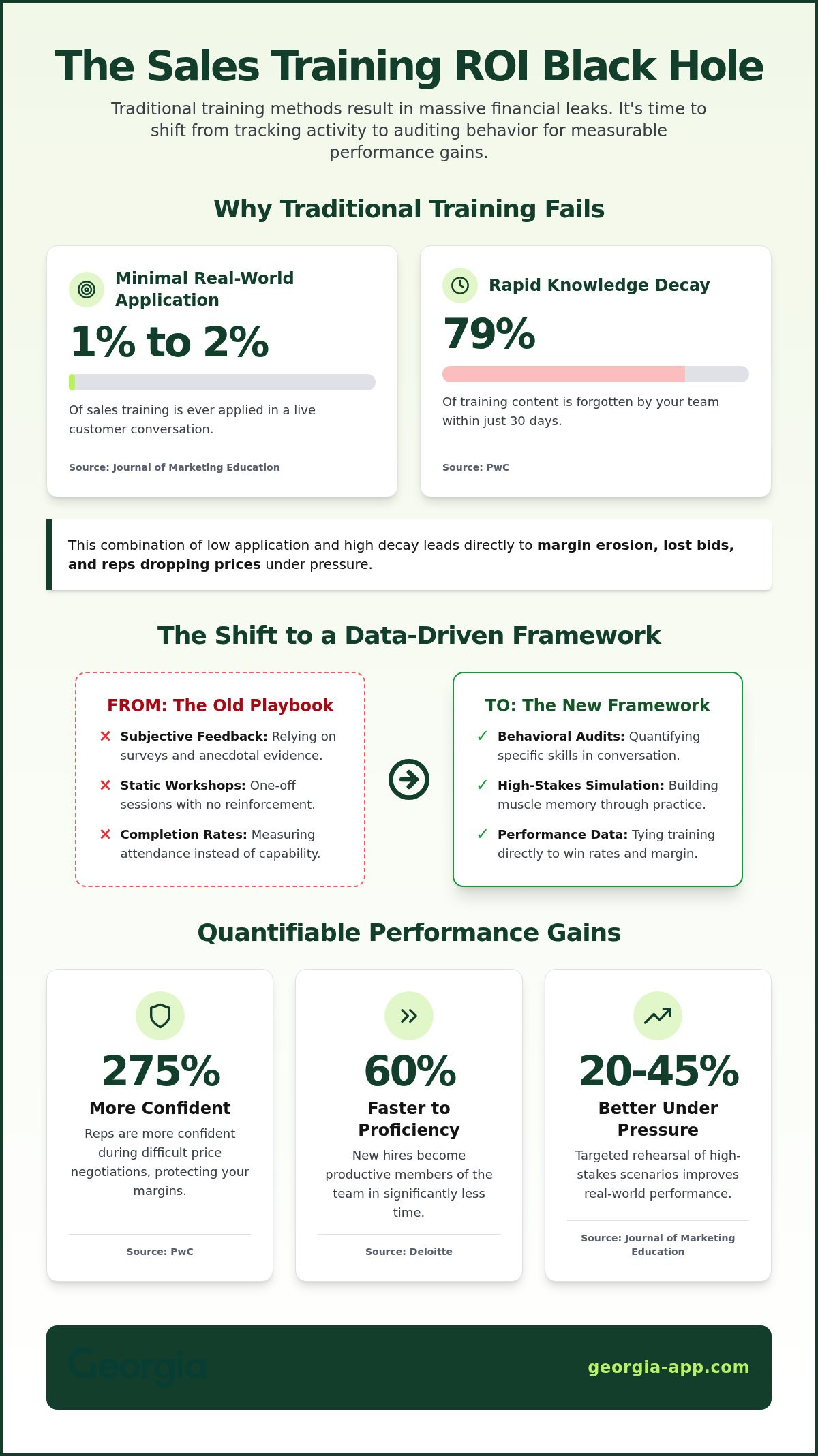
Only 1% to 2% of sales training is ever applied in a real customer conversation according to research from the Journal of Marketing Education. This represents a massive financial leak in your commercial operations. You likely see high training spend result in zero behavioral change while reps continue to drop price at the first sign of friction.
Measuring sales training effectiveness requires a transition from subjective surveys to rigorous behavioral audits. Traditional evaluation methods ignore the 79% of content forgotten within 30 days as documented by PwC. This lack of retention creates a structural failure in your sales pipeline.
You can transform vague soft skills into measurable financial assets by quantifying the specific behaviors that drive your sales performance. This article provides a roadmap to calculate conversational ROI and stop the margin erosion caused by unskilled negotiations.
We will examine how to reduce time to proficiency and ensure commercial compliance across multiple plants using a scalable, data driven framework. Treat sales conversations as audited financial transactions to ensure predictable performance.
Key Takeaways
- Audit the 1% to 2% application rate in real customer conversations to identify financial leaks in your commercial pipeline according to the Journal of Marketing Education.
- Adopt a data driven framework for measuring sales training effectiveness by quantifying behavioral changes instead of relying on subjective feedback surveys.
- Reduce time to proficiency by 60% for new hires by replacing static classroom sessions with high stakes simulation as documented by Deloitte.
- Protect your margins and secure the 5% price ceiling by ensuring reps are 275% more confident during difficult negotiations as reported by PwC.
- Improve performance under pressure by 20% to 45% through targeted rehearsal of high stakes building materials sales scenarios according to the Journal of Marketing Education.
Stop Bidding and Praying for Better Sales Training Effectiveness
Passive metrics only reflect the outcomes of interactions that have already occurred. This is a post-mortem approach to revenue. You cannot fix a lost bid after the customer has walked away. Measuring sales training effectiveness requires a focus on the behaviors occurring before the contract is signed.
To better understand this concept, watch this helpful video:
Revenue loss often stems from reps who cannot articulate value under pressure. Traditional training treats communication as a soft skill. It must be treated with the same rigor as a financial audit. Developing a deeper understanding of the sales process proves that every interaction is a measurable financial transaction. Fixing the revenue leak requires a focus on the point of interaction.
Identify the Financial Liability of Poor Communication
Poor talk in high stakes bids is a direct drain on the bottom line. Commercial construction sales require precise compliance and negotiation skills. Research from the Journal of Marketing Education shows that only 1% to 2% of training content is ever applied in real customer conversations. This gap represents a massive financial liability for your firm. Dispatch teams often fail to protect the price ceiling because of inadequate practice. They concede to contractors too quickly. This behavior erodes your profit margins. Consider these common points of failure:
- Poor talk in high stakes bids is a direct drain on the bottom line.
- Commercial construction sales require precise compliance and negotiation skills.
- Dispatch teams often fail to protect the price ceiling because of inadequate practice.
- Contractors exploit communication gaps to drive down your quotes.
Shift from Reactive Tracking to Proactive Practice
Monitoring dashboards is a reactive strategy. It provides zero improvement to actual skill. Dashboards track past outcomes. Future performance remains stagnant without intervention. Teams need Sales & Commercial Training Modules that prioritize active performance. Proactive simulation allows teams to fail in a safe environment. It builds the muscle memory needed for the field.
PwC research indicates that 79% of information is forgotten within 30 days without reinforcement. Performance scoring must be tied to real world negotiation scenarios. Move beyond completion rates. Focus on behavioral data that correlates with win rates. Practice is the only way to ensure your team can defend your price ceiling when the pressure is on.
Audit the One Percent Application Rate in Your Sales Pipeline
Research from the Journal of Marketing Education shows that only 1% to 2% of training content is ever applied in real customer conversations. This tiny application rate represents a massive waste of capital for building materials firms. Static classroom sessions create a gap between head knowledge and execution on the plant floor. You cannot rely on a rep's memory when they are negotiating a high volume aggregate contract under pressure.
Analytical leaders must track how much methodology is actually used on calls. Manual coaching cannot scale to cover every rep at every plant in a multi state operation. A narrative literature review in relation to sales force training evaluation confirms that traditional models often fail to account for this lack of transfer. Measuring sales training effectiveness is impossible if you only look at completion certificates.
PwC research indicates that 79% of training content is forgotten within 30 days. This rapid decay makes traditional workshops a poor investment for the construction sector. You are paying for information that evaporates before the next quarterly review. Measuring sales training effectiveness requires a system that captures behavioral data at the point of decay.
Measure Behavioral Change Instead of Attendance
Attendance records are vanity metrics. They do not predict revenue or market share growth. Real performance metrics focus on the application of specific sales methodologies in live scenarios. Use simulation data to identify which reps are struggling with objection handling before they lose a major bid. This allows for targeted intervention based on data rather than gut feelings.
Most managers assume a completed module equals a skilled rep. This is a dangerous assumption in high stakes construction bidding. A rep who passes a multiple choice quiz might still freeze when a contractor demands a 10% discount. Simulation platforms capture the specific words used during these moments of friction. You see exactly where the value proposition breaks down. If you want to see how your team handles these high pressure negotiations in real time, you should book a demo to review your conversational data.
Standardize the Practice Environment to Prevent Drift
Methodology drift occurs when every rep interprets training differently. This results in inconsistent pricing and fragmented brand messaging. AI simulations ensure the method is applied exactly as designed every time. Consistent practice prevents the dilution of your core sales strategy across different regions.
When a rep in one plant concedes on delivery fees while another holds firm, your pricing strategy collapses. This inconsistency is a direct result of unmonitored training. Standardizing the practice environment ensures every salesperson uses the same value based language. It removes the guesswork from sales management. You gain a clear view of commercial compliance across the entire organization.
Accelerate Time to Proficiency by Sixty Percent Through Simulation
Deloitte research indicates that simulation based training leads to a 60% reduction in time to proficiency. Slow ramp times are a structural failure in your growth strategy. Every day a new hire spends in a classroom is a day of missed revenue. Measuring sales training effectiveness requires tracking how fast a rep moves from trainee to producer.
New hires in the building materials sector must master complex commercial compliance rules quickly. They face high stakes negotiations with seasoned contractors who exploit inexperience. Continuous on demand practice allows reps to master soft skills on their phones. It turns downtime into high value skill development. This is how you build a competitive moat around your sales force.
Reduce the Cost of Onboarding New Sellers
Traditional onboarding relies on slow and expensive in person workshops. These events are logistical friction points that drain your budget. Digital role play allows new hires to practice high pressure scenarios before live calls. Research that empirically measures and utilizes trainee and trainer reaction shows that immediate feedback is critical for skill acquisition. You don't need a coach in the room to verify performance.
Scaling impact requires a training engine that works without manual oversight. You can't afford to have your best managers tied up in basic training sessions. Simulation platforms provide the necessary rigor while freeing up leadership for strategic initiatives. This shift reduces your training spend by 84% while improving the quality of the output. It replaces vague feedback with hard behavioral data.
Maintain Quality Control Across All Plants
Craftsman profiles demand that the method is applied without shortcuts. You need consistency across every plant and every dispatch desk. Centralized dashboards show activity and performance across the entire team. This transparency eliminates the guesswork in sales management. You see exactly who is practicing and who is coasting.
Simulation ensures every plant manager has a clear coaching focus based on real data. It prevents the dilution of your sales strategy as it moves through different regions. Measuring sales training effectiveness becomes a simple audit of behavioral compliance. You ensure that every rep represents your brand with the same level of precision and authority. This consistency protects your margins and secures your market position.
Treat Conversational Confidence as a Core Financial Asset
PwC research shows that participants feel 275% more confident when using simulation versus classroom only training. This confidence represents a measurable financial asset. It's distinct from subjective feelings. High confidence provides the necessary friction to resist improper price concessions during high stakes bidding.
Measuring sales training effectiveness involves auditing the psychological readiness of your frontline staff. A hesitant rep is a structural failure in your commercial strategy. They prioritize the ease of a quick "yes" over the long term value of a profitable contract. Measuring the gap between knowledge and the confidence to use it is critical for revenue protection.
Confidence acts as the primary driver of success in high stakes negotiations. It ensures your team can articulate value when a contractor pushes back. Without it, your sales methodology remains a theoretical exercise rather than a field tool. You must treat verbal fluency as a prerequisite for commercial compliance.
Link Confidence to Margin Protection
Sellers who lack confidence often resort to aggressive discounting as a default defense mechanism. This behavior occurs because the rep lacks the verbal muscle memory to defend the price ceiling. Role playing before live calls prepares the mind for the physiological stress of negotiation. It removes the panic that leads to immediate price concessions.
High stakes communication requires a level of fluency that static training cannot provide. When a rep can articulate value under pressure, they protect the bottom line. Repetition builds the neural pathways necessary to handle aggressive procurement tactics. Avoid practicing on your most valuable customers. Practice in a controlled environment to ensure your margins remain intact.
Build Category Authority Through Soft Skill Mastery
Authority is built when reps can respond to improper requests or aggressive pushback ethically and decisively. Mastery of soft skills positions your team as strategic advisors in the building materials industry. It elevates them above the level of order takers. This authority is a measurable asset in complex commercial cycles.
Persuader profiles thrive when they can project this level of expert authority to a skeptical contractor. They value the signature experience that building authority provides. Confident communication reduces the friction that typically slows down the sales cycle. It removes the uncertainty that leads to stalled deals and endless follow ups.
Measuring sales training effectiveness requires you to quantify the reduction in price concessions across your entire fleet. Traditional training fails because it treats confidence as a personality trait. It's actually a mechanical result of successful repetition. Every simulation session removes a layer of friction from the rep's delivery.
Rehearse Under Pressure to Secure the Five Percent Price Ceiling
Building materials suppliers often struggle to push prices beyond a 5% ceiling. This stagnation is a structural failure in your negotiation strategy. When customers push back on quotes, reps without recent practice concede immediately. Securing your margins requires a shift from passive learning to active rehearsal.
Sellers who role play before live calls perform 20% to 45% better under pressure according to research from the Journal of Marketing Education. This performance boost is the difference between a profitable contract and a break even deal. Measuring sales training effectiveness is the only way to verify that your team can hold the line during these critical moments.
Practice allows dispatch teams to handle difficult customer requests without panic. A panicked dispatcher is a financial liability. They prioritize speed over price protection. Simulation training allows reps to rehearse the objection before the call happens.
Protect Your Margins During High Stakes Negotiations
Drivers focus on ROI and revenue impact during every interaction. They have no patience for vague training that does not translate to the bottom line. Simulated business interactions reveal exactly where reps are leaking revenue. These leaks occur at the point of interaction.
Negotiation training must be continuous to be effective in real scenarios. One time workshops fail because they do not build the necessary muscle memory. Measuring sales training effectiveness requires an audit of how well reps defend your price ceiling over time. You must identify behavioral patterns that lead to margin erosion.
Ensure Commercial Compliance in Every Interaction
Improper requests from customers can lead to significant regulatory fines. These risks are not theoretical. They are significant operational threats. Reps must practice escalating concerns the right way every week.
Compliance modules should include avoiding antitrust violations and protecting confidential information. This is about more than just ethics. It is about protecting the structural integrity of your organization. You should consult a regulator for specific requirements in your jurisdiction.
Consistent practice ensures that every member of the commercial team knows the boundaries. It removes the ambiguity that leads to costly errors. Use Customer Operations Training to build a culture of compliance. This rigor ensures that your team remains an asset rather than a liability.
Audit Your Conversational Assets to Secure Market Share
Stop relying on passive metrics that ignore the 1% application rate in real customer conversations. Measuring sales training effectiveness requires quantifying the behavioral shifts that protect your margins and reduce time to proficiency by 60%. Transitioning to simulation based practice reduces training spend by 84% and saves $12.6 K per 10 rep team. This data driven approach ensures your sales methodology is a field tool rather than a forgotten manual.
"Retention scores tripled in 60 days. Leadership stopped questioning the program." - VP Sales Enablement, B2B SaaS
Final Thought
You will now stop evaluating training through attendance logs and start auditing the specific words used in high stakes negotiations. You will replace static workshops with continuous simulation to ensure every rep can defend your price ceiling under pressure. This shift transforms your commercial team from a cost center into a measurable financial asset that secures long term market share. You are now equipped to treat every sales conversation with the rigor of a financial audit.
Frequently Asked Questions
How do sales performance metrics impact the bottom line?
Sales performance metrics identify where revenue leaks occur during high stakes negotiations. Companies with comprehensive training programs see 24% higher profit margins according to Careertrainer.ai. Tracking these numbers allows leadership to secure the 5% price ceiling often lost to unpracticed reps. Measuring sales training effectiveness requires linking behavioral changes directly to income per employee. This rigor prevents the structural failure of your commercial strategy.
Can AI simulation improve sales negotiation skills?
AI simulation builds the verbal muscle memory needed to defend margins under pressure. Sellers who role play before live calls perform 20% to 45% better under pressure according to research from the Journal of Marketing Education. It removes the panic that leads to aggressive discounting. Reps practice responding to improper requests and defending price in a safe environment. This repetition ensures the methodology is applied exactly as designed every time.
What is the financial cost of the sales forgetting curve?
The financial cost is the loss of your $1,500 per rep annual training investment. PwC research indicates that 79% forgotten within 30 days is the standard decay for traditional training content. This decay means traditional workshops offer zero lasting behavioral change. You pay for knowledge that evaporates before it reaches the field. Georgia reduces this liability by providing continuous on demand practice for a $240 basic annual subscription. This shift saves approximately $12.6 K per 10 rep team.
How do I measure the ROI of communication training?
Measure ROI by auditing the application rate of your sales methodology in real interactions. Traditional surveys fail because they don't track the 1% to 2% ever applied rate cited by the Journal of Marketing Education. Real ROI comes from being 60% faster to proficiency as documented by Deloitte. Measuring sales training effectiveness involves comparing your $240 annual subscription to the revenue gains from defended margins. This financial audit replaces vague satisfaction scores with hard commercial data.
Why do sales reps struggle to apply training in real conversations?
Reps struggle because static classroom sessions do not prepare them for the stress of live negotiations. There is a massive gap between understanding a concept and executing it under pressure. Research from the Journal of Marketing Education shows that only 1% to 2% of training content is ever applied in real customer conversations. Without simulation, reps default to old habits when a contractor demands a discount. Practice is the only way to bridge this execution gap.
How can I reduce training spend while improving performance?
Reduce spend by replacing expensive in person workshops with scalable AI simulations. This transition results in an 84% lower training spend compared to traditional methods. You save $12.6 K for every 10 rep team while improving performance under pressure by 20% to 45% as documented by the Journal of Marketing Education. Digital role play allows for continuous reinforcement without the logistical friction of travel. It provides a higher ROI by focusing on behavioral outcomes.
What is the difference between lead and lag indicators in sales training?
Lead indicators are proactive metrics like simulation frequency and behavioral accuracy scores. Lag indicators are reactive outcomes like quarterly revenue and final win rates. Evaluating your program requires focusing on lead indicators to predict future performance. Lag indicators only reflect the results of interactions that have already occurred. You cannot fix a lost bid after the fact. Use lead indicators to identify and correct skill gaps before the call happens.
How does simulation-based training accelerate time-to-proficiency?
Simulation training accelerates proficiency by providing immediate feedback and high volume repetition. Deloitte research indicates that reps are 60% faster to proficiency when using simulation based training. It allows new hires to master complex commercial compliance and negotiation skills without practicing on your customers. Reps feel 275% more confident compared to classroom only training as reported by PwC. This speed to market ensures new sellers contribute to the bottom line faster.