

A rep who answers a price question before confirming what the buyer needs can reduce a complex opportunity to a quote request. Active listening exercises for sales teams help reps slow that reflex, uncover buyer priorities, and respond to the issue that matters.
Listening can feel easy in a scripted practice, then become harder when a buyer raises a concern or changes direction. Without clear behaviors to observe, managers have little to coach beyond “listen more.”
This article outlines five practical exercises based on real sales conversations, from clarifying a requirement to reflecting back what you heard. Each includes a way to run the practice and debrief what the rep missed, confirmed, or assumed.
You’ll leave with a repeatable approach for building listening habits across the team: fewer premature answers, clearer buyer needs, and more relevant next steps.
Key Takeaways
- Define the listening behaviors that prevent missed requirements and premature recommendations.
- Use five active listening exercises for sales teams to practice buyer conversations and check what reps hear.
- Match each drill to the listening gap, such as paraphrasing when reps misstate requirements.
- Make practice repeatable by choosing one behavior, using a real scenario, and debriefing what the rep observed.
- Track visible behaviors during practice so feedback stays specific and reps know what to improve next.
Treat active listening as a sales execution skill, not a personality trait
A missed quantity, specification, or delivery constraint can lead to avoidable follow-up and rework. A premature discussion of price can also send the conversation off course before the buyer’s priorities are clear.
Active listening means giving focused attention, clarifying what you hear, reflecting the buyer’s meaning accurately, and confirming the next step before recommending action. In sales, that includes checking the commercial, technical, and scheduling context behind a request. The Active listening overview provides a broader foundation.
Watch this overview of core listening behaviors before applying them to buyer conversations:
Identify the listening failures that disrupt buyer conversations
Interrupting to pitch can leave quantity, specification, or delivery details unconfirmed. If a buyer asks for an aggregate quote, first ask which requirement or delivery window should guide the recommendation. Discuss price once the buyer’s priorities are clearer.
Describe what effective listening looks like on a sales call
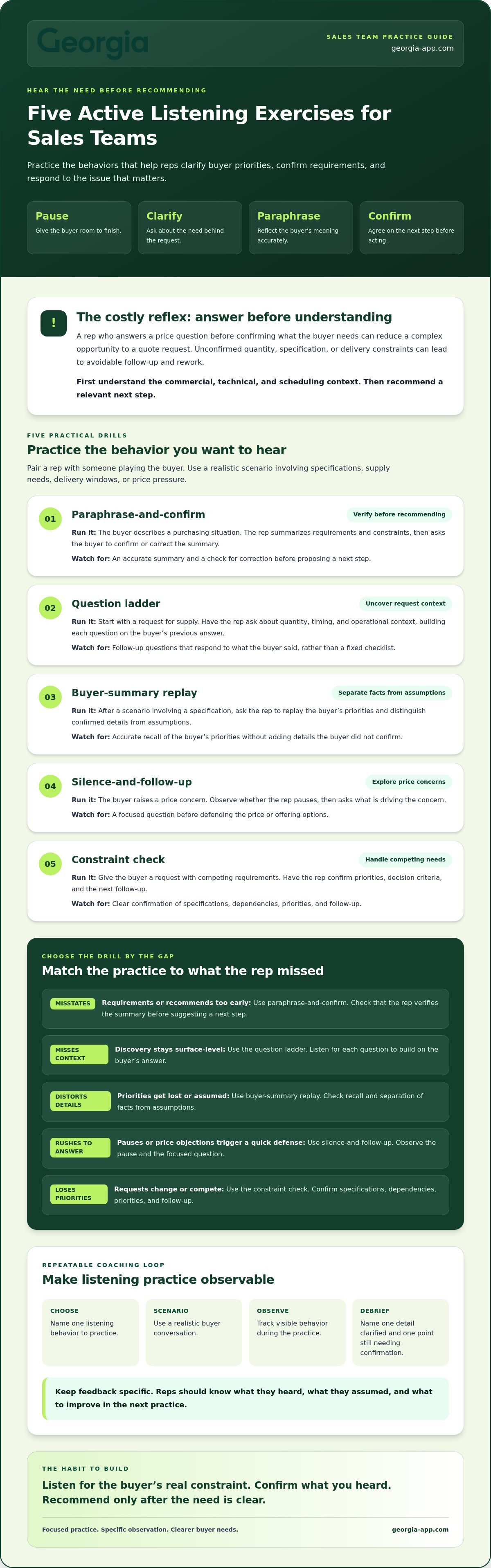
Coach four visible behaviors: pause, clarify, paraphrase, and confirm the next step. For example: “I heard that the delivery window is the main constraint. Have I got that right, or is another requirement driving the decision?” This gives the buyer a chance to correct the summary before the rep recommends action.
Run five active listening exercises for sales teams
Use these active listening exercises for sales teams to rehearse buyer conversations involving specifications, supply needs, delivery windows, and price pressure. Pair a rep with someone playing the buyer, and observe the behavior named in each drill.
- Paraphrase-and-confirm: Have the buyer describe a purchasing situation. Before recommending action, the rep summarizes the requirements and constraints and asks the buyer to confirm or correct them.
- Question ladder: Start with a request for supply. Have the rep ask follow-up questions about quantity, timing, and operational context, with each question building on the buyer’s previous answer.
- Buyer-summary replay: After a scenario involving a specification, ask the rep to replay the buyer’s priorities and separate confirmed details from assumptions.
- Silence-and-follow-up: Have the buyer raise a price concern. Observe whether the rep pauses before asking what is driving the concern, rather than immediately defending the price or offering options.
- Constraint check: Give the buyer a request with competing requirements. Check whether the rep confirms priorities, decision criteria, and the next follow-up.
Debrief with evidence: name one detail the rep clarified and one point that still needs confirmation. AI role-play can give teams another way to repeat buyer scenarios between manager-led practice sessions.
Choose the exercise that matches the listening gap
Choose the drill based on the behavior you want to change, then observe that behavior in a realistic buyer conversation. Keep the practice focused enough that the rep knows what to repeat or adjust.
- Paraphrase-and-confirm: Use this when reps misstate requirements or recommend too early. Observe whether they verify their summary before proposing a next step.
- Question ladder: Use this during discovery to uncover the context behind a request. Note whether each question follows from the buyer’s answer instead of running through a fixed checklist.
- Buyer-summary replay: Use this when reps miss or distort details. Check whether they accurately recall the buyer’s priorities and distinguish facts from assumptions.
- Silence-and-follow-up: Use this when reps rush to fill pauses or answer price objections. Observe whether they pause and ask a focused question before responding.
- Constraint check: Use this for complex or changing requests. Check whether reps confirm specifications, dependencies, priorities, and follow-up.
In price-pressure conversations, practice listening for the concern behind the buyer’s question before discussing options. Role-play gives reps a place to rehearse and managers a chance to observe, but it doesn’t guarantee performance improvement.
Compare live partner practice with simulated repetition
Peer practice lets a manager or partner observe the conversation and discuss a specific behavior right away. It also gives the team a chance to compare how different reps respond to the same buyer scenario.
Self-paced simulation gives reps another way to repeat scenarios individually between team sessions. Georgia’s AI role-play platform offers personalized simulations for practicing high-stakes communication.
Make listening practice repeatable and observable
Practice loses value when feedback amounts to “be more attentive.” Give each round one target behavior, then assess what the rep actually said or did. Specific observations make coaching clearer and let you revisit the same skill in a later conversation.
- Select one behavior: Choose a single target, such as asking a clarifying question before discussing price.
- Choose a real scenario: Use a recurring buyer interaction, such as a changing delivery window or an unclear specification.
- Run the drill: Have the rep practice the scenario while a manager or partner observes the chosen behavior.
- Debrief with evidence: Record the exact question or summary that clarified the buyer’s need, then identify one missed opportunity.
- Repeat: Ask the rep to replay the missed moment, then revisit the skill in a later practice round.
Score three observable actions: clarification, did the rep ask a question that resolved an uncertainty; accurate summary, did the rep reflect the buyer’s stated requirements without adding assumptions; and confirmed next step, did the rep check the buyer’s agreement before moving forward? Mark each as observed or not observed, and note the buyer detail that supports the rating.
Give feedback on behaviors rather than personality
Describe the evidence. “You asked which delivery window mattered most, and the buyer clarified the site schedule” gives the rep an action to repeat. Name one missed opportunity, such as moving to a recommendation before confirming quantity, then ask the rep to try that moment again.
Keep the debrief tied to the exercise objective. Avoid broad labels about confidence or attentiveness. A precise observation shows the rep what affected the conversation and gives the manager a consistent coaching standard.
Connect practice to real sales conversations
Build scenarios from recurring buyer interactions across your team. Revisit the same skill later with a different specification, supply need, or delivery constraint to see whether the behavior holds as conditions change. An AI role-play platform can support repeated individual practice between manager-led sessions.
For more on Georgia’s sales role-play practice, visit Georgia’s demo page.
Final Thought: Make active listening a repeatable sales habit
Choose one recurring buyer conversation for the first practice round. Focus on one behavior, such as clarifying a delivery constraint before discussing options, and record what the rep says or does. Bring that observation into the next team meeting and rehearse the moment again.
Active listening exercises for sales teams work best as a routine of specific practice, observation, and repetition. Georgia’s AI-powered platform supports personalized, self-paced role-play for practicing sales conversations under pressure. A demo can help you assess whether that approach fits your team’s practice needs.
Make Listening a Repeatable Part of Sales Practice
Buyer conversations move forward when reps confirm what matters before recommending a next step. The active listening exercises for sales teams in this article offer practical ways to rehearse that discipline, match drills to specific listening gaps, and observe behaviors managers can coach.
Start with one recurring buyer scenario and one behavior to practice. Give feedback on the rep’s actual questions, summaries, and confirmations, then revisit the skill in later practice. Specific repetition gives your team a clear standard to work toward.
Georgia offers sales and commercial training modules, alongside personalized, self-paced AI role-play simulations for practicing high-stakes conversations. A demo can help you assess whether that practice format fits your team’s needs.
Choose a scenario and a listening behavior to practice, then book a Georgia demo to explore whether the platform fits your team.
Frequently Asked Questions
What are the best active listening exercises for sales teams?
The best exercises target a specific listening behavior in a realistic buyer conversation. Use paraphrase-and-confirm when reps miss requirements, a question ladder to uncover context, buyer-summary replay to check recall, silence-and-follow-up to slow rushed responses, and a constraint check for complex requests. Choose the drill based on what you observe in calls. Keep each round focused on one behavior so your feedback points to a clear action.
How can sales reps practice active listening before a customer call?
Before a call, reps can rehearse a likely buyer scenario with a partner or through an individual simulation. Ask the person playing the buyer to raise a familiar issue, such as a delivery constraint or price concern. The rep practices pausing, asking a clarifying question, and summarizing the buyer’s priority before suggesting a next step. A short rehearsal can focus on one likely conversation moment without turning into a product pitch run-through.
Can role-play improve active listening in sales conversations?
Role-play gives reps a place to rehearse listening behaviors and receive feedback on what they actually say. It can surface habits such as interrupting, assuming a priority, or skipping confirmation. Repetition supports practice, but role-play alone doesn’t guarantee performance improvement. Georgia provides personalized, self-paced AI role-play simulations for practicing communication under pressure, alongside sales and commercial training modules.
How do you measure active listening during sales practice?
Use a short observation rubric tied to the exercise objective. Record whether the rep clarified an unclear detail, summarized the buyer’s requirements accurately, and confirmed the next step. Note the specific question or summary that supports each observation. This gives managers evidence for feedback and makes it easier to revisit the same skill later. Avoid scoring personality traits such as warmth or confidence when the target is listening behavior.
What should a salesperson say to confirm they understood a buyer?
Summarize the buyer’s stated need, then invite correction. For example: “I heard that the specification and delivery window are the key requirements. Have I understood that correctly, or is another factor more important?” This checks the rep’s understanding without assuming the buyer’s priorities. After the buyer confirms or corrects the summary, restate the agreed next step so both sides know what happens next.
How often should sales teams practice active listening exercises?
Set a cadence your team can maintain, such as adding a short drill to an existing team practice or coaching meeting. Repeat the same listening behavior in later sessions, using different buyer scenarios to check whether reps apply it consistently. You can also assign individual rehearsal between group sessions. The useful measure is whether practice recurs and produces specific observations, rather than whether the team completes a one-time training event.
How can managers coach sales reps who interrupt buyers?
Coach the moment, not the rep’s personality. Identify where the interruption occurred and what information the buyer had not finished sharing. Then replay that point: ask the rep to pause, let the buyer complete the thought, and follow with a clarifying question. Use a scenario based on a recurring call pattern, and record whether the rep waits before responding. Specific feedback makes the expected behavior clear and gives the rep a chance to practice it.