

When your team waits for approval, every decision can become a bottleneck. Avoiding common leadership mistakes starts with clear expectations, delegated decisions with defined boundaries, and the information and feedback people need to act. Build a team that can move work forward without relying on you to finish every task.
Vague direction creates rework, missed handoffs, and unnecessary escalation. Clear leadership changes that pattern: people understand the goal, know what they own, and can raise problems before work stalls.
This article explains how to build an independent team, delegate without micromanaging, communicate a usable vision, and recognize work in ways that support growth. It also covers strengthening your leadership through feedback, accountability, and deliberate practice. The aim is practical: fewer avoidable bottlenecks and a team better equipped to move work forward.
Key Takeaways
- Document essential knowledge and clarify ownership so work can keep moving when you’re unavailable.
- Delegate outcomes and decision boundaries, then give your team room to deliver.
- Connect daily priorities to a clear vision, and communicate progress and changes consistently.
- Make recognition specific to the contribution and the employee, with feedback that supports growth.
- Build leadership skill through reflection, active listening, and follow-up on the feedback you receive.
1. Building a team that can operate without the leader
If every unfinished task returns to you, your team has a bottleneck. A team member may complete 75 percent of a project and leave you to finish the rest. Set ownership and completion standards before work starts, so responsibility stays with the assigned person.
Prevent burnout by setting boundaries, taking regular breaks, and making time to recharge. Check employees’ workloads and address pressure before stress and fatigue affect their ability to work effectively.
For a closer look at how leadership habits affect teams, watch this video:
Document customer requirements, handoff steps, and escalation points in a shared reference. Adi Bathla notes that institutional knowledge held by one employee cannot simply be transferred to another location. Written procedures reduce dependence on individual memory.
Build teams through deliberate hiring and fair access to assignments. Adi Bathla recommends hiring people with greater expertise than the leader in their areas of strength, then giving them room to work. Apply consistent criteria when assigning opportunities, recognizing contributions, and discussing development.
Build relationships through focused conversations with employees and business partners. Ask what is blocking their work and how they prefer to raise concerns. Address disrespectful conduct directly: one person’s negative behavior can harm the whole team’s culture.
Building relationships with employees, stakeholders, and business partners helps leaders understand people’s communication and motivation styles. Make time to build bonds with people, rather than limiting contact to moments when work is blocked. Teams with effective communication are 3.5 times more likely to outperform their peers, making clear exchanges and trust central to independent work.
A strong leader provides direction, empowers others, and creates a positive environment where people feel valued and supported. This balance helps people take responsibility instead of waiting for intervention. When a team member expects the leader to finish unfinished project work, performance may suffer as the leader takes on more of the project’s demands. Clarifying ownership while remaining supportive can prevent this pattern.
2. Delegating and getting out of the team’s way
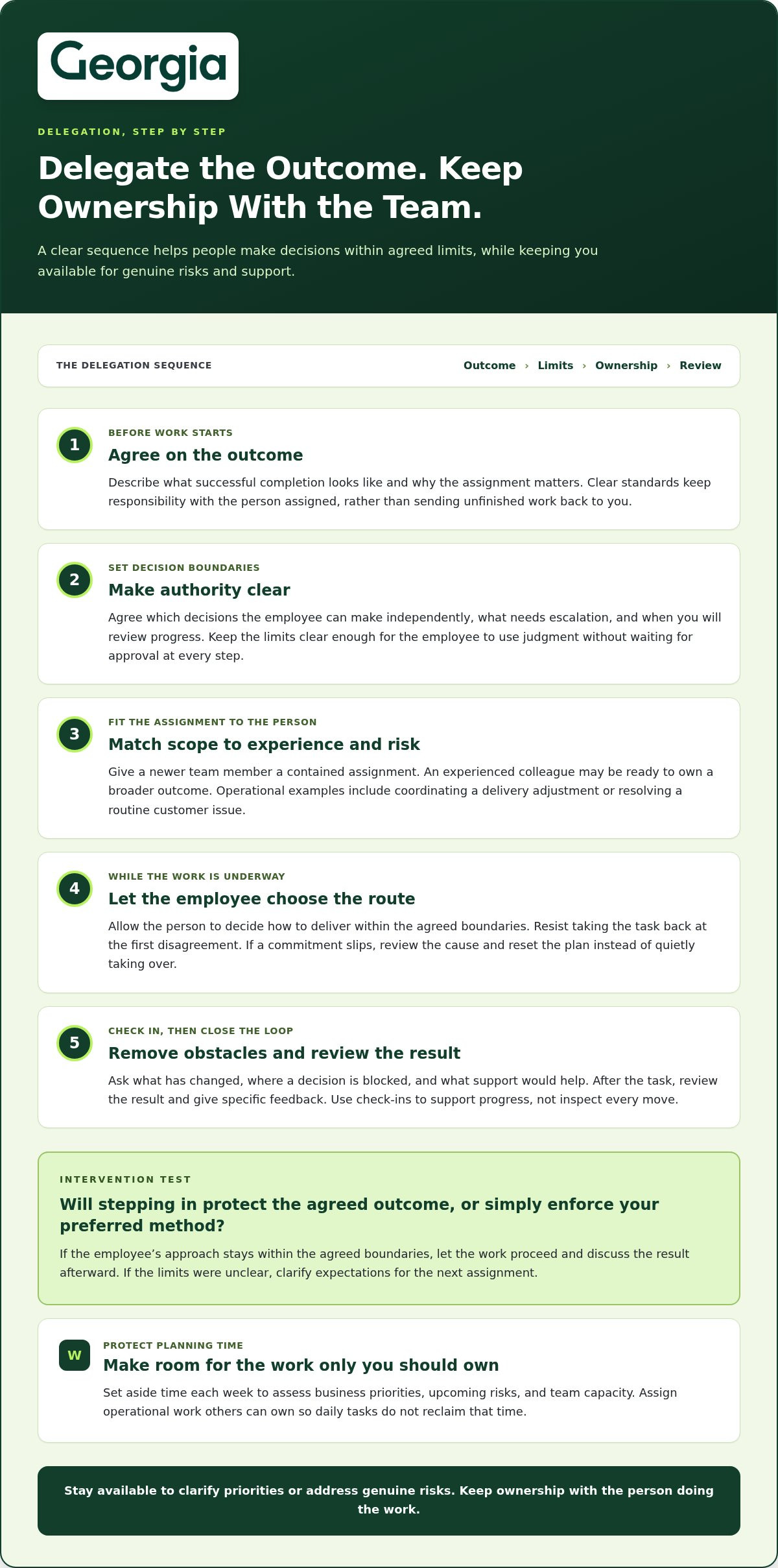
Micromanagement adds approval steps and slows decisions. Before assigning a task, agree on its outcome, decision limits, and review point. Then let the employee choose how to do the work within those boundaries. Trust becomes visible when you resist taking the task back at the first disagreement.
Delegation also protects time for strategic planning. Set aside time each week to assess business priorities, upcoming risks, and team capacity. Assign operational work others can own, such as coordinating a delivery adjustment or resolving a routine customer issue. Planning time creates value only when daily tasks stop reclaiming it.
Match responsibility to the employee’s experience and the work’s risk. Give a newer team member a contained assignment; an experienced colleague may be ready to own a broader outcome. Agree on how they’ll flag delays and what requires escalation. If a commitment slips, review the cause and reset the plan instead of quietly taking over.
Use check-ins to remove obstacles, not inspect every move. Ask what has changed, where a decision is blocked, and what support would help. After the task, review the result and give specific feedback. Practising delegation conversations can help you prepare for assignments that repeatedly trigger confusion or resistance.
Delegation does not mean withdrawing responsibility. It gives others room to take ownership within agreed limits. Reduce micromanagement by assigning tasks, empowering people to make decisions, and trusting their capabilities. Make that trust practical: define what success looks like and which choices the employee can make without permission. When people understand an assignment’s purpose, they can use their judgment instead of waiting for instructions at every step. The manager remains available to clarify priorities or address genuine risks without dictating the route. This keeps ownership with the person doing the work while preserving an appropriate channel for support.
Ask whether an intervention is needed to protect the agreed outcome or simply reflects your preference for how the work should be done. Controlling every detail can undermine the team’s abilities and waste time and resources. Micromanagement can also create unnecessary stress and hinder productivity. If an employee’s approach differs from yours but stays within the agreed boundaries, let the work proceed and discuss the result afterward. If the boundaries prove unclear, clarify expectations for future assignments instead of reclaiming every decision. When an issue needs your attention, explain the concern and invite the employee to identify a next step. This keeps guidance focused on the work, gives the employee a chance to exercise judgment, and distinguishes support from control. Over time, review which decisions still come back to you and whether they genuinely require your involvement. Adjust the assignment or decision limits where appropriate, and make clear that raising a problem is welcome even when the employee remains responsible for resolving it. The aim is to stay available without becoming another approval point.
3. Establishing and communicating a clear vision
A vision should guide real operating decisions, not sit unused in a presentation. Connect it to the organization’s values, mission, and plan. Then clarify what matters now and how each team’s work supports that direction. Without this connection, sales, dispatch, and operations may pursue competing priorities.
Define the future state across 1 year, 3 years, and 5 years. For example, a building-materials supplier might aim to improve customer updates while reducing preventable handoff failures. Translate that direction into measurable goals, name an owner, and agree how progress will be reviewed. Observable results help managers spot drift and adjust plans early.
Communicate priorities through the channels employees use: team meetings, written procedures, presentations, and one-to-one conversations. If a schedule change affects customer updates and load coordination, explain those impacts directly. Keep the message consistent across supervisors so employees receive the same expectations wherever they work.
Make communication open enough for employees to challenge a plan. Ask what could block a goal and listen before finalizing it. A sales representative might flag a customer commitment that conflicts with delivery capacity. Use that input to adjust the plan before it creates operational friction.
Keep the vision current by reporting progress, risks, and changes. Explain what has moved forward, what needs attention, and what action comes next. When priorities shift, say why and identify which work will change. Then ask an employee to describe their next step so you can correct misunderstandings before work begins.
4. Recognizing employees meaningfully
Generic praise gives employees little guidance on what to repeat. Name the action and its effect: “Your updated delivery notes helped the sales desk give customers accurate arrival information.” Specific recognition links effort to results, making the standard visible to the employee and the wider team.
Recognition works best when it reflects the person’s preferences. Ask employees how they like their contributions acknowledged, then choose an appropriate format. One person may value private verbal praise; another may welcome public recognition in a team meeting. Matching the approach helps recognition feel genuine rather than performative.
Use a range of methods, including timely praise, peer recognition, team celebrations, or public acknowledgment. Choose one that fits the contribution and setting. For example, thank a dispatcher directly for resolving a handoff issue, then share the useful process change with the team. Credit the employee’s work while making the lesson available to others.
Recognition can support intrinsic motivation as well as acknowledge completed work. Connect a task to challenge, learning, meaningful contribution, purpose, or talent development. If a sales representative handles a difficult customer conversation well, explain which listening or clarification skill made the difference. Then offer a chance to apply that skill to a more complex account.
Feedback supports both recognition and development. Give it regularly, close to the work, and with a clear next step. Instead of saying “be more proactive,” describe the observed behavior, its impact, and what to try next time. For example, ask a team member to flag a delivery risk as soon as it emerges, then agree on how they’ll communicate it.
Listen before prescribing a development plan. Ask which task the employee wants to improve, what feels difficult, and what support would help. A new customer service representative may need practice de-escalating tense calls, while an experienced employee may want to improve a handoff process. Their answers help focus training on actual work needs.
Training and development can support innovation and performance when they address a genuine capability gap. Identify the behavior the role requires, provide relevant learning, and review how it is used on the job. For example, after training on customer conversations, listen for clearer summaries and agreed next steps. Follow-up connects learning to observable performance.
Keep a simple record of each employee’s contributions, feedback, and development actions. Review it during one-to-one conversations so recognition reflects specific work, not just recent visibility. If the record shows repeated strength in resolving customer issues, discuss a development goal that builds on that skill. Consistent attention supports engagement and fairer decisions.
5. Improving leadership skills
Leadership skills improve through deliberate practice, observation, and correction. Set aside time each week to think strategically about the business and the direction your team needs. Review a recent decision: what information guided it, what happened afterward, and what you would change next time. This routine turns experience into practical progress.
New managers can spot mistakes by comparing their actions with team outcomes and asking employees for direct feedback. If work repeatedly stalls while waiting for approval, consider which decisions you’re holding too tightly. Clarify decision boundaries, then follow up to see whether the team moves forward. This helps prevent common leadership mistakes from becoming established habits.
Model the conduct you expect. If you ask employees to communicate clearly, give concise updates yourself. If a commitment slips, acknowledge it and explain what you’ll do to correct it. Employees notice the gap between stated standards and daily behavior. Your consistency gives the team a practical example of handling pressure and accountability.
Seek feedback from people who see different parts of your work. Ask a direct report where your instructions create confusion, or ask a peer how you handle disagreement. Listen without interrupting or defending your intent. Then choose one behavior to change and tell the person what action you’ll take.
One conversation rarely resolves every issue. Agree on a follow-up point, review what changed, and ask whether the new approach helped. After addressing a tense handoff, for example, check whether responsibilities are clearer and whether the same friction has returned. Follow-through makes feedback an ongoing process rather than a one-time exchange.
Emotional intelligence also means considering how employees experience a decision. Before responding to conflict, identify the behavior, its impact, and the business need at stake. Address destructive disputes promptly, while allowing constructive disagreement to test assumptions and improve problem-solving. Focus on actions and solutions, not judgments about personality.
Make learning specific to the leadership challenge in front of you. If customer conversations reveal gaps in listening, practise summarizing concerns before proposing a solution. If a change meets resistance, invite employees to test a practical adjustment and share what they learn. Small experiments give you evidence for your next decision and help you keep avoiding common leadership mistakes as conditions change.
Stay accessible while protecting time for strategic work. Set a clear route for urgent issues and make room for employees to raise concerns before they escalate. When someone brings a problem, ask what they have tried and what decision they need. This response builds judgment instead of dependence.
Track progress through observable behaviors: clearer handoffs, timely follow-up, or earlier escalation of risks. Review these signals with your team, then adjust your approach if they reveal a problem. Leadership is a skill you can practise, and ongoing learning keeps your direction responsive to real work.
Georgia: Sales & Commercial Training Modules
Georgia helps leaders practise high-pressure conversations through its AI Role-Play Platform and Leadership Development Practice. Use this approach when delegation, feedback, or difficult conversations keep producing inconsistent results. Leaders can rehearse clearer responses, then apply those skills in real team interactions.
For managers in sales, dispatch, and customer operations, practice can focus on conversations that shape daily performance: setting expectations, addressing missed commitments, and responding to concerns. Georgia also offers Sales & Commercial Training Modules and Customer Operations Training to help teams develop these communication skills.
Practise the conversations your team needs, then review what changes in day-to-day interactions. Contact Georgia to explore its leadership development practice.
Put Clearer Leadership Into Practice
Choose a current pressure point for your team, such as delayed decisions, unclear handoffs, or difficult feedback conversations. Set a practical change, explain what should improve, and observe how the team responds. This gives you a real test of your leadership, rather than another intention that disappears into the week.
Avoiding common leadership mistakes takes sustained attention to how your direction affects other people’s work. Keep asking for candid input, adjust your approach when evidence calls for it, and make your next commitment visible to the team. Consistent practice builds credibility one conversation at a time.
Georgia can help when you want structured practice for leadership conversations. Contact Georgia to discuss leadership development focused on the situations your team needs to handle.
Keep the next step focused and practical. Your team will feel the difference when your leadership makes progress easier to act on.
Frequently Asked Questions
What are the most common leadership mistakes managers make?
Managers often create bottlenecks by holding on to routine decisions, changing priorities without explaining why, or delaying conflict. Favoritism and vague performance standards also erode credibility. Watch for operational signals: employees repeatedly ask who owns a task, raise the same issue through several channels, or wait for approval on familiar work. Treat these patterns as evidence that your approach needs adjustment, then identify the behavior driving the friction.
How can leaders communicate expectations clearly and listen effectively?
State the required outcome, owner, deadline, and quality standard, then ask the employee to describe their next step. After assigning a customer escalation, for example, ask what they’ll communicate and when they’ll update you. Listen without interrupting, summarize the concern in your own words, and invite correction. This reveals whether you understood the operational constraint or only heard the first part of the issue.
How should leaders give constructive feedback and address poor performance?
Address poor performance with a specific example, a clear standard, and an agreed corrective action. Describe the behavior and its impact, such as incomplete order notes that leave the next shift without key customer details. Ask what contributed to the gap, then agree on what the employee will do differently and how you’ll review it. Keep the conversation focused on the work and follow up on the commitment.
How can leaders delegate work effectively without losing accountability?
Assign one accountable owner and make the expected result clear to everyone involved. For a customer delivery issue, the owner might coordinate the internal response while keeping relevant teams informed. Define which decisions they can make, what needs escalation, and how progress will be reported. If the result falls short, review the decision path and obstacles with the owner before changing responsibilities or stepping in.
What are the risks of avoiding difficult conversations or decisions as a leader?
Avoidance lets uncertainty set the rules. If you leave a recurring handoff dispute unresolved, employees may create separate workarounds, duplicate effort, or stop sharing information. Delayed decisions can also leave customers and colleagues without a clear next step. Address the behavior or decision directly, explain why, and state what happens next. Timely clarity gives people a basis for action, even when the answer is difficult.
How can leaders reduce bias and make fair, inclusive decisions?
Set decision criteria before reviewing candidates for a task, promotion, or development opportunity. Compare each person’s evidence against the same requirements, such as relevant experience, demonstrated follow-through, or a stated skill goal. Record the reason for the decision and invite another perspective when assumptions may affect your judgment. Consistent criteria make decisions easier to explain and help employees see how they can earn future opportunities.
What leadership habits help build psychological safety and trust on a team?
Respond to early warnings with curiosity, not blame. If an employee flags a scheduling risk, ask what they observed and what response they recommend before judging the outcome. Admit your own errors, give credit to people who raise valid concerns, and close the loop after they share feedback. Employees learn from repeated signals: whether raising a problem leads to useful action, fair treatment, and clear follow-through.