

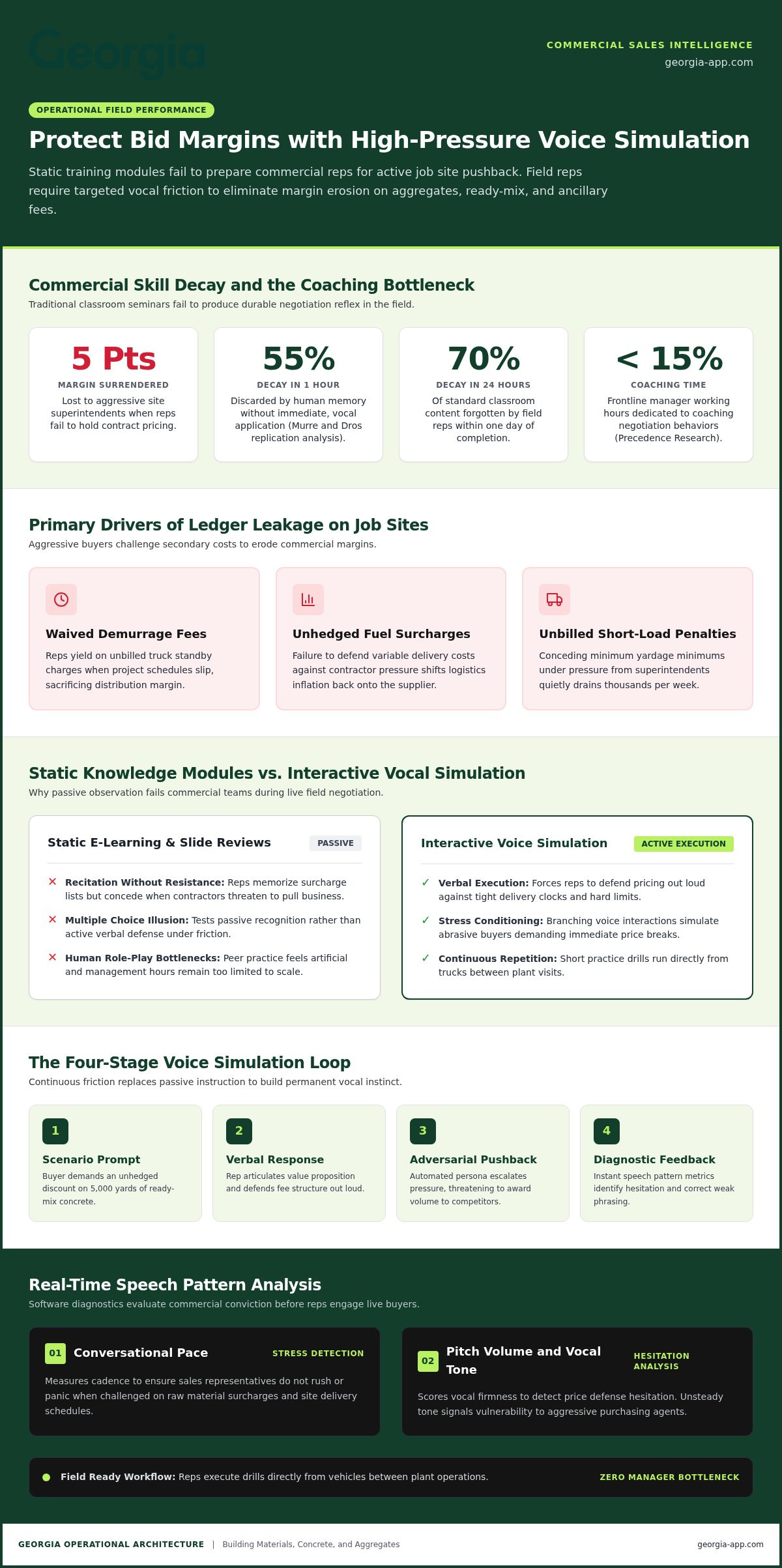
A sales rep standing outside a job site trailer just surrendered five points of margin to an aggressive site superintendent. Waived demurrage fees, unhedged fuel surcharges, and unbilled short-load penalties quietly drain thousands of dollars from aggregate and ready-mix ledgers every week. Most virtual sales training fails to stop this financial leakage because static slide decks leave reps unprepared for the friction of real commercial pushback.
You already see the structural cracks in traditional methods. Field reps forget 70 percent of classroom training within 24 hours, while frontline managers spend less than 15 percent of their working hours coaching negotiation behaviors. In this article, you'll learn why pressure is the missing variable in commercial skill retention and how targeted simulation protects quote margins on active job sites.
We will examine the operational mechanics of high-stakes voice practice, show you how to eliminate manual role-play bottlenecks, and provide a direct framework to build verbal fluency under pressure across your sales force.
Key Takeaways
- Passive video consumption builds zero conversational reflex, requiring active simulation to establish durable negotiation habits.
- Modern virtual sales training relies on branching voice interaction to prepare teams for aggressive buyer pushback.
- Automated role-play platforms eliminate the manager coaching bottleneck by providing continuous, self-paced scenario drills.
- Daily micro-practice counters rapid memory decay far more effectively than standard quarterly seminars.
- High-pressure vocal drills train field reps to defend contract margins and eliminate concession on ancillary fees.
Distinguish Between Video Conferencing and Virtual Sales Training
Most commercial organizations confuse the delivery pipe with the actual work. Hosting an instructor on Zoom to review slide decks is passive video consumption. It fails to build the vocal stamina or instinct required to protect bid margins on an active construction site.
Real virtual sales training establishes an operational loop: prompt, verbal response, adversarial pushback, and instant diagnostic feedback. Without live friction, reps merely observe selling techniques instead of executing them under pressure.
The Myth of the Digital Classroom
Watching a consultant talk through objection models produces zero muscle memory. Field reps nod along on screen, yet they freeze when a site superintendent attacks their delivery surcharges in real time. Passive listening creates false confidence. According to the Murre and Dros replication analysis, human memory discards 55 percent of unapplied training within an hour. Without immediate vocal execution, the material vanishes before the next quote goes out.
Why Interactivity Defines Success
Commercial competence requires speaking out loud. An effective AI role-play platform forces reps to articulate trade-offs against tight delivery clocks and hard pricing limits. This interactive model exposes hesitation, corrects weak phrasing, and builds verbal fluency before client calls occur. Reps run short, targeted practice reps directly from their trucks between plant visits, fitting rigorous skill repetition into demanding field schedules.
Prioritize Interactive Simulation Over Static Knowledge Modules
Knowledge alone does not stop margin erosion. A sales representative can recite every freight surcharge on a rate sheet, yet yield instantly when a general contractor threatens to pull business. Static e-learning modules present facts, but simulation builds the actual capability to execute under fire.
Construction buyers do not follow predictable scripts. They push back aggressively on mix designs, demand delivery accommodations without compensation, and pit competing aggregate yards against one another. High-performance virtual sales training uses responsive simulation so reps absorb pushback and make mistakes in an isolated environment before facing live revenue risks.
Moving Beyond the Multiple Choice Quiz
Multiple choice quizzes test passive recognition. Live field selling demands active verbal fluency. A rep scoring one hundred percent on a compliance test still concedes margin when challenged face-to-face on demurrage rates. Interactive simulation forces the rep to defend value out loud against authentic commercial friction.
The Role of Verbal Fluency
Hesitation costs money. When reps fumble their pricing rationale, buyers smell weakness and press harder for concessions. Regular voice simulation hardens pricing discipline so reps answer aggressive demands with steady, unyielding clarity. Teams wanting to protect bottom-line bid revenue can explore voice-driven simulations to test sales fluency before customer meetings take place.
Deploy AI to Scale Role Play Without Manager Burnout
Sales managers face an impossible math problem. Balancing dispatch emergencies, key customer disputes, and margin reports leaves little room for deliberate practice. When role-play depends entirely on human supervision, practice happens once a month or disappears entirely.
Automated platforms remove this operational bottleneck. Deploying conversational AI allows construction suppliers to scale interactive virtual sales training across dozens of distributed reps without draining management hours.
The Scalability Trap of Human Coaching
Frontline managers spend less than 15 percent of their time coaching negotiation behaviors, according to Precedence Research. Staging manual mock calls across a regional sales team consumes entire workweeks. Human evaluations also introduce regional bias and inconsistent grading standards. Automated systems eliminate scheduling friction, letting managers focus on high-level territory strategy while software handles repetitive verbal drilling.
How AI Mimics High Pressure Personalities
Standard role-play with a colleague feels artificial because peers pull their punches. Specialized AI buyer personas simulate the abrasive purchasing agent who demands immediate price breaks on five thousand yards of ready-mix. These simulations analyze speech patterns in real time:
- The system measures conversational pace to ensure reps do not rush under stress.
- The software scores pitch volume and vocal tone to detect hesitation during price defense.
- The engine evaluates exact vocabulary to flag unauthorized discounts or omitted surcharges.
- The program tracks response latency to eliminate awkward, costly pauses during aggressive interruptions.
Every rep gets equal repetitions against uncompromising buyers. The result is consistent commercial execution across every branch location.
Attack the Forgetting Curve with Consistent Repetition
Field reps forget roughly 70 percent of new commercial instruction within twenty-four hours of an offsite event. By day thirty, decay reaches nearly 90 percent. Relying on an annual workshop to sustain pricing discipline is an expensive operational failure.
Quarterly events fail because memory requires deliberate retrieval. High-impact virtual sales training breaks instruction into short, three-minute vocal scenarios delivered multiple times per week. Consistent friction transforms conscious calculation into automatic commercial reflexes.
Why One-Off Workshops are a Financial Leak
Pulling thirty reps out of their territories for an eight-hour hotel seminar generates immediate revenue losses. In addition to direct platform or travel expenses, the company pays for hours of lost prospecting, delayed job quotes, and unreturned contractor calls. The real issue surfaces forty-eight hours later when reps revert to old habits. Lasting behavioral change demands daily reinforcement rather than sporadic corporate lectures.
Building a Culture of Deliberate Practice
Professional competence in heavy building supplies requires systematic rehearsal. Top producers run audio simulations inside their trucks to test their pricing logic before stepping onto a job site. For deeper analysis on how to operationalize this approach, review how AI Training Platforms Must Simulate High-Stakes Pressure to Stop Revenue Leaks across distributed commercial units. Tracking these micro-drills gives leadership hard metrics on team preparedness rather than anecdotal opinions.
Simulate Real Stress to Prepare for Job Site Negotiation
Low-stakes practice creates brittle sales habits. When a site superintendent screams that four mixer trucks are backed up and demands that waiting fees be stripped or the pour stops, textbook relationship techniques collapse. Commercial survival requires stress inoculation.
Effective virtual sales training replicates the acoustic chaos, aggressive interruptions, and urgent deadlines of active jobs. Practicing in an intense conversational environment conditions reps to hold their ground on contracted rates rather than giving away profit to quiet an angry customer.
The Cost of Communication Friction
Reps who hesitate during price challenges surrender margin out of discomfort. In building materials, vague explanations regarding aggregate freight adjustments or fuel escalators translate directly into unrecovered overhead. Voice simulation exposes this conversational friction. Running realistic scenarios where artificial buyers cut reps off mid-sentence forces salespeople to state trade-offs clearly without retreating into unearned discounts.
Mastering the Objection Before the Call
Concrete and aggregate producers face predictable commercial challenges: aggressive price matching, demands for extended credit terms, and constant attempts to waive short-load minimums. Reps must rehearse exact counter-phrasings out loud until their delivery remains steady under fire. Research shows that sales negotiation training improves performance under pressure by forty five percent when deliberate verbal rehearsal replaces passive reading. Mastering these exchanges before dialing a contractor protects contract margins across the entire dispatch schedule.
Eliminate Margin Leaks Through High-Stakes Voice Simulation
Unrecovered waiting time, waived demurrage charges, and premature discounting drain cash from building material producers every week. Traditional slide lectures and sporadic manager role plays leave reps unequipped for abrasive job site interactions. Modern virtual sales training repairs this structural failure by deploying AI-powered simulations that force salespeople to articulate pricing out loud against relentless contractor pushback.
True conversational competence requires daily practice rather than quarterly webinars. Running short, high-stakes audio drills turns hesitant price defense into an automatic reflex before reps step onto an active job site.
Stop treating sales talk as an unmeasured operational liability. Treat negotiation fluency with the exact same rigor applied to fleet logistics and dispatch schedules. Your commercial team will enter every contractor negotiation prepared to protect margins and eliminate unearned concessions.
Frequently Asked Questions
Does virtual sales training actually work for construction teams?
Virtual sales training works when it shifts from passive lecture slides to interactive voice simulation. Construction materials sales require quick verbal defense under site pressure. Reps who practice against simulated general contractors retain pricing logic and defend delivery surcharges directly. Passive digital modules fail because they omit acoustic stress and conversational friction. Active voice simulation builds the required muscle memory to protect bid margins on site.
How much time should sales reps spend on virtual training each week?
Sales reps should complete ten to fifteen minutes of targeted simulation weekly. Spacing practice across three five-minute audio sessions yields better retention than a single multi-hour block. Micro-drills fit into daily field operations between plant visits and job site drops. Short, daily vocal practice prevents cognitive decay, hardens negotiation reflexes, and keeps commercial standards consistent without taking reps out of territory prospecting.
Can AI really simulate a difficult buyer in the building materials industry?
Conversational AI replicates the exact aggression of real site personnel. Platforms program synthetic buyers to cut reps off mid-sentence, demand unearned price breaks on aggregate orders, and threaten vendor switches over dispatch delays. The system forces the rep to handle conversational hostility out loud. Practicing against an uncompromising digital contractor trains salespeople to control vocal pace and hold line-item pricing without panic.
What is the difference between a sales webinar and a simulation?
A webinar is passive observation, while a simulation is active physical execution. Webinars push theoretical information through presentation slides to silent participants. Voice simulations force the salesperson to articulate trade-offs, answer spontaneous objections, and solve complex logistics pushback in real time. Observation tests recognition; simulation builds operational reflex. True behavior change requires vocalizing the response against dynamic commercial pushback.
How do you measure the ROI of virtual sales training?
Measure return on investment by tracking price realization and ancillary fee recovery. Monitor average realized margin per yard or ton, adherence to fuel surcharges, and collection rates on short-load or demurrage invoices. Teams utilizing simulation show immediate drops in discretionary discounting at the job site. When reps stop waiving contractual accessorial fees under contractor pressure, the revenue saved flows straight to operational net margin.
Why do sales reps forget training so quickly?
Reps forget training because organizations deliver dense information without immediate spoken application. The human brain rapidly discards theoretical concepts that lack practical friction and repeated testing. When salespeople do not vocalize new negotiation arguments within hours of learning them, retention drops precipitously. Replacing periodic annual lectures with recurring, spaced audio simulations counters natural memory decay and locks habits into place permanently.
Is virtual role play better than manager-led role play?
Virtual role play provides scale and objective scoring that manager-led sessions cannot match. Sales managers lack the working hours to drill every rep weekly, creating an operational bottleneck. Human role-play also suffers from inconsistent grading and polite colleagues who pull punches. Automated software delivers objective, standardized feedback on pace, tone, and pricing compliance across every territory simultaneously without draining management capacity.
How does virtual training help with price negotiation?
It conditions reps to withstand buyer intimidation without surrendering contract points. Contractors frequently exploit hesitation by demanding price cuts on delivery deadlines. Interactive virtual sales training forces reps to vocalize margin defenses, restate schedule value, and reject fee waivers until the response becomes second nature. Reps enter real job site trailers with pre-tested verbal fluency, neutralizing contractor aggression before margins slip away.