

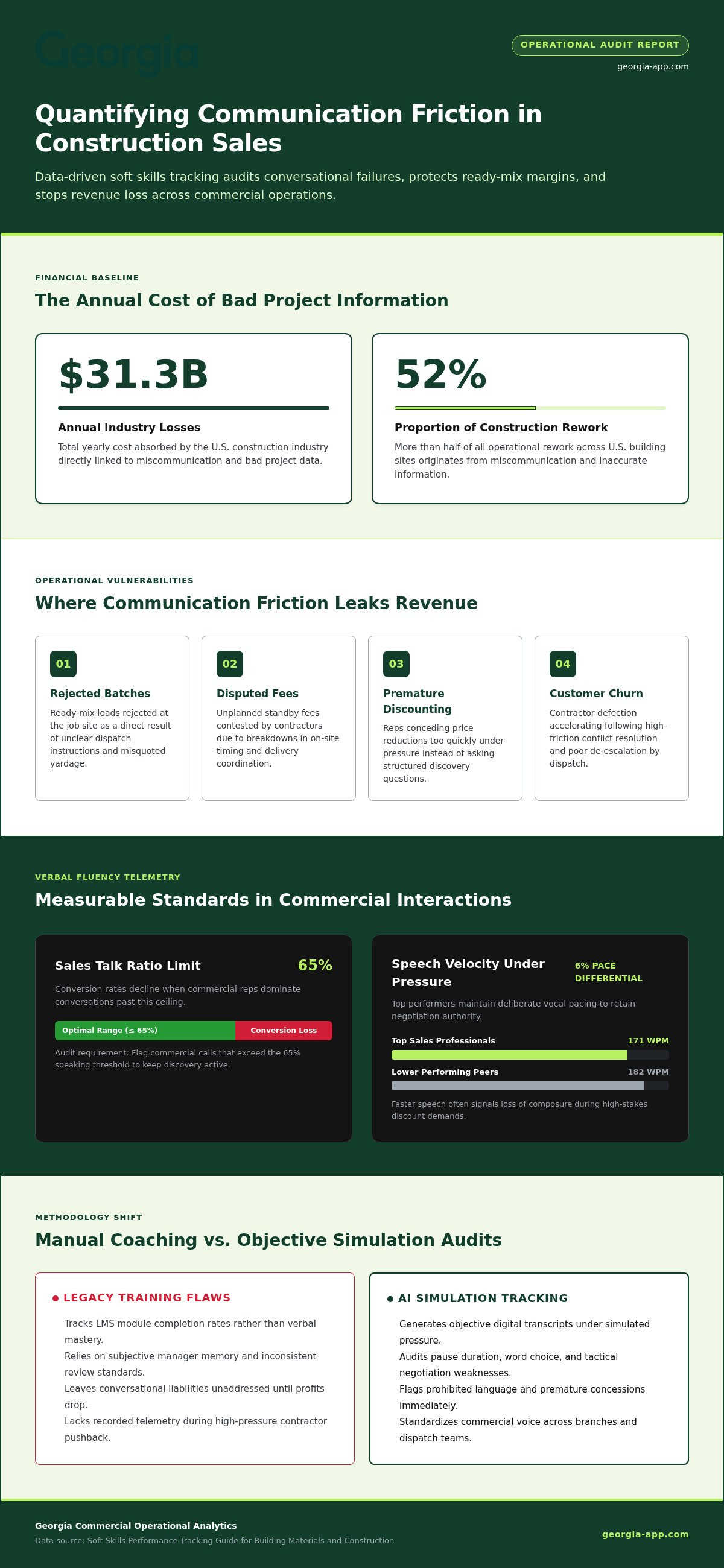
Miscommunication and bad project information cause 52% of all rework in the U.S. construction industry. This failure totals $31.3 billion in annual losses. Soft skills performance tracking identifies where these losses occur by auditing conversational friction.
Every rejected ready-mix batch or disputed standby fee is a direct drain on your bottom line. You see the revenue leak. You lack the tools to plug it because the source remains invisible. Traditional training methods leave these liabilities unaddressed.
Manual coaching is too slow and inconsistent for a high-stakes environment. You likely feel the frustration of reps who discount too quickly under pressure or dispatchers who fail to de-escalate conflict.
This guide shows you how to quantify that friction. You will discover how to implement a data-driven dashboard for conversational fluency. We detail the path to reducing friction in sales interactions and securing a clear ROI on your training spend.
Key Takeaways
- Treat verbal fluency as a measurable financial asset. Identify communication friction points that slow down commercial transactions and erode profit margins.
- Use soft skills performance tracking to establish a consistent data baseline. AI role-play simulations provide the metrics needed to audit conversational quality across the entire organization.
- Eliminate subjective bias from performance reviews by using objective digital transcripts. Simulations provide a clear record of how employees perform under high-pressure scenarios.
- Identify if your team exceeds the 65% talk ratio that lowers conversion rates. Map communication failures to specific stages of your sales funnel to stop revenue leaks.
- Standardize the customer experience across national branches and dispatch offices. Ensure your commercial voice remains consistent across every regional location.
Treat Soft Skills as Measurable Financial Assets
Poor communication acts as a friction point. It slows every commercial transaction in the building materials industry. Traditional training treats interpersonal and soft skills as personality traits. This perspective is a liability. You must treat conversational quality as a predictable operational variable. Every interaction is a data point in a larger audit of organizational health.
Communication failures are structural failures. They result in rejected ready-mix batches and misquoted yardage. These are significant financial liabilities. They represent a structural failure in your operation. Tracking these skills allows leadership to manage communication with the same rigor as a financial audit. You manage what you measure. If you don't measure conversational quality, you can't control your margins.
To better understand the impact of communication on operational efficiency, watch this helpful video:
Quantify the Cost of Communication Friction
Identify the specific moments where sales reps lose control of price negotiations. Many reps discount too quickly when a contractor pushes back on a quote. This is a failure of verbal control. It is a direct drain on your margins. Communication friction manifests in several ways:
- Rejected ready-mix batches due to unclear dispatch instructions.
- Disputed standby fees caused by poor site coordination.
- Lower conversion rates from reps who fail to ask discovery questions.
- Increased customer churn following high-friction support calls.
You need to learn how to calculate communication training ROI to stop these revenue leaks. Soft skills performance tracking turns these invisible errors into audited financial figures. It provides the telemetry needed to see where the sales funnel is leaking. You can then apply targeted fixes to specific conversational bottlenecks.
Move Beyond Completion Rates in Corporate Training
LMS data tells you if a video was watched. It remains silent on whether behavior changed. Performance tracking must focus on verbal fluency and objection handling accuracy. Most corporate training programs prioritize completion rates over skill mastery. This approach is ineffective. It rewards attendance at the expense of performance.
High-stakes scenarios require immediate, accurate responses. Shift the focus from time spent in modules to the cold reality of performance metrics. Soft skills performance tracking ensures your team can execute under pressure. It replaces vague professional development with rigorous operational auditing. Mastery of high-stakes scenarios is the only metric that matters for your bottom line.
Audit Conversational Friction with AI Driven Metrics
Subjectivity is a structural flaw in most training programs. Traditional workshops rely on the fallible memory of a manager. This produces unreliable data. AI role-play platforms provide a consistent baseline for auditing every employee. They remove the human element of bias. You receive a cold, hard transcript of performance. Automated systems track the use of prohibited language. They flag weak negotiation tactics. This is the foundation of soft skills performance tracking.
Quantitative metrics replace the vague feedback found in legacy training. Management sees the telemetry of improvement. This replaces guesswork. Consistent auditing ensures that every team member meets a minimum standard of excellence. This rigor is necessary for maintaining margins in the concrete and aggregate sectors. You can audit your team's verbal fluency through a live demonstration of these metrics.
Analyze Verbal Fluency Under Simulated Pressure
Pressure reveals the cracks in your commercial team. Track how a rep responds when a simulated customer demands an immediate discount. Measure the pause time. Audit the specific word choice. Long pauses signal a loss of authority. Weak word choice signals a loss of control.
Top sales professionals speak at an average of 171 words per minute. This is roughly 6% slower than lower performing peers at 182 words per minute. They also complete 54% to 78% more conversational turn-taking switches. Use data to identify who crumbles under stress before they talk to a real client. Research shows a measured return on investment from soft skills training when it targets these specific behavioral benchmarks.
Track Consistency in Objection Handling
Your commercial strategy is only as good as its execution at the branch level. Every team member must meet a minimum standard of excellence. Identify outliers who deviate from the commercial strategy. Use an AI role-play training platform to ensure the entire sales force uses approved responses for common industry objections.
Digital simulations record every word. They provide an unarguable transcript of performance. This allows you to scale practice across national teams without increasing headcount. You eliminate the variation between your best and worst performers. Every conversation becomes a predictable asset rather than a variable liability.
Replace Subjective Coaching with Objective Performance Data
Human judgment is a variable your operation cannot afford. Observers introduce bias into performance reviews based on personal rapport. This rapport masks structural deficiencies in your commercial team. Digital simulations record every word to provide an unarguable transcript of performance. You move from opinion-based feedback to a rigorous audit of verbal behavior. Soft skills performance tracking provides the telemetry needed to manage your workforce with precision.
Data allows managers to conduct performance reviews based on facts. The focus remains on objective results. Objective tracking builds trust by showing employees exactly where they fall short. It eliminates the friction caused by perceived favoritism. You establish a culture of accountability. Every rep knows the standard. Every rep knows their score.
Eliminate Observer Bias in Sales Evaluations
Charisma is a mask for inconsistent processes. You must standardize the criteria for what constitutes a successful sales interaction. Many managers fall victim to the halo effect. They excuse poor communication habits in high-performing closers. This is a mistake. A closer who ignores your commercial strategy is a long term liability.
Focus on the mechanics of the conversation. Audit the talk-to-listen ratio. Top performers maintain a 43:57 balance. Measure the density of discovery questions. High-converting calls average 11 to 14 questions. Soft skills performance tracking identifies these patterns. It removes the personality of the speaker from the evaluation of the skill. Performance becomes a matter of execution: not charm.
Scale Performance Audits Without Adding Headcount
Manual role-play is a resource drain. It requires two people for every practice session. This 1:1 ratio prevents you from training a national workforce effectively. It is an expensive way to identify common mistakes. You are paying for the time of two employees to fix the errors of one.
AI platforms change the math of professional development. They allow 500 reps to practice and be audited simultaneously. You scale your training capacity without increasing your headcount. This efficiency is critical for concrete and aggregate suppliers managing multiple regions. Redirect your training managers to high-value strategy. Repetitive drills belong to the machine. You gain a comprehensive audit of your entire organization while your leadership focuses on growth.
Isolate Specific Communication Failures to Prevent Revenue Loss
Revenue loss is a diagnostic signal. It indicates a failure in conversational execution. You must map soft skill deficiencies to specific stages in the sales funnel. Identify if the revenue leak happens during discovery. Audit the final closing. Soft skills performance tracking reveals the root cause of failure. It distinguishes between a lack of empathy and poor technical knowledge. Preventable errors in communication are the primary cause of lost bids in construction.
Information flow determines project success. Miscommunication and bad project information cause nearly half of all rework. This is an operational failure. It is a financial liability. You cannot fix a leak you cannot locate. Auditing every interaction allows you to see the exact moment a deal collapses. This is the difference between a guess and a surgical intervention.
Map Soft Skill Gaps to Lost Sales Opportunities
Correlate low verbal fluency scores with lower win rates in specific territories. Use the Georgia platform to simulate the exact scenarios where deals stall. Identify the specific behaviors that lead to price erosion. Sales reps often fail because they lose control of the narrative. They allow the customer to dictate terms. This results in unnecessary discounts. It erodes your margins.
Construction industry participants lose $177.5 billion annually to non-optimal activities. Workers spend an average of 14 hours per week handling conflict. They hunt for project data. They correct mistakes. These are communication failures. They are measurable. They are fixable. Tracking these gaps allows you to see which regions are underperforming due to verbal friction. You can then deploy targeted corrections before the next bid cycle begins.
Target Specific Training Interventions Based on Data
Avoid wasting time on broad training. Generic programs address problems your team does not have. This is a waste of operational capital. Assign specific role-play modules to individuals based on their audited performance gaps. Performance tracking ensures that training is relevant. It ensures training is effective. You are no longer guessing what your team needs.
Monitor the improvement of these specific metrics over a 30 day period. Data provides a clear view of behavioral change. It confirms that the intervention worked. You move from hopeful coaching to verified mastery. This is how you protect your revenue. This is how you ensure a consistent voice across your national brand.
Standardize Verbal Fluency Across Your Commercial Teams
A national brand requires a consistent voice. This voice must exist across every branch and dispatch office. Performance tracking ensures that a customer in one region receives the same quality of service as another. Inconsistent messaging is a financial liability. It creates confusion and erodes trust. Verbal fluency is a skill that can be coached. It requires repetitive: audited practice. Soft skills performance tracking allows you to enforce this standard across a distributed workforce.
Standardization reduces the risk of compliance failures. In the building materials sector: precise communication is a safety requirement. A dispatcher who fails to confirm a slump tolerance or a load limit creates a physical risk. These errors lead to brand damage and legal exposure. You must treat conversational quality as a non-negotiable operational standard. Audit every interaction to ensure total alignment with corporate policy.
Build a Repository of Conversational Excellence
Identify the top 5 percent of performers in your organization. Audit their conversational patterns to find what works. These individuals are your most valuable communication assets. Use their data to build the AI personas for the rest of the team to practice against. This clones your best performers without increasing your payroll. You can scale this methodology across hundreds of locations simultaneously.
This repository becomes the gold standard for your company. It replaces vague training manuals with living: interactive benchmarks. You move from abstract theory to concrete execution. High-performing patterns are no longer a mystery. They are a documented requirement for your soft skills training programs. Every rep has a clear target for their verbal performance.
Accelerate Onboarding with Data Driven Role Play
New hires reach peak productivity faster when they have a safe space to fail. Learning on real customers is an expensive mistake. It results in lost bids and damaged reputations. Failures in a simulation are free. Audit new hire progress daily to ensure they are ready for high-stakes interactions. This data-driven approach to soft skills performance tracking removes the guesswork from onboarding.
Automating the initial feedback loops reduces the burden on senior staff. Your best managers should focus on strategy: not repetitive drills. AI role-play handles the foundational training. It provides immediate: objective feedback. This accelerates the time to value for every new employee. You gain a workforce that is ready to perform on day one. Consistency is no longer a goal. It is a verified outcome of your operational audit.
Audit Your Conversational Assets
Communication failures are no longer invisible expenses. You have the tools to treat every interaction as a measurable data point. Soft skills performance tracking replaces the ambiguity of manual coaching with the precision of a financial audit. Use AI-driven verbal fluency auditing to identify where your margins are eroding. Personalized simulations for high-stakes roles ensure your team is ready for the pressure of a real bid. Detailed performance tracking dashboards provide the telemetry needed to scale excellence across every branch.
Securing your bottom line starts with the words your team uses every day. You have identified the flaw. Now you can implement the solution.
Final Thought
You no longer rely on manager intuition to evaluate your team. You now treat communication as a hard operational metric. Every dispatcher and sales rep operates against a verified baseline of verbal fluency. You identify revenue leaks in the sales funnel before they impact the quarterly report. This shift from subjective coaching to data-driven auditing secures your margins and standardizes your brand voice.
Frequently Asked Questions
How do you measure soft skills performance objectively?
Objective measurement requires the removal of human bias. You use AI role-play platforms to record and analyze every verbal interaction. These systems track specific metrics: talk-to-listen ratios, the density of discovery questions, and adherence to approved commercial scripts. Digital transcripts provide an unarguable record of performance. This data replaces the subjective impressions of a manager with a rigorous: data-driven audit of conversational behavior.
Can soft skills tracking improve sales revenue?
Soft skills performance tracking identifies the exact moments where reps lose control of price negotiations. It reveals if your team discounts too quickly when a customer applies pressure. By fixing these specific conversational friction points, you protect your profit margins. Data-driven interventions target the behaviors that lead to revenue leaks in your sales funnel. You move from hopeful coaching to verified commercial execution.
What is the difference between an LMS and a soft skills performance platform?
An LMS tracks completion rates and quiz scores. It tells you if an employee watched a video. A soft skills performance platform audits actual verbal behavior under pressure. It measures fluency and objection handling accuracy in real-time simulations. One tracks attendance: the other tracks operational mastery. You need performance data to confirm that behavior has actually changed on the job.
How does AI role-play track verbal fluency?
The platform analyzes acoustic clarity and word choice during high-pressure simulations. It measures the latency between a customer objection and a rep's response. Automated systems flag filler words and prohibited language that erode authority. This provides a granular audit of how effectively an employee communicates during high-stakes scenarios. You receive a score based on execution: not just participation.
Is soft skills performance tracking compliant with privacy regulations?
Georgia adheres to national data protection standards to ensure your information remains secure. Simulations occur in a controlled environment designed for professional development. Data is used strictly for internal performance auditing and skill gap identification. You maintain total control over user access and record retention. This ensures your organization remains compliant with privacy laws while improving commercial performance.
How long does it take to see results from performance tracking?
Initial performance gaps are visible immediately after the first simulation. You can identify outliers and structural failures within the first 24 hours of deployment. Behavioral improvement typically manifests over a 30 day period of audited practice. Continuous tracking ensures that these gains are sustained across your national commercial teams. You see the impact on your operational efficiency in real time.
Can this software integrate with my existing CRM?
Integration capabilities allow you to correlate communication scores with actual sales outcomes. You can map verbal fluency metrics directly to win rates and deal velocity in your CRM. This creates a closed loop between training activity and financial performance. It provides leadership with a clear view of training ROI. You see exactly how conversational quality impacts your bottom line.
What industries benefit most from soft skills auditing?
High-stakes industries like building materials, concrete, and construction see the highest return on investment. These sectors face physical costs from miscommunication: such as rejected ready-mix batches or site disputes. Any organization with a distributed commercial team requires this level of standardized auditing. It ensures a consistent brand voice and protects profit margins across every regional dispatch office and sales territory.