

Every time a sales rep defaults to a 5% discount to close a building materials contract, your profit margin suffers a structural failure. This is a revenue leak. Calculating communication training ROI is the only way to stop this financial liability and prove the value of your development budget.
You likely view professional development as an opaque cost center. It is difficult to justify spending when the results feel intangible. High turnover in your sales team and friction in customer operations are persistent operational drains. The link to the bottom line remains hidden while your margins continue to erode.
This article provides the exact framework to quantify the financial impact of soft skills with the same rigor as a financial audit. We will move past vague professional development jargon to analyze specific performance metrics. You will learn to reduce operational friction and recover lost revenue through precise, measurable training outcomes that satisfy executive scrutiny.
Key Takeaways
- View communication failures as measurable financial liabilities that directly erode your profit margins.
- Implement a specific framework to calculate communication training ROI by tracking the reduction in revenue leaks.
- Replace static workshops with AI role play to build permanent behavioral skills through repetitive practice.
- Link practice frequency to closing rates to prove the impact of development programs on the bottom line.
- Deploy Georgia to automate high-stakes conversation simulations and recover revenue lost during price negotiations.
Identify the Hidden Cost of Poor Conversations
Communication failure is a silent tax on every business transaction. In the building materials and concrete industries, precision is the difference between a profitable contract and a loss.
A fumbled objection during a high-stakes negotiation creates immediate friction. This friction slows down your operations and drains your margins. You are paying for these mistakes every day through missed opportunities. A total loss.
A single mismanaged conversation at the dispatch desk can derail a week of production. Quantifying the cost of the status quo is the first step in calculating return on investment for any new initiative. This baseline is essential for measuring your eventual communication training ROI.
The financial reality is blunt. The result is clear. Poor verbal fluency leads to immediate revenue loss. When a sales rep lacks the skill to defend a price increase, they default to a discount. You must treat these interaction gaps with the same rigor as a financial audit.
To better understand how to quantify these financial impacts, watch this helpful video:
Audit Your Current Revenue Leak Points
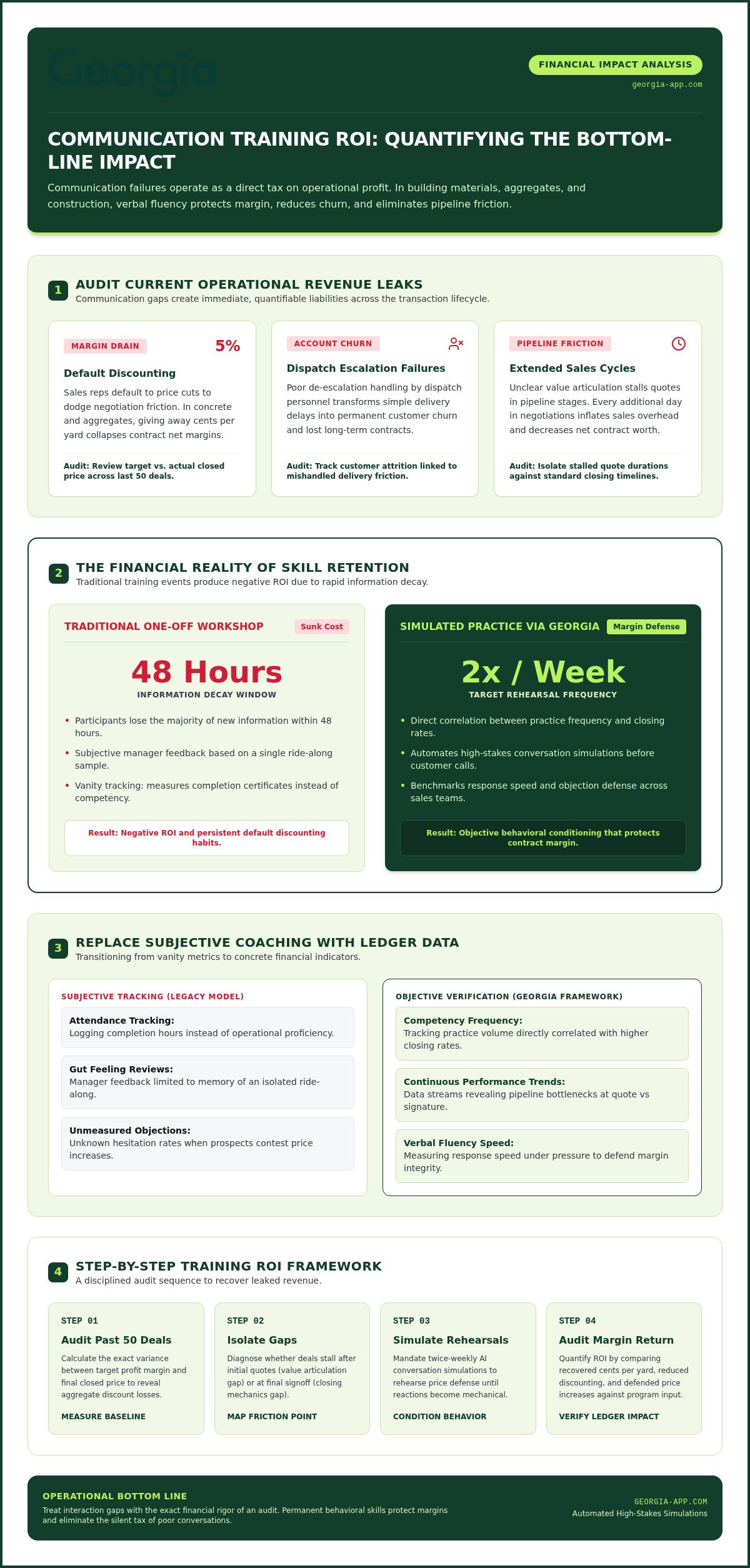
Identify exactly where the money disappears in your current workflow. Unnecessary discounting is often the primary culprit. Reps trade away your profit to avoid the discomfort of a difficult conversation.
Customer churn is another significant leak. Poor de-escalation by dispatch leads or support staff turns a minor delivery delay into a lost account. These are measurable financial liabilities.
Sales cycles extend when reps cannot articulate a clear value proposition. Every extra day a deal sits in the pipeline increases your overhead and reduces the net value of the contract.
Calculate the difference between the target margin and the actual closed price across your last fifty deals. This data reveals the scale of the problem.
The Financial Reality of the Forgetting Curve
Traditional workshops are a failed investment model. Research on the forgetting curve shows that most participants lose the majority of new information within forty eight hours.
This rapid decay creates a negative communication training ROI for one-off events. You are paying for temporary engagement. Permanent skill requires consistent reinforcement.
Scalable practice through platforms like Georgia is the only way to protect your capital. Your team needs a way to rehearse high-stakes conversations until the correct response is mechanical.
Effective training requires a shift from information delivery to behavioral conditioning. Without consistent reinforcement, your training budget remains a sunk cost that never reaches the bottom line.
Link Communication Metrics to Hard Revenue Data
Stop measuring attendance. Completion certificates don't pay the bills. If you want to prove communication training ROI, you must track behavioral changes that impact the ledger. You need to move beyond "completion rates" and start looking at "competency rates."
Measure the correlation between practice frequency and closing rates. A sales rep who practices high-stakes negotiation twice a week should outperform one who hasn't rehearsed in months. This isn't a theory. It's a performance metric that directly correlates to your net income.
Identify specific communication gaps in your sales pipeline. If deals stall after the initial quote, your team likely struggles with value articulation. If they stall at the final signature, the issue is closing mechanics. Data-driven coaching replaces subjective manager feedback with objective evidence.
Traditional coaching relies on a manager's memory or a single ride-along. This is a flawed sample size. You need a continuous stream of performance data to see the real trends in your organization's verbal proficiency. Constant data creates a feedback loop that drives revenue recovery.
Track Verbal Fluency and Negotiation Success
Evaluate how reps handle price objections without dropping margin. In the concrete and aggregate business, a few cents per yard can be the difference between profit and loss. Monitor the speed of response in high-pressure scenarios. Hesitation signals weakness to a buyer.
Use AI simulations to benchmark performance across the entire team. This creates a standard baseline for excellence. It removes the "gut feeling" from performance reviews. You can see exactly where a rep is losing the room before they lose the contract.
- Track the frequency of specific objection-handling phrases used during simulations.
- Measure the time it takes to reach a resolution in a conflict scenario.
- Identify which reps default to discounting when the buyer pushes back on price.
- Compare the practice frequency of top earners against the rest of the cohort.
Quantify the Impact on Customer Retention
Better communication reduces friction in customer operations. When dispatchers can de-escalate a frustrated contractor, you save the account. Measure the reduction in escalated tickets after support training. Fewer escalations mean lower operational costs and better resource allocation.
Link conversational excellence to long-term account value. A client who feels understood is a client who stays. You can see how data-driven practice improves these metrics by testing your team's current baseline. Account retention is a direct result of how your team handles the high-stakes moments when things go wrong on the job site.
Compare Traditional Workshops to AI Driven Practice
Passive learning is a financial liability. Static courses deliver information. They fail to build behavioral skill. You can't stop a revenue leak by watching a slide deck. Real communication training ROI demands active, repetitive rehearsal.
Traditional workshops operate on a one and done model. This is a structural flaw. Knowledge without practice decays. Skill development requires a high volume of repetitions. AI driven practice provides this volume without the overhead of human intervention.
Personalized simulations mimic the actual pressure of a sales call. A rep faces a skeptical buyer. They must defend a quote. The software tracks their performance in real time. This happens on a self paced schedule. It minimizes operational downtime. Your team stays in the field while they sharpen their skills.
The Cost of Human Led Coaching
Manual role play is a bottleneck. It's expensive. It's difficult to scale across a distributed workforce. Managers lack the bandwidth for consistent one on one training. Their time is better spent on high level strategy than basic drill instruction.
AI platforms provide instant feedback at a fraction of the cost. The system identifies verbal filler. It flags missed objections. It provides a level of scrutiny that a busy manager can't match. You get a higher volume of training data for a lower capital investment. Efficiency is the priority.
Build Muscle Memory Through Simulated Stress
Real world performance requires practice under realistic pressure. A polite classroom setting is a poor substitute for a job site dispute. AI personas test a rep's ability to stay on script during conflict. They create the necessary stress to forge new habits.
Repetition ensures the right response becomes the default response. You're building muscle memory. In a high stakes conversation, there's no time to think. There's only time to execute. Constant rehearsal turns professional development into a predictable revenue driver.
Stop paying for attendance. Start paying for performance. AI driven platforms like Georgia transform soft skills into a hard asset. You gain a team that is prepared for the cold reality of the market.
Build Your Communication ROI Calculation Framework
Stop guessing about the effectiveness of your team. Start auditing their performance with financial precision. You need a transparent framework to justify your budget. Prove that communication training ROI is a concrete reality.
Determine the baseline cost of your current communication failures. Every botched quote and every missed follow-up has a specific price tag. You are already paying for poor communication. You just haven't accounted for it yet.
Calculate the total investment in training software and the time your team spends practicing. Software licensing and implementation fees are clear line items. Include the hourly rate of your staff during their practice sessions to get a complete picture of the capital required. This data allows you to compare the investment against the cost of doing nothing.
Measure the increase in average deal size after training. Better value articulation leads to larger contracts and higher margins. When your team speaks with authority, they compete on value. Factor in the savings from reduced manager coaching hours. Reallocating executive time from basic drills to market strategy is a significant operational win.
A Five Step Formula for Training ROI
Follow this methodical progression to quantify your results. It removes the subjectivity from professional development. The data provides the only truth that matters in a high-stakes environment.
- Step one: define the target revenue metric such as win rate or average margin per order.
- Step two: record the baseline performance before training begins to establish a control group.
- Step three: implement a thirty day AI role play sprint using Georgia to build behavioral muscle memory.
- Step four: measure the performance delta in live calls using your CRM data.
- Step five: subtract the training cost from the total revenue gain to find your communication training ROI.
Document the Savings from Reduced Discounting
Calculate the margin saved when reps hold their price under pressure. This is the most immediate way to recover lost revenue. A rep who holds firm at a price objection protects your bottom line. A 1% improvement in price retention across a high-volume sales team often pays for the entire training budget within weeks.
Multiply the saved margin by the total number of monthly deals. This figure represents a direct, liquid return on your training spend. It turns a soft skill into a hard financial asset that appears on your balance sheet. You are trading a small, fixed cost for a large, recurring gain.
Deploy Georgia to Capture Lost Revenue
Georgia provides the mechanical infrastructure for consistent soft skill practice. It removes the human variability from your training program. You can finally stop the financial leak caused by poor verbal fluency. This is how you secure a high communication training ROI.
The platform integrates into your existing sales and support workflows. It is an operational tool. Custom modules address the unique challenges of the construction industry.
Your team practices the exact conversations they face at the job site and the dispatch desk. They rehearse until the correct response to a concrete shortage or a price dispute is automatic.
Interaction gaps are structural failures. Georgia identifies these failures before they reach the customer. It provides the data you need to manage by objective results. You possess the performance metrics to prove who is ready for a high-stakes negotiation.
Scale Your Training Without Increasing Headcount
Traditional training requires more managers as your team grows. Georgia breaks this linear cost curve. It allows every employee to practice difficult conversations independently. The AI handles the evaluation while practice happens on their schedule.
Managers are inconsistent. Their feedback is shaped by personal bias and fatigue. Georgia provides a uniform standard for every member of the team. This consistency ensures your brand voice remains professional across every territory.
You achieve quality control that manual coaching cannot replicate. The AI provides objective feedback in seconds. It identifies structural failures in a rep's argument. You can review a Georgia platform demo to see this efficiency in action. Scaling your expertise requires better technology.
Fix Your Revenue Leaks with Targeted Practice
Focus your training on the specific objections that kill your deals. Use an AI role-play training platform to audit your team's current weaknesses. Identifying the gap is the only way to close it. You need a surgical approach to skill development.
Generic training is a waste of capital. You need Soft skills training programs that target your specific operational friction.
Targeted practice ensures your team is ready for high-stakes moments. It transforms communication from a liability into a measurable asset. Your communication training ROI depends on this level of precision. Every rep becomes a profit protector.
Stop the Revenue Drain with Measurable Skill
You possess the framework to transform soft skills into a hard financial asset. View every interaction as a potential revenue leak. Use targeted practice to seal these gaps. Measuring your communication training ROI requires a shift from passive workshops to active, data-driven rehearsal. By linking practice frequency to margin retention, you turn professional development into a predictable profit driver. The tools for this transition are now in your hands. Execute the framework to secure your competitive advantage.
Final Thought
You treat communication as a core operational metric. Human interactions are now measurable financial assets. Objective performance data from AI simulations replaces subjective manager feedback. Instead of hoping for success, you verify behavioral competence before the next high-stakes negotiation. You are equipped to stop revenue leaks and build a team that defends your bottom line with every word they speak. Your training budget is a profit engine.
Frequently Asked Questions
What are the most important metrics for communication training ROI?
Stop tracking employee satisfaction scores. Hard communication training ROI is found in margin retention, win rates, and sales cycle velocity. You must measure the delta between the target price and the final discounted price across your team. If reps hold their price more effectively after training, your revenue recovery is a direct result of their improved verbal proficiency. These are the only metrics that satisfy executive scrutiny.
How do I calculate the cost of poor communication in my company?
Audit your sales pipeline for unnecessary discounting and stalled deals. Communication failure acts as a silent tax on every transaction. Calculate the total margin lost when reps default to a 5% discount to avoid a difficult negotiation. Add the cost of customer churn caused by poor de-escalation at the dispatch desk. These figures reveal the massive scale of your current operational friction and revenue leakage.
Why do traditional communication workshops often fail to show ROI?
Traditional workshops suffer from the forgetting curve. Research shows that most participants lose 70% of new information within twenty four hours. These one-off events provide information but fail to build behavioral skill. Without consistent, repetitive rehearsal, the knowledge decays immediately. This creates a negative return on your investment. You're paying for temporary engagement rather than permanent, measurable performance improvements in high-stakes conversations.
Can AI role play really replace human coaching for soft skills?
AI role play solves the problem of scale and objectivity. Human managers are a bottleneck. They lack the time for the hundreds of repetitions required to build muscle memory. AI provides a tireless, bias-free environment for every employee to practice alone. It doesn't replace leadership, but it handles the mechanical drill work of skill development. This allows managers to focus on high-level strategy instead of basic rehearsal.
How long does it take to see a return on communication training?
You see a return the moment a rep defends a single large contract price instead of discounting. ROI isn't a long-term mystery. Behavioral changes usually stabilize after a thirty day sprint of consistent AI-driven practice. In the building materials sector, a 1% improvement in price retention across a sales team can pay for the entire training budget in weeks. Speed to competency is the primary driver of revenue recovery.
What is the best way to prove training value to a CFO?
Present a clear communication training ROI framework that uses the delta in win rates and margin retention to justify the spend. CFOs don't care about "soft skills" or "empathy." They care about revenue recovery and operational efficiency. Show the baseline cost of current communication failures vs the projected gain from reduced discounting. Treat your training budget with the same financial rigor as a capital equipment audit.
How does verbal fluency impact sales performance in construction?
In construction, buyers sense hesitation and exploit it. Verbal fluency is the ability to defend value and handle objections without flinching. If your reps can't articulate why your concrete or aggregates are worth the premium, they will lose the margin. Fluency ensures that the right response becomes the default response during job site disputes. It transforms communication from a liability into a tool for profit protection.
Is self paced training more effective than group workshops?
Self-paced simulations are more effective because they allow for personalized pressure. Group workshops default to the lowest common denominator. They waste the time of high performers while failing to challenge the laggards. Individual simulations through a platform like Georgia ensure every person reaches the required competency level. This happens without the massive operational downtime of pulling your entire team out of the field for a day.