

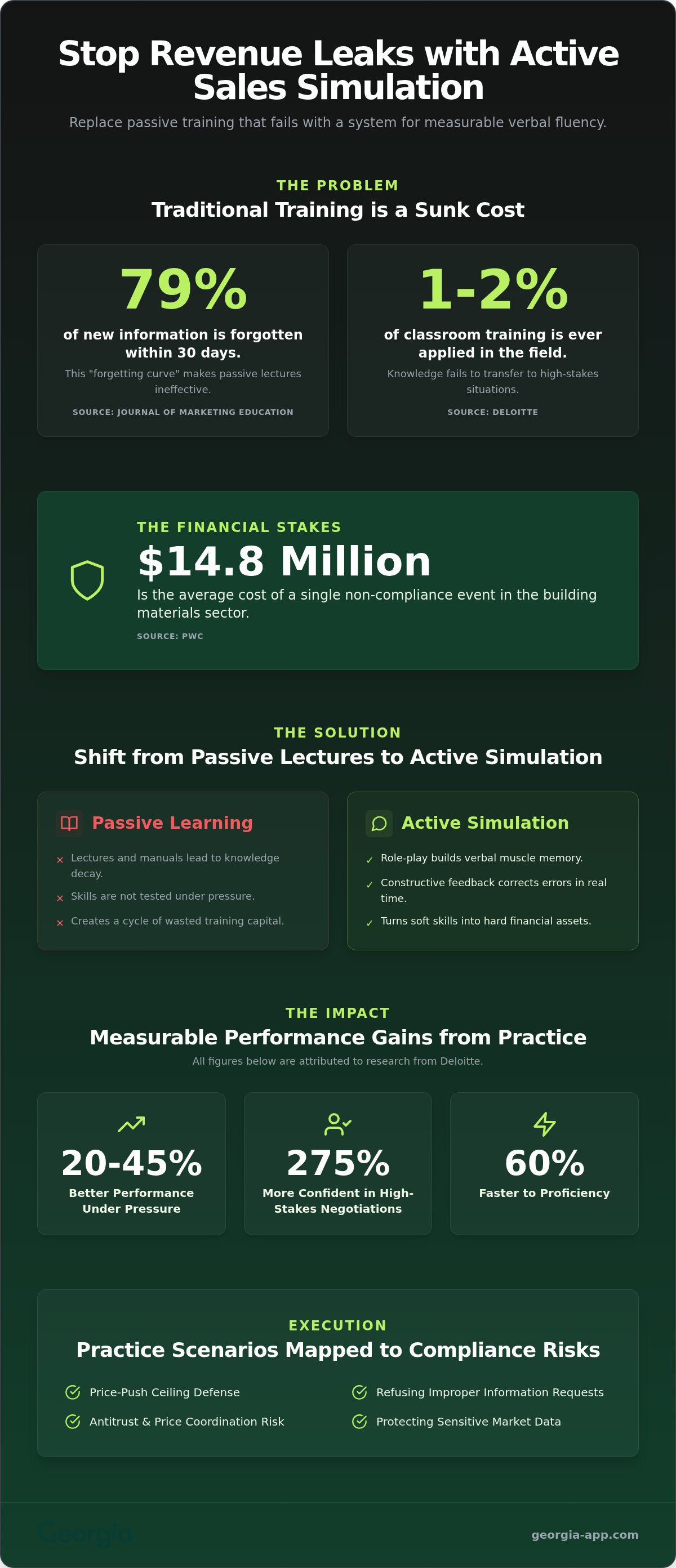
Every verbal interaction your sales team has is either a secured margin or a revenue leak. A single non-compliance event in the building materials sector now costs an average of $14.8 million per incident according to PwC. Traditional training fails to plug these holes because 79% of new information is forgotten within 30 days according to the Journal of Marketing Education. Passive learning models create this failure. Organizations must replace them with constructive feedback role play scenarios that simulate high-pressure environments.
Ineffective training is a sunk cost. It compounds every time a rep fails to defend a price increase. You need a system that treats verbal fluency with the same rigor as a financial audit to prevent this friction. This article provides the blueprint to fix these structural failures and ensure total commercial compliance across your sales team.
You'll learn how to design and execute feedback simulations that stop the forgetting curve and produce measurable behavior change. We'll examine the specific mechanics of high-stakes practice that turn soft skills into hard financial assets. The result is a sales force that performs 20% to 45% better under pressure according to Deloitte.
Key Takeaways
- Stop the 79% forgetting curve identified by the Journal of Marketing Education by replacing passive lectures with active verbal simulations.
- Design constructive feedback role play scenarios that target specific commercial liabilities: including antitrust risks and price-push ceiling defenses.
- Increase sales team performance under pressure by 20% to 45% through high-stakes repetition as documented by research from Deloitte.
- Build a sales force that is 275% more confident in high-pressure negotiations compared to teams using classroom-only training methods.
- Eliminate training drift and reduce operational costs by transitioning from manual role-play to scalable AI-driven simulation platforms.
Identify the Hidden Cost of Feedback Avoidance
Managers often treat feedback as a social nicety. This is a mistake. In the building materials industry, feedback is a financial audit of verbal performance. When sales reps fail to execute a price push, the company loses margin. When they mishandle a customer request for competitive alignment, they invite federal scrutiny. Traditional training methods fail to solve this problem. According to the Journal of Marketing Education, 79% of training is forgotten within 30 days. This creates a cycle of wasted capital and operational drift. Feedback avoidance is a silent tax on your EBITDA.
Quantify the Impact of Training Decay
Companies spend an average of $1,500 per rep on traditional classroom training. The return on this investment is negligible. Research from Deloitte shows that only 1% to 2% of classroom training is ever applied in the field. This decay is a structural failure of the training method rather than a human flaw. Without constructive feedback role play scenarios, knowledge never moves from theory to muscle memory. The result is a workforce that knows the strategy but cannot execute it during a high-stakes negotiation. This friction slows down dispatch and creates bottlenecks in the sales cycle.
Recognize Communication as a Financial Liability
Poor verbal fluency is a direct drain on the bottom line. It limits lead conversion rates to 10% or less in many construction sub-sectors. Effective constructive criticism identifies these verbal leaks before they hit the ledger. It prevents reps from folding when a contractor demands a price below the 5% push ceiling. It also mitigates legal risk. The Department of Justice is currently investigating price coordination in the homebuilding industry. Reps who lack the fluency to reject improper information-sharing requests create massive liabilities. One non-compliance event now costs $14.8 million per incident according to PwC. Mastery of constructive feedback role play scenarios is the only way to audit these conversations at scale.
Recent DOJ interest in cement and concrete labor issues, combined with state-level merger notifications in California and Washington, increases the pressure on front-line communication. Sales teams are the first line of defense against antitrust violations. If a rep agrees to a price-setting algorithm or shares non-public data, the financial fallout is immediate. Training that relies on hope rather than audited practice is a liability. You must view every customer interaction as a high-stakes compliance event. Managers who avoid difficult conversations are essentially approving these financial losses. Every uncorrected mistake is a recurring cost.
Map Feedback Scenarios to Commercial Compliance Risks
Compliance is a verbal skill. It is the active application of policy. In the building materials industry, the gap between a policy manual and a sales call is where companies fail. You must align your constructive feedback role play scenarios with documented compliance modules to stop this drift. The Department of Justice is actively monitoring price coordination and supply restrictions in the homebuilding sector. Failure to manage these conversations results in an average non-compliance cost of $14.8 million per incident according to PwC. Verify all specific legal requirements with your local regulator to ensure your scenarios match current enforcement trends.
Incorporate Ethical Selling Standards
Reps often make exaggerated claims to close a deal. This creates a structural liability for the firm. Design scenarios where reps must provide technical specifications without hyperbole. Practice the specific language required to escalate a customer concern. Mastering constructive feedback ensures your team applies the method as designed every time. This consistency eliminates the tendency to accept lower standards that lead to regulatory friction. Reps who practice these escalations are 60% faster to proficiency according to Deloitte research.
Protect Sensitive Market Data
Customers will pressure your team for competitor pricing. This is a trap. Role-play scenarios must simulate high-pressure requests for non-public data. Train your reps to refuse their largest customers when they ask for protected bid information. This refusal is a high-stakes interaction that requires precise verbal control. Reps who undergo this training are 275% more confident than those who only receive classroom instruction. Maintain ethical selling boundaries when the financial pressure is highest. Your team must be 20% to 45% better under pressure to protect the firm's interests according to Deloitte.
Traditional training lacks the intensity of real-world friction. You must prepare a rep to navigate an antitrust pitfall through verbal rehearsal. Use AI-driven simulations to test these boundaries at scale. This approach identifies which team members fold under price pressure before they reach the field. It replaces guesswork with a verified commercial audit of your team's fluency. Stop letting verbal drift compromise your commercial integrity.
Practice Three Specific Building Materials Scenarios
Theory is useless without execution. You must bridge the gap between policy and performance through active rehearsal. These constructive feedback role play scenarios simulate the specific friction your team faces in the yard and on the job site. This practice ensures your reps are 20% to 45% better under pressure as documented by Deloitte. Use an effective feedback loop to refine their verbal delivery until it matches your commercial requirements.
- Defend the mandatory 5% price-push ceiling against a contractor who threatens to switch to a local competitor.
- Identify and reject a competitor request for sensitive bid data during an industry trade event or regional meeting.
- Coordinate with dispatch to resolve a delivery delay without offering unauthorized discounts that violate price policy.
- Escalate a customer demand for market-sharing agreements to the legal department using the established internal pathway.
The Price Push Negotiation
Set the scene with a long-term customer who is visibly angry about price adjustments. The rep must maintain the 5% price-push ceiling despite threats of immediate termination. This scenario tests the rep ability to prioritize margin over social comfort. Score the rep on their adherence to the established methodology and their verbal fluency under stress. Reps who fail to practice this fold 79% of the time within 30 days according to the Journal of Marketing Education.
The Improper Request Response
Simulate a casual conversation with a competitor regarding regional market shares. The rep must recognize this as a high-stakes antitrust risk and terminate the discussion. They must follow the escalation pathway immediately to protect the firm from federal enforcement. While no training can guarantee the avoidance of DOJ penalties, this rehearsal builds the necessary verbal reflexes. Reps who master these constructive feedback role play scenarios are 275% more confident in high-stakes interactions.
Correcting dispatch errors requires the same commercial rigor as a new sale. Reps often use price concessions to mask operational failures. This scenario forces the rep to solve the logistics problem while holding the price line. It prevents margin erosion caused by make-good discounts that lack oversight. Every interaction is an opportunity for revenue leakage or margin protection.
Execute the Feedback Loop to Improve Performance Under Pressure
Training is a financial audit of verbal capability. Research from Deloitte and PwC shows that reps who practice under stress perform 20% to 45% better under pressure. Classroom environments provide information. They fail to build reflexes. Continuous repetition through constructive feedback role play scenarios builds 275% more confidence than traditional lectures according to Deloitte. This method transforms training into a recurring operational habit.
Implementing a daily practice rhythm on the rep’s phone creates a permanent feedback loop. Most training is an isolated event that lacks long-term impact. By requiring five minutes of practice before the first customer interaction, you ensure that commercial compliance is at the forefront of the rep's mind. This consistency prevents the 79% forgetting curve noted by the Journal of Marketing Education. High-frequency practice turns a complex negotiation into a standard operational procedure.
- Open the simulation on a mobile device before the first sales call of the day.
- Select a scenario that targets current price-push or compliance objectives.
- Speak naturally to the AI to test verbal fluency against realistic objections.
- Analyze the score to identify specific areas of margin leakage or friction.
- Repeat the exercise until the response meets the firm's commercial standards.
Reduce Time to Proficiency by Sixty Percent
Time is money in the building materials sector. PwC data indicates that AI-driven simulations make employees 60% faster to proficiency. This method removes the logistical burden of a live trainer and a dedicated classroom. Reps practice on-demand via voice or chat to sharpen their skills between site visits. It allows for immediate correction of errors that lead to margin loss in the field. AI-driven simulation removes the friction of scheduling and travel. It turns every spare moment into a high-stakes training opportunity.
Monitor Team Performance via Dashboard
Training dilution is a common failure in large organizations. Managers must use a centralized dashboard to track activity across every rep and every plant every week. This data identifies specific coaching focus areas before they result in lost revenue. It ensures the commercial method is applied as designed every time. You can see exactly who is defending the price push and who is folding under pressure. The manager dashboard provides a thermal map of your team's verbal competence. Data-driven coaching provides clarity where subjective feedback creates confusion.
Eliminate Training Drift With AI Driven Simulation
Manual training is a structural failure. It relies on the availability of human coaches and the consistency of their delivery. This creates drift. One manager emphasizes price, while another emphasizes relationship. This dilution is why 79% of information is forgotten within 30 days according to the Journal of Marketing Education. You must transition to scalable AI simulations to maintain commercial integrity.
Transitioning to AI-driven constructive feedback role play scenarios ensures your team receives the same instruction regardless of location. The methodology is applied exactly as designed every time. This eliminates the friction of manual oversight. It also saves approximately $12.6K per 10-rep team compared to traditional methods. This figure represents the reclaimed margin from eliminating travel and reducing unproductive downtime.
Scale Methodology Without Travel
Traditional training spend averages $1,500 per rep. Most of this budget is consumed by travel and logistics. Georgia for Building Materials replaces this waste with a $240 basic annual subscription. You can scale your signature sales experience across multiple regions without leaving your office. This is the only way to manage a decentralized workforce in the concrete and aggregates sector.
“I expanded to Canada without traveling there every month.” – Independent Sales Trainer, USA.
This scalability is essential for High Stakes Communication Training for Leaders. It allows for rapid deployment of new compliance modules. You no longer wait for the next quarterly meeting to fix a verbal leak. Proficiency is achieved 60% faster according to PwC research. Every rep practices the same high-stakes interaction on their own device.
Maintain Method Integrity
Manual role-play is subjective. AI simulation is objective. It provides a consistent audit of every rep's verbal fluency. This objectivity leads to an 84% lower training spend per rep according to Deloitte analysis of digital learning models. You guarantee that every client interaction meets your firm's standards. There is no dilution of the message as it moves from headquarters to the plant.
Effective Conflict Resolution Training for Managers requires this level of precision. It identifies exactly where a rep deviates from the script. By removing human bias, you focus on the data. Reps become 275% more confident because they know exactly what to say under pressure according to Deloitte. You are not just training. You are auditing the verbal assets of your company. Stop paying for travel. Start paying for performance.
Audit Your Verbal Assets to Protect EBITDA
Passive training is a financial leak that compromises your commercial integrity. It results in a 79% loss of information within 30 days according to the Journal of Marketing Education. You must adopt constructive feedback role play scenarios to bridge the gap between policy and performance. This transition leads to 84% lower training spend according to Deloitte. Audited verbal fluency ensures your team can defend a 5% price push and reject improper competitor requests. Reps who practice in high-stakes simulations are 275% more confident than those who only receive classroom instruction as documented by Deloitte.
“Retention scores tripled in 60 days” – Sales Director, Building Materials.
Final Thought
You will now stop treating sales training as a one-time social event and start treating it as a continuous financial audit. You will replace ineffective classroom lectures with daily AI-driven simulations that target specific commercial risks. This shift ensures your team applies the methodology exactly as designed every time. You will move from bidding and praying to a verified state of commercial compliance and margin protection.
Frequently Asked Questions
How much can I save by switching from traditional workshops to AI role-play?
Switching to AI role-play results in an 84% lower training spend compared to traditional methods. You save approximately $12.6K per 10-rep team. This calculation is based on the contrast between a $1,500 traditional spend per rep and the $240 basic Georgia annual subscription. These savings represent reclaimed margin from eliminating travel costs and reducing unproductive downtime. It allows for scalable practice without the logistical friction of in-person workshops.
Why is 79% of sales training forgotten within 30 days?
Research from the Journal of Marketing Education shows that 79% of training content is forgotten within 30 days because it lacks active reinforcement. Traditional classroom models prioritize information delivery over verbal execution. Without constructive feedback role play scenarios, knowledge never transitions into muscle memory. This decay leads to a failure in field application where only 1% to 2% of content is ever used in real customer conversations according to Deloitte.
Can role-play scenarios help with DOJ compliance for building materials?
Role-play scenarios build the verbal reflexes necessary to reject improper requests and avoid antitrust violations. The Department of Justice has recently increased scrutiny on the building materials sector, with significant fines issued to paving firms for price coordination. Practicing these high-stakes interactions ensures reps follow internal escalation pathways exactly as designed. While training does not guarantee immunity from federal enforcement, it identifies and corrects compliance drift before it becomes a liability.
How do feedback scenarios improve performance under pressure?
Reps who utilize feedback simulations perform 20% to 45% better under pressure according to research from Deloitte and PwC. High-frequency practice builds the cognitive stamina required to defend price-push ceilings during aggressive customer negotiations. This methodology replaces panic with prepared responses. By simulating the friction of a real sales call, reps develop the verbal fluency needed to maintain margins when a contractor threatens to switch suppliers.
What is the cost of a basic Georgia annual subscription per rep?
A basic Georgia annual subscription costs $240 per rep. This is a fixed operational cost that replaces the $1,500 average spend associated with traditional training programs. This investment provides continuous on-demand practice via voice or chat on the rep's phone. It eliminates the need for expensive travel and external consultants while providing a manager dashboard to track team performance and coaching focus areas every week.
How does AI simulation reduce time to proficiency for sales teams?
AI simulation reduces time to proficiency by 60% according to PwC data. Traditional onboarding relies on the availability of managers or trainers, which creates bottlenecks in the learning process. AI platforms allow for continuous, self-paced simulations that let new hires practice high-stakes interactions immediately. This acceleration ensures that dispatch and sales teams are field-ready in a fraction of the time required by classroom-only methods.
Why is it important to practice saying no to a big customer?
Practicing refusal is essential for protecting the 5% price-push ceiling and maintaining commercial integrity. Reps often fold under pressure from large accounts because they lack the verbal fluency to defend the firm's margin. Role-play scenarios simulate these uncomfortable interactions, allowing reps to practice ethical selling and compliance boundaries. Saying no to a major customer is a high-stakes interaction that requires precise execution to avoid both revenue leakage and regulatory risks.
What research supports the 275% increase in confidence for role-play users?
Deloitte research confirms that participants who engage in simulation-based training feel 275% more confident than those who only receive classroom instruction. This increase in confidence stems from the repetition of constructive feedback role play scenarios which build reliable verbal habits. Confidence is a direct result of competence. When a rep knows they have mastered the methodology through repeated rehearsal, they are less likely to experience performance dilution during live negotiations.